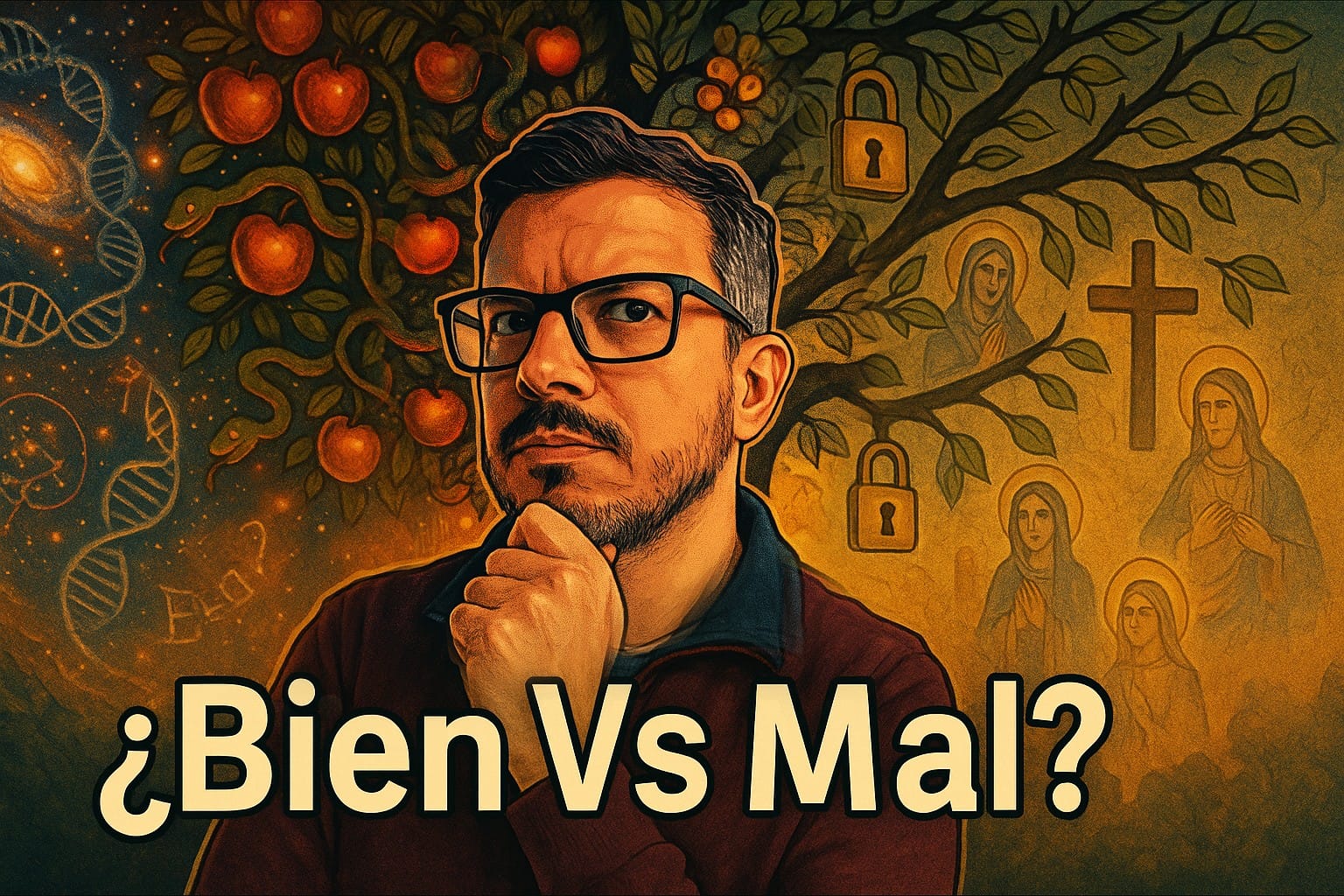
Today we are going to reflect on a concept as ancient as humanity itself, one that has defined cultures, religions, and our own morality: the struggle between good and evil. We have seen it portrayed in a thousand forms, as a cosmic battle between opposing forces, light against darkness, the noble against the perverse. But what if this struggle, as we traditionally conceive it, did not really exist? What if the true battle were fought on a different terrain? Accompany me in exploring this idea.
Beyond the Caricature: Does «Evil» Make Sense?
When we think of «evil», we often create a caricature: a purely destructive force, selfish, that rejoices in causing pain without apparent motive. However, if we analyze it coldly, what is the point of this?
«Good», understood as collaboration, altruism, and empathy, has a clear evolutionary foundation. Cooperation has proven to be a successful strategy for the survival and prosperity of species, allowing them to overcome obstacles and adapt. But what evolutionary sense would a pure «evil» make, an impulse to harm for the sake of harming, even oneself?
We could look for clues in nature. Does evil exist outside the human mind? We see predation, certainly, but it fulfills a function in the food chain. We see behaviors that seem cruel to us, such as a cat «playing» with a mouse before (or without) eating it. Is this intrinsic evil?
The Key Could Be in Ignorance
This is where I propose a change of perspective. Rather than pure evil, could we interpret these acts through the lens of ignorance? It is difficult to attribute a conscious malicious intent to the cat. Perhaps, from its perspective, it is a hunting instinct, a training, an entertainment where it neither perceives nor cares about the suffering of the other being as an equal. There is no deep understanding of another's sensitivity.
And this is where the human factor comes into play: consciousness. The emergence of consciousness places us in a unique position. We have those same animal instincts –aggressiveness, competition, the pleasure sometimes derived from another's misfortune (that initial impulse to laugh when someone trips)–, but we also have the capacity to reflect on them, to feel empathy, to establish moral codes and to aspire to a «superior will».
This «evil» that we perceive in ourselves often manifests as an internal force that leads us to act against what we know or feel is good for us or for others. It is an internal struggle, a conflict between our most basic impulses and our consciousness or aspirational will.
The «Capital Sins»: Natural Instints Run Wild?
Let us think of the so-called «capital sins»: lust, greed (gluttony), avarice, sloth, wrath, envy, pride. Beyond the religious connotation, are they not exaggerations or imbalances of natural impulses with evolutionary roots?
These forces, in themselves, are not inherently «evil». They have a function. They become problematic when, thanks to our complex society and consciousness, they run wild, are practiced without measure, or are directed in destructive ways. The «struggle», then, would not be against an external malignant force, but against our own inability to consciously moderate and direct these natural impulses. It is a struggle for obedience to a self-imposed superior will (whether divine, moral, ethical, or rational) against total submission to instinctive nature.
The Metaphor of Eden: Blessed Ignorance vs. Painful Knowledge?
This is where the story of Genesis, present in the Abrahamic traditions, becomes fascinatingly relevant, not as a literal account, but as a deep psychological and spiritual metaphor.
And the fundamental rule, the only explicit prohibition: Do not eat from the tree of knowledge of good and evil.
Let us stop here. Why would knowledge be the forbidden thing? ¡Knowledge is something that almost all cultures venerate! The Bible itself is considered a source of knowledge. This paradox is crucial.
What the story seems to suggest is that the paradisiacal state was a state of blessed ignorance. Adam and Eve did not know what good and evil were, they did not know the complexities of their own nature (lust, mortality, etc.). They were, in a way, like superior animals living in instinctive harmony.
The Serpent, often seen as the embodiment of evil, acts here as the catalyst of knowledge. It tempts Eve (and through her, Adam) to know, to «be like gods, knowing good and evil».
By eating from the fruit, they acquire consciousness:
This story resonates with the popular saying: «Ignorance is bliss». Think about it: are we not sometimes happier ignoring the processes behind our processed food, the destructive complexities of the global economic system, or even the terrifying immensity of the cosmos and our own finitude?
Did We Lose Paradise by Choosing Science?
We could draw a bold parallel: does Eden represent the life of the hunter-gatherer? Ethnographic studies on the few tribes that maintain this lifestyle suggest that, despite the inherent difficulties and dangers, their level of subjective happiness, their leisure time, and their connection with the environment could be, in certain respects, superior to those of modern industrialized societies, plagued by anxiety, depression, and existential stress. The hunter-gatherer lives more in the present, takes what nature offers, without the burden of massive accumulation or the very long-term planning that agriculture brought (the first great step toward «knowledge» and control of nature).
Humanity, symbolically, «ate from the fruit». We chose the path of knowledge, of agriculture, of science, of technology, of control over nature. And this seems to be an irreversible choice. We cannot, as a global society, simply «decide» to go back to being ignorant and happy hunter-gatherers. The knowledge acquired, the consciousness of our mortality, of our power and our fragility, is already an intrinsic part of what we are. It is the «original sin» understood not as inherited guilt, but as the human condition resulting from having awakened to self-consciousness and to knowledge.
The True Modern Struggle: Knowledge vs. Ignorance
If we accept this interpretation, the archetypal struggle of good against evil needs an urgent redefinition for our time. It is no longer a matter of angels against demons on an abstract plane. The true crucial battle for our survival as a species is now fought between:
In the interconnected and technologically powerful world that we have built, ignorance is no longer blessed; it is actively dangerous. It is ignorance that feeds hatred, environmental destruction, inequalities, and the conflicts that threaten to destroy us.
Our Responsibility: Creator Gods or Destroyers?
The Serpent, or the impulse toward knowledge, promised us «to be like gods». We have come a long way in that direction: we dominate (or believe we dominate) nature, we alter genetics, we create artificial intelligence, we possess the power to destroy the entire planet.
We have chosen the path of knowledge, the path of the Promethean fire. Now, the fundamental question is not whether we can go back, but what kind of «gods» we will choose to be:
Will we use our knowledge to create a fairer, more sustainable, and more conscious future, becoming benevolent guardians of life on this planet?
Or will we succumb to ignorance, to selfishness, and to uncontrolled impulses, becoming a capricious and destructive god that provokes our own extinction and that of countless more species?
This is my perspective, an invitation to look at the old struggle between good and evil with new eyes. What do you think?
I would love to read your opinions and reflections in the comments. If this exploration has brought you value, share it and let us keep building together this bridge between Spirituality and Science.