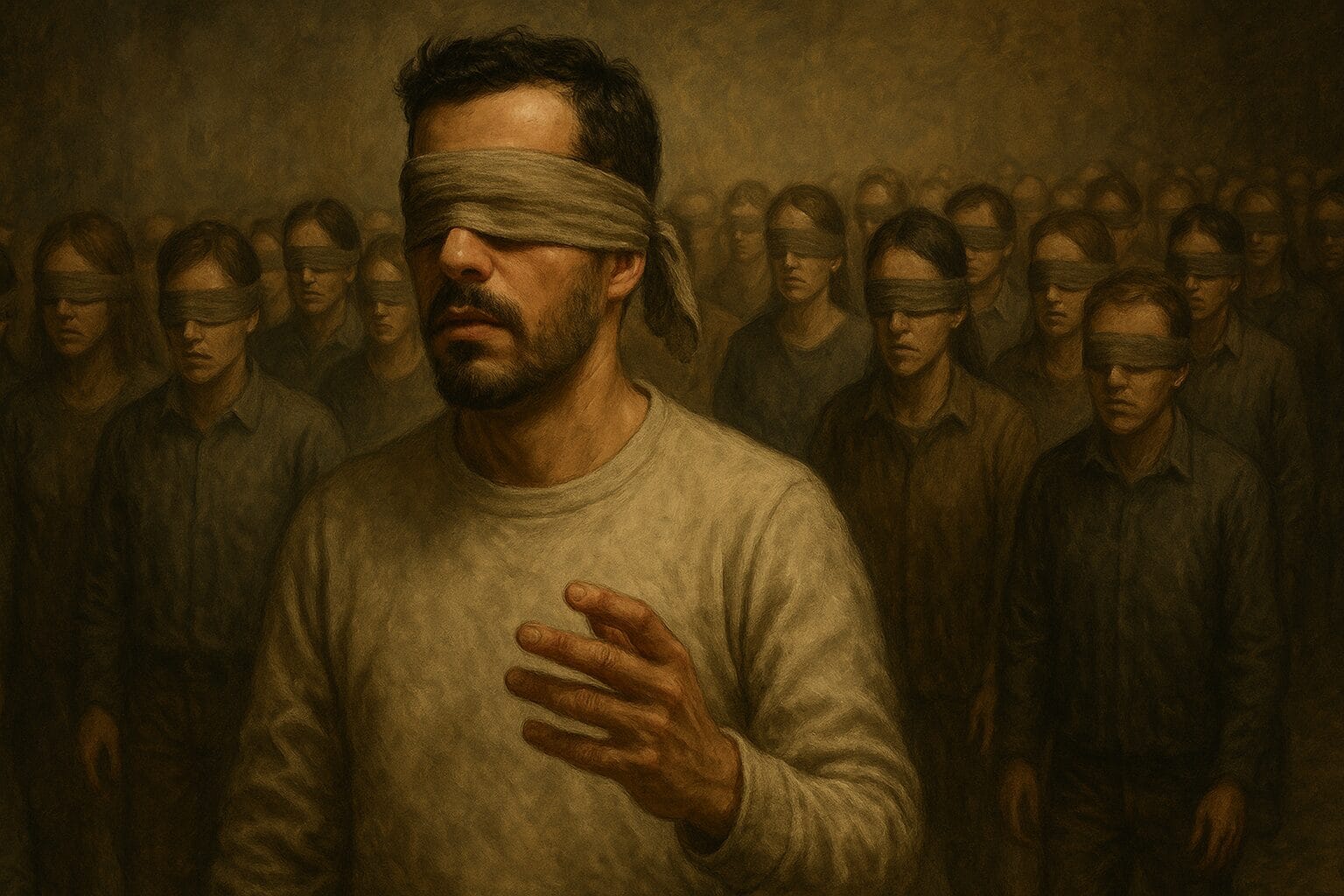
Today I want to talk about a phenomenon that is becoming more and more omnipresent, especially noticeable in political discourse since the days of the pandemic: post-truth. Although the term may sound recent, the dynamic it describes is as old as civilization itself. We are going to unravel what it means, where it comes from, how it affects us psychologically and socially, and, most importantly, how we can navigate these turbulent waters by integrating scientific rigor with a spirituality based on the honest search for truth.
At first glance, «post-truth» suggests that the truth has become obsolete or irrelevant. And in a sense, that is the idea. It describes a cultural and political environment where objective facts influence public opinion less than appeals to emotion and personal beliefs.
It is a concept that spreads rapidly thanks to technology and social networks. Here, «truth» ceases to be a faithful and verifiable description of reality, becoming instead a cultural construct or an ideological currency. Evidence and data yield ground to the version of reality presented by a charismatic leader, or to the emotional resonance that a claim has with our pre-existing beliefs. In post-truth, feeling that something is true becomes more important than knowing whether it is based on evidence. The narrative that validates our view of the world triumphs, above the uncomfortable and complex reality.
However, this is not new. It is a technologically enhanced version of the propaganda and manipulation that have always existed in the struggle for power. Let us think of the propaganda of totalitarian regimes such as Nazi Germany. Joseph Goebbels perfectly understood that a lie, repeated a thousand times and appealing to fears and prejudices, could become a «truth» accepted by millions. The strategy is clear: simplify reality, create enemies, appeal to basic emotions (fear, pride, resentment) and discredit alternative sources. The objective is to create an information bubble controlled by the authority.
We can even find parallels in the history of organized religions. Sacred texts such as the Bible or the Quran, for their most orthodox followers, have been (and are) the sole and absolute source of truth about the universe, history, and morality. The authority resided in divine revelation, not in empirical evidence. Any scientific discovery that contradicted the scriptures was erroneous by definition, and had to be ignored, denied, or reinterpreted.
The case of Galileo Galilei is emblematic. His observations supported Copernicus's heliocentric theory, contradicting the literal biblical interpretation of an immovable Earth. The ecclesiastical authority, clinging to its monopoly of truth, forced him to recant, regardless of the observable evidence. This pattern –the authority dictating the truth and suppressing evidence– is precisely what we see reflected in contemporary post-truth.
Curiously, the Judeo-Christian tradition contains the idea of the Logos or creative Word («In the beginning was the Word… and all things were made through him»), which suggests that the word precedes and creates material reality. A sort of antithesis, in a way, of the scientific approach.
Modern science was born precisely from a revolution against this uncritical acceptance of authority. The scientific method postulates an objective reality that exists independently of our desires, and that we must discover through systematic observation, rigorous experimentation, and rational interpretation.
This step from «revealed truth» to «truth sought and verifiable» was the heart of the Enlightenment. Yuval Noah Harari calls it the «revolution of ignorance». Its engine was not the arrogance of believing we know everything, but the radical humility of admitting our immense ignorance. Recognizing that our intuitions often fail and that the only reliable way to know the world is to observe it, measure it, and be willing to revise our beliefs, even the most comfortable ones.
Scientific truth is not a dogma; it is provisional knowledge, our best explanation so far, always subject to revision. Skepticism (the demand for robust evidence) is fundamental. Science advances by questioning itself, not by clinging to doctrines. This vision clashes head-on with the ideological conception of truth proper to post-truth, which represents a regression to a more tribal and authoritarian thinking.
History is full of examples where scientific truths with economic or social implications clashed with the resistance of those who benefited from the status quo.
These cases show how economic interests can motivate the denial of evidence and the promotion of alternative narratives (post-truth), prioritizing short-term benefit or power over collective well-being and even over one's own future.
To understand why we fall so easily into manipulation, we must look at our own brain. We are social animals, and our survival has depended on cooperating and building shared realities through stories. Our brain is predisposed to think in narrative terms, not to process data coldly.
Evolution endowed us with mental shortcuts (heuristics) to make quick decisions. These heuristics, efficient in ancestral environments, can lead us to systematic errors (cognitive biases) in our complex modern world.
A good story organizes chaotic information, gives it meaning, establishes cause-and-effect relationships (often incorrect but easy to digest) and emotionally hooks us. We remember a story much better than a list of abstract data (as illustrated by the example of memorizing resistor colors with the word «necarona beas biogribla»).
That is why a false claim wrapped in a convincing story that appeals to our fears and hopes can be more persuasive than complex but truthful facts. It is easier to believe in a simple conspiracy with an identifiable villain than to accept a multifactorial and chaotic reality. We prefer stories that cast us as the good ones, the special ones, the chosen ones – something that religions and populist politicians exploit masterfully, selling emotional narratives of belonging and of a fight against a common enemy.
When our beliefs clash with each other or with reality, we experience cognitive dissonance (Leon Festinger), an uncomfortable mental tension. To reduce it, we can change a belief, seek information that reinforces it (confirmation bias), or minimize the importance of the conflict. Often, we opt for modifying the story in our head, clinging to false beliefs even in the face of contrary evidence, because abandoning the comfort of the known and accepting our ignorance is painful and difficult. It is part of why leaving dogmatic religion for an authentic spirituality, based on humility and search, is a demanding path.
The COVID-19 pandemic exacerbated these tendencies. The avalanche of complex and sometimes contradictory information (about transmission, the effectiveness of masks, etc.), added to the uncertainty and the fear, generated fertile ground for conspiracy theories (the virus created in a laboratory, Bill Gates, etc.). These offered simple explanations and clear villains.
The very nature of science –which advances by correcting itself– was misinterpreted by a society accustomed to «absolute truths» and to leaders who never admit errors. Seeing scientists adjust their recommendations as new evidence emerged was seen by some not as rigor, but as inconsistency or deception, eroding trust. Moreover, the pandemic brutally exposed our vulnerability, leading us to seek refuge in simplistic certainties. The isolation may also have radicalized world leaders (it is speculated about the case of Putin and the invasion of Ukraine).
There is a history of deliberate manufacturing of ignorance or doubt (agnotogenesis) for political or commercial ends. Today, these techniques are refined in the digital age. Strategies such as «piling on the zone» (according to Trump's strategist, Steve Bannon) seek to generate so much noise and confusion that people stop paying attention and rational debate erodes, leaving the field open to ideology and blind loyalty.
In a complex and uncertain world, the vacuum is filled by charismatic leaders who offer easy solutions in exchange for unconditional loyalty. It is a psychological pact similar to that of cults: the leader promises security, power, or happiness, and the follower surrenders his critical thinking. Blind faith, where evidence is irrelevant or even an enemy («the sin of doubting»), becomes the currency.
While a certain trust in leadership is necessary for social cohesion (the social contract), uncritical submission is dangerous.
What is the way out? Cultivating a healthy skepticism and intellectual humility as a life attitude.
Navigating the age of post-truth requires a conscious commitment to the search for truth, no matter how complex and uncomfortable it is. It requires the courage to question our own beliefs and the dominant narratives, and the humility to accept that we do not have all the answers.
Integrating the rigor of scientific thinking with the depth of an authentic spirituality –one that values honesty, humility, and genuine connection with reality– offers us the tools to resist manipulation and to build a clearer and more compassionate understanding of the world and of ourselves.
I hope this reflection is of use to you.
Good path and good breeze.