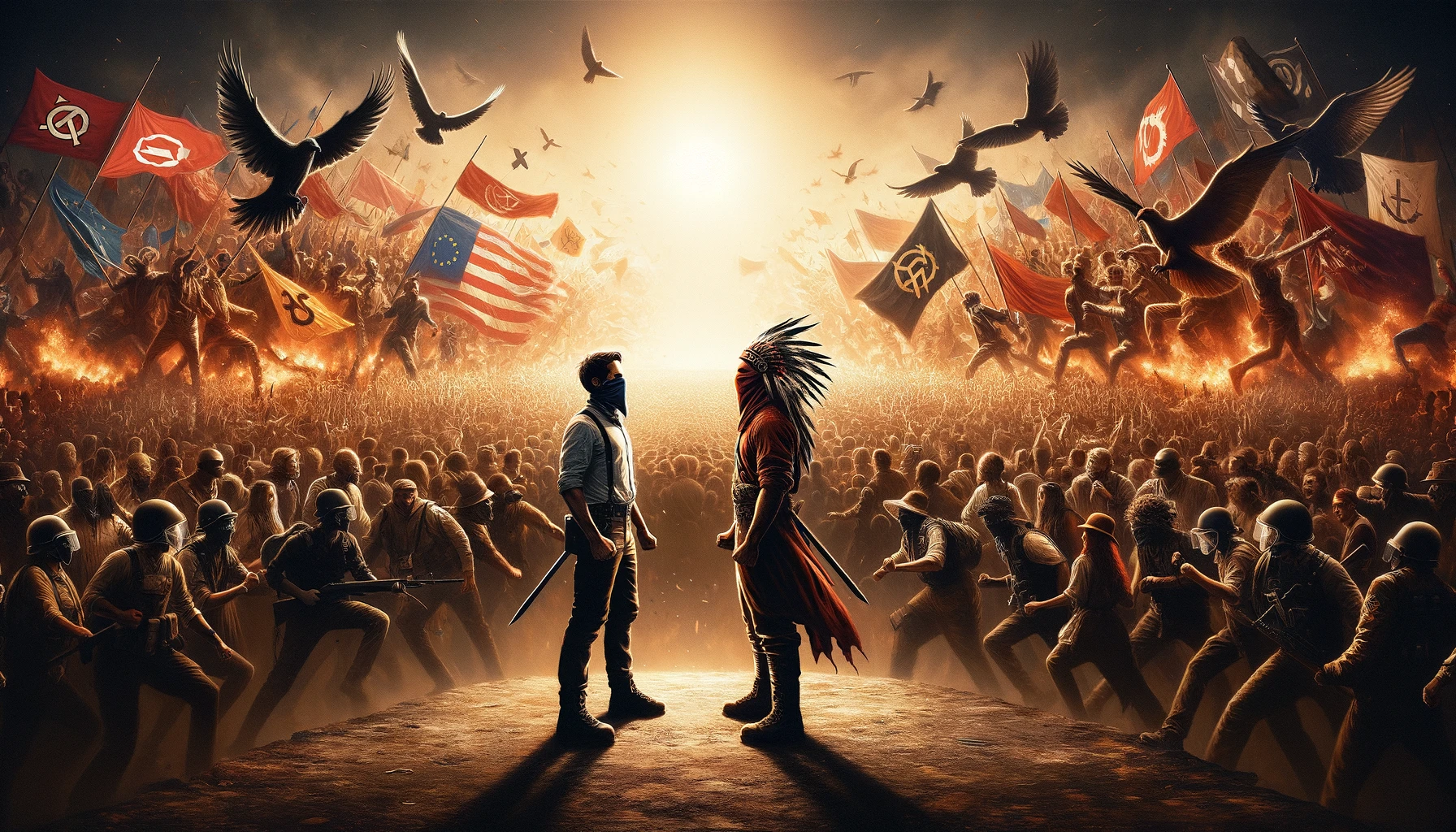
A topic I want to address is the current confrontation between the concepts that would be translated from English as ‘libertarianism’ and ‘wokeism’. This dispute is clearly reflected in the political scene of the United States, where Donald Trump's followers accuse Joe Biden's people and the Democrats of being part of ‘wokeism’, while Biden's followers, particularly the most fervent Democrats, criticize Trump for representing a false or extremist form of libertarianism.
To better understand the term ‘woke’, which may not be widely used in Latin America, it refers to a political and cultural stance that advocates for and promotes aspects of social justice, such as gender equality, the rights of the LGTBI community, and the promotion of ethnic and cultural diversity in all sectors of society. The defenders of this movement are often called ‘social justice warriors’. The movement has its origins in the ethnic claims of the twentieth century, which highlighted the importance of being aware of the oppression of African American communities in the United States and the need for social change. Originally, the expression ‘awake’ was used to indicate the need to be alert, but since the beginning of the 2010s, a new term has emerged, adopting the word ‘woke’. Although grammatically incorrect, this variant has become popular to describe an attitude of active and constant alertness toward social realities and the dishonesty that society may normalize or conceal.
These movements gained momentum and found a significant point of inflection with the killing of Michael Brown, a young African American, by the police in 2014. This event gave rise to the Black Lives Matter movement, which centers on social justice activism. Consequently, the political left, traditionally associated with progressivism and the search for equality of rights and freedoms, has adopted a more combative stance in the fight for social change. This approach has evolved from peaceful marches and awareness campaigns to more vehement and eye-catching protests.
To capture the attention of an audience increasingly focused on social networks and short-lived media phenomena, we observe how liberalism evolves into progressivism and subsequently into what could be called ‘wokeism’. The latter term encompasses the causes considered essential to achieve social justice, which is why its followers are known as ‘social justice warriors’. ‘Wokeism’ covers and represents issues such as feminism, environmental conservation, the defense of animal rights, gender equality and equity, the promotion of diversity in the workplace, and the political representation of all factions of society.
This advance in society reflects a significant change in the norms that were considered acceptable in most Western societies. Ancient practices, such as slavery or the exclusion of women from the right to vote and to property, are today seen as vestiges of a more archaic era or of societies governed by restrictive religious dogmas. The worldwide change includes the increase of the female vote, the presence of women in public office and managerial positions, aspects that politically had been part of the development of both the left and the right. Traditionally, the right has favored the interests of capital and of those who have access to it, generally white men, but it had not opposed social advances directly, including a greater participation of women and, to a lesser extent, of other ethnicities.
In Latin America, for example, although racism against indigenous and Afro-descendant communities is still present, the difference is not as marked as in North America, especially in urban areas. To a certain point, a natural and gradual progressivism had been reached, although not as fast as some communities require.
However, with the appearance of ‘wokeism’, the dynamic changes, since this movement groups the demands for change of various communities into a single political current, associated with specific platforms, candidates, and interest groups. This phenomenon leads to a dilution of the individual identity of each group, which are varied and diverse.
The needs of feminism, although they may share some common points, differ significantly from the concerns of African American communities in North America, and even more so from topics not directly related to sociocultural issues, such as the response to climate change. The latter, along with public health measures such as the promotion of vaccination and the use of masks during pandemics, has become increasingly associated with the ‘wokeism’ movement. However, the grouping of these broad and varied topics under a single political current has been criticized, since they are too complex to be represented by a single line of thought.
Leaders and influential figures of these various movements may have seen the opportunity to join forces to induce faster changes. Authors like Naomi Klein represent this urgency to accelerate the transformation, especially in critical issues such as climate change, which demands more immediate and decisive actions rather than gradual advances. This convergence of causes has led to a sudden explosion in the promotion of progressivism and ‘wokeism’, surprising many with its speed and intensity, despite the general consensus on the validity and legitimacy of these struggles.
In the United States, fundamental changes have begun to materialize, especially in the academic sphere, with the designation of African Americans, women, and members of the LGTBI community as deans and presidents of universities. The selection of faculty has also begun to be based on their personal beliefs and their promotion of diversity and progressive values. This has generated discontent among more conservative sectors, who have historically maintained a tension with the forces of change, preferring to preserve the status quo.
This eternal drama between conservatism and liberalism reflects the human dynamic of growth and evolution. From childhood, where obedience and imagination predominate, to adolescence, where personal identity is sought and established norms are challenged, human beings undergo constant changes. This need to redefine and challenge what is established has been especially evident in youth movements, such as the pacifists of the 1960s, driven by the desire of young people to shape the world according to their own ideals and perspectives.
At the other end, we find the opposition, usually of older adults who have been witnesses to numerous changes throughout their lives, who have observed the failure of many of these changes and have seen wars arise and disappear in the name of various causes. This experience leads them to adopt a more conservative stance, wishing to maintain the status quo and preserve the elements that, in their judgment, have contributed to reaching the current state of society. Therefore, the conflict we observe today between different ideological currents is not something new; it is rather a reflection of the human psyche, where it is commonly assumed that there should exist a political center that harmonizes all perspectives, but in reality, this is an ideal difficult to achieve. The human mind is inherently dual, composed of two hemispheres and multiple cortical columns that process information simultaneously, offering different perspectives.
This phenomenon of duality and internal conflict has been observed in neuroscience studies, for example, in cases where the brain hemispheres have been separated to treat epilepsy, revealing different ‘will’s within the same individual that may be in conflict with each other. This reflects how, within our mind, multiple ‘beings’ or aspects with different perspectives coexist, something that has been attempted to be represented in a simplified manner in cultural media such as the film ‘Inside Out’, where emotions such as fear, sadness, and joy are personified.
In real life, although we are not an exact representation of these emotional characters, we do experience internal conflicts, especially when facing complex situations such as the current conflicts in the world, such as between Ukraine and Russia or the situation in Israel and Palestine. These events lead us to experience and reconcile within ourselves various perspectives and judgments until we reach, at least temporarily, an internal consensus, which may change as we receive new information or reconsider our positions.
From the social point of view, the idea of a unifying center is more of an ideal than a reality, since there will always be individuals whose priority is to preserve what exists, valuing the advances and improvements that the current system has brought to the life and conditions of millions of people around the world. On the other hand, there are those who, despite recognizing tangible improvements in quality of life and reduction of poverty attributed to the Western world, feel that great injustices and evils still prevail and need to be addressed, even if it means radical changes such as wars or social revolutions.
As for woke culture, an increase in the manifestations of this current is observed, especially in North America during the pride month, previously known as gay pride. This month is now dedicated to celebrating diversity, in particular that of the LGBTI+ community, with companies promoting diversity and equality through initiatives such as the modification of logos with the colors of the rainbow. Although these actions are positive and promote inclusion, they are also criticized for being marketing strategies aimed at a market niche with growing purchasing power.
On the other hand, there are cultural expressions that resist this normalization of diversity and the search for inclusion, especially from conservative perspectives. Although some conservative groups support gender equality and sexual diversity, others see the demands for immediate change as unjustified. They argue that sufficient progress has been made and that there is no need to accelerate these changes. However, as progressivism raises new claims, conservatism seems to run out of solid arguments, resorting to stances considered outdated by many, such as opposition to abortion, a stance that many women, especially in developed countries, reject, insisting on the right to decide about their own body.
Conservatism has been evolving to adopt a more attractive and cohesive form, seeking new approaches that allow it to be more relevant in the political space. In the United States, for example, the Republican movement has lost followers, particularly because its base is in rural areas, while urban areas, more progressive and diverse, especially with regard to the LGBTI+ community, show different realities. Interaction in cities with diverse communities leads to a natural support for equality of rights and the elimination of social prejudices. Moreover, in cities the need for women to participate in the economy stands out, not only as labor but as intellectual contributors, which contrasts with the more traditional perspectives of the countryside.
Urban areas, being more progressive and liberal, contrast with rural conservatism, which still sees traditional roles for women and considers homosexuality as something abnormal. In this context, the conservative movement seeks to renew its approaches to attract young people, women, and members of the LGBTI+ community. They use the reaction against certain excesses of the woke movement to position themselves, although it is important to clarify that the term ‘woke’ does not represent a unified group with defined leaders or parties, but a series of political movements and trends.
It is suggested that the mistakes of the woke movement, perceived by some as serious, have strengthened its opponents, leading to the emergence of a current that could be identified with ‘authoritarian libertarianism’. This term, however, could be confusing or even misleading, suggesting a contradiction in the classic libertarian principles by incorporating authoritarian elements.
The critic points out that the woke movement has adopted a combative approach that may undermine the foundations of Western society. The criticism centers on how some groups within the movement have described current society as unjust and cruel, assigning a disproportionate responsibility to white men for various social and global problems. This perspective has led to accusations that white men are the main cause of the lack of diversity in the workplace, of wars, and of the social and economic barriers faced by other groups.
Although it cannot be denied that many historical figures of power have been white men and that they have contributed to significant problems, the critic argues that this view ignores the positive contributions that white men have also made. This unilateral approach, according to the argument, diverts attention from the importance of diversity and equity as forces for global progress. Instead of valuing people for their ideas and skills, without considering their gender or race, it is perceived that the movement focuses on displacing white men from power as a solution to social problems.
As a result of this polarization, the emergence of movements gathering people who feel alienated by the generalized accusations of the woke movement has been observed. Among them are not only white men, but also women, members of the African American and Latin American communities, who believe that the solutions proposed by some sectors of progressivism are more harmful than the problems they seek to solve. This feeling has led to a greater alignment with authoritarian libertarianism, in contrast to the woke approach of recent years, suggesting a reevaluation of the strategies to address injustice and inequality in society.
The controversy mentioned arises from the response of Google Gemini, an artificial intelligence, to requests to generate images of historical figures. Instead of reproducing historically accurate representations, Gemini chose to create diversified versions of known Caucasian figures, such as George Washington represented as a black man, Alexander Hamilton as an Asian, among others. This approach generated mixed reactions, with some users finding humor in the interpretations, while others saw it as an example of the supposedly absurd limits reached by the drive for diversity.
This incident did not only affect Google's stock price, but also rekindled a debate about the search for diversity and equality in representation. Some argue that these actions, far from promoting real equality, divert attention from the true diversity of perspectives and experiences, while others see in these acts a step toward a more inclusive representation in the media and technology.
The debate extends to representation in Hollywood, where the inclusion of characters of different ethnicities in historical contexts, where they would not have been present, has been criticized by some as an unrealistic revision of the past and a disrespect to the real history of oppression and inequality. However, this approach is also interpreted as an attempt to rectify the historical exclusion of minority groups in predominant narratives.
The commentary on the colorized videos from the end of the nineteenth century and the scene in Vietnam illustrates how the perception of history can be influenced by contemporary representation, highlighting the complexity of interpreting acts of the past with modern sensibilities. This anecdote reflects the tension between accurate historical representation and the reinterpretation or idealization of the past, underlining the importance of context and perception in the understanding of history and human relationships.
Recently, a controversy has arisen related to the launch of Google's new artificial intelligence, called Gemini. It has been reported that, when requested to create images of people, this AI generates diverse representations, but notably absent of white men. For example, when asked for images of the founding fathers of the United States, Gemini produces versions of figures such as George Washington with African American features or Alexander Hamilton with Asian features, avoiding representations of Caucasians.
This tendency of the AI has extended the discussion to other historical contexts, such as the representation of Nazi soldiers during World War II, where again the artificial intelligence opts for diversity instead of historical accuracy. This phenomenon has generated debates about the limits of inclusiveness and diversity in digital and historical representation, reflecting a drop in Google's stock and fueling discussions about political correctness and respect for history.
In addition, this incident recalls a broader phenomenon observed in Hollywood productions, where a tendency to represent history with anachronic diversity has been noted, which some critics consider a romantic reinterpretation that ignores the realities of oppression and racism of the past.
This topic is linked to the reflection on how historical and cultural events are presented in modern media, contrasting with the documented reality of earlier eras, such as the colorized videos from 1896 that show interactions between colonial society and the local population in Vietnam, reflecting a complex and often problematic dynamic that is simplified or ignored in contemporary representations. The discussion centers on finding a balance between diverse representation and respect for historical accuracy and collective memory.
In the analysis of current circumstances, it is fundamental to recognize that, as humanity and individual beings, we experience constant growth and evolution in our way of thinking, adapting to new realities. At the social level, we have evolved and modified our self-perception, our vision toward our fellow beings and toward other species, as well as our relationship with the planet. In this process, it is crucial to be aware and coherent, accepting that our past includes actions that, although at the time they were acceptable, today could cause us embarrassment. However, this should not turn us into relentless judges of previous generations.
The need for change in the world must be directed toward the future, focusing on current injustices and seeking ways to improve. We should not waste time judging and rejecting our past. This approach is reflected in the problems faced by the WOC movement, especially in the context of racism, one of the heaviest burdens in North American society. Despite the historical burden of injustice and racism, the significant advances made cannot be denied, marking changes in public consciousness and laying the foundations for future progress.
It is essential to understand that the past is behind us, marked by different circumstances and levels of knowledge. We must accept and be grateful for the changes that have occurred, which have brought us to the current reality, while continuing to seek improvements for the future. These goals are not contradictory; they represent complementary visions that, unfortunately, politics and the media often present as mutually exclusive. We are presented with a false dichotomy: either a ‘woke’ stance is adopted, rejecting the entire past and advocating for a total destruction in search of utopian diversity and equality, or one leans toward an authoritarian libertarian extreme, rejecting any change and promoting a government dominated by authoritarian and belligerent figures.
This polarization is reflected in figures such as Javier Milei in Argentina, who, despite the media representation, offers economic perspectives based on the free market that could be considered rational. Nevertheless, he has also been associated with the anti-woke current, criticizing the excesses of progressivism and seeking to limit changes that, although possibly exaggerated, have provided benefits to certain segments of society. It is vital to find a balance, recognizing both the mistakes and the successes of all perspectives to foster a more inclusive and just future.
In the current political and social landscape, figures such as Vladimir Putin and Donald Trump stand out, who embody a worldview that many consider authoritarian and regressive. These leaders, representatives of a generation that idealizes the 1970s and 1980s, perceive progressive movements and social struggles as threats to global prosperity and stability. In their perspective, the return to an era where authority could not be questioned and claims for rights were labeled as communist and therefore subject to persecution, seems to be the path to follow.
In this context, I make a call for reflection and moderation. It is crucial not to be dragged by the extremes and to consider that, in reality, absolutes such as white and black rarely exist. Life itself, just like death, is not limited to a binary state; it is a spectrum in which even after the cessation of brain activity, the biological components of a being continue to contribute to the chain of life.
Likewise, the current ideological confrontation between left and right, between conservatism and liberalism, is composed of numerous nuances. In this weave, it is possible and, in fact, beneficial to adopt elements from both spectrums. For example, the promotion of diversity and equality of opportunities are values that I personally support. I consider that, in the processes of labor selection, the omission of information such as name and geographic origin could mitigate biases and prejudices, contributing to a fairer and more equitable evaluation of candidates.
Nevertheless, I am also aware that quota policies, although controversial, in some contexts are necessary to guarantee the representation and visibility of historically marginalized groups. Although these measures may seem unfair to those who have prepared intensively for certain positions, in practice they may be the only means to balance opportunities in an inherently unequal system.
Finally, I would like to invite you to reflect on this cultural dynamic that we are experiencing. I am interested in knowing your perspective: do you identify more with progressive or libertarian ideas? And how do these convictions align or contrast with your spiritual beliefs?