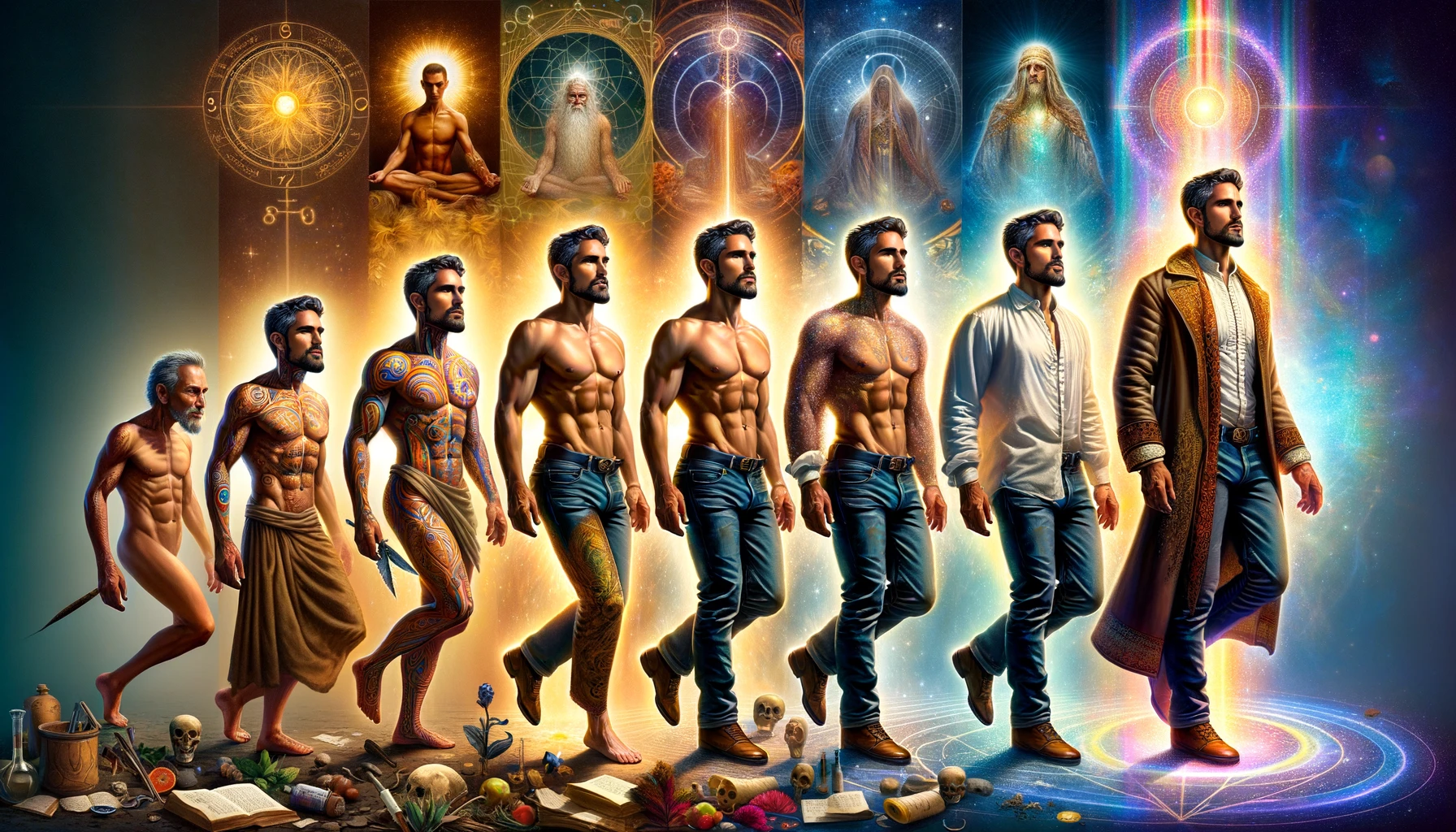
Some time has passed since my last episode, which closed an important stage by concluding the narration of my spiritual journey. This journey began, perhaps without full awareness of it, in the Sierra Nevada de Santa Marta, where an Arhuaco baptized me in a mystical way, although initially against my will. Along this path, I shared with you how the love for my shamanic teacher, the discovery of yagé, and my immersion in shamanism, esotericism, meditation, Buddhism, and a deep introspection about my relationship with religion, transformed my life. For almost 15 years, I have shared stories and experiences with the hope of resonating and offering guidance to those who begin their spiritual path in a different era.
In this episode, I reflect on the changes in my life and in the world during these months, seeking a more direct connection with those who have trusted this space. At the end of 2023, I was surprised to discover that, despite being a modest and unadvertised podcast, I have managed to gather around 300 listeners in several countries, including Colombia, the United States and Mexico, who value my stories, which I prepare carefully as if they were articles or columns.
The pause in publications was a conscious decision to dedicate time to my family, professional and personal projects, and also to contemplate the future of the third season of the podcast. The original idea of this project was to document my spiritual story, with the final goal of writing a book. Now, that book, titled «Hijo del Cosmos», is a reality. Following the advice of a writer friend, I plan to make the text more accessible by condensing it and possibly dividing it, which explains why I haven't yet done an official presentation.
The podcast served me as a personal commitment to persevere in writing my story, sharing my experiences, evaluating the resonance with the audience and refining the message I wanted to convey. I started this project at the beginning of the lockdown due to the pandemic in March 2020, a time when I was still processing and understanding the depth of my spiritual journey, intensely marked by the years dedicated to shamanism.
I continued participating in some ceremonies and rituals learned during my years of living with the Muiscas and Amazonian communities. Although in Canada I didn't find a space or community to share that knowledge as I did in Colombia, I considered myself a shaman and practitioner of those traditions. However, the pandemic marked a turning point, revealing that my story hadn't yet concluded. Despite being far from the Colombian indigenous and ancestral context, it was necessary to close cycles and reflect on my vision of spirituality. I wanted to achieve a communion between spirituality and academic knowledge, with an objective approach to reality, and to scientifically represent the experiences and phenomena lived.
The pandemic completed my transformation, by evidencing the damage caused by magical thinking, superstition, and a mystical vision of reality. The spread of conspiracy theories about COVID-19, the promotion of treatments without scientific basis, and the support for controversial figures like Donald Trump by people considered spiritual, led me to question both others and myself. I saw myself reflected in those who, without evidence, spread information, distancing myself from practices and beliefs without empirical foundation.
This process of introspection made me recognize the importance of differentiating between ancestral knowledge, based on traditions and experiences, and personal “inspirations” without verification. Although I value popular wisdom and the teachings of the elders, I began to question the interpretations and revelations themselves received in altered states of consciousness or moments of deep reflection, especially those related to esoteric topics like the nature of the soul or the spirit. This questioning drove me to seek a balance between respect for ancestral traditions and the need for a critical and evidence-based approach.
I recognize that, on various occasions, I created and shared ideas that I sincerely believed were being transmitted to me through meditation or the use of sacred plants, attributing them to external sources like God, natural elements or guardian spirits. However, these ideas emerged from my mind without support or a discernment process to verify their truthfulness. Influenced by the trust that others placed in me, I shared these beliefs without questioning them.
A notable example of this was my perception of plants as sentient beings, a common idea in the realm of ancestrality. I took this notion further, suggesting that plants used humans to see, feel and hear, creating a sphere of shared consciousness. Despite how poetic the idea is, I must admit that, however imaginative it may be, it doesn't align with reality nor does it have evidence to support it.
This reflection leads me to criticize and assume the responsibility of alerting about the practice of disseminating spiritual teachings based on imagination or creativity without real foundation. Many times, these teachings are adaptations of information from books or other disseminators, without an act of contrition or recognition of their lack of basis in reality.
I recognize that there is a human tendency to believe in our own goodness, even when our methods may be questionable. Our society, especially in the Western context, tends to reject and condemn error, without appreciating the learning opportunity that these offer. Mistakes, even those committed voluntarily under the belief that they were minor or positive, can reveal important lessons once greater awareness is acquired.
My intention is to address the importance of recognizing and learning from mistakes, understanding that not all of them are committed out of ignorance or carelessness. Some are conscious decisions that, when reflected upon, allow us to grow and improve. This process of introspection and admission of mistakes is fundamental to advance toward a more authentic and grounded spiritual practice.
At this moment, I advocate approaching spirituality from a scientific perspective, applying the scientific method to the exploration of our internal and subjective experience. Although in the circles I participated in, the acceptance of reality and the recognition of mistakes were valued, one rarely hears someone admit a change of belief without adopting another in its place. In my case, I haven't replaced my old beliefs with a new theory based on my personal interpretation. I have decided that my approach to spirituality will focus exclusively on the interior, on the world of the mind in a metaphysical sense: the thoughts and ideas, which I consider the true realm of spirituality.
I recognize that, outside this internal realm, regarding the physical functioning of the brain, the material world and beyond, I should have had the humility to admit that understanding these phenomena requires dedication and time, possibly a whole lifetime to understand only a fraction of a phenomenon. Human beings, individually, don't have enough time to achieve a complete understanding of areas as complex as neuroscience or subatomic physics.
This awareness of our finitude and human limitations leads me to accept that the only way to approach the truth is to trust collectives dedicated to the study and research in these fields. The pandemic made me see that many people, with equal or less knowledge than me in sciences or pharmacology, recommended treatments without respecting those who have dedicated their lives to the study of these fields. I saw myself reflected in that attitude, having previously recommended natural treatments with conviction, without considering the ongoing scientific research on these topics.
This recognition underlines the importance of valuing specialized knowledge and dedicated research, and of approaching spirituality and science with humility, recognizing our limitations and the need for a more rigorous and evidence-based approach.
The knowledge accumulated over hundreds of years by abuelos and taitas has revealed many secrets about healing and the functioning of the world, but these cannot be assimilated with just a few nights of participation in rituals or even in five years of continuous learning. In the old days, to be recognized as a taita, one had to already be an elder, have an established family and show exemplary behavior, avoiding vices like alcoholism, promiscuity or financial irresponsibility. However, in recent times, a tendency toward considerably younger taitas is observed, some barely 25 to 40 years old, who are still exploring this world and its medicinal practices. This evolution reflects a significant change from past traditions, where I myself, during a stay in New York, performed a yagé ceremony, retrospectively recognizing the recklessness of such an act.
This period of introspection, especially intensified during the pandemic, led me to reconsider my own actions and the importance of skepticism as a path to truth. Skepticism, far from being a denial of knowledge or an inability to believe, is a stance that invites humility and a deep understanding of our limits. Unlike faith, which is taught from childhood as the ability to believe without seeing, skepticism promotes healthy questioning and an objective search for truth, through reading and constant learning.
The Enlightenment marked a turning point in history, changing the focus from knowledge based on sacred texts and their interpretation by scholars, toward an acceptance of ignorance and doubt as foundations for the advancement of knowledge. This movement not only questioned established practices, like the crusades or the Inquisition, but also opened paths toward scientific exploration and constant questioning that has shaped the development of modern society. Recognizing our ignorance and subjecting our beliefs to rigorous scrutiny is fundamental to advancing in the understanding of the world around us.
The transition toward the scientific method marks a milestone in the history of human thought, centered on methodical doubt as the essence of skepticism. This approach doesn't imply an unfounded denial, but a systematic, disciplined and objective doubt, focused on suspending the acceptance of any claim until the available evidence supports it conclusively. This critical attitude doesn't seek to challenge authorities without reason, but to ground our beliefs in empirical evidence.
The knowledge derived from the scientific method is intrinsically provisional. As new tools are developed and new data is discovered, what was considered established knowledge can be questioned and revised. A classic example is the transition from Newtonian physics to Einstein's theory of relativity, motivated by astronomical observations that classical mechanics couldn't adequately explain. This process underlines the evolutionary nature of science, which is always open to revision and refinement based on new evidence.
This principle of constant revision based on evidence also applies to the exploration of spirituality under a scientific approach. Authentic spirituality, in my opinion, shouldn't contradict scientific findings, since if something can be evaluated and understood within the scientific realm, then it is subject to its scrutiny. Science operates under the principle of falsifiability; that is, a theory must be potentially refutable to be considered scientific. This extends to the debate about the existence of metaphysical entities like God, where science faces inherent limitations, not due to incapacity, but because such questions transcend the realm of the empirically verifiable and enter the domain of faith and personal belief, highlighting the distinction and at the same time the interrelation between science and spirituality.
The fundamental purpose of science is to establish the truthfulness of claims by refuting false hypotheses, which requires experimental and observational methods capable of overcoming the biases inherent to human perception. The existence of God, as a concept, could be an object of scientific study if verifiable empirical evidence of its manifestation in the physical plane were presented, accessible to objective observation and measurement by multiple observers.
Allegations of divine manifestations shared by groups of people can be questioned from a scientific point of view due to the lack of objective and verifiable records. Such experiences, although deeply significant for those who live them, could be interpreted as collective hysteria or shared hallucinations, psychological phenomena where the influence of a group's convictions can lead its members to perceive events that have no observable physical correlate.
This reflection is illustrated with a personal experience during a visit to Bojacá, a place of pilgrimage near Bogotá, where the occurrence of a miracle was anticipated during a religious ceremony. Despite the promise of maintaining an objective and skeptical approach, the direct observation of the sun, motivated by the expectation of witnessing a miraculous event, resulted in the perception of an intense glow, a natural reaction to ocular exposure to the sun, rather than evidence of a supernatural phenomenon. This episode underlines the complexity of discerning between faith and empirical evidence, and how expectations and beliefs can influence our perception of reality.
Reflecting on the personal experience of looking at the sun during a religious event and perceiving an intense brightness that leads to closing the eyes triggers a series of common sensory observations when the sight is exposed to a strong light source. This experience, marked by the appearance of colored spots when closing the eyes, is a natural optical phenomenon and not a supernatural manifestation. Although some attendees, including family members, claimed to have seen the sun dance, this perception can differ significantly from one person to another, underlining the subjectivity of shared experiences.
Science and spirituality seek to understand reality from different perspectives, and while science relies on empirical evidence and the reproducibility of results, spirituality deeply values personal and subjective experience. Individual experiences, like those lived during rituals with yagé, are deeply personal and not necessarily universal. This recognition invites a reflection on humility and the understanding that what is lived at a personal level doesn't establish a reality shared by all.
The idea of “my truth” as an expression of personal experiences lived “in flesh and blood” suggests a respectful approach toward the diversity of spiritual perceptions and experiences. This approach emphasizes the importance of recognizing our own experiences without projecting them as universal absolutes. In the spiritual realm, particularly in experiences with substances like yagé, it is fundamental to remember that experiences are intrinsically personal and can vary considerably between individuals.
The reflection on the desire to share these deep and potentially transformative spiritual experiences, and the temptation to assume a leadership role or spiritual guide, highlights the complexity of navigating these experiences responsibly. Recognizing the limits of our experiences and the potential isolation that can arise from considering oneself special or advanced on the spiritual path is a step toward greater understanding and empathy toward the experiences of others. Ultimately, spirituality can be a deeply personal path, marked by individual exploration and respect for the diversity of human experiences.
Subjective experience, like love, fear or any other human emotion, encapsulates one of the deepest mysteries of consciousness. These experiences, although universal in their occurrence, are deeply personal in their experience, which raises the question of whether what we feel is identical to what another human being experiences. This enigma extends to multiple disciplines, from psychology to neuroscience, and even physics and artificial intelligence, all exploring what constitutes human consciousness and how we can understand subjective experience.
The Chinese room thought experiment illustrates the complexity of discerning whether an entity, like an artificial intelligence, possesses consciousness. Although it can simulate understanding of Chinese through the manipulation of symbols according to a manual, this doesn't imply authentic understanding nor the presence of consciousness. This challenge reflects the inherent difficulty in measuring or validating subjective experience, since, to date, we don't have tools that allow us to objectively capture these internal processes.
Spirituality, in this context, presents itself as a fertile field for the exploration of subjective experience from an objective approach, but respectful of the uniqueness of each experience. Science, for its part, deals with what is observable and measurable, from the functioning of metabolism to the life support systems of the human body, without invading the terrain of spirituality, which focuses on the study of the soul and internal experience.
This approach toward a spirituality rooted in personal subjective experience, without contradicting the findings of the external sciences, is proposed as a way of integrating knowledge and experiences in a manner that benefits and heals not only at a personal level, but also collectively. The invitation to share experiences and reflections on this intertwining of spirituality and science, through channels like Telegram or email, reflects a desire to dialogue and delve into these topics in an open and enriching way.
This change toward a more conversational format in the discussion of spirituality and science seeks to facilitate a more direct and personal exchange, recognizing that, although one doesn't always have the time for elaborate preparations, the value resides in the authenticity of the conversation and the relevance of the topics addressed. This approach underlines the importance of maintaining a space for dialogue and mutual learning, where each individual can contribute from their unique perspective and explore together the vast terrain that lies between spirituality and science.
Epic Legendary Cinematic | Movie by Alex-Productions is licensed under a Attribution-NonCommercial 4.0 International License.
Awakening (Cinematic Inspirational Piano) by MichaelSchullerMusic is licensed under a Attribution-NonCommercial-NoDerivatives 4.0 International License.