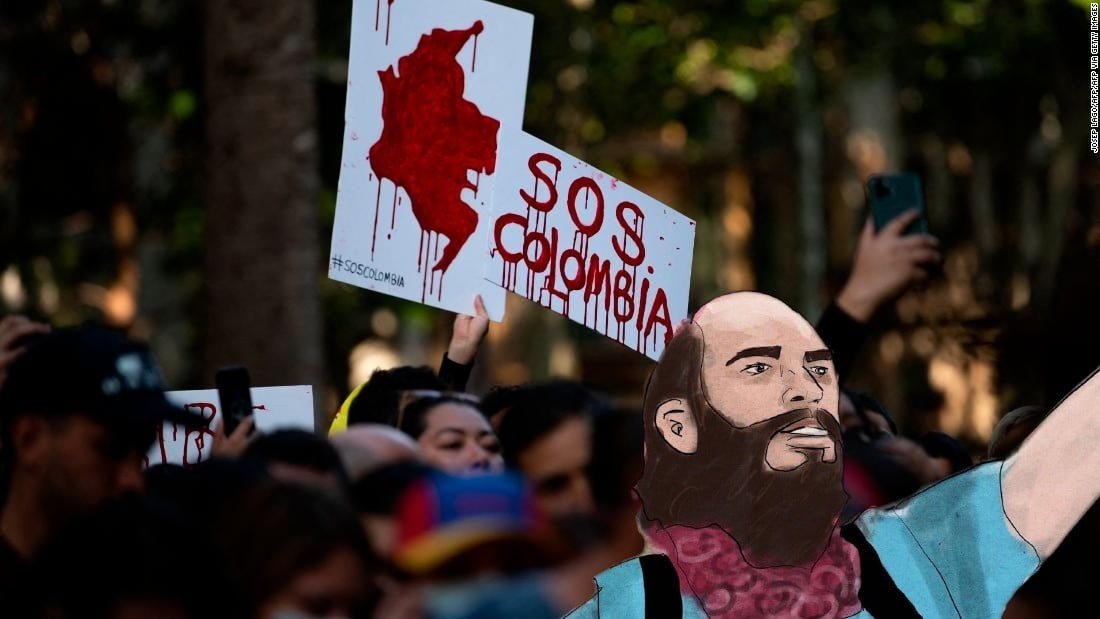
I had planned to share today the second part of the conference on conspiracies and digital manipulation that I published last week, but the events of the last few days in my country have made me reflect and consider that perhaps it is more pressing to discuss the role that spirituality plays in the midst of a social outbreak, in the face of an oppressive government, or in general, in a Society in which terrible injustices are committed around us.
For those who listen to me from other countries, let me put you in context: right now in my country, Colombia, the government in office is violently repressing the peaceful protests that multiple sectors of Society have convened to denounce the abuses of an indolent government that had no problem proposing a tax reform that would increase taxes on the middle class and the cost of the family basket in the middle of a pandemic that has increased poverty by more than 20%.
It has been very moving to see that most of my spiritual friends, yagé drinkers, and indigenous people have taken to the streets to join the protests or at least have spoken out through social media to denounce the outrages of the police and riot agents against the civilian population. I understood that even though spirituality tends to keep itself apart from politics, it is valid to ask what the position of someone who considers themselves spiritual should be when the effects of politics end up affecting us whether we like it or not.
A while ago, while doing my research for one of the first episodes of this podcast about the dark side of spirituality, I found an article in which the author said that to be spiritual, first you have to have a full stomach and a roof over your head. What I understood from that expression was that if we have basic needs that are not met, we cannot expect to have the tranquility to sit down to meditate, do mantras, and find inner peace.
This statement would surely cause a heated debate among several of the spiritual teachers I have met, because for some of them, there is no prerequisite for applying the precepts of spirituality. In fact, many would say that it is precisely the adverse external circumstances that predispose or motivate us to let go of the things of the world and seek peace in something beyond the material.
Religious and spiritual literature offers many examples of people who lived amid scarcity or vicissitudes and, instead of opposing them, used adversity to find enlightenment. The case of Job in the Old Testament is the clearest example of this archetype of sanctification through suffering. The Biblical God vents his wrath against poor Job only to prove to his adversary that Job's loyalty and worship were not conditioned on his good fortune, but that even in the midst of calamity and on the brink of death, Job would maintain his devotion.
This case, however, shows a different aspect of the human relationship with misfortune, because it reflects the stoic attitude that most spiritual traditions promote when it comes to natural calamities. Life is chancy, and when misfortune knocks on our door, we have no choice but to muster the best of ourselves and take advantage of the circumstances to discover something about ourselves, or to connect with something higher and transcendent.
In a gentle way, you can shake the world
But when misfortune is caused by a corrupt ruler, a despot, or a wicked king, not all the spiritual teachers I have met would agree that turning the other cheek is the solution. In this context, perhaps the most famous example is that of the peaceful revolution of Mohandas Gandhi, the famous political and spiritual leader of India who was nicknamed Mahatma, which means “ascended master.”
Gandhi is known as the leader who achieved the independence of India without firing a single shot, promulgating nonviolence and coordinating peaceful marches throughout the country. For this reason he is considered by many as the best example that without violence transcendental transformations can be achieved, even defeating the might of an empire armed to the teeth.
This vision, however, is an oversimplification and ignores important factors that come into play when we try to understand what the role of a spiritual person is in the middle of a revolution. In the first place, although it is true that Gandhi always maintained his pacifist intention, the process of liberation of India took about 90 years, during which there were numerous battles, massacres, and violent protests.
It must also be considered that in the year India obtained its independence, the United Kingdom had just come out of the Second World War with a battered economy, cities destroyed by Nazi bombings, and the need to focus its efforts on its own recovery. In addition, the United States was pressuring the British to grant India's independence, probably because they had their own interests in the subcontinent, something that was demonstrated later on.
This does not mean that Gandhi's contribution was insignificant, only that the pacifist movement was not the only one, but an important part of a series of factors and actors that coincided to achieve the independence of the nation. Historical records confirm that politicians in London considered Mahatma Gandhi an important leader and his movement as representative of the popular will of the Indian people.
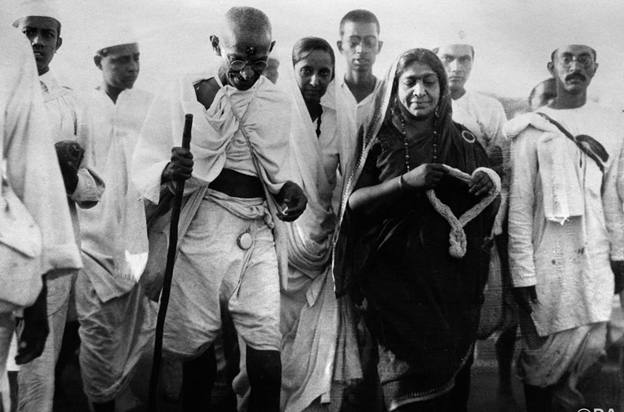
However, several historians agree that Gandhi's great contribution, more than leading marches, was inspiring the people and unifying them behind the idea of a single nation. India was, and still is, a melting pot of different cultures, creeds, and languages, with great differences and few things in common. Gandhi made a large part of all those very diverse states believe in a single independent and sovereign country.
But even for Gandhi, the nonviolent revolution was not a revolution without blood. In April 1919, Gandhi called an open and nonviolent protest, which was joined by the population of the city of Amritsar, who demanded the release of some leaders who had been detained by the British. In retaliation, the British army attacked a public demonstration in the city and caused the death of 20,000 Indians. Gandhi himself later confessed that calling that movement without contingency plans was a mistake.
A mistake by a pacifist that ended in the death of 20,000 people. Of course, it was not Gandhi's fault, but the fact demonstrated that acting without violence does not guarantee a proportional response from the adversary, just as hundreds of peaceful protesters in Colombia experienced this week, who have found a repressive state and a public force that abuses its dominant position to commit misdeeds in the name of those in power.
So what should be the attitude of a conscious person working on their spiritual self-realization in the face of the injustices and social transformations that are being experienced in Colombia and other Latin American countries?
In this part I share with you my personal opinion from what I have learned on my path. I believe that in the face of any external circumstance that life presents to me, I must act with coherence. Coherence means that there is harmony between what I believe and what I do, and from that point of view, as a spiritual person I must ask myself what the values are that I consider paramount and act accordingly.
If for you the current order of things is not right, then the coherent thing is to do something to change it. If you believe that things are not right but that the means promoted to change it are not right either, then the coherent thing is to propose a different way of achieving that change, but also to try it. If you believe things are fine as they are, then the coherent thing is to do something to defend the status quo.
In any case, coherence is closely related to action, and in fact, one of the most important precepts I have learned is that spirituality is action. It is not enough to believe that you are a kind person or to say how much you would like to help someone who needs it, if you do nothing when on your path you come across someone who needs a hand and you keep walking, looking the other way.
The second point to consider then is that the action you take adds to the achievement of the objective you believe in. This aspect requires a second quality, and that is wisdom. They say the road to hell is paved with good intentions, and that is precisely what Gandhi understood after the Amritsar march. The easiest alternative, or the most common or the most popular, is not always the best for achieving an objective.
This was another thing Gandhi understood, and that is why he chose nonviolence. Armed insurrection, targeted assassinations, and other violent means had already been tried and had failed before, so it made no sense for Gandhi to resort to them, even though at the time, armed protest might have seemed like the best alternative.
I don't necessarily mean that peaceful protest is always the way out. I say it was in the case of the liberation of India, but it has not served the same way in many conflicts around the world in which peaceful populations end up being co-opted by the violent or at the mercy of the tyrannies of the moment. But the alternative, that is, armed insurrection, has also proven to be quite ineffective, except for a few exceptions, and almost as a general rule, even when it is effective, it tends to carry side effects and vices that in many cases make the new situation even worse than the one it managed to abolish.
There is also an element of anachronism in the use of violence to achieve political ends. When one looks at the history of the nations of the world, one finds that almost all of them resorted to the use of force to achieve ends that could be considered noble: freeing themselves from a tyranny, vindicating the rights of an oppressed group, or dismantling criminal groups.
Nevertheless, almost all of these success cases in the use of violence to achieve a noble end belong to the past. In the modern world, almost all the important conquests of all colors of the ideological spectrum have been achieved by other means: such as civil disobedience, suffrage, journalistic denunciation, denunciation before international human rights bodies, or social media campaigns, in the case of the most important achievements of the civilian population, and propaganda, fake news, vote buying, and digital manipulation, in the case of the most important conquests of the oppressors.
Colombia is a special case, since after 60 years of armed conflict and an uninterrupted history of social conflicts, one of the highest rates of corruption and inequality on the planet and very poor respect for human life, hundreds of thousands of people still believe that the best solution to defeat those who think differently from them is to take their lives, and often, doing it in the most humiliating and cruel way possible.
A few weeks ago a book about the history of political violence in the region of Yacopí, where my father is from, came into my hands. And my blood ran cold going through those dark passages of the history of Colombia that very few know. The book covered several periods of the 20th century, but above all the one known as the era “of the violence” between liberals and conservatives.
The stories narrated by the author of “Sobrevivientes de la Tempestad” come from people who lived through the events, and what they describe reminded me almost verbatim of the stories I learned about paramilitary violence in Colombia during its heyday at the beginning of this century: mutilations, skinning, decapitations, a diabolical cruelty against women and children, and the clear intention of doing as much damage as possible.
One of the points in common among the testimonies of “Sobrevivientes de la Tempestad” was the thirst for revenge of those who managed to escape with their lives but had to witness the abuses to which their loved ones were subjected.
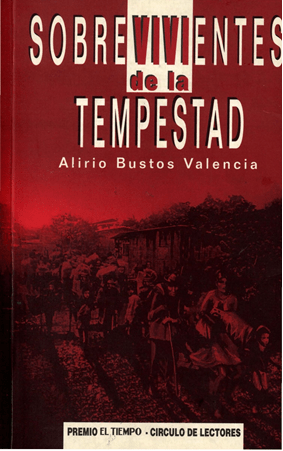
In a couple of cases, it is told how the victims became victimizers and managed to take revenge against their executioners. I have always believed that revenge never brings peace to the heart of a victim, but judging by the accounts in the book, when you have very little to lose and nothing else to live for, revenge ends up being a balm for the wounds.
The problem, of course, is that that balm opens another wound that sooner or later ends up making more blood flow, more hatred accumulate, and the horrible night never end. In episode T2E5: The Origin of Suffering I told the story of two families that exterminated each other over 11 years because of an offense by a member of one family against a young woman of the other. It largely reflects the drama in which we Colombians have been embroiled for decades.
So far I have only reflected on facts and circumstances, but I still have not said what my position is regarding what I should do as a spiritual being in the face of tragedies like the one we are experiencing in my country, where in the middle of a pandemic, people are forced to take to the streets to demand that an incompetent and corrupt government take charge of its responsibility to keep people from continuing to die of hunger, of Covid, or at the hands of the violent, who have again been seizing de facto power in the countryside and the cities.
Well, what I believe is that we have the responsibility, first, to take a clear position. Spirituality, I have said, is coherence and action but also decision. A person of wisdom does not avoid difficult topics nor settle for half-measures when it comes to fixing their position against injustice, abuse, and evil. Spirituality, being universal and natural, gives us the possibility of escaping these topics if we so wish, and I have known spiritual people who wash their hands saying that violence is part of nature, that if you go out to protest in the street and get shot by a policeman, it was because it was written that it should be so, and the victim had a soul agreement with their victimizer to “learn” a lesson in this life through that suffering.
There are also those who believe that if we are oppressed and abused, it is because we have not raised our vibration level to “deserve” being in a better situation. I, with all due respect for those who think this way, consider that all of that is cowardice disguised as spirituality, and in my opinion, this kind of belief is no different from the one that leads a multi-million-dollar company to respond to the demands of its exhausted and stressed employees by gifting them a subscription to a mindfulness meditation app for their phone: If you feel bad, it's not because I exploit you but because you haven't learned to control your mind...
My vision then is that spirituality should lead us to be more balanced, more unhurried to analyze but also more forceful to decide. So what comes next is knowing what the best decision is to act wisely. Should I go out and march with my compatriots and make the corrupt see that it is not a handful of misfits but an entire people that is rising up? Yes, I definitely believe it must be done as much as possible, and not only in person but through all the means we have at our disposal.
Do I believe it is worth dying for that cause? It is possible! If life puts me in a situation where a decision of mine can save the lives of thousands or improve the destiny of a people, or free a nation from suffering, I believe that losing my life under those conditions is better than dying of old age with the remorse of having had the opportunity to make a difference for the world and not having done it out of cowardice.
However, being cannon fodder in a confrontation between unarmed civilians and a contingent of murderous policemen not only seems unnecessary to me but also useless. There are some of these dead who become a symbol for a movement that transforms the world. This was the case of George Floyd, the African American who was murdered by a racist policeman who ironically is surnamed “Chauvin.” But there is no way George could have known that his death would be so significant for the Black Lives Matter movement, and in the United States, since 2013 alone, the police have murdered more than 1,940 African Americans. We only know the name of one of them.
Something similar happened in Colombia with Dilan Cruz, the young student who was murdered by a riot policeman during one of the peaceful protest days of November 2019 in Bogotá. Some of us remember his name, but despite his sacrifice, 18 months later not only has not a single one of the goals Dilan was protesting for been achieved, but 38 more people have been murdered by the criminal weapons of the Colombian armed forces during the popular demonstrations of May 2021, and there is talk of more than 500 disappeared in just 7 days of protests.
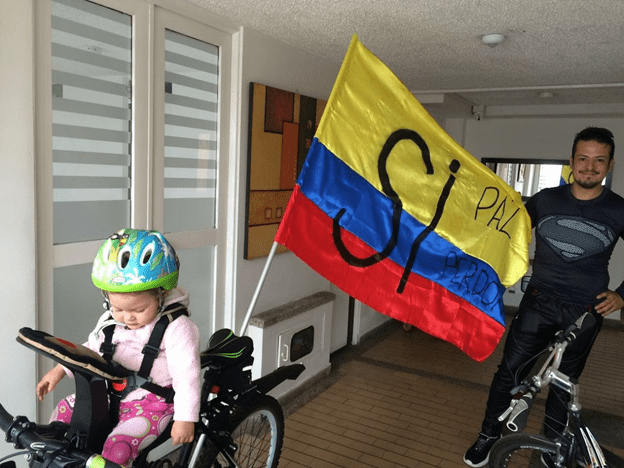
In the face of this carnage and the imbalance between a people armed with placards and sometimes stones or sticks, and agents armed to the teeth and even with air support ready to shoot at protesters, I think the principle of preservation of life that I have learned on my path must prevail. “Live today to fight another day,” said Demosthenes when he was censured for desertion for having fled the battlefield in which more than 3,000 Athenians died during a confrontation with the Macedonians.
Not only will you have the opportunity to fight another day if you save your life today, but you will surely be able to do so from a position of advantage. The famous book The Art of War by Sun Tzu teaches that when the warrior faces an enemy that surpasses him in number and power, he should never attack him head-on, but rather let him pursue him, lead him into his own territory, and attack him strategically when he finds himself in a vulnerable position, to then keep fleeing and repeat the strategy as much as possible.
The Art of War, by the way, is a book that speaks not only about military combat but about all kinds of confrontation, and that is why it has been used as a guide for business strategy and also for the inner work of the spiritual seeker. What the passage I just referred to means is that if you face any kind of adversary more powerful than you, you must bring him to fight one on one, there where you are strongest.
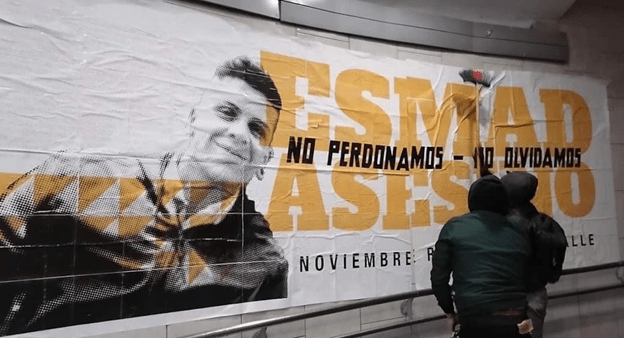
If Dilan had not died that November afternoon, perhaps he could have become a great political leader who, from the City Council, would have promoted ordinances to improve the quality of public university education in Bogotá. We all have some strength, and it is on that field that we must fight. Mine is this podcast, and if I can inspire one or two people to fight the battle on the ground where they are strongest, then my effort sitting in front of a computer at 1:00 in the morning in Toronto is more useful than walking alone through the streets of the city with the Colombian flag on my back.
Even so, I have marched for my country and I hope to do it again, but I also hope to always come back home to hug my loved ones, and I hope you can do it too, so that together we can keep fighting where we are strong, where we can win. Touching minds and hearts so that we use the power of the vote, of science, of education, of technology, of words to defeat the violent and the corrupt.
So it is, so it is fulfilled and so it is realized!

Gandhi's Pacifism and Indian Independence (monthlymagazine.com)
Mahatma Gandhi: A Peaceful Revolution – Exploring your mind
How Did Gandhi Gain Independence for India? (reference.com)
History of India's Independence – Timeline of Freedom Struggle's Important Movements (culturalindia.net)
A timeline of 1,944 Black Americans killed by police – Vox
Muerte de Dilan Cruz, en medio de protestas en Colombia, fue «violenta» y un «homicidio», dice Medicina Legal | CNN
The Art of War by Sun Tzu – Chapter 11: The Nine Situations (suntzusaid.com)