In a previous episode, we explored the fascinating (and sometimes worrying) world of post-truth, that environment where emotions and personal beliefs seem to carry more weight than verifiable facts. We saw that it has deep roots in propaganda and dogma. But also, and perhaps more important for us at the individual level, we discovered that it comes from a very particular way our brain works: the use of heuristics.
Heuristics are mental shortcuts, quick approximations that our mind uses to process the avalanche of information it receives and to make timely decisions. Think about it: if we had to exhaustively analyze all the pros and cons before each small daily decision, we would be unable to function! These shortcuts are essential for quick survival.
But here comes the challenge: while heuristics allow us to act quickly, they also make us susceptible to errors of judgment. They are like small «flaws» or «vulnerabilities» in the design of our mind, known as mental biases or cognitive biases.
Our brain is an incredible machine, yes. But to manage the immense amount of data and to make quick decisions, it relies on those shortcuts. For animals that live in natural environments, where immediate survival is key, heuristics are more than enough. They do not need to plan long-term, build complex societies, or develop medicines.
However, we human beings took (or rather, our development led us to take) the path of knowledge. We did not settle for living tribally under hierarchies, but we seek answers, explanations, and try to understand the laws that govern reality to use them to our advantage. In this complex world that we have built, blindly trusting mental shortcuts can lead us to dead ends or to harmful decisions.
Being aware of these biases does not mean that we are «stupid» or that our mind is «broken». It simply means understanding their inherent functioning so that we can identify them and, if necessary, counter their effects.
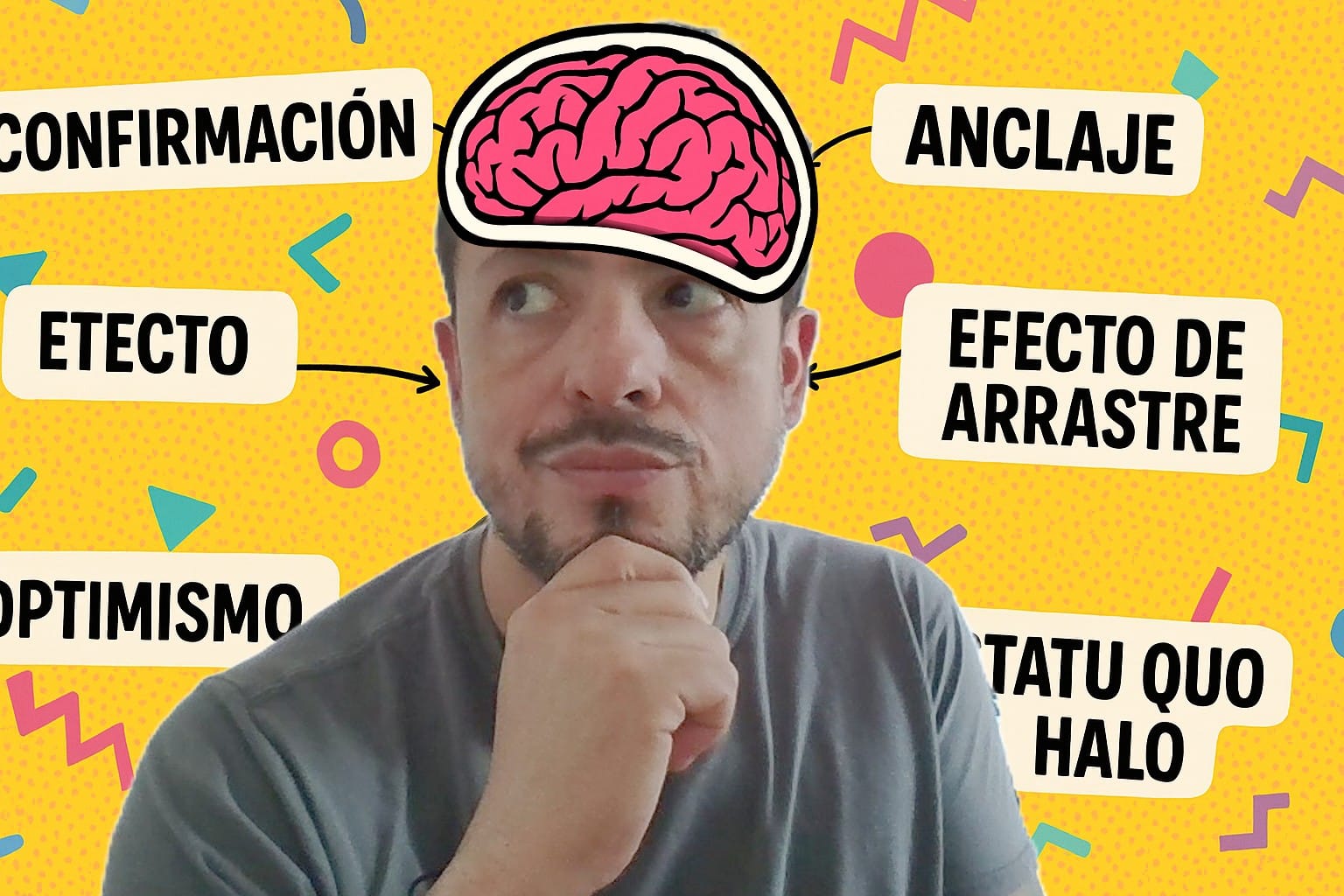
We are going to explore some of the most common biases so that you can begin to recognize them in your own thinking and in that of others.
1. Confirmation Bias: This is perhaps the most well-known. It is our powerful tendency to seek, interpret, and favor information that confirms our pre-existing beliefs or the hypotheses we already had. And, of course, to ignore or downplay everything that contradicts them. We assume in advance that we are right, and our brain devotes itself to giving us the right.
2. Anchoring Bias (or Focalism): We cling to the first information we receive about something, using it as an «anchor» or reference point for subsequent judgments.
3. Availability Heuristic: We overestimate the probability of something happening if we can recall or imagine it easily. Recent or very vivid events (especially if they were impactful or emotional) seem more likely to us than what real statistics indicate.
4. The Dunning-Kruger Effect: This one is fascinating and ironic. People with very little skill or knowledge in an area tend to greatly overestimate their own ability. At the beginning, when they start investigating a topic, they do not have enough information to realize how vast the field is and how little they really know. They underestimate the complexity. On the contrary, experts who have studied a topic for years are increasingly aware of its complexity and of everything they do not know, so they tend to underestimate their relative competence.
5. Hindsight Bias («I Knew It All Along»): Once we know the outcome of an event (a natural disaster, a financial crisis, a pandemic), we tend to believe that it was much more predictable than it really was. «Sure, everything seemed to indicate that it was going to happen…», we say. But why was it not predicted with that same certainty beforehand?
6. Bandwagon Effect: It is the tendency to believe or do things simply because many other people do them or believe them. We jump on the «bandwagon» of the majority.
7. Self-Serving Bias: We tend to attribute our successes to our own qualities (intelligence, effort, skill) and our failures to external factors (bad luck, others' fault, the situation was impossible). It is a mechanism to protect our self-esteem and avoid taking responsibility.
8. Attribution Bias (Fundamental Attribution Error): This is the complement of the previous one, applied to others. We judge the acts of others based on their character or personality («he is stupid», «he is bad», «he wants to mess with me»), while if we commit the same mistake, we attribute it to external or circumstantial factors («I was in a hurry», «I had a bad day»).
9. Halo Effect (and Horn Effect): If we have a positive impression of someone or something (Halo Effect), we tend to attribute other positive qualities to them without evidence («he is charismatic, so he must be honest»). The opposite also occurs (Horn Effect): if the first impression is negative, we tend to see everything negatively.
10. Optimism/Negativity Bias (and Hot-Hand Effect): We can believe that we have less probability of suffering something bad and more probability of having luck (optimism), or the opposite (negativity), without basing it on objective data. The hot-hand bias is a variant: if good things (or bad things) have happened to us recently, we believe we are on a «streak» and that the probability of it continuing increases, which goes against the laws of probability for independent events.
11. Survivorship Bias: We focus only on the people or things that «survived» a process successfully, ignoring all those that did not. This distorts our perception of the probabilities or of the causes of success/failure.
12. Sunk Cost Fallacy: Although it is sometimes seen more as a trap in decision-making than a pure fallacy, it is linked to our biases. It is the tendency to keep investing time, money, or effort in something simply because we have already invested a lot, even when the evidence shows that it is not the best option for the future. It is related to loss aversion: the pain of losing what has already been invested is greater than the possible benefit of abandoning or changing course.
We have seen how our mind, by design, tends to take shortcuts that can distort our perception of reality. In our daily life, the first and most important step to counter these biases is simply to know them and learn to observe ourselves. Let us doubt our immediate judgments, especially the fastest and most emotionally charged ones. It is a constant exercise of self-awareness and critical thinking.
But what do we do when it comes to facing reality on a large scale, to building objective knowledge, to developing technology or medicine that works for everyone? This is where the Scientific Method enters.
The scientific method is not just a set of rules for experiments; it is a system developed precisely to counter our inherent biases. After centuries of living under dogma and authority (which are very influenced by biases such as authority bias, confirmation bias, etc.), humanity found in science a tool to seek a more objective representation of reality.
The scientific method is a series of tactics to get over our biases and approach a useful truth, a knowledge that allows us to build things that work in the real world. You cannot build an engine or develop an effective medicine based only on beliefs or anecdotes; you need to apply precise and tested knowledge.
This is where spirituality and science meet in a crucial question: If we fully trust science and its method (designed to minimize biases) to build our vehicles, our computers, our bridges… why do we sometimes doubt it when it comes to creating our medicines or understanding the workings of the universe?
Think about it: Would you feel safe driving a car manufactured based only on the interpretation of an ancient religious text, and whose safety was verified by a spiritual leader instead of a test engineer with objective data? Probably not.
The question is: Where do we draw the line? How far are we willing to accept hierarchical authority, dogma, or personal belief (strongly influenced by our biases), and from where do we decide to trust evidence, critical thinking, and the scientific method to guide us?
This is a personal and fundamental decision on the path toward a clearer and less distorted understanding of reality.
That is all for today. I hope this exploration of cognitive biases is useful to you for observing yourself and the world with a new perspective. In a next episode, we will address argumentative fallacies, which are errors of reasoning in the way we build our arguments, also very linked to how our biases influence what we accept as valid.
In the meantime, I invite you to reflect: Which of these biases do you most recognize in yourself or in your environment? How do you think they affect your daily decisions? Leave your comment below.