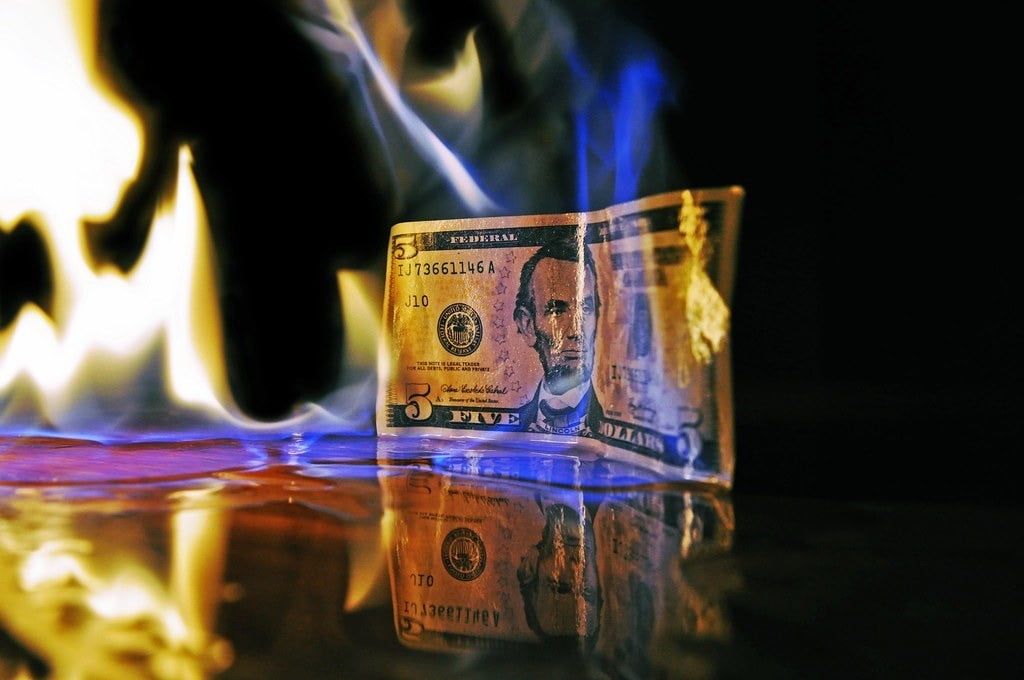
The world economy is in a coma. Despite what the media want us to believe, and ironically, despite the undeniable progress in reducing absolute poverty, hunger, and illiteracy. We have been living for more than 10 years with an economy in a vegetative state. An economy that never recovered from the 2008 crisis but has kept worsening to the point where only a small jolt was needed to deliver the final blow.
Well, the jolt came and it was not small, but the worst economic crisis in history, hand in hand with the Coronavirus, and our capitalist system is sentenced but refuses to die. What we see in the news today are the last spasms of a future corpse clinging to life.
I know this sounds bleak, but it is important that we prepare ourselves, because in the coming years we are going to live through a fundamental transformation of the economy all over the world. Perhaps a change of the predominant currency and certainly several versions of a new capitalism.
But let's start by discovering how we got to this point. This episode is for the most part an adaptation of the excellent work of the YouTuber Dagogo Aldrige, which I share on my page, who explains very well all the economic concepts we need to understand in order to grasp the irrationality of the situation we are living through.
We are going to look at the three ways in which money is created and some of the consequences that are going to happen. I'm also going to show you the true origins of wealth inequality.
The first form of money is the one created by the government. In practice, it is outsourced to the central bank, but it is the government that controls the issuance of currency. Physical money comes in two forms: bills and coins. But physical money is barely a small fraction of the economy. In most economies, this type of money represents only around 3 to 8 percent. Physical money is created with the main purpose of meeting the obligations of private banks when customers go to an ATM and try to withdraw cash. Banks need to make sure they have enough cash to meet those obligations.
Let's take a $10 bill, for example. It costs approximately 3 cents to print that bill. This means there is approximately nine dollars and 97 cents of profit in the manufacturing of a ten-dollar bill. These $9.97 can be added to the government's income. This income is called seigniorage.
Since the government is the beneficiary of printing and minting currency, we might think: why don't governments simply always print physical money instead of collecting taxes? The main reason governments don't create most of the money is the politicians. If a sitting politician could create money at will, there would be a tremendous conflict of interest. He could be tempted to keep the presses running to fulfill his campaign promises or to finance wars. This would, in theory, cause the destruction of the currency through excessive printing, triggering massive devaluation.
The more money there is in circulation, the less it is worth, and that is a key point. For example, if massive inflation occurs and the average citizen has a million dollars, but that million dollars only serves to buy an apple, how much is a million dollars really worth? The loss in the purchasing power of money over time is called inflation, and when inflation gets out of control, money stops having value. Why does this happen? Well, because money must represent existing wealth or the wealth that will exist in the future. I'm going to explain this in a moment, but for now, the important thing is to know that when a merchant loses faith that money really represents the wealth of the country and it is simply paper created by the politician of the moment, he begins to fear that this money is going to lose value in the future and, to protect himself, he will raise prices. If many merchants do this, it becomes a self-fulfilling prophecy, because indeed buyers' money starts to stretch less, so the next day prices go up again to protect themselves. This vicious circle, when it fires exponentially, is called hyperinflation.

Some recent examples of hyperinflation include Argentina, Zimbabwe, or Venezuela. Inflation can happen in a very short time. And no one sees it coming.
We can think of money as a yardstick for measuring value, a yardstick that is highly elastic and can change depending on how much of it there is. For thousands of years, gold was the standard measure of value, like a kind of physical anchor that kept the money supply in balance and governments accountable. It's not that gold has any intrinsic value. After all, it is stone, just as bills are paper. But it has the advantage that it cannot be created out of nothing, it is difficult to extract, and there are limited supplies of gold in the world. But in 1971, the president of the USA, Richard Nixon, announced that the United States would no longer convert dollars into gold at a fixed value. As we know, most countries followed suit, and from that moment on, money was disconnected from gold and the yardstick for measuring value became elastic.
Furthermore, since the US dollar backs all other currencies as the reserve currency, Nixon's decision changed the world. With this you can notice that, despite politicians supposedly not being able to influence the creation of money, it is happening anyway. This of course is causing problems, as we will see later.
Now let's look at the second way of creating money:
The vast majority of the money created today is created by the private banking sector. In most of the most developed economies in the world, approximately 97 percent of the entire money supply is created digitally by banks, and therefore, most of the money in the world is privatized.
Banks invented digital money when they managed to convince lawmakers, shortly after the first bank runs. A bank run is an event in which most depositors try to withdraw most of their money at the same time and the banks run out of cash. From these events, the banks argued that they should be legally authorized to create more deposits than actually exist, but based on debt, and that is how governments outsourced the creation of digital money.
The idea of using debt as money began much earlier than this. English innovators set the stage for banks to become the creators of money all over the world. In 1704, the English Parliament passed the Promissory Notes Act. A promissory note is a written promise stating that someone will pay the money received as a loan. According to the law, a promissory note for the sum of $20 was fully equivalent to a $20 bill. Today we digitize this agreement and call it debt.
If it helps you as a reference, every time I mention the word debt in this episode, you can think of a promissory note and thus remember that it is as valid as money. Well, so banks were authorized to use these promissory notes as if they were money. From this point on, banks in practice were free to create and destroy debt and, therefore, money.
In the modern world, as we will see, the economy of the entire world is based on these promissory notes. Let's see with an example how this matter works. When you go to a bank and ask for a loan, the banking license gives that bank the capacity to create money every time it issues a loan. They do it through a system called double-entry bookkeeping. For example, if you buy a $500,000 house, the bank creates $500,000 in its account and you receive $500,000 in debt; that is, the promise to return it with interest. This $500,000 debt can enter the country's economy, because when the house was bought, the seller of that house can use that new debt money that was created by the bank, which was given to you and which you gave to the seller, to buy other things in commerce or in the financial market.
This means that in the system we have, if we want to achieve greater economic growth, we need more debt. The key point here is that debt is actually new money, only seen from a different point of view. For the lender, it is a money asset. For the debtor, it is a debt liability, but they are the same thing. It sounds a bit complicated, but all you need to know is that when a bank issues a loan, the money it lends is not another person's savings, as many believe; it is not money the bank had. It is essentially new money that the bank has created. They simply type it into a computer and it appears as a digital representation of money that belongs to the State.
I'm going to repeat this in another way: If you lend money to a friend, you have to work many hours, collect your salary, and save it in order to do so. A bank, on the other hand, simply types in the amount the client needs and automatically the amount appears, on which the client is going to have to pay interest, in some cases for many years.
Now, the beneficiary of this new money is actually the bank, not the State, because they can charge interest on that money and that is how they make profits. Later, when this loan is paid off, the debt disappears and the money disappears too, but the profits the bank earned from the interest remain.
Real estate and financial markets are the most important tools for creating digital money. This is because the banks decided that they are the safest and also most profitable ways to invest the debt money they create. This is because if the client cannot pay the loan, the banks simply take the house away, auction it, and recover all their money, including the interest owed.
In developed nations, the mortgage market backs large amounts of money. In Canada, the United States, and Colombia for example, this has been getting out of control in recent years. For decades, banks have stopped investing in the productive economy and have shifted their focus to investments in housing and stock market shares. This has made housing prices rise vertiginously. People take on more and more debt to buy properties they could not otherwise afford, and at the same time the banks earn more and more money. This cycle over many decades has caused all those housing bubbles we see on the planet. Here in Toronto for example, a 100 m² apartment in a residential area can be worth on average about $500,000 Canadian dollars, that is, almost 1,400 million Colombian pesos.
So those are the loans, but then what happens with deposits? When you deposit money in a bank, you no longer have legal ownership of that money; the banks become the owners. They keep 10% of the deposits they receive as reserve and can lend the remaining 90% of that money to other people, and those other people can deposit that money in another bank, and then that bank can lend 90%, and so on. This is known as fractional reserve lending.
After the chain of fractional loans we just saw, an initial deposit of $100 with a 10% reserve requirement can lead to a total of one thousand dollars in circulation. Well, at least that's how it used to work until March 26, 2020. Now, at least in the United States, there is a zero percent reserve requirement. According to the Federal Reserve website: “This action eliminated reserve requirements for all depository institutions.” That means banks can now create infinite amounts of money without having to hold reserves, but the thing doesn't stop there. When a bank receives your deposit, it can — together with investment funds — gamble with your money through financial instruments such as derivatives and securities. They do this in order to achieve even greater profits. Most of the time, these instruments are ultimately simply bets on whether the price of an asset will rise or fall, but this game taken to the extreme can be truly ridiculous.
Enron, for example, the famous American company that went bankrupt due to corruption in 2001, used financial instruments to bet on the weather.
Weather derivatives, as they are technically called, are financial instruments that can be used by companies that have some operation that can be affected by, or depends on, the weather. They are used as part of a risk management strategy to reduce the risk associated with adverse or unexpected weather conditions.
Weather derivatives are instruments based on indices that generally use data observed at a weather station to create an index on which a payment can be based. This index could be, for example, the total amount of rainfall over a period of time, which can be relevant for a hydroelectric generation business, or whether the minimum temperature drops below zero, which could be relevant for a farmer protecting himself against frost damage. Enron, of course, did not depend on the weather by any means, but any person or entity can buy these instruments as long as they pay for them.
These kinds of eccentric financial instruments are part of what caused the housing market crash and the consequent collapse of the world economy in 2008. But the problem today is that banks are playing with many more derivatives, often stacked multiple times one on top of another, or rather, intertwined in such a way that nobody really knows how much money is invested in this game. Some estimates place the derivatives market at more than one quadrillion dollars, which is more than ten times the size of the world economy.
When times are fat, everyone goes into debt, that is, they take loans from the banks and spend it on things they normally could not afford, but this causes economic growth. Eventually, people cannot afford to take on more debt and cannot pay it back. The banks stop lending, many debtors start defaulting, and the economy suffers a recession. This cycle is natural and has happened many times over the centuries. But in 2008, everything changed. The world did not want to go through the pain of a recession, and some analysts point to that moment as the one in which the real economy died.
In 2008, the banks had become so big, intertwined, and integral to the money supply that when they were about to collapse, governments had to use the central banks to bail them out. Remember that the banks are creating 97% of all circulating money in the form of debt, and if that money cannot be recovered, the economy can suffer a systemic failure, a risk of collapse of the entire global monetary system.
In 2008, the world economy was dead, but it has been kept on life support ever since. A decade of super-low interest rates in developed countries, which basically made the cost of borrowing money almost free, has caused such great market distortions that they have worsened the entire original problem. There were short-term gains, but at the cost of long-term pain.
When private banks make risky bets and incur losses, the central banks can bail them out with their infinite wallet. I'll talk about central banks in the next section, but as you will soon see, in the end it will be us citizens who will have to pay these debts. All that money being created is like that promissory note we talked about at the beginning, except that it is signed by all of us, and we sign that we are going to pay this debt through taxes: us and our future generations.
It is important to keep in mind that governments don't actually sustain citizens; it is the citizens who sustain the government through taxes. Taxes and foreign trade are the two main ways governments can collect money. This collected money is used to pay the central bank loans with their respective interest. So, when governments use central banks to bail out private banks for their irresponsible behavior, the governments are left with the debt that taxpayers will eventually have to pay in the future.
The third way of creating money is called “quantitative easing” or QE. Quantitative easing is a new way of creating money that was invented by the Japanese central bank in 1989. It was later popularized by the Federal Reserve in the United States during the 2008 crisis. QE is when a central bank creates money to issue loans directly to the banking sector, large corporations, and, as has been seen in the United States with the pandemic financial stimulus, to the public as well. It is a way of injecting money into the economy in situations of extreme events, such as the 2008 financial crisis or the COVID crisis in 2020.
As a result of this, central bank balance sheets have gotten completely out of control, trying to keep the economy alive a little longer. In 2008, during the mortgage crisis and the first time it was attempted outside Japan, the $700 billion QE bailout was quite controversial.
The plan that President Bush executed that year allowed the Treasury to buy up to seven hundred billion dollars of those bad loans that the banks had irresponsibly given to people with no income, no job, and no assets, but those bad debts then passed onto the account of American citizens. Congress had to raise, because of that, the legal limit of the national debt from 10.6 trillion to 11.3 trillion dollars. We are talking about trillions — billones in Spanish — that is, millions of millions, not billions.
It was initially thought to be a one-time emergency measure, but in the following decade, the Federal Reserve was unable to reverse it. To give you an idea of the magnitude of all this, it took from the founding of the United States in 1776 until 2008 for the nation to reach one trillion dollars in debt. By 2014, that number had expanded to 4.4 trillion, and since the start of the COVID pandemic, another three trillion were added in the span of three months. Now, the central bank of the United States is creating hundreds of billions in a matter of hours. Just today I saw the news that the Central Bank of Canada is also in the process of injecting 250 billion dollars into the economy using quantitative easing. The problem is that this measure seems to have less and less effect the more it keeps being applied.
So, how do central banks use their magical money? What they do is buy the equivalent amount of government bonds through the bond market, which is a kind of exchange that exists to lend money to corporations or governments. Although the stock market, that is, of shares, gets more press, the bond market is actually bigger. But what is a bond? For the purposes of this episode, it is basically the same as a promissory note, except that it is issued by a government or a corporation. Central banks, which have no savings, can create money to buy these bonds. In this way, the money central banks create becomes a debt that the government will have to pay later by collecting taxes or tariffs.
So here an important question arises: can a central bank go bankrupt? Well, according to the European Central Bank, according to a document it published in 2016, central banks are protected against insolvency due to their capacity to create more money. That is, they cannot go bankrupt because when they need to, they can print more money and that's it. If this sounds a bit unfair to you, wait until you hear the following.
Governments in this very complicated current situation are caught between a rock and a hard place: they cannot collect money except by raising taxes, but they owe billions to the central banks. The hope is that the money they have borrowed can get the economy going to revive it, but there is a small problem: central banks go shopping
When central banks buy bonds (that is, debt securities) issued by the government or corporations, they can end up owning many of the world's assets. For example, the balance sheet of the Japanese central bank is bigger than the entire GDP of Japan: they own 80 percent of its entire stock market. That's right, the Bank of Japan is the largest shareholder in that country's stock market. The Swiss central bank owns 90 billion dollars in American stocks, including shares of Apple, Microsoft, Google, and Amazon. Dagogo, the author of the original video, said that when he found out about this, he had to do research because he couldn't believe it was legal. This means that central banks are creating money out of nothing, they cannot go bankrupt, so they can take any risk they want, but instead they are indeed buying and taking ownership of real assets.
But this business of creating money out of nothing and buying things has some consequences: these kinds of central bank interventions disconnect the stock markets from reality. Throughout the 20th century, the stock market was used to reflect the real state of the economy, but in recent years that is completely out of control. So much so that the US stock market has come to be almost twice as big as the GDP of the entire nation, which, literally, makes no sense.
That is why we see the fact that today, in the middle of the worst economic crisis since the Great Depression, with many industries completely stopped and more than 30 million people unemployed in the United States alone, the stock market keeps growing as if nothing had happened.
The central bank printed millions of millions, gave them to banks and investment funds at almost zero percent interest, supposedly to revive the economy, but this money went directly to the stock market and, to a lesser extent, the real estate market, while the real economy barely got the crumbs. We are seeing exactly this in Colombia, where the government is bailing out large corporations and banks and little or no help is reaching the small businesses that are the ones that move the real economy.
Earlier we discussed that printing money leads to inflation, as happened in Venezuela when the Chavista government dedicated itself to printing money to compensate for the lack of income from taxes and tariffs. So why haven't we seen inflation in the US yet? Well, the reality is that we have seen it. That exaggerated increase we have seen in housing prices and in stock markets is the inflation that this printing frenzy has caused. The created money ends up in all these assets, which pushes up the prices of stocks and properties, making the few people who own large amounts of stocks and real estate ridiculously rich while there is no growth in the real economy. The rich get richer and the poor get poorer.
Many people can feel and see wealth inequality, but very few have any idea where that phenomenon comes from.
Since the 1980s, the wealth of the top of society has been tied to the stock market. Since 2008, when the economy went into a coma on life support, the stock market became a Siamese twin of the Federal Reserve. The more money is printed, the more the value of the stock market rises and the richer the rich become. Since 1980, the wealth of that elite has grown 420%. When the central bank prints money, the first recipients of that newly printed money enjoy increasingly higher standards of living at the expense of the secondary recipients of that money, once inflation has already taken hold.
This phenomenon is known as the Cantillon effect. Experts believe that when the rich finally begin to sell their stocks and real estate to buy other assets in times of distress, the velocity of money, that is, the rate at which money changes hands in the economy, will begin to recover, and it will be then that we will start to see real inflation in the general economy. Therefore, money is going to be worth less and less than it was when the richest held it.
It is clear that people who have lost their jobs need help. Printing money is only a drop in the bucket. Decades ago, societies and nations should have focused on the creation of wealth instead of exclusively financing real estate, the stock market, and those speculative instruments such as derivatives, futures, and options. That is, banks should have made loans to productive areas of society: small and medium-sized enterprises, entrepreneurs, education, manufacturing, innovation, research and development. Imagine what our world would be like today if banks invested hundreds of billions of dollars in this kind of thing, instead of in properties and in betting on whether the price of something goes up or down.
Of course this is riskier for the banks, but the benefits lead to more jobs, innovation, better competition, and better standards of living in the long term. Also, governments could collect more taxes through those new incomes without needing to increase existing taxes. You can print money, but you cannot print wealth.
The problem is that focusing on the creation of wealth and productivity requires time, effort, and hard work, and apparently, people these days don't have the patience for that, and the truth is that it is already too late for this option. As I stated at the beginning, the economy is moribund and all that is left for us is to deal with the consequences of a fragile system.
What is going to happen next? I share the point of view of the author of the video, that all this will lead to something very big and unpleasant in the next decade. It is not known what it will look like, but it may involve runaway inflation in many of the world's economies and much slower economic growth. This situation is known as stagflation. This happened in the 1970s in the US, but this time it could be much worse, due to the excessive amounts of debt held by both governments and individuals, aggravated by the additional effect of social instability and the pandemic.
The widespread opinion seems to be that over time, the world will lose faith in the US dollar, although some macroeconomists believe that the American dollar may even increase in value as other nations try to sell their products or exchange falling currencies for the US dollar, because for better or worse, it is the strongest economy in a world of collapsing economies. This theory is called the Dollar Milkshake Theory. What happens will also depend on the monetary management of China and the European Union and, perhaps, on how many people start to trust cryptocurrencies as a store of value.
There are other economists who argue that nations can simply print infinite amounts of money, as long as enough production of goods is maintained to pay the interest on the debt that the government owes to the central banks. The argument here is that the debt actually never has to be repaid, only the interest. This is called modern monetary theory.
This is something that has never been tried before, but it seems like another easy-way-out solution. Instead, small communities in Venezuela and a small town in Italy have taken the initiative to regain control and have just issued their own currencies. We are starting to see many solutions appear, of which most will fail and perhaps a few will succeed.
On the positive side, all the events to come could generate a massive reform. They say that from the worst circumstances, the best innovations arise. So, what can you do on a personal level? This is already my personal opinion, but I believe that most everyday people have more debt than savings. If you are fortunate enough to be a happy exception and have some good savings, maybe it is time to diversify, perhaps by buying gold, cryptocurrencies if it is something you understand well, or if not, perhaps part in national currency, another part in dollars, and another in euros.
Personally, if I had significant savings, I think I would invest in real estate, but in areas with prospects for future growth, not in overvalued places.
But if you belong to the majority that lives more or less day to day, I believe the best investment is education: a postgraduate degree, a master's, a certification, or job training in arts and trades that you like and that have good prospects will without a doubt be the best way to be prepared for what is coming, which will not be pretty, but I think it is going to be necessary.