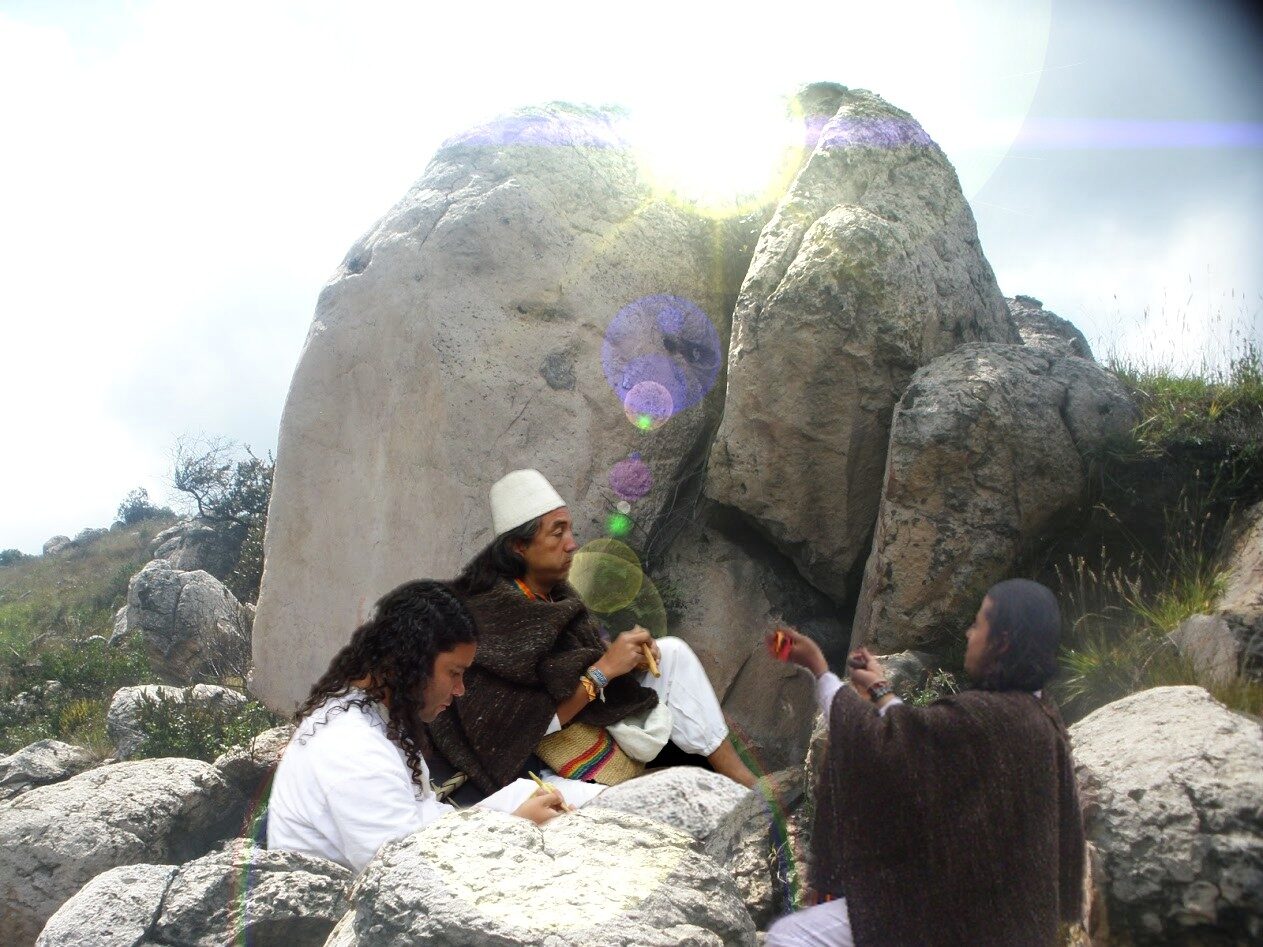
The big day arrived one week after my difficult tobacco limpia. The meeting point was the family home of the abuelos Suagagua and Xieguazinsa, next to the Fúquene lagoon, near the town of the same name. That heart-shaped lagoon was the sacred sanctuary for the Muiscas, where tradition held that the tchyquys, or priests, submerged themselves in order to travel through it to other places on Earth and in the cosmos.
I arrived shortly after noon together with Leonardo Prieto, a pleasant member of the community who had done his rite of passage a year earlier and was about to become governor of the indigenous cabildo that was being formed. We arrived a little late, so the abuelos' sister, who was at the house, told us the group was at the lagoon performing a ritual.
Leonardo knew where the others should be, since that was where his rite of passage had begun when he had applied. This time, he would take part as an assistant to the abuelos. We reached a small hill next to the lagoon, climbed for about five minutes, and found abuelo Suaga Gua, his assistants, and the other candidates for the rite of passage. There, the abuelo was about to begin the mortuoria ritual, which, as he told us, consisted of making an offering, or pagamento, to the lagoon so that through it we would connect with the three mothers that the Muiscas revere in the dual process of life and death. We are born from the physical mother through her inner waters at the moment of childbirth. Mother death receives grandmother placenta, who sustained us during our gestation, and delivers us to mother Hycha Guaia, or mother earth, who with her waters sustains us until mother death receives us again and delivers us to a new birth in the higher worlds. Death and birth as two sides of the same coin that transforms everything that is into what it can become in the infinite dance of the cosmos. The Muiscas say that what master Jesus Christ did in the Garden of Gethsemane shortly before being handed over to his passion was a mortuoria ritual.
Those words, the offering of quartz crystals, shells, cotton, and other elements to the lagoon, put all of us attendees in a reflective and circumspect state, but highly reverential. The abuelo answered the many questions of the attendees with wisdom, and I could notice that beyond any personal interest in his political and organizational work, abuelo Suagagua had a genuine altruistic motivation and wished to share valuable knowledge with those of us fortunate enough to belong to his community.
After finishing the mortuoria work, we came down from the hill and returned to the house, where the abuelos' sister welcomed us with a tasty chicken sancocho. We couldn't eat red meat because of the work we would do later. The time passed pleasantly, and the camaraderie relaxed the nervousness that expectation caused me. Then we all helped with the household chores and sat down to chat with abuelo Suagagua and his wife Yanguma. Shortly before nightfall, abuelo Nemequene arrived, who as always displayed his tenderness and appreciation toward his community.
The conversation, which initially had been about general topics, gradually focused on the ritual we were about to begin, but we still didn't quite understand what it involved. The abuelo told us that difficult trials were coming, that not everyone would manage to pass them, but that there would always be an opportunity for a new attempt. The abuelos dodged every question about the particulars of the ceremony and simply kept building up the expectation.
The tobacco medicine began to circulate among the attendees, and little by little the tobacco cigars were lit and the cloud of smoke that usually accompanied our gatherings began to form. There was no dinner, and as they let us know, there wouldn't be breakfast either, since we had formally begun our ascent to the rite of ATA, the first Muisca initiation.
Around nine at night, abuelo Xieguazinsa arrived, having had setbacks that kept him from showing up earlier. We all greeted him enthusiastically, but I could notice the abuelo was out of harmony. He listened to our conversation impatiently for a few minutes and then took the floor, which he then monopolized for a couple of hours.
His intervention, which I personally longed for because I imagined it would be one of his inspired spiritual dissertations, turned out to be a string of legal terms, political jargon, and administrative minutiae. The general idea of his intervention was that what we were about to do was not only spiritual but eminently political. Upon receiving the rite of passage, we would acquire a commitment to our Muisca ancestors, to the abuelos, and to the sociopolitical process of the Pueblo Nación Muisca-Chibcha.
The unexpected immersion in constitutional law and indigenous law, indigenous legislation, and the cabildo's statutes caused discomfort among some of the ceremony attendees, particularly Santiago Salazar and his closest friends, who had already expressed their disinterest in the sociopolitical component of the Muisca process. Santiago took the floor to complain about what he considered a deviation from what was fundamental for us on that occasion, and took the opportunity to denounce a visit the community had received from a candidate for the city council, which he called opportunistic and ill-advised.
That intervention frayed abuelo Xieguazinsa's nerves a little, while Suagagua limited himself to listening as he worked concentratedly on his poporo, and both Yanguma and Nemequene seemed to nod in agreement with Santiago's complaints.
Even so, abuelo Xieguazinsa's agenda continued its course, and he proceeded with the reading of the long statutes of the Pueblo Nación Muisca-Chibcha. I was even invited to read part of them. Meanwhile, abuela Yanguma moved among the attendees administering her proverbial insufflations of hoska and then giving each of us candidates a portion of sweet tobacco, the kind that cowboys in the southern United States often chew.
After finishing the reading of the statutes, the abuelos passed around some printed forms that we ceremony participants had to fill out and sign. In the document, we basically committed ourselves to practicing obedience to the statutes we had just read, which by the way I had already almost completely forgotten, to respecting and obeying the authority of the community's council of elders, to keeping the internal affairs of Pueblo Nación confidential, and to contributing something to the cause. The last one was open to interpretation, so I committed to taking charge of information technology matters for both the community and the abuelos. Promises I honored while I belonged to the community.
Once we signed the documents, the torturous contractual paperwork session came to a close and we resumed our longed-for spiritual mambia. The first to speak was abuelo Suagagua, who said:
“Do you remember I told you that the rite of passage is a serious matter and that you need commitment? Well then, the first trial to access the rite of passage begins now, and it consists of each candidate handing over their hair.”
The questions were not long in coming: “All of us? Even the women?” “All the hair or just part of it?” “Can it be exchanged for something else???”
Bewildered looks crossed the room, and I, who had already shaved my head about seven years earlier, had already decided the trial wouldn't stop me, but I felt sorry for the four women who were candidates to receive their initiation, all of them with lush, well-cared-for manes of hair. Some of them couldn't hold back their tears, but while the abuelos insisted on the importance of the trial, I thought it was curious that several of the brothers and sisters who had done their rite of passage a year earlier sported manes that had clearly taken much more than a year to grow. It was also possible that the trial was different for each cohort, but even so, it seemed unlikely to me that abuela Yanguma would allow such an outrage against her women, especially when she herself had mentioned more than once the importance of women letting their hair grow long and wearing it loose.
Despite the doubts and fear, all the female candidates accepted going through the trial, and needless to say the male candidates too, even though some of them already had long hair. The three abuelos armed themselves with scissors, approached the candidates, and one by one took them by the hair, gave a couple of snips in the air, and shook their hand, giving us a small tug. The brave women let out a sigh of relief and the men a nervous chuckle.
With that, the first trial we had to overcome to receive our rite of ATA ended, which in the Muisca language means “First.” Abuelo Suagagua took the floor again and began telling us about the next trials. This time, it wouldn't be they who imposed them on us, but we would have to face them in the “inner worlds.” When the abuelo said this, my eyes opened wide and my heart beat strongly. Did this mean we would finally begin doing spiritual work in the subtle worlds, just as I had heard so many times from the abuelos and other more advanced initiates? What would those trials consist of?
The abuelo took out of his bag a couple of printed pages explaining the trials we would have to face. He asked some of those present to help by reading them aloud, and once again I had the honor of being chosen for that task. I read the third of the four trials that the text described, which I now transcribe below:
In the old Egypt of the pharaohs, those four trials had to be faced valiantly in the physical world. Now the candidate must pass the four trials in the suprasensible worlds.
This trial is to test the serenity and sweetness of the candidate. The wrathful and choleric inevitably fail this trial. The candidate finds himself pursued, insulted, slandered, etc. Many are those who react violently and return to the physical body completely failed. The victorious are received in the Hall of the Children and feted with delicious music. The music of the spheres. The flames horrify the weak.
Those who despair over the loss of something or someone; those who fear poverty; those who are not willing to lose what is dearest to them, fail the trial of air. The candidate is hurled to the bottom of the precipice. The weak scream and return to the physical body horrified. The victorious are received in the Hall of the Children with parties and festivities.
The great trial of water is truly terrible. The candidate is cast into the ocean and believes he is drowning. Those who do not know how to adapt to all the varied social conditions of life; those who do not know how to live among the poor; those who, after shipwrecking in the ocean of life, reject the struggle and prefer to die; those, the weak, inevitably fail the trial of water. The victorious are received in the Hall of the Children with cosmic festivities.
We have to learn to make the most of the worst adversities. The worst adversities offer us the best opportunities. We must learn to smile in the face of adversity; that is the Law.
Those who succumb to pain in the face of the adversities of existence cannot pass the trial of earth victoriously.
In the higher worlds, the candidate finds himself between two enormous mountains that close in threateningly. If the candidate screams in horror, he returns to the physical body failed. If he is serene, he emerges victorious and is received in the Hall of the Children with a great celebration and immense joy.
My memory is not prodigious, and therefore it's not that I memorized the two pages. What happened is that shortly after the rite of passage, I began working on the task Santiago Salazar had given me when I went to therapy at his cozy office. I read the book “El Misterio del Áureo Florecer” by Samael Aun Weor, which I found fascinating, and just as Santiago had recommended, I continued afterward with “El Matrimonio Perfecto”, and in it, on page 184, I came across the four trials of the elements, along with three additional trials of guardians of the threshold and the description of the nine initiations of lesser mysteries and five initiations of greater mysteries.
But then, if this knowledge was part of the Gnostic teachings of Samael Aun Weor, why had it been part of an ancestral indigenous ritual? This is something that took me a few more years to unravel and that I will share later in this book.
Back to the rite of passage… We all fell silent at the description of the trials. The truth is that I personally didn't understand what it was all about, and judging by the looks of the other attendees, most of them didn't either. I asked the abuelos whether those trials would be in the astral world and whether I would be conscious of them, and abuelo Nemequene answered me:
“Let your lamps be burning; and be like servants waiting for their master to return from the wedding feast, so that when he comes and knocks, they may open the door for him at once.”
I recognized the biblical quote, and not only did I remain without understanding in what form the trials would come, but now I also had religious references within my ancestral indigenous ritual.
It was already around two in the morning, and I was completely drunk on tobacco, but it was the sweet tobacco the abuela had shared with us that eventually became the hardest for me to bear. I got up from my chair and went out to the backyard, where I vomited intermittently between loud retches. Then I felt an irrepressible and inexplicable urge to cry, and I let it be. Then a friend from the community came out to assist me, accompanied me, and encouraged me with beautiful words of comfort, which unfortunately I no longer remember.
I returned to the gathering, and everyone was already getting up to head to their resting places. In my case, it would be one of the several tents we had set up in the front yard of the house. I considered myself lucky that I would share a tent with Santiago Salazar and abuelo Nemequene. I settled in to try to fall asleep, but my mind was fixed on the four trials. I thought that maybe that night I would have lucid dreams and in them experience what the reading had narrated. The prospect excited me, above all because shortly before I had had a beautiful lucid dreaming experience in which the spirit of tobacco had visited me, wrapped me in tobacco leaves, and told me that from that moment on I was tobacco and tobacco was me.
Suddenly, my musings were interrupted by a more earthly trial. Despite having been lying down for barely ten minutes, abuelo Nemequene had begun snoring quite loudly, and I, who have always been a light sleeper, knew my efforts to fall asleep had reached their end. Shortly after, Santiago left the tent saying:
“Oh no, nobody's sleeping in here anymore. I'm going to go mambear with abuelo Xiegua, who must be poporeando…”
His friend Daniel, who was also in the same tent, followed him, and there I stayed suffering my sleeplessness, since I still believed I had to sleep in order to pass the trials of fire, earth, and water… Perhaps the trial of air was already coming from the lungs of dear abuelo Nemequene.
I expected the reveille at six in the morning, as the abuelos had announced, but if I had learned anything in my time with the community, it's that the Muiscas are good at staying up late but bad at getting up early, so the sound of the conch shell, or tata as it is known in the Muisca language, was barely heard around eight thirty. I found myself alone in the tent, since abuelo Nemequene, who was indeed used to rising early, had surely been up for two hours.
I suppose abuela Yanguma and the sister of the Ingativa Neusa interceded so that they wouldn't send us to the mountain with completely empty stomachs, so they served us a glass of hot panela water and a piece of white wheat bread. With that, we set out on the final journey toward our rite of passage, under a pleasant sun that accompanied us along the march. We began the ascent of a considerable slope that started on the other side of the road. On some stretches we even had to use our hands to make the climb easier. Along the way, of course, we received our doses of hoska and ambira as we sang in muyscubun and chatted animatedly.
An hour later we reached our destination, a ramshackle old house located in a clearing in the mountain, from which we had a good view of part of the lagoon. The abuelos held consulta, which was what they called the process of closing their eyes, invoking their guide spirits, and asking for advice to make a decision. Each one did their own and then shared the results. If the majority agreed, they proceeded accordingly.
On that occasion, the decision to be made was the order in which we should present ourselves to the ritual. I was among the first, right after a boy I had seen only a few times at community gatherings and who had somewhat effeminate mannerisms. This would become relevant later.
Once the decision was made, the abuelos' helpers proceeded to cover our eyes with blindfolds they carried for that purpose. From then on, the abuelos assigned César, one of my closest companions in the community, to be my guide during the process. Abuela Yanguma then announced that, from that moment on, we all had to be in perfect silence and that any noise or conversation could disqualify us from the process.
César guided my right hand to his left shoulder and whispered in my ear to follow him. I began walking behind him and soon noticed he was leading me in circles, surely to disorient me. On a couple of occasions he stopped and set off in the opposite direction, until we reached a point where he told me I should sit down and wait. He also indicated that my instrument would be the tata (conch shell), and that when I heard it I should head toward it without removing my blindfold until I reached the spot where whoever was blowing it stood.
I spent probably half an hour in that place, during which I heard no sounds other than the birds roaming the area and, eventually, the discreet footsteps of someone passing near me. The blindfold was so tight that I was in total darkness. I couldn't even perceive the sun's brightness, and I also noticed the sun began to hide among the clouds, since I stopped feeling its warm caress on my skin.
The truth is that the feeling of being in the dark in the middle of the forest began to cause me a certain level of anxiety. Some of the terrifying yagé images came to my head and mixed with memories of abuelo Xieguazinsa's strange legal talk, the unexpected confidentiality contract, and the expectation of the trials of the elements, which by the way I had no memory of having faced during the brief moments in which I had managed to fall asleep.
Suddenly I heard the sound of a drum beginning to roll. That sound, which I already associated with the start of the heavy work in yagé, only worsened my state of unease, so I had to devote myself to controlling my thoughts, using the conscious breathing I had learned from the Vipassana meditation exercises. After a while I heard shouts of insults and jeers coming from the older members of the community. I assumed it was some kind of ego trial, so I did my best to ignore them and continued my individual task. After a while I heard the sound of a maraca from some distant point in the forest, and shortly after, the insults and jeers again.
In this case, however, the process lasted a bit more than twice as long as the first candidate's, and later I learned it was the boy I mentioned earlier. Apparently, the abuelos confronted him about his supposed homosexuality and nearly denied him the rite of passage. Eventually, they allowed him to complete it, as long as he made some commitment that I don't know about. I only saw him once more at community gatherings and never again.
Finally, when I had already spent more than an hour in darkness, I heard the sound of the tata from somewhere in the forest. I got up like a spring and proceeded to seek out its origin with my hands in front of me and taking slow but long steps. I noticed that whoever was blowing the conch wasn't in a single position but kept moving, which notably complicated the exercise. Of course, I suffered more than one fall and several close encounters with trees and branches. On a couple of occasions, César pulled or pushed me to keep me from hurting myself.
Then I heard the expected shower of insults, but none of them bothered me in the least, because I knew they were part of a performance, because I could hear the acted voices of the helpers, but above all because they were careful not to use things that could truly wound me. I even thought they should have said things to me like “Do you think you're very smart? Well, we all see you as a pretentious, arrogant guy who thinks he's better than everyone else.” Something like that would have hit me inside, but instead they shouted common things at me like “You're nobody!”, “You're weak!”, “What a laugh, the little blind guy!”. In fact, I had to hold back my laughter on a couple of occasions.
Then I heard a new order:
“Find the staff of command!”
I assumed it would be near the place where the conch was sounding, and I noticed I was no longer in the middle of the trees but probably in the clearing I had seen before, so I began to move faster and with an unusual state of consciousness in my other senses: the murmuring of the helpers and the abuelos drew a mental map with which I could orient myself, and the warmth of the sun, which had come out again from between the clouds, allowed me to orient myself so as not to turn in circles indefinitely.
When I felt the tata was about three meters away, I leaped forward and managed to touch the staff of command, which was a stick about two meters long adorned with ribbons and weavings. The tyba, or man, holding it tried to run at my sudden attack, but sensing where his steps were heading, I stretched out my right arm and grabbed the staff firmly. The truth is that leap had probably been unnecessary, but assuming the abuelos were judging my level of decisiveness and daring, I threw myself into my task.
At that moment the abuelos let out an emotional “Ejeeeeeeeeeeee”. Then I heard the voice of abuelo Nemequene, who congratulated me on reaching my destination, expressed his affection and respect, and welcomed me into the circle of the abuelos. He gave a brief description of the merits he saw in my candidacy and told the other abuelos that he recommended my candidacy for the rite of passage.
Then abuela Yanguma spoke to me. She began speaking with her customary affection, but soon hardened her words and changed her tone of voice, probably noticing in my face the certainty of her support. She told me I still had a long way to go and that I had to be more committed to the community's activities. Then she said she wasn't sure about recommending my candidacy, and the truth is I believed her words completely. Then she said she wasn't going to make any recommendation, that she would have to sit down with me to review it later, but that she was going to leave the decision to the elder.
Then abuelo Suagagua spoke. He welcomed me again, picked up on both abuelo Nemequene's and abuela Yanguma's words, and announced that, in his spiritual consulta, I had all the merits to receive my rite of passage. At that moment my tightly closed eyes welled up, and I felt great gratitude toward that wise man. Then he told me that the only thing needed to receive my anointing was to take the oath.
Next, he asked me to place my right knee on the grass and to grasp the staff of command with both hands. I felt the three abuelos do the same, and the abuelo told me:
“Do you swear loyalty to the community of Pueblo Mayor Muisca-Chibcha, its statutes, and its norms?”
“Yes, I swear!” I said with determination.
“Do you swear loyalty to the Law of Origin and the Ordinances of the territory?”
“Yes, I swear!” I said again with total conviction.
“Do you swear loyalty to the abuelos of the council of elders, their word, and their teachings?”
Then I fell silent for a few brief seconds. The truth is I didn't expect that oath. Despite my respect and admiration for them, I still saw the abuelos as human beings, fallible and imperfect. Swearing loyalty to them was not in my plans, but I also knew that a negative answer would disqualify me instantly.
I felt uncomfortable and, in a way, trapped. I knew the power of the word, and I didn't want to make a decision I would later regret. However, time was also working against me, since even my indecision could be grounds for disqualification. I felt a slight emptiness in my stomach and said:
Abuelo Suagagua approached me, placed his hand on my left shoulder, and said:
“If that is so, may the Great Spirit and Hicha Guaia reward you; if not, may He and She demand it of you.”
Then he took me by the arm and helped me to my feet, hugged me with appreciation, helped me turn 180 degrees, and removed the blindfold from my eyes as he said:
“My brother, welcome to your Rite of Passage.”
The sunlight blinded my eyes, just as Plato described in his allegory of the Cave, referring to those who lived in darkness should they ever come to know the light of day. Little by little images populated my sight, and I found myself face to face with a majestic view of the Fúquene lagoon, over which the reflection of the afternoon sun shone brightly.
The image moved me to tears. Truly, I felt I had just been born. The immensity and beauty of Mother Hycha Guaia overwhelmed me to the depths of my soul, and the image of my community brothers dressed in white, smiling and radiant, struck me as indescribably tender.
At that moment abuela Yanguma stood in front of me and hugged me with genuine affection as well, congratulating me on receiving my initiation. Then she asked me to open my mouth and told me:
“From now on you must take care of your word, using it only to speak the truth and not for gossip or idle talk. That is why you must pass one more trial, and it is the trial of the spicy word.”
Then she stuffed into my mouth a heaping spoonful of a dark powder that I immediately recognized as ají chirca, or wild chili, probably ground green. Part of the powder went down my throat and part rose up my pharynx, leaving me in an unexpected sensation of choking mixed with intense burning, which I barely managed to endure after letting out a couple of involuntary coughs.
The abuela told me I had to endure it until she said so, and although the burning was quite intense, somehow I felt strong enough to face the trial. As usual, I focused on stopping my thoughts, centering myself in the present, and controlling my breathing. The burning remained at the same intensity for several minutes, after which it slowly began to subside.
About ten minutes later, one of the abuela's helpers came to me and told me I could now spit out the chili and that I should go up, because the elder was waiting for me.
I returned to where the abuelos were waiting for the next candidate, and abuelo Suagagua told me:
“Go to the cuca behind those trees. The elder is waiting for you there.”
Cuca is the Muisca word for cave. I headed where I had been directed and found abuelo Xieguazinsa perched in a small grotto about six meters up a slope hidden behind the trees. Next to the abuelo, also working on his poporo, was my friend Santiago Salazar. That image of a Nazarene and an abuelo who had the bearing of a legendary long-haired samurai struck me as impressive.
I climbed the steep slope using my hands and knees, and soon found myself kneeling at the feet of the elder. All of it: the ritual, the oath, the vision of the lagoon, and now being in the presence of those two beings who seemed from another world, was something totally surreal and, in fact, intimidating.
There had always been some debate among community members about the hierarchy among the abuelos. Some, close to abuelo Nemequene, considered him the abuelo of the greatest spiritual stature. However, the majority, including me, thought the strength of the movement rested on the shoulders of the Ingativa Neusa brothers. Some leaned toward Suagagua and others toward Xieguazinsa, but at that moment it seemed clear to me that Xieguazinsa was the eldest elder of the Muisca People. Perhaps on the level of the ancient caciques of the region.
Xieguazinsa raised his gaze with a certain disdain and began speaking to me with the same tone and eloquence as that night in my apartment. However, his words felt ominous to me. He reminded me of the gravity of the oath I had taken and asked me to tell him whether I recognized him specifically as my elder and my authority.
Unlike the first time I was asked to swear loyalty that day, when Xieguazinsa asked it of me, I didn't even contemplate the possibility of refusing my submission. As far as I was concerned, Xieguazinsa was the personification of God on earth. I didn't even feel fear. I saw Xieguazinsa as a wise man, and more than at any other moment of my rite of passage, it was there, kneeling before the elder, that I felt I had arrived at the place that corresponded to me, the place I had sought so much ever since I awoke from among demons and suffering, thanks to the sacred Yagé.
What I didn't know was that I had signed my entry into a new purgatory, from which it would take me years to emerge, with much wisdom, to be sure, but not without first paying a good share of suffering and anguish for it. My path was only just beginning.