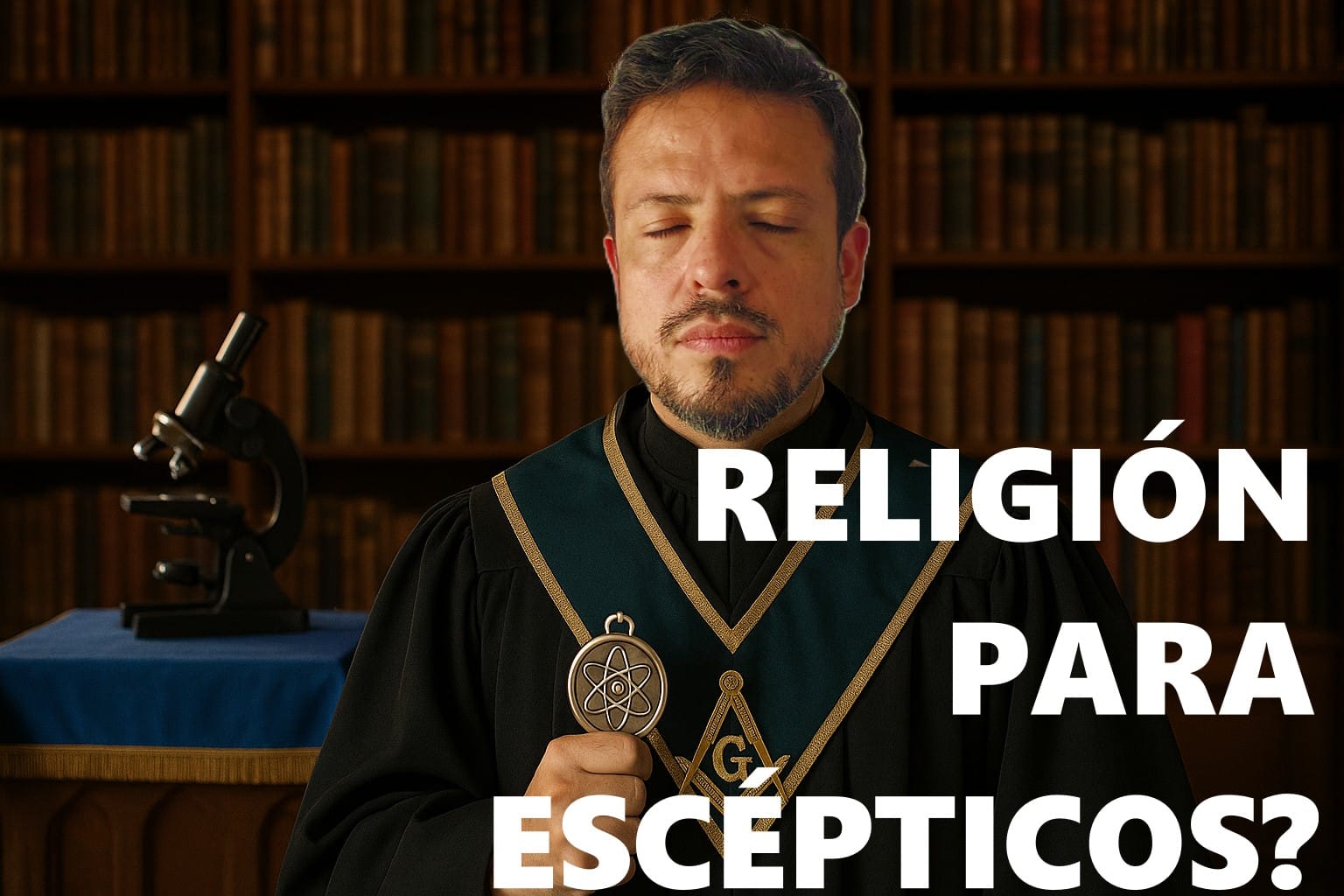
Hello, I am Manuel Avila, and in this «Spirituality & Science» space I want to invite you to a reflection that may seem counterintuitive: could religion, or at least its underlying mechanisms, be useful and even necessary for everyone, including those of us who have embraced skepticism and the scientific method?
Far from the classic critique that brands religion as the «opium of the people», today I want to explore how our own biology and evolution have predisposed us to need narratives, rituals, and community, elements intrinsic to religious structures.
Our Origins: The Hunter-Gatherer Brain and the Need for Stories
To understand this, let us travel back in time. As <i>Homo sapiens</i>, we have spent the vast majority of our 300,000 years of existence as hunter-gatherers on the savanna. Our brain evolved to survive in that environment, developing two crucial skills: communication and large-scale cooperation. These allowed us to overcome our physical limitations against stronger predators and to adapt at an unprecedented speed.
But here comes a fascinating detail: the scientific method, with its rigor of hypothesis and experimentation, is a very recent invention in our history. Long before that, the most effective tool for cohesing groups, for securing that vital cooperation, was the creation of stories, myths, and legends. These shared narratives united us, established common norms, and gave meaning to our existence.
Why Do We Believe? Two Evolutionary Perspectives
Yuval Noah Harari, in his work «Sapiens», suggests that religion emerges as a channeling of these stories, allowing distant tribes to trust one another by sharing a system of beliefs and a superior being that «watched over» the compliance of the norms. Believing in the same god or the same spirits created an artificial familiarity, essential for cooperation between strangers.
On the other hand, the biologist Richard Dawkins proposes that religion could be a byproduct of a childlike mind evolved for obedience. Children who obeyed their elders had greater chances of surviving. This «programming» for obedience could persist into adulthood, no longer toward other adults (whom we see as equals), but toward a figure of superior authority, whether real or imaginary, such as a god, a king, or even a charismatic leader.
Regardless of the exact mechanism, both perspectives point to a truth: our brain is, in some way, «wired» for shared narratives and for the structures that foster cooperation.
The «Beaver Syndrome»: The Persistence of Instincts
Imagine a beaver in captivity. Even though there is no river to dam and no natural materials to do it with, it will often try to build dams with whatever it has on hand, such as Lego pieces on a dark strip on the floor. It has no practical use in that context, but the instinct to build is so strong that it needs to express it.
Similarly, although the modern world offers us social and legal structures (nations, laws, police) that partly replace the cohesive functions of religion, our mind, adapted for millennia to those myths and legends, still «needs» something similar.
The Modern «Religions»: From Patriotism to Sports
If we observe closely, many of these religious patterns have transferred to secular institutions:
The Skeptic's Dilemma: Where Do We Find Our «Sacred Place»?
Those of us who have opted for skepticism and critical thinking tend to question, to not «swallow it whole». This, which is an intellectual strength, can leave us a void as far as that instinctive need for cohesion and shared transcendence is concerned. If the basis of religion is cooperation through common beliefs, are skeptics at a disadvantage for forming strong communities and finding that sense of belonging?
Proposals for a «Skeptic's Spirit»:
A Personal Experience: The Anglican Community
When I arrived in Canada with my family, not knowing anyone, we found an unexpected refuge in a small local Anglican church. They welcomed us with an astonishing warmth and openness. I enjoyed the beauty of the place, the stained glass, the music, and I observed the ritual differences with Catholicism. The most valuable thing was the community: after the service, they shared coffee and cookies, a simple space to chat and connect. There we met our first friends in this country, and our daughter took part in children's groups. It was an example of how a religious institution can offer community and belonging, even to those of us who do not fully share its doctrine. We baptized our son Benjamin there, an act of integration and gratitude.
The Dream of «Temples of Science»
I long for the day when we have «skeptical temples» or «temples of science»: beautiful spaces, perhaps in universities or community centers, open to everyone to discuss ideas, share knowledge, practice philosophy, and simply connect. Spaces that feed the spirit with beauty, wisdom, and community, without the need to adhere to a supernatural creed.
Currently, as this post is published, I am in my first 10-day Vipassana meditation experience. A personal search for connection and understanding that I will undoubtedly share with you.
The need for connection, meaning, and ritual seems to be profoundly human. Perhaps the challenge for skeptics is not to eradicate this need, but to find or create the forms and the places to satisfy it in an authentic and enriching way, in keeping with our values of reason and evidence.
What do you think? How do you satisfy this need in your life? I would love to read your reflections in the comments.
A hug, good path and good breeze.