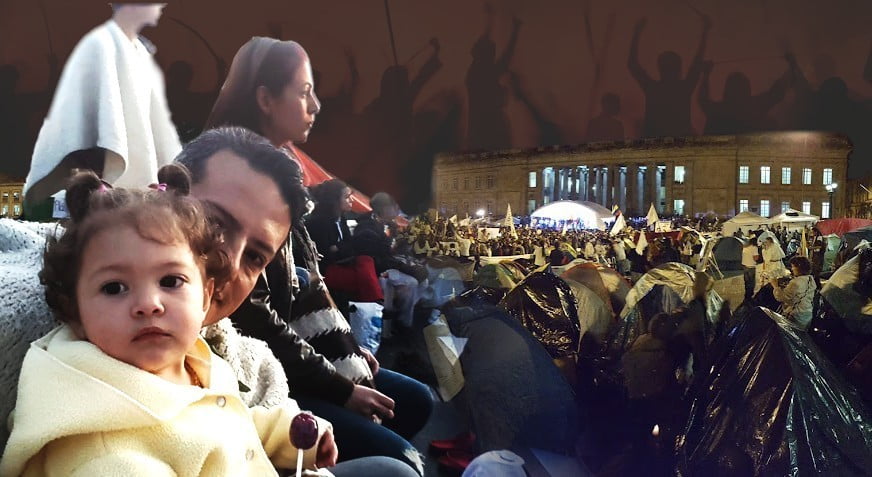
My father was one of the millions of Colombians who had to flee his hometown because of the war. Back then, peasants were killed for being, seeming to be, or befriending members of the political party opposed to the one holding power in the region, and my grandmother preferred exile over the possibility of one of her children ending up on the list of dead of the absurd war between liberals and conservatives.
Thanks to that sacrifice of my grandmother and my father, I was born and raised in the city, far from the horror of the war that, even as the third decade of the twenty-first century begins, continues to stain the beautiful Colombian geography with blood. My father prospered in the city, but the damage caused by the bloody environment in which he lived during his childhood left marks on him that were never completely erased.
Inevitably, part of that trauma was inherited by me and my sisters, through the same mechanisms by which millions of Colombians have learned to fear, hate and harm, without having any idea of the causes that sowed the seed of violence throughout our long-suffering country.
Since I was a child I learned to fear the street and strangers, but also God and my father. When I began to understand politics, I learned to distrust conservatives and the rich, but I had to try to reconcile that distrust with the obligation to trust the conservative Catholic Church and the aspiration of becoming rich myself someday.
And upon becoming a father, I learned to hit my children the same way my parents hit me when I disobeyed or disrespected them.
But perhaps the most damaging effect that Colombia's long war caused in my life was that I learned from my father that I am a monster I must fear. For my father, surviving amid the poverty and violence of the countryside meant having to turn fear into rage, hide the soul of a scared child behind the complexion of a reckless bully, and, when necessary, let his own violence show through to avoid ending up as prey.
Well, that tactic, which surely he had to practice from a young age until it became second nature, surfaced several times during my childhood when, without meaning to, I pulled the triggers of his anger. Some act of rebellion, the deliberate disobedience of some order or even a bad-taste joke earned me slaps, knocks on the head, lashings with a belt or pinches; which without a doubt hurt less than the terror of seeing my father transformed into a monster and the sadness of having to hate him with all my soul for a few minutes after he left me hurt, insulted and disappointed at having been violated by the man I most admired.
While I cried, flooded with rage, I fantasized about seeing my dad suffer or learning of his death, feeling the foul pleasure that revenge promises. When the anger faded, I looked for my father to ask his forgiveness for the offense, although secretly, my act of contrition obeyed not repentance for having violated one of his dull norms, but for having hated him and wished his death in the midst of my rage.
I know these lines sound terrible; especially coming from someone who has narrated these events laughing while sharing beers with family and friends. In Colombia, being a victim of domestic violence has for a long time been a subject of jokes and anecdotes; but the thing is, I am not making this account as the adult who understands the sociocultural context and the traumas of his father, due to the harshness of his upbringing. I describe the events from the perspective of the child who still dwells in me, who could not understand why someone who loved him could also look at him and attack him with so much hatred.
The domestic violence that my sisters and I received from our parents, especially from our father, is far from having been exceptional. On the contrary, it was at that time the most widespread way of applying corrections at home. My father has told me how in his time, it was not only the dads, but also school teachers, priests and other authority figures who beat and mistreated the children who in their judgment “behaved badly”.
And it was not just about the knocks on the head and occasional beatings that our parents gave us. My father received blows with a whip or ferule on his back, and on one occasion, a teacher forced him to kneel on corn kernels while holding a brick in each hand. The old animated television series “Tom Sawyer” showed that daily life of American children at the beginning of the twentieth century, which in Colombia those of us who grew up before the year 2000 also had to endure.
This environment of domestic mistreatment is perhaps the inheritance of centuries of normalization of violence in many other aspects of daily life in my country: forced displacement, genocides for ideological reasons, armed struggle for power, spirals of vengeance between families, supposedly to defend honor, “social cleansings”, gang activity, police repression and brutality toward animals. Each and every one of these, justified — even today — by an unacceptably large number of Colombians of all social classes.
Perhaps because of the extreme fear I developed during my childhood toward armed violence, I always felt committed to pacifism and instinctively understood that it made no sense to resort to violence to achieve altruistic ends. However, I justified my dad's mistreatment as acceptable, in his determination to raise us as good people and keep us away from vices or harmful behaviors.
I felt that, despite his occasional propensity to let himself be carried away by anger, my dad loved us and showed us so with his dedication, games, teachings and hard work to get us ahead. Furthermore, I knew firsthand the experience of other children — some of them close relatives — who had it much worse than me for contravening paternal rules. Sexual abuse, lacerations with cables and sticks, heavy-duty insults or beatings for no reason every time the dad got drunk, were some of the stories I heard and that led me to conclude — well into my adulthood — that my parents were rather measured with punishments and that they never got to mistreat us.
This conviction, without a doubt, was the wedge I clung to to eventually become a mistreater myself. My standard of conduct regarding physical corrections during the upbringing of my daughter Ana María consisted simply of not going as far as executing the most severe punishments my dad inflicted on us, but above all of not allowing myself to transfigure the way he did when anger dominated him.
With that, I gave myself permission and justification to hit Ana María on multiple occasions, give her a few lashings with a belt and a slap a couple of times. I also hit my first wife on two occasions, when I judged that she was hysterical and that the best thing I could do for her was to give her a slap that would “snap her out of the trance”.
Those were dire moments in which my childhood traumas and the fear of becoming the dark side of my father surfaced and tortured me for a few hours after carrying out my role as punisher, while my exegete self bent the guilt with flimsy justifications.
For many years, this perceived capacity for self-control allowed me to forge the myth that I was an even-tempered and prudent person, worthy of admiration and respect by virtue of my values. I knew myself to be persuasive and believed that faculty came from my intelligence and analytical ability, but the years and spiritual work showed me a painful and far less decorous truth.
The Muisca elders used to say that there is no better gym for the spirit than the couple. It was their way of saying that, in the sentimental relationship of two beings, where passions, pleasures and some of the best expressions of human emotion arise, the storms of the ego also lurk and with them, some of the darkest abysses of the soul. But in that dance of two hearts, however, the true liberation from the bonds of the past can be forged, and one can transcend toward a life of purpose and peace.
Paula was the teacher who, from her candor, helped me discover this teaching and make it flesh and blood, as the elders said. She — how could it be otherwise — was also a victim of mistreatment during her childhood, but not like my sisters and me, who suffered physical mistreatment, but not emotional. Paula, on the other hand, had to endure for years, beyond the separation of her parents and paternal absence, emotional mistreatment, at home and at school, which ultimately led her to leave her house at barely 18 years old and venture into a distant and different city.
Shortly after meeting Paula, her sweet and gentle appearance gave way to an unexpected facet, to which I soon had to get used: the beautiful blonde was also a temperamental woman who did not even try to contain her angry impulses when she felt violated. Having grown up in a working-class neighborhood of Medellín, Paula also made use, during those fits of rage, of a rich profane vocabulary that was totally foreign and inappropriate to me.
However, what would eventually become a breaking point for our relationship was that, if the situation escalated, Paula could resort to physical aggression against me. The first time it happened, she pulled my hair back hard before the impassive gaze of my sister Laura. The second time, during an argument in our bedroom, she began to hit me in the chest with her fists and I, as a reaction, grabbed her firmly by the wrists and threw her onto the bed.
In the face of that situation, of course, I assumed the position of moral superiority and as such gave her the ultimatum that, if those advances were repeated, that would be the end of our relationship. I also implemented other measures unilaterally, such as hanging up the phone immediately or leaving the house if she resorted to insults or shouting at me, and I must say that the sanctions I applied took effect: Paula was so committed to our relationship that she bit her tongue, learned to walk away when she felt like hitting me, and replaced aggression with long tirades from which we only came out after a couple of hours of argument and mutual exhaustion.
But none of that healed her wounds, nor filled her loneliness, nor connected her with me. Despite her efforts, the pressure she felt inside kept bursting from time to time, but she no longer had an escape valve to release it, so tears and silence replaced the fists and insults.
My inflated ego told me that I acted with justice and that eventually Paula would become a just woman like me, but my evenness and apparent calm hid a dark secret: Paula and I were two sides of the same coin, victims and victimizers, parts of the endless cycle of violences that plague the country of wars that gave birth to us.
Paula was emotionally mistreated and she grew up swearing that she would not become someone who abandons and belittles like her parents, but then the pain turned into physical aggressiveness, irritability and storms of words. I was physically mistreated and grew up swearing that I would not become someone who hits and frightens like his father, but then the pain turned into emotional aggression, an ability to hurt with soft words and to confuse.
When I finally did the homework that elder Suaga Gua left me, of observing myself moment by moment, analyzing down to the slightest emotion, every thought, every word that came out of my mouth, I realized that behind many of Paula's episodes of aggressiveness there was a subtle hurtful phrase on my part, aimed at her weakest points. Behind many of her moments of sadness there was an underhanded phrase I told her, thrown to make her feel guilty about something she had said or done. Behind many of my supposed reassuring and reconciling phrases was the hidden intention of making it clear that the fault was hers and that I was nothing more than a victim of her shortcomings.
It was not easy to reach this understanding. First there was denial, then disbelief and finally fear. It could not be! If I was essentially good, that behind many of my attitudes and actions there could be such petty motivations. But then Pandora's box opened and I could see clearly, for the first time, the face of the monster that dwelled inside me and that, during so many yagé ceremonies, had shown itself to me as Satan himself possessing me and leading me down the path of evil.
I remembered the malice with which I manipulated — or tried to manipulate — my sister Julia so that she would fall for one of my childish pranks or take the blame for one of my impertinences, but, above all, for the first time I realized the cruelty with which I abused my sister Laura's affection and admiration to stir her anger and amuse myself with it, or to ignore her needs when they did not coincide with my whims.
I do not believe I was a bad brother at all times, but without a doubt I was on too many occasions. As a teenager, already clad in the unbearable ego I formed as armor and sword, I did nothing but judge my sisters, especially Laura, and be perfectly absent whenever they needed me.
Then came my partners, women of good hearts and souls crushed by their own childhood mistreatments, who became the new victims of the devil that I and all we lucifer-men carry in our guts. I used Ana María's mother, forced her to give birth and discarded her when I had a new entertainment. I enjoyed my first wife, abandoned her and took her back when I needed her as a nanny and housekeeper, until, fed up with existing only as my appendage, she decided to cut herself off and leave me to go as far as she could.
Then came 5 more years of darkness during which I left my daughter in the care of her mother, my mother and my sisters, while I conquered, deceived, used and discarded unhappy women, most of whom found in me another abandoning or mistreating father to repeat their childhood ordeal.
Then I arrived at Yagé and Paula, and with them at the nakedness of the soul in which I could finally truly see who I was; who almost all of us men are: angels expelled from paradise, half Lucifer and half demon, doing harm and confusing until perhaps some day, by some chance, we can, through love, awaken from our unconsciousness and find within ourselves the essence of the forgotten divinity and with it, the return to the lost paradise.
Accepting that there really was a monster in me took me too long. The denial phase lasted longer than it should have, due to the stubbornness of my ego of perfect man and spiritual “chosen one”. Something that helped me a little to accept the terrible truth was understanding that I am not a special case but just one among billions of fallen angels seeking their redemption. I am not saying that women are free of their own demons, but I am not a woman, so it is not up to me to speak of their inner world.
One of the most difficult aspects of this understanding was realizing that what I always perceived as admiration and respect toward me was almost always actually fear. My daughter Ana María, who has also been a great companion on this journey of discovery, is the only person who has calmly told me that she sometimes feels afraid of me. She helped me understand that that relentless, destructive and violent facet that dwells within me, which can just as easily slap, humiliate or abandon, peeks out from behind my characteristic smile and my good manners.
Jordan Peterson, the famous Canadian psychologist who, with his YouTube lectures, helped me give shape to this narrative of the monster I am, says that to achieve transformation and influence one must recognize that monster and master it. This phrase of his sums it up well:
“A rabbit has no virtue; it cannot do anything other than let itself be devoured. It is not virtuous.
If you are a monster and you do not act monstrously, then you are virtuous.”
The Mayas shared this vision, although with a less disturbing allegory. According to the red path, the encounter with the Nahual is the recognition, taming and domination of the internal animal; an epic that has frequently been adapted by cinema and literature, and that I gradually understood as the nature of my spiritual growth process. The effort that came after understanding this reality — which will surely take me the rest of my life — is that of reconciling with that internal animal and putting it at the service of love and not of the ego, of healing and not of causing wounds, of accompanying and not of abandoning.
The coexistence of a possible conscious and divine being with an instinctive and predatory primate is, of course, not an exclusive drama of my life or of the children of that suffering territory named Colombia or Latin America, but of all the “homo sapiens” who dominate planet Earth. However, judging by the historical statistics of murders, rapes, forced displacement, kidnapping, disappearances, femicides, animal mistreatment and countless other outrages, Colombia occupies a dishonorable place on the podium of nations in which life in general and human integrity in particular are most violated.
The narration of my spiritual path has been above all a recognition of those violences that surrounded the first part of my life, those that marked my growth and those that I myself perpetrated until the spiritual path put me face to face with them, to understand them and finally decide how to reconcile with that past that I will never be able to change, and transmute my violence to ensure a future in peace, possible and necessary.
Coincidentally, while I was traveling this search for internal healing, Colombia seemed to be traveling a similar path collectively. The warlike government of Álvaro Uribe Vélez between 2002 and 2010 was determined to destroy the armed insurgency, doubling military spending and granting awards and promotions to the Army units that reported the most combat casualties. As a result, not only did the real operations against the FARC, the ELN and other smaller armed groups intensify, but as a fruit of those incentives, thousands of soldiers undertook a systematic genocide of innocent civilians, passing them off as guerrilla combatants to artificially inflate their war indicators.
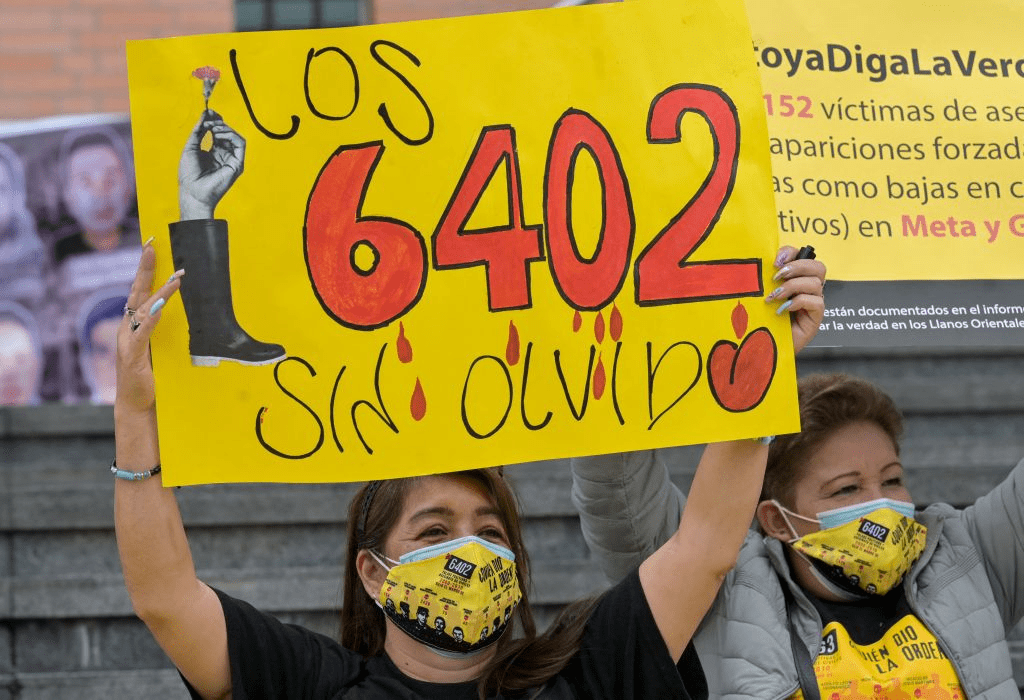
The result of that barbarity, which was baptized with the euphemism of “false positives”, was 6,402 murders of innocents, including peasants, homeless people, minors and even disabled people, whose lives were traded for promotions, free weekends and decorations.
At the same time, hundreds of paramilitary units besieged the Colombian countryside, massacring peasants, extorting merchants and making entire towns disappear with backhoes, after having exterminated their inhabitants with chainsaws and machetes. One of the leaders of those paramilitary groups was the one who years earlier ordered the murder of Jaime Garzón, that likable comedian whose death in August 1999 shocked us to tears and sealed the beginning of the bloodbath and terror that awaited us in the following decade.
The Colombian guerrilla groups also intensified their war machine and kept kidnapping merchants and politicians, ambushing police officers and sporadically kidnapping ordinary citizens on the country's highways, to whom they did a quick credit check, and if they determined that they had some property in their name or some significant savings, they held them until their family agreed to pay an amount that could range from a few thousand dollars upward.
This practice, known as “miracle fishing”, became the terror of the middle class of my country, which now felt like a prisoner in the cities, and was one of the factors that weighed most heavily in the weariness the general public accumulated toward the leftist guerrillas. That, together with the acts of barbarity they committed, widely spread by the media, made most Colombians ignore or even support the barbarity of the paramilitaries and the abuses of the army, considering them necessary evils to finally eradicate the plague of “communism”, “socialism”, “leftism” or any other qualifier the establishment press used to refer to everything that strayed from the doctrine of “democratic security”, which is how the chief boss, Álvaro Uribe, baptized his authoritarian neo-feudalist crusade.
In 2010, Uribe reluctantly said goodbye to the office in which he would have screwed himself in indefinitely, had it not been for the brave intervention of the Constitutional Court, which, with a vote of seven against two, closed the door to such a possibility and in passing saved the fragile rule of law that has incredibly held up in Colombia despite all its tribulations.
The “eternal president”, as many call Uribe Vélez, stepped down from Bolívar's seat, but he did not abandon power. In his place, he made sure to leave one of his closest pawns, whom he misjudged as the sure continuator of his policies of war and extermination of his detractors.
After eight years of relentless war — it must be acknowledged — the Colombian guerrilla groups were weaker than ever and their popularity at the lowest point in history. However, they were not defeated, and as the survivors they are, the guerrillas had managed to adapt to the State's fierce onslaught and could still reorganize and thrive thanks to the absence of state presence in a large part of the Colombian territory and the abundant income from their activities related to drug trafficking.
But the most serious thing, at the end of the Uribe era, was not that the guerrilla was still alive and kicking, but that the paramilitaries now co-governed a large part of the country and had become social, political and economic elites in many departments. Drug trafficking was also prospering as never before, and a new generation of displaced peasants, victims of violence and dispossession threatened to re-tread the endless cycle of vengeance that turned Colombia into one of the most violent countries in the world.
Between 2010 and 2012, I was living the most intense part of my spiritual path; facing my demons, recognizing my inner monster and agonizing in the yagé with the images of the war that I did not live directly but that had penetrated each of my cells through the blood and stories of my parents. The rest of Colombia, for its part, was doing the catharsis of one more decade of hatreds and deaths, which was added to the 5 previous ones since the assassination of Jorge Eliécer Gaitán in 1948.
The 50s and their war between Liberals and Conservatives; the 60s and 70s of the emergence and rise of Marxist, Leninist and Maoist guerrilla groups; the 80s with the heyday of drug trafficking, the holocaust of the Palace of Justice and the extermination of the ideological left, including more than 4,000 militants of the Unión Patriótica; the 90s full of the terror unleashed by Pablo Escobar, the failure of the peace dialogues with the FARC and the assassination of Jaime Garzón; and the first decade of the 2000s with the already narrated horror of Uribista paramilitarism and the guerrilla's miracle fishing.
Then, in 2012, the year in which esotericists expected an ascent in planetary consciousness, the new president of Colombia, Juan Manuel Santos, announced the approaches to begin peace dialogues with the FARC, the largest and oldest guerrilla in the world.
Juan Manuel Santos gradually distanced himself from his predecessor, reversing policies of the Uribe era, such as the antagonism with the left-wing government of Venezuela and the non-recognition of the existence of an armed conflict in Colombia. For Uribe, the guerrillas had no validity as political interlocutors, and any negotiation with them had to be limited to a submission to justice.
Reality, as stubborn as it is, reflected something different instead. In a large part of the Colombian territory, the only authority and law was dispensed by the FARC, the ELN, the EPL or now by some paramilitary groups. Although their methods were primitive, autocratic and unsustainable, they undeniably filled a power vacuum in communities historically forgotten by the State.
Thus, Santos began a peace process with the FARC, which would extend for four more years and which by itself de-escalated the spiral of violence that in 2010 seemed unstoppable, reducing for the first time in many years almost all of Colombia's violence indicators, including massacres, displacements, forced disappearances and murders, particularly of combatants, both insurgents and military and police.
The international community turned out to support the peace process, and the most vulnerable communities of the country celebrated what seemed to be the beginning of a new dawn for Colombia. But Álvaro Uribe, his political group and almost all his followers became the worst enemies of the process. For almost all of them, this was nothing more than a stratagem of the guerrilla to recover from the collapse suffered during the Uribe government, and the negotiation would only open them a political space that they considered they neither had nor deserved.
Despite the fierce opposition of Uribismo, most of the country accompanied the effort, tolerated the impertinences of some guerrilla leaders and swallowed some toads, hoping to see the longed-for peace emerge, or at least, the end of a part of the war that had caused so much damage.
With the birth of Luciana, my second daughter, I understood that I had to do everything within my reach to prevent her from having to deal with the heavy burden that I had received from my parents and they from theirs, and so on since who knows when. The peace process became a personal obsession and I put it at the center of my shamanic and social efforts.
In our circles of words we talked about peace and linked the Havana process with our own individual and group process. For most, or rather all, of the spirituality walkers I met in those years, the peace process was the realization of a collective dream and perhaps — at least in part — the result of years of ceremonies, pagamentos and cleansings in the territory by elders, taitas, mamos, wisdom keepers and their communities.
Elder Luis and I frequently talked about the advances of the process and offered our penance during the yagé sessions we attended, with the mystical hope that our ancestors, the spiritual beings of the territory and the joint will of all the conscious beings that inhabit it would receive that pagamento and bring about the signing of a peace agreement between the State and the guerrilla.
While President Santos, the FARC leadership, the State delegates, the NGOs and the representatives of the international community slowly discussed the six points of the agreement in Havana, hundreds of taitas, indigenous people, esotericists and mystics held ceremonies and rituals, just as surely thousands of Catholics and religious people prayed and prayed for the peace of Colombia.
We will never know if all those prayers and rituals had any influence on the outcome of the peace process, but the work of dissemination, awareness-raising and promotion of peace that hundreds of spiritual and religious organizations carried out surely contributed its grain of sand to give a social context and popular support to what, for a growing part of the population, was beginning to look like an exhausting game of vanities destined for failure, like that of the San Vicente del Caguán peace process carried out between 1998 and 2002 and which led to the first presidency of Álvaro Uribe.
Public opinion had grown tired after four years of a process that was estimated to last about two years at most. In the cities little had changed, apart from the fact that inactive guerrillas were beginning to be seen on the streets, whom the State maintained and protected while the peace process advanced. A few of those guerrillas — it is true — robbed and caused disturbances occasionally, in addition to the fact that citizen security continued to suffer from the usual evils: gangs, armed robberies, pickpocketing on urban transport, street drug sales. In any case, urban Colombians did not perceive any benefit of the process in their daily lives.
The only ostensible difference in Bogotá was experienced in the corridors of the Central Military Hospital, which had the lowest occupancy of recent decades and, for the first time, blood units were not scarce to attend to the mutilated and badly wounded soldiers who previously entered by the dozens, coming from every corner of Colombia.
In the regions, things were very different: people could move along the highways without the fear of miracle fishing and without the need for armed vehicles and war tanks in grotesque military caravans with which Uribe invited Colombians to “live Colombia and travel through it”. But the most important thing was that the absence of clashes between the army and the guerrillas had stopped the shedding of innocent blood, “collateral victims” of the conflict.
But unfortunately, those achievements of the peace process were barely disseminated by the mass media, and in the increasingly omnipresent social networks, marginal populations were conspicuous by their absence. Instead, more and more pro-establishment urban activists participated in Facebook groups and Twitter hashtags against the peace process, disregarding the achievements whose benefits were only enjoyed by the “nobodies” of the forgotten communities, and demanding the return of “democratic security”, to subdue the insurgents at gunpoint, as if it were a novel idea and not exactly the monster that condemned us to 60 years of fratricidal war.
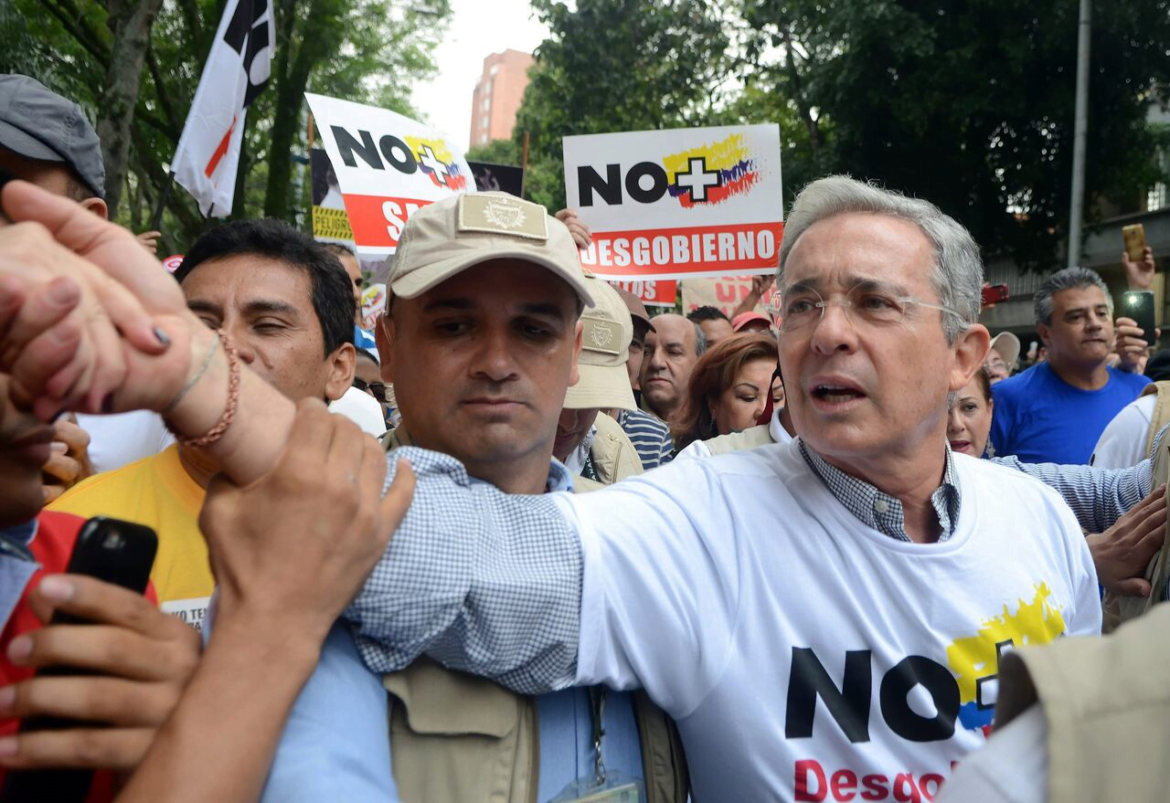
On April 2, 2016, those of us who supported the peace process watched with unease as the streets of 25 Colombian cities filled with groups of people in white shirts shouting: “No more Santos... No more FARC”. The marches were convened through Facebook groups, created by citizens of Colombia's main cities, but they were quickly adopted by Álvaro Uribe and his new political party as a form of rebranding, no longer as the champion of the fight against the FARC, but of the fight against the peace process, and, above all, against his new archenemy, President Juan Manuel Santos.
It was clear that something unthinkable a couple of years earlier was now totally possible: that the majority of the Colombian population would oppose a peace agreement with a guerrilla that no government had been able to defeat in 60 years. Those of us who supported the process took for granted that peace was something good enough in itself not to require much support. We stayed with our likes, our ceremonies and our prayers while the enemies of peace were organizing themselves and becoming more sophisticated.
Time was running out for the peace process and something had to be done to save it, but I was very busy with my affair with Diana and then restoring my relationship with Paula, so at critical moments for the peace process I withdrew from activism and even from shamanism. Furthermore, in September 2016 I received the bad news that our recent and complex application for a work visa to the United States had been rejected, so our future, as well as Colombia's future, was at a crossroads.
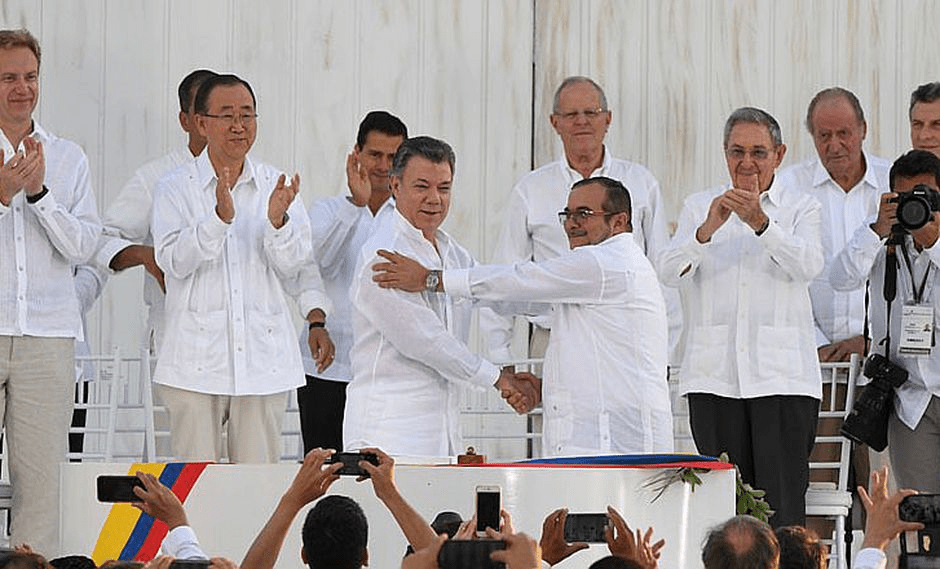
In the face of growing opposition to the peace process, the government and the FARC accelerated the negotiations of the two remaining points of the agreement, and on September 26, in the city of Cartagena, the longed-for signing of the peace agreement finally took place. I remember the emotion in front of the television while the representatives of both sides signed the end of a war that began when my father was barely a child and my mother had not even been born.
However, the signing in Cartagena was only a formality. For the agreements to become law, the Colombian people had to endorse them through a national plebiscite that would be held on Sunday, October 2, with a simple question: “Do you support the final agreement for the termination of the conflict and the construction of a stable and lasting peace?”
This question, which under normal conditions and in a country less divided than mine would surely have generated an absolute majority of positive responses, in the Colombia of 2016 did not even achieve a simple majority. Hope dissolved in tears when the newscasts announced the victory of the “No” with 50.21% of the votes. 53,908 people tipped the balance against peace in the Catatumbo region of Norte de Santander, in Cauca, in Putumayo, in the Montes de María, in the jungle of Caquetá, in the lands of the “nobodies”. What would happen then? Would the guerrilla return to the mountains, would the fields fill again with antipersonnel mines and the hospitals with people mutilated and bleeding out from the absurd war?
Fortunately, none of this happened, since the government skillfully used the legal provisions at its disposal to save the agreement. The government interpreted the popular will expressed in the plebiscite as a mandate to review the agreements and introduce some modifications, so that the peace would be more complete and inclusive of all sectors of civil society.
However, the distrust of the peace process and the fatigue after four years of negotiations were only part of the story behind the failure of the plebiscite. Something much darker and more extraordinary happened during the weeks prior to the plebiscite: the promoters of the “No” to the peace agreement, like the promoters of “Brexit” in the United Kingdom and Donald Trump's presidential campaign in the United States, resorted to a stratagem involving the largest social network in the world, Facebook, and an unscrupulous social data analysis firm based in London called Cambridge Analytica.
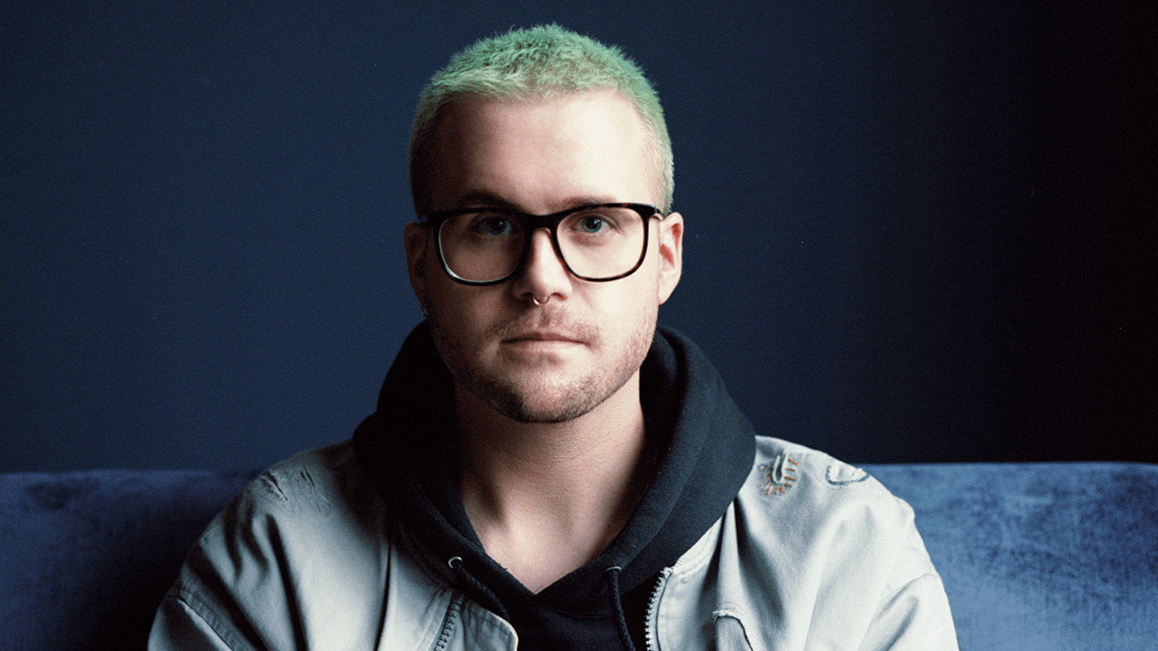
As was learned months later, thanks to the leaks made by the company's former research director, the Canadian Christopher Wylie, Cambridge Analytica took advantage of the vulnerabilities of the Facebook platform, as well as its questionable content promotion mechanics, to manipulate the notifications and news of millions of Facebook profiles in Colombia, inserting fake news, hoaxes and conspiracy theories to sow fear and rejection of the peace agreement with the FARC.
During those days of September and October, all kinds of lies were spread about the points of the agreement, among them, that the State would pay almost four million pesos monthly to each demobilized fighter, that the pensions of retirees would be expropriated to give them to the FARC, that the agreement required the imposition of a supposed “gender ideology” with which homosexuality and the disappearance of the conventional family would be promoted, among others.
The promoters of the “No” amplified these stories through WhatsApp and other minor social networks, but the main culprit of the blow to the peace agreement was Facebook, which promoted all these false stories without any kind of control and which, with its algorithm that privileges user “engagement” over truthfulness or the common good, boosted those contents. With each click and each share, Facebook widened its coffers, while putting at risk the lives of thousands of Colombians from the most remote and vulnerable regions of the country.
The victory of the “No” re-established Álvaro Uribe with a leadership he was beginning to lose and granted him — without anyone explicitly deciding it — the voice of those who voted “No” to the peace agreement. The plebiscite became a new divider of Colombian society. Those who felt like winners celebrated that “guerrilla Colombia” had lost and that the “good people” had imposed their will.
A friend of mine, perhaps the only yagenaut I knew who supported the “No” to the agreement, told me she was glad that the peace agreement had been buried. I asked her if she did not care that this meant the death of thousands of Colombians from impoverished populations, and she answered me that if they were killed it was because they were guerrillas and that then they deserved it. I never spoke to her again; I did not feel capable of being friends with someone who thought like that. In the same way, families, coworkers, even couples were divided.
The good thing about the failure of the plebiscite was that those of us who were sleeping on our laurels woke up, and the “spirituals” understood that it was necessary to move from intention to action. On October 5, 2016, thousands of Colombians took to the streets to demand the completion and implementation of the peace agreements with the slogans “Agreement now!” and “I am peace!”, in what became known as the “March of silence for peace”, in reference to the march of silence that Jorge Eliécer Gaitán convened shortly before being assassinated almost 70 years earlier.
One of the student activists who helped organize the march published a post on the Facebook page of the demonstration that said: “Upon arriving tomorrow at the plaza, let's stay there camping, for as many days and nights as necessary, until Uribe, Santos and the FARC reach an agreement. Without getting up!”
It was suspected that Uribe's strategy, and that of his entourage, to tear the agreement to shreds could be to delay the negotiation of the modifications to the agreement until one of the parties walked away from the table. That way, Uribe would be recognized as the one who lifted the veil on the FARC's deception and perhaps as the only hope of defeating them by armed means, which was the only way he liked and that suited him.
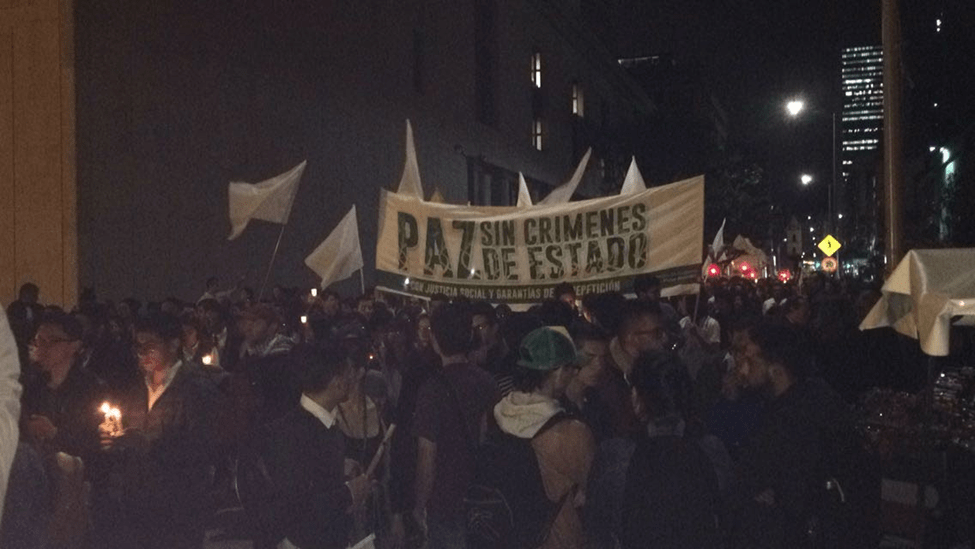
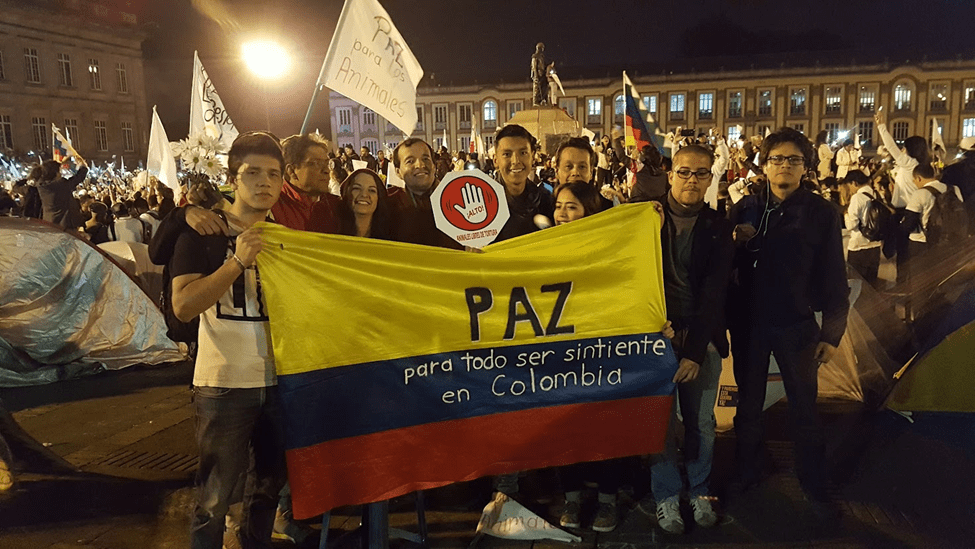
So, freed from my sentimental entanglements and focused on resolving the uncertainty of both our immediate future and the future of Colombia, I set out to accompany as much as possible the newly installed “Peace Camp” in Bolívar Square. There, hundreds of young students, activists and victims of violence gathered to talk, sing and protest, right in front of the most important government buildings in the country, with the goal of not getting up until the peace agreement with the FARC was officially ratified.
That was one of the most enriching experiences of my spiritual journey. For the first time I felt I had moved from the spiritual work for humanity that the elders taught me, ethereal and intangible, to the real execution of something that could have tangible consequences in the world.
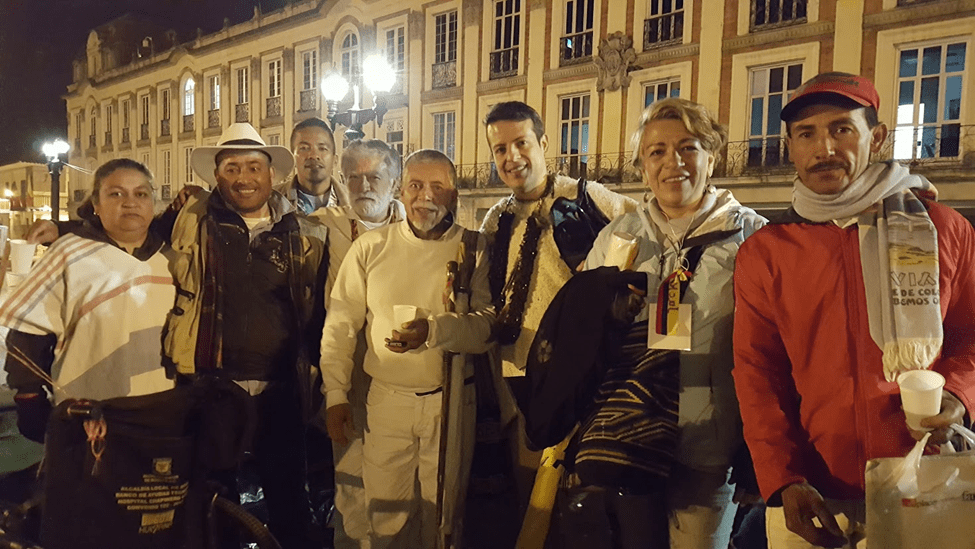
During the first days of the peaceful takeover of the government square, I met young people committed to the future of their country, human rights organizations and pacifists who showed a genuine interest in achieving social justice and reconciliation among Colombians, and representatives of the international community, including the press, who documented that exciting demonstration of the civilian population to make it known to the rest of the world.
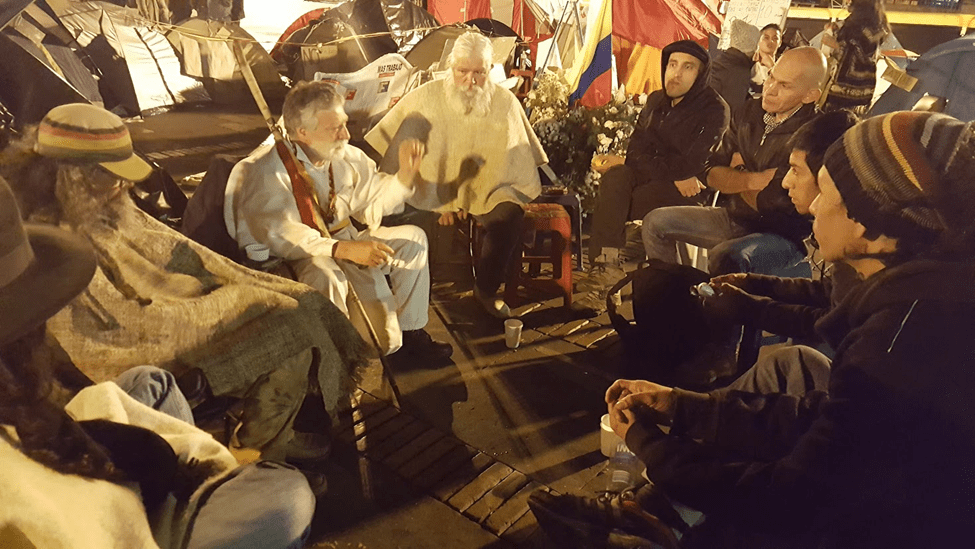
During those days I was able to see a country different from the one that seemed condemned to violence a few days before with the victory of the “No”. Even at the camp I met some people who had voted against the approval of the agreements but who were there demanding that the necessary modifications be negotiated to proceed with their implementation as soon as possible.
During the days I accompanied the demonstration I saw no signs of hatred or political extremism. I found people of all colors, origins and ideologies, but all with the conviction that the time for reconciliation had come.
The most moving moment for me was when, during one of the many discussion forums in which I participated, a man of indigenous features, about 30 or 35 years old, asked for the floor. His name was Juan and he narrated how, barely five years earlier, armed men, probably belonging to the FARC guerrilla, entered his little house in the countryside, in some municipality of the department of Caquetá.
After identifying him, they informed him that he had been judged as a collaborator of paramilitary groups and that they were there to carry out his sentence. His explanations were of no use, nor was justifying his actions as a representative of a human rights organization, which sought the protection of the rights of any person, regardless of their militancy.
To Juan's horror, the punishment was not his execution, as he would have preferred. Instead, the inhuman guerrillas proceeded to massacre his wife, his two children and his parents. The worst nightmare a human being can conceive had become real for him, and madness seemed to be the only possible way out.
Juan did not understand then why they had left him alive, knowing that he could have devoted himself — as so many thousands before him — to the pursuit of revenge. He longed for death for a while and contemplated the path of arms to seek some peace in his mind, but thanks to the support and affection of key people who appeared on his path, he decided that the only thing that would give him tranquility would be achieving peace in his region, so that no one else would have to suffer the hell he was going through.
Thus, Juan joined one of the many groups of victims of violence in Colombia and from there offered his life and his hands to support the Havana peace process, which led him to the Peace Camp, a place he did not plan to leave until the government and the insurgents signed the agreement to end the war.
After he told his story, I approached him and asked him for a hug. Juan agreed, and while I hugged him I thanked him for his courage and his nobility, I promised him that someday I would tell his story and that, from wherever I was, I would also contribute so that the death of his children and the rest of his family would not be in vain. He was also moved and thanked me for the hug and for accompanying the struggle for peace. Every time I hear someone claim that those who caused so much damage should not be forgiven, I remember Juan and think that, if he could forgive, all the rest of us have the obligation to do so.
Little by little, more victims of violence, more indigenous delegations and marchers from different parts of the country kept filling the square. I felt that my presence at the camp had fulfilled its purpose and I became convinced that the citizens who kept arriving represented better than I did that forgotten Colombia that was no longer willing to let the opportunity for peace pass by.
So, on October 12, 2016, I said goodbye to the camp with one last memorable encounter. This time, with a famous activist from Nariño: Professor Gustavo Moncayo. Nine years earlier, when his son, Corporal Pablo Emilio Moncayo, had already spent 10 years kidnapped by the FARC, the “profe” undertook a walk of more than 800 km from Sandoná, his hometown, to Bogotá, demanding the humanitarian exchange of imprisoned guerrillas for kidnapped soldiers.
Happily, his efforts were fruitful and helped the exchange take place. But the Walker for Peace decided not to stop walking but to take advantage of his fame to keep walking for the liberation of all the other kidnapped people and eventually for the realization of a peace agreement between the FARC and the Government.
As could not be otherwise, Professor Moncayo showed up at the Peace Camp and shared his wisdom and affection with us, showing himself to be a simple peasant who had decided to take control of his destiny and do what few dare: act.
On November 12, the Government and the FARC achieved a new peace agreement, which included some of the proposals introduced by the delegation of supporters of the “No” to the initial agreement. There was no national celebration, as would have been expected after a new agreement, inclusive of even more social sectors, came to a happy conclusion. Faithful to the Colombian tradition of not rejoicing in victory unless someone else is defeated, the promoters of the “No” alleged that they had been deceived and their proposals plucked until they were reduced to inane tweaks to the initial agreement.
At the Peace Camp, the celebration also lasted little, since that same day the mayor of Bogotá ordered the police riot squad to immediately evict those who were in Bolívar Square. Reluctantly, the leaders of the marches complied with the order and left without offering resistance.
With the signing of the peace, I felt that a cycle had closed not only for the country but for my life. Meeting so many people who truly work to achieve changes for humanity also filled me with humility. In truth, I felt a little ridiculous for having believed for so long that with my yagé writhings and traditional pagamentos I was somehow helping to achieve peace not only in Colombia but in the entire world.
I remembered that yagé session in which I had the vision of being a terrified young woman during the massacre of the paramilitaries in El Salado in February 2000. I always believed that with my entheogenic penance of a couple of hours I had helped “heal” in some way the victims of that horror. But the Peace Camp showed me that only the hug I gave Juan after he shared his story could be considered a true spiritual act. Only spiritual warriors like Juan himself or Professor Moncayo could boast of their major contributions to the peace of Colombia. They could, but they would not, because in them humility shone like the gold of the authentic warriors of wisdom.
After this experience, I could no longer sit in circles of words and pretend that a few puffs of tobacco smoke or mystical invocations by themselves would achieve the transformation the world needed. I thought of Paula, of my daughter Ana María, who had just come of age, and of my little Luciana, barely one year old, and I concluded that, faced with the uncertain effectiveness of esotericism, my safest bet would be to focus on continuing my own healing so as not to have to condemn them to keep carrying the burden of the generational trauma I needed to get rid of.
To achieve this, Paula and I decided that what would make the task easier for us would be to take advantage of the situation to look for a better place to raise our children, so that they would not have to grow up amid so much division, animosity and hatred as the one breathed in Colombia, despite the signing of the peace, particularly as a result of the horrible disinformation campaign conducted by the detractors of the peace process and made possible by Facebook and its machine of profiling and emotional manipulation.
We decided that we would leave Colombia, but not to the United States, where the doors seemed to be closing, and where we had already realized they suffered from the same ills as Colombia, despite their wealth and development. Our target would be Canada, and we immediately sprang into action to leave as soon as possible.
Colombia was left for the new generations of Colombian men and women that I recognized in Bolívar Square. Only they could decide the course of their country, as Jaime Garzón ruled when he told young people that, if they did not assume the direction of their own country, no one would come to save it for them. We would keep contributing our grain of sand from wherever we were, raising our children as those young people Jaime Garzón dreamed of and of which I could not be a part because of my fears and weaknesses.
Unfortunately, a confused and fearful country chose in 2018 an arrogant henchman of Álvaro Uribe Vélez, not for his merits but out of fear of his opponent, the former guerrilla, former mayor and progressive former congressman Gustavo Petro. The new president did not win for his affinity with former president Uribe either, since by then public opinion knew about the false positives, the persecution of the opposition, illegal wiretaps and a host of other illegalities and rascalities that Uribe had committed during his term.
The victory of the right in 2018, motivated by resentment toward the one who once took up arms against the state and by the fear of trying something different from the infamous status quo, meant four years during which the country regressed in almost all its human rights and social inclusion indicators, while bankers, investors, speculators and above all friends of the puerile head of state filled their pockets.
But in an act of heroism and desperation, the Colombian youth woke up and in 2019 began a social protest movement that showed the establishment and society that they were not willing to repeat the same mistake of 2018. Then came the pandemic, which tested the nation's resilience, and a long chain of outrageous abuses and frivolities of the pusillanimous president through whom Uribe Vélez governed by proxy.
With those circumstances as a backdrop, in 2022 the 2018 election was repeated with the same lies and fears promoted by those who have always governed, and the same patient and shrewd contender, who for the third time ventured to prove that a country bled dry by war, injustice and the low value of life could take the step toward reconciliation, electing as its president a citizen without pedigree, lands or great capital.
This time, however, Gustavo Petro was not alone, but was accompanied by Francia Márquez, a fierce Afro-Colombian social leader. He also surrounded himself with social movements of a broader political spectrum and, yes, also with an entourage of traditional politicians with a questionable past, to say the least.
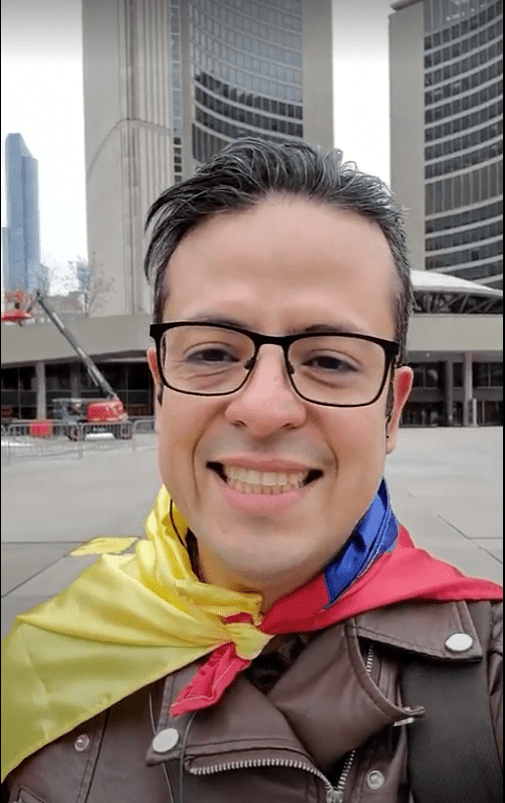
With that motley group, which was called the “Pacto Histórico”, and largely thanks to the almost unanimous contempt of Colombians for the puppet president in office, on June 19, 2022, Petro obtained the presidency of Colombia, for the first time in history for a left-wing movement. He won in part because of his new alliances and strategies, but, above all, because millions of those “nobodies” forever forgotten by the Establishment, the Juans and the Professor Moncayos, the Muiscas, the Arhuacos, the Ingas and the Huitotos, the Manuel Ávilas and, above all, the millions of young people that Jaime Garzón dreamed of, mobilized as never before to assume the direction of their country.
At the time of writing these lines, the government of Gustavo Petro and Francia Márquez has not yet taken office. Many campaign promises will be broken and many mistakes will be made, but it is at least a first step and an opportunity for reconciliation after the dawn of peace. In my opinion, it was worth taking the risk.
It is also a reason for optimism that, in June 2022, the Truth Commission delivered its final report detailing the causes, manifestations and consequences of the armed conflict in Colombia. The commission, which is part of the Comprehensive System of Truth, Justice, Reparation and Non-Repetition, was created as part of the 2016 peace agreements and, between 2018 and 2022, investigated, analyzed and documented testimonies of more than 3,000 victims of the armed conflict in Colombia, to reveal to the whole society the objective facts that were part of the conflict and the responsibilities of the combatant and civilian parties. It also formulated recommendations aimed at preventing the conflict from repeating, not only in Colombia but anywhere in the world.
Just as my country had to go through the horrible night of paramilitarism between 2000 and 2010 to be able to recognize the size of its wounds and head toward a healing process of its social fabric, I had to go through my own dark night of the soul before being able to understand the nature of my wounds and leave my traumas behind definitively in order to begin a new life in Canada. The process was not easy at all, but as in the rest of my path, the learning was invaluable and abundant.