
One thing my mother has always said is that having broken things in the house brings ruin. The most common example was a defective watch or one without a battery; my mother said it was bad luck, so I inherited the habit of hurrying to change the batteries every time a watch stops, and even of resetting the time every time, due to a power outage, the clocks of the appliances appear blinking in the morning.
This is one of the many beliefs that for a long time I understood as superstition, or as an excuse we find in capitalist culture to get new appliances or furniture when they start failing or we no longer like them that much. In any case, I have always felt that accumulating objects that don't work is something negative, a sign of abandonment or neglect, and I have striven my whole life to get rid of things that are no use and for my home to be a pleasant and functional place.
But today I want to share with you an interesting perspective on this topic: it turns out that fixing up the house is not a superstition nor merely a beneficial habit, but a spiritual path, or at least part of the spiritual path.
In recent months I have been listening to the lectures of Jordan Peterson, a Canadian psychologist and philosopher who has been in vogue in academic circles and also in the media since 2017, because of a video that went viral in which Peterson faced off with a group of LGTBI community activists over opposing a bill from the province of Ontario that would require members of the educational community to use the preferred pronouns of gender-diverse people.
That is a complicated topic and it is not the purpose of this episode, so for now I will not go deeper into it. The point is that, on a friend's recommendation, I started listening to Peterson's lectures, and although it is evident that he has a marked religious influence and some of his political positions are controversial, the pragmatic approach of his values and moral convictions caught my attention a lot. In fact, one of the first lectures I listened to from Peterson was the one in which I finally found a convincing answer for the dark visions that yagé delivered me in some of my experiences with the plant.
With this, I kept listening to Professor Jordan and I have found many interesting things, but the one that is to the point today is the advice he says he gives to many of the people who come to his office, particularly young men, with depression, anxiety, or internal conflicts: "Clean up your room."
It sounds exactly like the advice, or rather the order, that many of us heard during our youth from our parents: "Clean up that room," "Pick up that mess," "Put some order into that mess," and so on. And of course, the instinctive reaction of many children and young people is to push the mess under the bed, cram the clothes and shoes into the closet, stretch the blanket over the half-stretched sheets, and blow the dust off the surfaces so it doesn't show. Something like that…
Not coincidentally, one of the nicknames Jordan Peterson has earned is "father figure of the millennial generation." Of course, when it is our parents who impose on us the sense of order and cleanliness, we understand that, since it is their house, what they are asking us to do is to clean up their property, to remove our disorder from their lives.
In many cases that is one of the conflicts between parents and children during adolescence, when the parents have already reached the understanding of the importance of maintaining order in their house and want to impose it by force on children who were not cultivated with the habit from a young age and were not taught the meaning of that task.
But then Peterson comes along, with the eloquence and moral authority before a population that is hungry and thirsty to escape the disorder in which their lives have become, and they turn the famous psychologist into a superstar, a guru as admired as Osho or Sadghuru.
The success of Jordan Peterson is that he gives the form of a spiritual doctrine to a knowledge that is in fact engraved in our veins and that is part of human psychology probably since human beings lived in caves.
This doctrine is based on some philosophical concepts like the inevitability of suffering and the natural tendency of the Universe toward chaos. This last postulate has been scientifically proven already, but the first is somewhat more subjective and personally debatable. In any case, what Peterson says is that the natural tendency of things is to deteriorate, to corrupt over time. The only thing that prevents that deterioration and that in fact contributes to there being an improvement is for conscious beings to intervene and fix what is deteriorating, to replace what is no use.
This does not correspond to reality in nature, where everything is renewed through self-sustaining cyclic processes, but it does correspond to the artificial reality that we humans have created, in which, if human beings do not intervene constantly, things go bad and end up collapsing, being swallowed by nature. You may have seen this graphically in the documentary "The Earth Without Us" back around 2008. It showed what would happen if human beings suddenly disappeared from the face of the Earth: within a matter of months, weeds would be growing between the tiles of the sidewalks and streets, wild animals would invade the cities, and in just 20 years the jungle would cover most of the objects created by humans.
From that point of view, nature is against our civilization, and it is already clear that our civilization is, in large part, against nature. Whether we want it or not, each one of us makes up part of this pulse between our civilization and nature, and so humanity has to be constantly renewing its creations so that nature does not destroy them. That is the pulse that each one of us lives in their own house: dust constantly penetrates through the windows and accumulates on all the surfaces, metal objects rust, wood cracks, and even concrete and brick end up corroding.
If we don't intervene, mold reproduces on the walls, mites take over the furniture, and spiders conquer the ceilings and the cracks. I know all this sounds obvious, and it is clear that sooner or later we have to do something to prevent the house from falling on top of us, but what does this have to do with the spiritual path?
Well, just as nature opposes the development of civilization and the cleanliness of the house, nature also opposes the development of the Being. This can be jarring for those who venerate nature as a kind and compassionate mother. Well, none of that: my teacher Mara says "nature has no morality"; just as it is beauty, harmony, and life, it is also chaos, destruction, and death. Just as nature does not care about our cities, dams, and monuments, it is also not interested in the slightest in our emotional stability, inner peace, or happiness.
Nature gave us consciousness of ourselves and consciousness of our death. As a result, we live in the anguish of our own extinction, trying to find purpose and meaning in a life that we know nature itself will ask back at the end of the road. What nature is interested in in our mind is our capacity to survive and propagate life. Being happy and transcending is something we have to achieve despite mother nature.
This is a somewhat gloomy reflection, though a realistic one; but the point I want to get to is that, just as we have to be constantly cleaning our house, repairing what gets damaged, detecting leaks, and remodeling, we also have to be, all the time, cleaning our mind, healing our wounds, detecting our sufferings, and reinventing ourselves.
As if that were not enough, all of nature and the rest of the complex systems of the Cosmos also have against them the second law of thermodynamics, which says that all particles tend to disperse equally toward more uniform states. This is what is scientifically known as entropy, or the tendency of matter toward chaos, although chaos is misinterpreted as "disorder" when what it actually means is the exact opposite: a uniform dispersion of energy.
Life is constant work, a permanent effort to create complexity in a universe that tends toward entropy, and consciousness is constant work, a permanent effort to create meaning and purpose in a nature that tends toward death and natural selection.
In a reality that is in constant motion, staying still is the equivalent of going backward. This is evident on the physical plane because we know that, if we don't clean, repair, and renew, our house falls on top of us. But it is not so evident on the spiritual plane, where sometimes we believe that it is enough just to not be bad, to live by inertia without worrying about cleaning, repairing, and renewing ourselves on the inside.
I understood that after many yagé doses: at first one understands that the vomiting is strong and that one has to writh around for a good while, because for many of us it is only until one takes yagé that one begins to look inside oneself and recognize all the garbage one carries in the soul, all the loads one carries on one's shoulders.
But then time passes, the doses pass, and after a year or more of going to take yagé frequently, it happened to me that sometimes I had those cleanings that were so hard, where I would vomit pains, sadnesses, rages, anguishes, and I would ask myself "but where does all this come from?". Then yagé would show me all the things of the everyday life that were causing me pain without me being aware: hurtful words from people I love, situations in which I acted with selfishness, passive-aggressive arguments with someone in my family, frustration over work, the times I cruelly criticized someone, lies of all kinds, and even the things I was watching on television.
The last of these impacted me, because in altered states of consciousness with yagé, it often happened to me that images of movies and series would come to me, generally full of violence, or things I had seen in the news, and I would start vomiting and vomiting. Like something inside was telling me "All this is the garbage you are feeding your mind." After that, what I did indeed was stop watching the news, and as for movies and series, since I am a fan of the action genre, I decided that I would still watch series and movies of that genre, but limiting myself to productions of such good quality and rating that the vomiting afterward is worth it.
But with the other kind of pollution, that of the small things of the everyday life, the matter is more difficult, because daily life distracts a lot and it is very hard to avoid all the things that hurt us without us being aware. Some come from outside, but many come from within ourselves, because of our lack of self-observation and present attention from one moment to the next.
At the end of the day, whether by one's own will, as in my case with violent movies, or out of unconsciousness, like everything else, the truth is that all the time we are collecting dirt, deteriorating some part of our life, and accumulating garbage, and just as with our house, we need to clean ourselves on the inside, making sure that each day the temple of our soul is more harmonious and a more pleasant place to inhabit.
Because that is what happens with houses and bodies: when they are not given attention, they break down and become unpleasant places to inhabit, places where their occupants, whether the guest of a house or the soul of a body, become bitter and no one wants to go visit them.
This relationship between the cleaning we do every day in our house and the cleaning we do not do but that we should be doing constantly in the house of our soul, that is, our body and our mind, is probably what motivated Jordan Peterson to acknowledge the importance of tidying up the space in which we live as a psychological therapy for his patients.
According to Professor Peterson, youth always seeks to improve the world, to transform society, and to change the current schemes, but he says that how can they change anything if they are not even capable of fixing the mess in their room. What he proposes, then, is that, in order to take a first step that is really effective toward a transformation at every level, one has to start with the small things, with the simple things, from the inside out.
In one of his lectures, he said that frequently people from all over the world call or write to him and tell him they were on the verge of suicide or that their life was a complete disaster, and just to try, they decided to start organizing their room every day. And, would you believe it, things start to improve! Some say they have even found a job, a partner, or fixed their relationships with their families.
Peterson says the secret lies in two things: the first, doing something instead of nothing, which in many cases is already a substantial improvement, and the second, creating the habit of bringing order to chaos, fixing what doesn't work. This seems self-evident, but the mental effect it has is not something that is commonly understood: by fixing what is on the outside, we acquire the skill to fix what is on the inside.
This is the reason why, in some high-class schools, students are required to clean the classroom every day, to do gardening and other trades to maintain the campus. When I learned that they did this at schools like the Gimnasio Moderno in Bogotá, they told me it was so that the students would learn to serve, in order to later become leaders and serve society.
That may have been a commendable additional objective, but the reality is that the habit of tidiness, both in schools and in military barracks, where it is implanted, is to create people who are disciplined with themselves, rigorous, in a certain sense implacable. The person who is careful with tidiness is meticulous and rarely mediocre, because they are accustomed to detecting small imperfections and have the impulse to correct them. Of course, this can also become pathological when a person becomes obsessed with cleanliness and perfection to the point of no longer being functional, and then they turn into a hypochondriac or an obsessive-compulsive person.
This relationship between being orderly and spirituality is also the reason why the masonery was formed precisely by architects and builders, who from the beginning understood the relationship between the trade of building buildings and the trade of building the soul. It was masons who built almost all the Christian temples of the world, and in them they placed a quantity of esoteric symbology that reflects the ascent of consciousness from the mundane, which is left behind at the threshold of the main portal, through the path that is made through life along with the congregation, which can be made through the central nave that represents the correct path, or through the path of sin, which is made in the side naves, where the only redemption is in confession and that is why the confessionals are found there, or in penance; until one reaches the revelation of the truth and the alliance with God at the altar.
But not only does Christianity reveal to us this connection between the physical temple and the temple of the spirit. Maybe you have seen at some point an episode of the Netflix series, I think it's called "The Magic of Order," with the famous organizing consultant Marie Kondo. In her program, and also in the books she has written, the Japanese woman teaches the KonMari method, which in broad strokes consists of gathering together all the belongings we have in our house, one category at a time, starting with clothes, selecting the things that give us a "spark of joy," and getting rid of what doesn't give us some joy. She also teaches tricks for folding clothes efficiently, organizing the closets, the garage, and so on, but the most important thing is what the title of the series says: that organizing should be joyful, almost magical.
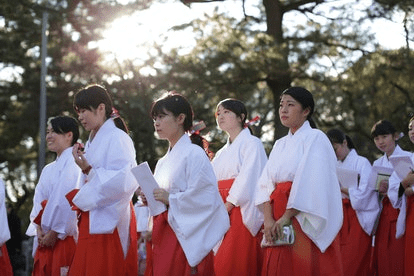
Well, it turns out that Marie Kondo spent five years of her life as a maid in a Shinto shrine, where she helped the priests with the rituals, sold amulets and talismans (omamori), and helped clean the grounds of the shrine. This influence of her youth was what inspired Marie to start greeting her clients' houses before starting to organize them; according to her, that happened naturally, based on the etiquette of worship in Shinto shrines. She started doing it to reduce the tension that could be felt when a client opened the door for her, and she felt that that sensation resembled the atmosphere when one passes under the door of a shrine and enters the sacred precinct. Marie says she notices a difference in the speed of the cleaning process if she performs the ritual greeting first.
The shrine doors that Marie Kondo refers to are torii gates, which are found at the entrance of every Shinto shrine and represent the border between the secular world and the sacred world. When you pass beneath a torii, you are entering a sacred space. Shintoism teaches that, when one walks toward the torii, one must calm the mind and prepare it to enter a sacred area. Notice that this is the same philosophy behind the Muisca ritual I narrated previously, for entering a cusmuye or maloca: one greets each one of the two pillars of the main entrance, one cleans the mind, and one enters facing backward to leave behind what belongs to the world and enter the precinct of the Spirit.
There is a part of Marie Kondo's process that confuses TV viewers even more, and it is the way in which she "awakens" objects by touching them. According to her philosophy, we can stimulate our material belongings by physically moving them, exposing them to fresh air, and making them 'aware'. This is also part of the Shinto world view, which includes the belief that the kami, or the sacred, exists in everything, that everything contains an essence, whether good or bad. Just like most Amerindian cultures, Shintoists believe that spirits, whether sacred or not, exist in everything that exists in nature, like the wind, the rain, the mountains, the trees, the rivers, and fertility.[1]
Regardless of your spiritual beliefs, the truth is that human beings project toward the outside what we have inside our mind, and we also build mental states based on what we observe and experience in the world. If we are complacent with our mediocrity and allow ourselves to inhabit a place that is disordered, dirty, deteriorated, it is very likely that our inner state will also be one of abandonment, disorder, and discomfort.

Note that I am not saying that the only way to be in harmony is for everything around us to shine like a silver cup. The concepts of order and harmony vary greatly from person to person, and frequently what is a kind of order for someone can be unacceptable disorder for another person. What is important is that we feel in harmony with our surroundings.
Returning to the previous point, if our inner state deteriorates, consciously or unconsciously, because of the space we inhabit, it is possible that the result is even less attention paid to that space, because human beings tend to ignore what causes us discomfort, and then the vicious circle is completed.
On the other hand, if we strive to create a pleasant space to inhabit, then perhaps our spirit will be uplifted and we will be motivated to improve that space little by little, until we reach living in a place we would not have imagined before. Not only a physical place, but an emotional, sentimental, work, and spiritual place. That would be the virtuous circle of order.
I emphasize again that, as everything has its risks, here the danger is to become obsessed with order and reach the point where nothing is enough, where the slightest disorder causes anger or anxiety, and to reach the point of constant exhaustion from being at cleaning. That can also happen with spiritual work; I have known people obsessed with perfecting their mind and their life, and well, being human, it is clear that this is swimming against the current.
My personal experience on this topic coincides with the vision of both Peterson and Marie Kondo. I was never particularly industrious in my home during my childhood; my mom asked me to help, but never to the point of me being self-sufficient in my daily life. When I left home, I left committed and with a daughter. My partner took charge of the cleaning, and I took charge of contributing the money for all the expenses.
Later I separated, and since I had no one to fix up my house, I hired someone to do it. Eventually I found another partner, and once again I had someone taking charge of the house while I earned money for everything. I separated again, and of course I found again someone taking charge of my dirty laundry, my dirty dishes, and keeping everything clean. Sometimes I paid an employee, but I also shared a home with people who paid me rent with their work doing housework.
So was my life until I went to yagé for the first time, where I practically lived an exorcism and found sense and purpose in my life (see T2E4: Death and Rebirth in the Yagé). After that, one of the things I changed in my life was forcing myself to "help" with the chores of my home. As I narrated in T2E8: My Spiritual Path – Paula, I was soon living with Paula, my wife, but she was not willing to accept the arrangement of being exclusively a housewife. We both worked, and she took on most of the responsibilities of the home, as is typical in our machista society, but I felt increasingly compelled to also contribute with my hands, not only with money.
Our first apartment was a beautiful growth experiment in understanding our role with respect to caring for the temple of the soul and the temple of our family; however, we had many lapses, and as a result we ended up having an infestation of mold and fleas in our small apartment.
We understood that things had not worked out entirely well, so in our new apartment we started doing things we hadn't done before, like washing the walls, kneeling on the floor to clean the floors, and that kind of thing. At the same time that we were growing in that aspect, we were also learning to clean our mind from the pollution caused by misunderstandings in speaking and learning to listen to each other.
At that moment I didn't see the relationship between one thing and the other, but now I think that definitely there was a synergy between the physical act of constantly cleaning, observing and detecting the impurity, and then doing something, acting accordingly to restore order, and the act of constantly observing ourselves, detecting the details that needed to be polished, and restoring order in our lives.
Today, I believe that I have finally reached the level that Marie Kondo prophesies: making cleaning a ritual and one that brings joy. We all know that, because of the pandemic, our houses get disordered and dirty probably twice as much, if not three times as much as before, when we spent most of the day outside. Living in Canada means that there is no salary that can pay for daily cleaning service, so the three adults who live in the house had to divide up the housework.
I have to say that I still don't have a share of housework equal to the share that my wife and my oldest daughter take on, but even so, my contribution is much more substantial than it ever has been before. I bake bread weekly, I pick up the children's mess almost every day, and daily I take charge of fixing up the kitchen. The last of these has become for me a ritual I adore. While I organize and clean up the mess of the day, I listen to audiobooks, lectures, podcasts, and I think about the important decisions of the next day.
The pleasure I find in seeing the kitchen like new before I sit down in the living room or at my desk is undoubtedly a serotonin boost. Moreover, I have created the habit of detecting the things that don't work in the house and learning to repair them. This, besides being the most responsible thing for the environment, generates a personal satisfaction that I find very similar to the satisfaction of resolving a disagreement with someone I love. The magic is in the fact that repairing what doesn't work becomes like a superpower. My daughters and my wife frequently bring me broken or damaged things, and I feel special for being "the one who fixes things," in a way similar to the satisfaction I feel when my friends look me up to give me advice or to listen to me, because then I feel special for being "the one who helps fix things."
[1] How Shinto Influenced Marie Kondo's KonMari Method Of Organizing (bustle.com)
5 years ago. Manu, I give infinite thanks to life for finding you on my path; to see your spiritual growth is magical, a being of light just like Pauli, you are a gift. Thank you for everything you have taught me; I felt that I was looking for this message. With the pandemic, my housework is tiring me out; I count on my husband's support, however, there were days I didn't want to do anything and still I did it; the way you explained everything from the spiritual sense made me reflect on many things I have to improve. I also listen to my podcasts while in my kitchen cleaning ritual; now spirituality and science will be in my top 5 of the best. A huge hug and Buen Camino
Comentarios (archivo, solo lectura)
Mostramos 1 comentario guardados de la versión anterior del sitio. Ya no se aceptan nuevos comentarios.
Manu, Gracias infinitas doy a la vida por encontrarte en mi camino, ver tu crecimiento espiritual es mágico, un ser de luz al igual que Pauli, son un regalo.
Gracias por todo lo que me enseñaste siento que este mensaje lo estaba buscando, con la pandemia mís tareas del hogar me están cansando, cuento con el apoyo de mi esposo, sin embargo habían dias que no quería hacer nada igual lo hacía; la forma en que explicaste todo desede el sentido espiritual me hizo reflexionar de muchas cosas que debo de mejorar.
Yo también escucho mis podcast al estar en mi ritual de limpieza de cocina ahora espiritualidad y ciencia estarán en mi top 5 de los mejores.
Un abrazo inmenso y Buen Camino