Growing up in Colombia in the 80s and 90s meant being part of a divided and wounded society, heir to the injustices and hatreds described in the chapter about my father; but besides the above, it meant witnessing the growth of the phenomenon of drug trafficking, which in its obscene clandestine profitability has served as fuel for all manifestations of criminality: guerrilla, paramilitarism, common and organized crime. The drug business has also been like a cancer that metastasized in almost every level of society. Politics, commerce, culture and even religion were infiltrated by the corrupting money of drug trafficking, so that very few Colombians have not had some direct or indirect relationship with this illegal phenomenon.
For many families, this relationship began with one of their members accepting an illicit job offer with the promise of immediate fortune. Politicians received money to promote laws that benefited the narcos, public officials received it to issue documents, licenses, permits, etc. The poorest, already used to the violence in the streets, were employed first as errand boys and then as guards, and many finally as hitmen. In the middle class, thanks to a higher level of education, the narcos recruited young people to operate the production chain: packing drugs, recruiting mules[1] or counting stacks of money.
My family was no exception. Several of my father's nephews — already adults when I was a child — succumbed to the promises of quick wealth and were able to enjoy it for a few years until they met death the same way almost all the other poor people did who believed they could escape poverty by the path of the white powder.
Despite all this, my sisters and I never had contact with the part of the family that got involved in shady business. My father preferred to keep his distance and prevent us from having access to luxuries and ostentation that could influence the way we saw the world. In the same way, knowing well the many dangers that lurked in the streets, especially in a poor neighborhood like the one we lived in, our parents generally discouraged the possibility of going out of the house to play with other children. Thus, the world I grew up in was isolated from the reality that was being lived in the country at the time.
The first time I remember becoming aware of a violent event happening was in November 1985. On the evening news they showed images of a huge building engulfed in flames with a war tank entering through the main door while soldiers took cover in various places in the square in front of it. It was the Palace of Justice, taken over by M19 guerrillas with the support of the Medellín cartel and destroyed by the National Army in a retaking operation that many have described as a holocaust.
The episode was doubly memorable because a cousin of mine who was doing his military service in the Military Police was assigned to stand guard a few blocks from the scene. I remember parts of his account of the events during one of his frequent visits to my mom. It was the first time I remember feeling that a bloody event, in which around 100 people lost their lives, had not been just a distant story, but a real, close event. While I listened to my cousin tell his experience, at only 5 years old I thought that that mysterious phenomenon of dying could happen to someone close.
This new awareness that, just as there were evil beings on television, evil also existed in real life, was consolidated as the war of the Medellín cartel intensified. Pablo Escobar had declared war on the Colombian State to pressure the deactivation of the extradition treaty with the United States, and the strategy he had chosen to pressure the government was to cause terror in the population. During the eighties and until his staged surrender to justice in 1991, Escobar carried out multiple assassinations, of which the only thing I remember were the images of riddled corpses, usually next to a car, that were repeated in the news. But what had the most effect on the lives of ordinary Colombians who lived through that time were the terrorist attacks, bloody and indiscriminate, which from 1988 on filled the streets of Bogotá and Medellín with blood.
When I was 9 years old, I was in school doing the first grade of secondary and I participated in a couple of evacuation drills due to terrorist attacks, but despite that, I remained oblivious to the state of anxiety that many adults experienced just by going out into the street. This changed for me the following year: I saw for the first time a corpse victim of violence and I became a victim of the crime that most affects the daily life of Bogotanos.
In 1990, I studied at a public school located in the south of Bogotá, in an area known for the presence of youth gangs and drug dens. During the hours of student arrival and departure, the traffic of about two thousand of them generated a feeling of relative security. However, that year my parents enrolled me in the preparation for my first communion — an important event for a Catholic family — so I started attending school some afternoons and weekends. At such times, the surroundings of the school were lonely and the youth gangs lurked waiting for unwary and vulnerable people to rob them, generally using knives and razors, but sometimes also firearms.
I once escaped a couple of robbery attempts; it was a matter of time before luck wasn't on my side. I must say that I wasn't easy prey, since at the slightest sign of being about to be approached by robbers, my instinctive reaction was to run as fast as I could; something that worked for me on several occasions, but which, as is well known, cost many people the punishment of their assailants, who don't like escape attempts or resistance. Being threatened with a knife by young people almost always underage who showed the effects of drugs was for some people just another annoyance of daily life, but for me, who had grown so alien to the rampant insecurity of most Colombian cities, it meant the transformation of the world into a hostile and dangerous place.
Suddenly, evil and crime were no longer scenes on television or stories told by third parties but the reality in which I lived every day. Several of my classmates boasted of belonging to gangs, being robbers or having “chuzado” — a Colombian euphemism — some enemy. The bullies weren't limited, as they do in the movies, to pushing their victims and punching them in the abdomen, but frequently intimidated them with knives, and on more than one occasion I saw students with real injuries being taken out of school.
Surviving secondary school meant having to ally with some protector from the higher grades and avoid falling into the antipathy of a “maloso”. All that situation was hopeless for me. The panic that evil and abuse caused me overcame any hint of courage I could have, and the truth is that the last five years of secondary school were for the most part a real ordeal that passed between my effort to be invisible at school, the feeling of being invisible to my dad at home, since our relationship during those years became rather distant, and the fear of going out alone into the street. My favorite place was my room, where reading, music and fantasies were in charge of giving color and meaning to my life.
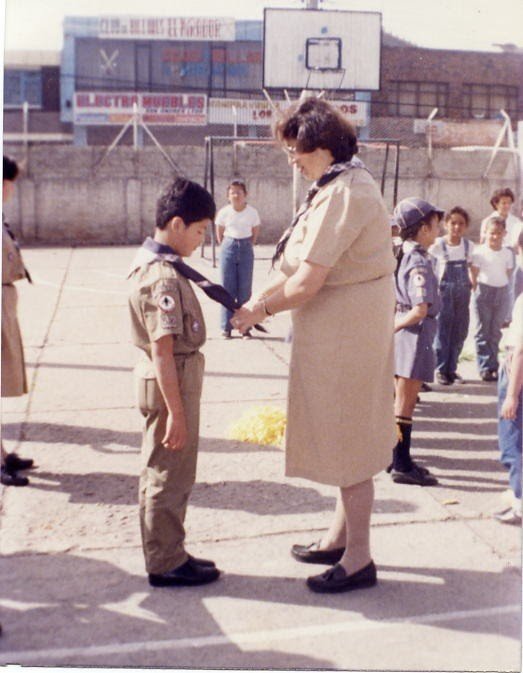
My fears were a topic that was very rarely talked about. I remember mentioning it to my dad, who by the way had already shared with us many of the stories I narrated in the first chapter of this book, which made me admire him as a brave man, from whom perhaps I could learn to be less cowardly. I don't remember his answer well, but I know it had the practical style of the reasons my parents learned to accept: The important thing is not to think too much about those things, not to show fear and to be careful. There was no motivational talk of “you have the strength inside you” or anything like that, nor was there money to allow me a change of school to a higher stratum one or to pay for private transport, but I believe that that talk could have been one of the reasons why my parents enrolled me in karate classes and in the Boy Scouts[2] of Colombia.
I have to say that although I don't believe either of the two activities took an iota of fear away from me or made me braver, they were two of the most pleasant experiences I lived in those years. The karate class of barely one hour a week wasn't enough to give me the slightest advantage in hand-to-hand combat, let alone protection against street robberies, but it did give me the first opportunity to practice physical discipline, the mystique for ancestral knowledge and the art of concentration. The Boy Scouts also did their part in fostering in me discipline, concentration and mystique; although not religious but a mystique for ingenuity, service and authority. With the Scouts I met young people curious about science and technology and eager to own knives and razors to earn the respect of the troop, but not through fear as I had seen at my school, but through admiration and hierarchy.
From my short time in the “State of Israel” company of the Scouts, I remember however one of the many tragic stories that urban insecurity has written in Colombia. The husband of the coordinator of the company I belonged to had also been an enthusiast of the Scout movement and coordinator of a large group of girl and boy explorers. One day, while he was with his troop camping in one of the eastern mountains of Bogotá, in the upper part of the National Park, the group of scouts, who were learning to make knots, stakes and other survival knowledge in nature, was assaulted by a group of thugs with firearms. Without consideration for the presence of children, the assailants stripped the group of money and valuables, during what must have been, for the kids, endless minutes of panic. But not content with the loot, the assailants decided to sexually harass some of the girls of the pack. The coordinator of the group, faithful to his principles and responsibility toward the minors, tried to prevent the attack, at which the assailants opened fire on him, taking his life in front of his pupils.
The events had occurred several years before I joined the Scout company, but even so, the story had a deep impact on my impressionable mind. How could there be people in the world who acted with such evil? What must those minutes of panic have been like while the criminals walked among the children frisking them and threatening them with revolvers? What must have been the last thoughts of that good man, who surely didn't imagine that when he left home in the morning it would be the last time he would see his wife and children?
The images of that event, which I didn't witness but recreated in my mind based on the story I heard, have haunted me ever since and from time to time they reappear. Sometimes I felt as if the spirit of that man killed for his bravery asked me not to forget him, that he didn't want his sacrifice to be in vain. I didn't imagine I would ever write his story, but here I am honoring his memory, since he represents at the same time what I desire and what I most fear: the courage to confront injustice against the weak and the possibility of leaving this world at the hands of the unconsciousness that abounds in it.
My favorite place in the house was my room, but not even there could I completely isolate myself from the difficult reality of living in a poor neighborhood in a hostile city of a violent country. My room was on a second floor, with a view of the street and almost no acoustic insulation from it. Some nights, usually Fridays or Saturdays, my fragile sleep was interrupted by cries for help coming from outside, sometimes also by gunshots and frequently by the noise of fights between drunks. When it happened, depending on the severity of the episode, my reaction was to remain motionless in my bed, feeling the cold of fear and visualizing in my mind the events that would correspond to the noises I heard.
My wife, who grew up in a working-class neighborhood in the city of Medellín, tells me that she remembers that, during her adolescence, on more than one occasion she heard nearby gunshots from her room, but not of a revolver or pistol but of a rifle or machine gun, and that the next day the story wasn't one of a robbery or settling of scores but of a massacre carried out a few meters from her house. Common crime has been substantially reduced in Colombia in recent years and experiences like these aren't as frequent as they were during the 90s; however, there would still be a lot of terror left before hitting rock bottom and Colombians recognizing that our country was about to become a failed state, a narco-state in civil war that would have made the tragedies of Syria or Yemen pale in comparison.
The above was prophesied by Jaime Garzón, a brave — and probably crazy — comedian who dared to denounce the formation of paramilitary groups at the service of the recalcitrant right and the connivance of politicians and drug traffickers. Personifying a humble and candid shoe shiner, Jaime sat at the feet of the most famous and powerful people in the country and from there told them “chanda”, “cafre”, “delincuente”, “corrupto” with apt impudence, while throwing them sharp criticisms and inquisitive questions. The interviewees laughed nervously and tried to respond without seeming cornered, but what they didn't know was that millions of viewers who waited for each appearance of Heriberto, the character created by Jaime, saw ourselves reflected in him and felt a small popular victory with each intellectual knock-out he delivered.
Unfortunately, Jaime Garzón was murdered on August 13, 1999, when he was heading to his work at the radio station “Radionet”. It was the first assassination that touched my heart and I still remember that Friday morning when my mom entered my room distressed with the news: “they killed Jaime Garzón”. The sadness and anger were felt as if it were a close friend. Some headlines said “They killed the laughter” and a news anchor said goodbye to that day's newscast saying “… Good afternoon… What a shitty country!”
The death of Jaime Garzón was just the beginning of one of the darkest periods of Colombia, a new bloody chapter in the history of my country that seems to have the habit of inaugurating a stage of infamy with an assassination and a catastrophe: in 1948 political violence began with the murder of Jorge Eliécer Gaitán and the burning of downtown Bogotá, in 1985 the violence of drug trafficking began with the murder of the justice minister Rodrigo Lara Bonilla and the Armero avalanche, but I happened to live more closely the paramilitary violence that began with the death of Jaime Garzón and a devastating earthquake in the coffee city of Armenia. With the new millennium, a new nightmare began in Colombia.
[1] Name given to the human couriers used by drug traffickers to take drugs abroad, commonly adhered to the body or ingested.