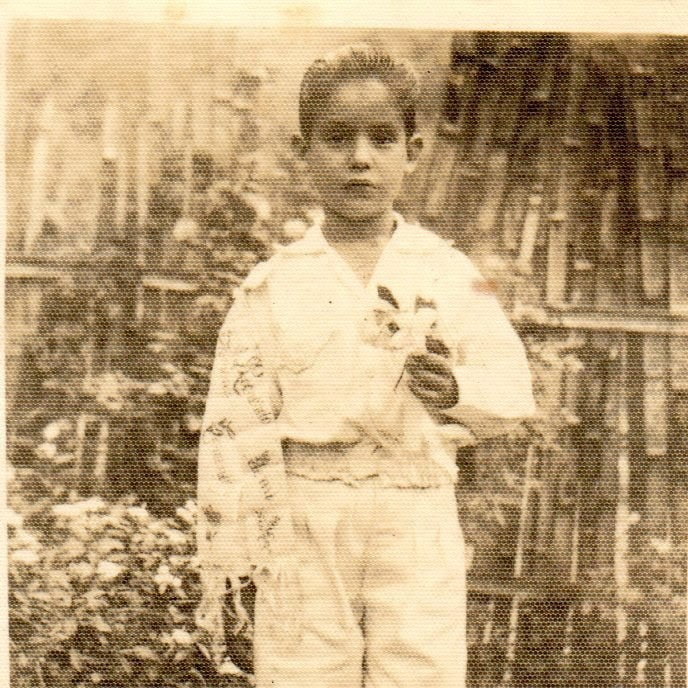
It is with great emotion that I want to share with you the first chapter of the story of my spiritual path, which I wrote more than a year ago. It is very important to me, because on the one hand it gathers together the experiences that my father, like millions of poor children and young people in Colombia, had to face in the long conflict that is bleeding my country dry.
On the other hand, it reflects the sociopolitical changes of the mid-twentieth century and many of the circumstances that marked my spiritual path, even before my birth.
I hope you enjoy this narration and share your comments with me.
Víctor Manuel Ávila, my father, is the youngest of nine siblings. He was born in Paime, a small town in the Colombian department of Cundinamarca, 130 kilometers north of Bogotá, and there he lived his childhood during a turbulent period in Colombian history, a prelude to what would be known as the era of “La Violencia”, which took place between 1948 and 1958.
There is no certainty about the exact circumstances that gave rise to this bloody chapter in my country’s history, but what is fully accepted is that it was driven by the political rivalry and clash of interests between the liberal and conservative parties. The government in power provoked the opposition with savagery, using fiery speeches, and provoking responses in the form of the organization of guerrilla movements, paramilitary groups and corruption, especially within the state armed forces. The confrontations that took place during that era caused more than 300,000 deaths, more than 8,000 disappearances and some 7.6 million victims over more than 55 years[1].
My grandfather, Rafael Jiménez Suárez, who had been a doctor and the mayor of Paime for the liberal party, was found dead when my father was three years old, presumably drowned while crossing the Mancipá river, which separates the towns of Tudela and Cuatro Caminos, towns near the municipality where my father was born.
Besides the poverty and the limitations typical of the first half of the twentieth century, my father also had to confront the anguish provoked by the persecution the family suffered because of its liberal origins. He feared being attacked by the ‘chulavitas’, paramilitary bands of the conservative party that roamed the rural paths of the region, and which he had to cross to run errands for my grandmother. Many times these criminals threatened to enter the town, which caused unrest among the inhabitants, who feared for their lives and their property. Massacres frequently occurred in the countryside, so my father was a first-hand witness to the arrival in town of peasants carrying the corpses of their family members or neighbors.
Violence touched the lives of most people living in the rural zones of Colombia, but with even greater savagery in some regions. The animosity that existed between liberals and conservatives was mixed with corruption, provocative speeches and, occasionally, fistfights between figures from the highest social classes, who were in charge of infecting the people with hatred and fear, with the collaboration of some priests from the pulpits. In rural communities, this resentment translated into massacres, house burnings, rapes and other brutal acts.
When he was a very young child, my father tells me, he heard the story of a pregnant liberal woman whose husband cut open her belly and extracted the fetus to decapitate it, because he believed that in his absence she had been with a conservative: “No vaya a ser que nazca otro hijueputa godo”, he is said to have added as an epilogue to the macabre act — “Lest there be born another goddamn godo bastard”, as they say in Spain.
It was impossible to tell which party the victims of the violence belonged to. The bandits of one party and the other, goaded on by their leaders, remained eager for vengeance, so it was enough for a victim to be pointed out by someone they knew, to receive the order, or simply for someone to be seen wearing clothes in the colors of one or the other party, for that person to become a target to be pursued and eliminated.
My father’s family was not involved in politics, but was exposed to hostility and persecution by the conservatives because of its closeness to a former liberal mayor, my grandfather who had already died, and that led my grandmother to give her children her own surname rather than her husband’s. That is the reason my family name is Ávila and not Jiménez.
After the death of her husband, my grandmother sold the books and medical instruments he had, to raise some money with which to stretch the limited funds he had left, and so survive a little longer with her children. Once the reserves were exhausted, the Ávila family went to live in Tudela, a ‘corregimiento’ (sub-district) of Paime, in a small farm my grandmother had bought thanks to a bank loan. There the violence was even more brutal, especially in the countryside. Mules frequently arrived carrying the corpses of peasants stretched across their backs.
One event of childhood that deeply marked my father took place in those years of atrocious fighting between liberals and conservatives in Tudela, when he was only eight or nine years old. The conservative government in power, alerted by the growing organization of the “cachiporros”, as the liberals and their paramilitary bands were called, who were consolidating themselves in the north of the department of Cundinamarca, in the area formed by the towns of Yacopí, Topaipí, Caparrapí and Tudela, sent a ferocious army lieutenant whom my father remembers as Lieutenant Guerra, with the mission to “pacify” the region. To achieve that objective he had been assigned a small contingent of soldiers, clearly insufficient to carry out the assignment, had not the infamous lieutenant formed his own paramilitary army with dozens of peasants, whom he himself trained to torture and kill in the most savage way.
A known acquaintance of my father surnamed Rocha, who was among the irregular members of Lieutenant Guerra’s squadron, told him about the methods they used to finish off the “cachiporros”, making use primarily of the machete as the instrument of justice. Guerra and his men rained on the region for months looking for informants, torturing prisoners and using other violent tactics to obtain the names of the peasants who, secretly, formed the liberal self-defense bands.
One day, just before dusk, Lieutenant Guerra arrived in Tudela with his group, bringing along a string of livestock, horses and mules that they had stolen from the farms they had passed through. The lieutenant in question gave the order to find a place where his animals could feed and drink, before continuing their journey. The next morning, when the band was about to set off on its way, the lieutenant took inventory of his animals and noticed that a mule was missing. Some soldiers set out to look for the animal, but as they could not find it, they reported the news to Guerra, who, extremely furious, threatened the locals, telling them that if the mule did not appear, the inhabitants of the town would pay for the insult. He immediately gave the order for the soldiers to gather the men of the place in the central square and to bring ropes from the town’s stores. They came back accompanied by dozens of men who stood in the square, and in terror they heard the order to be bound neck to neck, one to another. My father, by his age, did not suffer that ignoble treatment, but several of his relatives did, who had the misfortune of being in sight of the soldiers.
“O me dicen dónde está la mula que se robaron o los llevo a todos amarrados de aquí hasta Villagómez”, the lieutenant bellowed — “Either you tell me where the mule they stole is, or I take you all bound from here to Villagómez”. While he did so, the soldiers pointed rifles and machine guns at the terrified inhabitants, who trembled at the prospect of being victims of Guerra’s threats, for the distance was some twenty kilometers from Tudela.
Guillermo, one of my father’s brothers, found the courage to address the odious lieutenant and asked permission to go with a friend to look for the mule in a place of difficult access, where they knew animals tended to get lost. Guerra agreed, not without first warning them that if they did not succeed, they would have to join the macabre human “rosario” (rosary — a string of bound men). Fortunately, the boys found the lost animal and managed to free the unjustly detained neighbors. This would be, however, an ephemeral relief, for before continuing on their way, the lieutenant made use of some beautiful horses that belonged to the family of one of my father’s sisters and announced that he would take them to Villagómez and leave them there, unless someone went with them and brought them back. Guillermo, the brave brother who had just achieved the freeing of the town, was not about to let the animals be lost, so once again he turned to Lieutenant Guerra and announced that he and my father would go with them to bring the horses back.
The two boys set out to cover the twenty kilometers of the route on foot, behind the sinister procession that was going on horseback. When they had advanced a couple of hours, on arriving at Cuatro Caminos, Guerra split the platoon into two groups: one would continue to Villagómez and the other would head for Paime. As one of the animals stolen from the family would end up in Paime and the others in Villagómez, Guillermo convinced my father to go with the group heading to Paime, and that he would take care of the rest.
My father still remembers the mixture of fear and excitement that overwhelmed him when he found himself alone, following the group of ruthless assassins, and the courage he had to keep going without knowing whether they would keep their word. The recruitment of children for armed struggle was a common practice at that time and one that still continues in the twenty-first century on the part of illegal armed groups in Colombia. Fortunately, that was not my father’s fate, since he managed to return triumphant with the horse of his sister’s husband. Before reaching Tudela, he ran into Guillermo, who looked imposing astride a gleaming saddle mounted on one of the horses Guerra had taken. When my father asked him about the saddle, he said: “Me la regaló el teniente por haber tenido la valentía de irme con ellos” — “The lieutenant gave it to me as a gift for having had the courage to go with them”.
When my father recounted this story to me, he told me of the pride it was for him not to have surrendered to his own fear and to have been able to rise above it to protect the property of his family. The fear of human violence and the need to confront it in order to prevent injustice would be two very great forces in his life. The episodes narrated here, together with many others he had to live through, became the stormy nightmares that pursue him to this moment of his life. Frequently, at night, he has vivid dreams in which he shouts that they are coming to kill him, fights with robbers, acts as if killing animals, or asks that they grab a bandit. Likewise he has had to live accompanied by a fear, at times irrational, of dangers that lurk at every corner; I judge that the cause is the persecution his family was a victim of. Fear became an imprint of his personality. For many years he assumed the role of protector and watchman over his loved ones, a demanding task that would rob him of the joy of life, which for the most part stayed away from the hardships of his childhood and which was, instead, full of love and well-being.
His courage to face violence, experienced in episodes like the one in the account above, endowed my father with the ability to confront injustice despite the fear. Something without doubt admirable but also dangerous, as would become evident several decades later when, with more than 70 years on his shoulders, he resisted an armed robbery carried out near his home, just as he had withdrawn a large sum of money from a bank. My father wrestled with one of the robbers, defending the jacket in which he was carrying the money, without caring that he was the target of a firearm. The bandits managed to snatch the garment and opened fire during their flight, without wounding my parents.
It is worth noting that many people in Colombia have lost their lives during experiences like this one, so my parents were lucky to come out unharmed, at least physically. For both of them it represented a psychological trauma from which my mother recovered quickly, making use of her usual positivity, but for my father the event signified the materialization of those gloomy dreams of old and the manifestation of episodes of anxiety and then of the symptoms of Parkinson’s disease, which has accompanied him ever since.
It is no less true that my father’s courage also put the family to safety on several occasions, not defending us from violent events like the ones he lived through, but using it to overcome his own vices, like the cigarette before my birth, the liquor when he noticed that it made him aggressive with his wife, and the craving for “easy” money that preyed on him and which was the culprit of the death of several members of his family.
My father’s family lived five years in Tudela, because my grandmother decided to sell the farm and return to Paime, where she and her children, with the help of the prisoners in the municipal jail, built the house. To live in a violent municipality meant living in constant apprehension. There were frequent warnings of the presence of the ‘chulavitas’ in the town, so the women and children would run to hide and spend whole nights among the thickets of guava near the river. The men were in charge of guarding the entrances to the town, armed with their machetes.
I tell you, Chucho the muleteer, who lives in the channels
That they kill some of us as godos, and others as liberals
But what does that matter, grandfather, so what is it that matters
My old ones were so good, they did no harm to anyone
Only one thing I am sure of, that before God we are all equal.
There appear in elections some they call caudillos
That go around promising schools and bridges where there are no rivers
And into the soul of the peasant comes the color of the party
So he learns to hate even the one who was his good neighbor
All because of those damned professional politicians.
“A quién engañas abuelo” — Traditional song of Colombian folklore.
The two-party violence that was already out of control in a good part of the country was about to worsen even further with the assassination of Jorge Eliécer Gaitán, the liberal candidate for the presidency of the republic, at the hands of a hapless wretch, on April 9, 1948, on the corner of Avenida Jiménez and carrera séptima in Bogotá, according to some theories, at the behest of the CIA and with the support of the conservative government of Mariano Ospina Pérez. This act unleashed the rage of hundreds of Gaitán’s supporters, who quickly cornered Juan Roa Sierra, the material author of the assassination, whom they lynched and dragged up to the steps of the presidential palace. There they continued to gather, the furious followers of the fallen caudillo, and faced the possibility of a popular uprising, the government of Ospina Pérez repressed the protests violently. The clash between the demonstrators and the armed forces unleashed such chaos that it culminated in looting and arson throughout most of the center of the city. These events would be known from then on as “El Bogotazo”.
Poverty reigned in my father’s home, a situation that required him and his siblings to go to relatives’ and friends’ places in search of groceries and food. My father remembers that despite the poverty they were going through, the family kept the dignity that came from the fact that my grandfather had been a doctor and a mayor. The friendships, especially those of my grandmother, were the most prestigious in the region. “Que no se nos note la pobreza” — “Let it not be noticed that we are poor”, my grandmother used to say, who took great care in the good manners and personal presentation of her children.
The situation of both violence and poverty became unsustainable in Paime, so my grandmother made the decision to send my father to the house of a friend of hers who lived in Bogotá. Just as millions of peasants would be forced to do in the decades that followed, my father emigrated to the big city in 1949, a year after the assassination of Gaitán, and so was able to see for himself the devastation wrought by the violence unleashed during El Bogotazo.
Living in Bogotá, my father was forced to take on any job he was capable of doing: a deliveryman of products in the market, an assistant in a butcher shop where he made home deliveries, a helper in a stationery store, the caretaker of a dairy farm, a warehouseman, a telephone operator, and even a construction worker. At that time it was common for poor children to work alongside adults in heavy and sometimes dangerous tasks, as long as they had the strength to carry them out.
At that time, the center of Bogotá was inhabited mostly by working and honest people, but in some areas, like the one where my father came to live, it was common for robberies, fights, the presence of prostitution and other problems typical of the most populous zones of a metropolis in the making. It was not the best environment for a child, but the advice and values instilled by my grandmother kept him away from criminal activity, though not from alcohol and cigarettes, which captivated him from a very early age and which would be a constant trial for his strength of will for many years.
Despite the daily efforts, the family's financial situation did not improve. Alipio, one of the older brothers, in a sense his hero and the family member closest to my father in Bogotá, wanted to become one of the hundreds of smugglers, to bring in liquor, clothing and other products from Venezuela and thus obtain money more quickly. Smuggling would be, years later, the first criminal activity of Pablo Escobar. The young Alipio already knew the necessary contacts among the customs officials and the tactics for smuggling all kinds of products without being discovered, so he invited my father to join him in this activity. It is easy to guess that my father saw in the proposal a quick and effective way to get out of the difficult financial situation they were in, while enjoying an adventure alongside his admired brother, and so he committed to participating in the project.
The plan never came to fruition, because Leticia, one of my father's sisters, together with her husband Octavio, took charge of dissuading him from such a foolhardiness, preparing their best arguments to achieve it. As in order to enter Venezuela my father had to have his military record book and had not requested it, they invited him to their home in Junín, Cundinamarca, under the pretext of helping him to resolve his military situation before embarking on the neighboring country. My father gladly accepted the help and traveled to Junín to receive the promised aid. When he arrived, he did find a hand extended, but the offer was different: that he cancel his trip to Venezuela and, in exchange, they would help him to validate his elementary studies and support him to apply for a scholarship at the Escuela Normal for his secondary studies, and in addition they would provide him protection, companionship and the necessary support to become a rural teacher, and as if that were not enough, they would help him obtain his military record book, through the influential contacts of his brother-in-law.
The plan worked, my father could not refuse such an offer, and so he ended up living with Leticia, Octavio and their four daughters in Junín. There he completed the four years of secondary education he needed to become a rural teacher. They were difficult years for a young man who was already accustomed to conquest, to drinking and smoking, and to getting into fistfights from time to time, but who found himself obliged to honor the trust of Octavio and that of his sister. With the approval of my grandmother, my father fully kept the word he had given, abandoned the idea of smuggling, left his vices and devoted himself to studying.
At the Normal, my father found it very difficult to comply with the strict rules imposed by the religious who ran the educational institution, and to accept the authority of teachers who were barely a little older than him. He had problems with one of them, who, by those coincidences of life, was also interested in a young woman my father used to frequent. One day, on arriving at the school after having been absent without permission, he ran into the teacher in question at the door, who was waiting for him. Faced with the reprimand and the threat of expelling him, my father, furious, confronted him, for which he was referred to the rector's office, where the priest in charge reproached him for his behavior, rubbed his face with the scholarship and suspended him for fifteen days. This incident nearly put an end to his career as a teacher.
Despite the ill feeling of the priests who ran the school and of the teachers, my father had won the respect and affection of his classmates, who admired him for his frankness and solidarity. The students my father taught during his teaching practicums also respected and loved him. He developed a talent and love for teaching, and a skill both for listening and for advising people in need, so much so that my father came to contemplate the possibility of becoming a priest, in order to serve the community in this way and, probably, to do it better than those retrograde clergymen he had known, some of whom proclaimed, for example, that no liberal could call himself a Christian. I believe this is also the origin of my own interest in doing something meaningful for others.
Becoming a priest, before finishing his studies, would be another project my father would not carry out, but not by the intercession of my grandmother or of Octavio, his “guardian angels”, but by the church's discrimination against “natural” children or bastards. As my father only had my grandmother's surname, his civil registry looked like that of many illegitimate children, a sufficient reason to be rejected as a seminarian. Looking back in retrospect and knowing that my father had a very good time in the company of women in the following years, I dare to doubt his consistency in clerical apostleship.
In parallel with the fierce political and social violence that has struck my country for most of its history, sexual violence is the expression of terror that has most relentlessly targeted women and children, especially in the marginal zones of Colombia. In the beginnings of his teaching career, my father had to confront this reality through his students and learn to recognize its signs, in order to help those who were abused and to stop the propagation of the evil among the children themselves, who, painfully, went from being victims to being perpetrators.
Such was the case of Pulgarcito, one of my father's students in his first years of teaching at an institution dedicated to training in arts and trades in Girardot, for juvenile delinquents captured in the neighboring towns, called “El Amparo del Niño”. One of the crimes most frequently imputed to the minors that this center attended to was the sexual abuse of other minors, taking advantage of the anonymity provided by the extensive forests bordering the Magdalena river. Many children who had been abused by adults did the same to even younger children, whom they intercepted on the lonely paths of the area.
One of the little ones who suffered this scourge was a lively and cheerful child whom everyone knew by the nickname “Pulgarcito”. My father remembers this child both for his joy and talent for music, and for the difficult experiences he went through, which are a show of a sick society. Pulgarcito was raped by children older than he was, and as if that were not enough, he was infected with syphilis, a sexually transmitted disease. The infection spread to his internal organs, causing renal failure and other problems that brought Pulgarcito to the brink of death. My father, together with other teachers, took on the care of the child for several days and nights, providing him with the necessary medicines and care, until, fortunately, he achieved his full recovery.
The preceding would not be the last time that Pulgarcito had to escape the clutches of death. During an outing to the Magdalena river, the teachers who were looking after the minors, including my father, warned those who did not know how to swim to stay on the bank, far from the strong currents of the copious river. Pulgarcito was one of the minors who did not know how, so they panicked when they did not find him on the riverbank. They set out to search for the child and finally managed to see him when he approached the bank, swimming clumsily, from the middle of the river.
My father helped him out onto the bank so he could collect himself, and then asked him why he had said that he did not know how to swim. Faced with the question, he answered, “Aprendí ahorita que José me empujó desde aquella piedra” — “I just learned that José pushed me from that stone”. A story with a jocular ending that could have ended in tragedy, and that also shows the ruthless law of the jungle that the children in the marginal zones of Colombia lived — and still live. Many stories like this one also formed in my father an acute distrust of human nature, which he considered prone to evil and lack of restraint. “Piensa mal y acertarás” — “Think ill and you will be right” — was one of his most frequent sayings, especially when it came to sexual instincts.
This distrust was not only toward strangers, but even toward himself, and later toward me, his son, as men bearing that “original sin” or seed of evil that could surface at the slightest negligence. This distrust would become, much later, a determining factor in my spiritual path and in some of the trials we had to face together, but that is part of another chapter of this book.
Not having managed to become a priest, something that in any case would have been a challenge considering the romanticism of my father, he became a rural elementary teacher in the midst of the political and cultural revolution of the sixties. These years of agitation deserve a brief contextualization. At that time, Latin America had become an ideological battleground of the cold war, where a struggle was being waged between an oppressive and religious right-wing government and a left-wing wing formed by three revolutionary armed groups, a couple of communist parties and most of the workers' unions.
Just as in most Western countries, in Colombia, being a representative democracy, the citizens go to the polls every four years to vote to elect a president who, as in most countries, is the head of the executive power of the State. The presidential candidates, during most of the twentieth century, always belonged to either the liberal party (center-left) or the conservative party (right). Both factions have been led, since the beginning of the republic, by white men belonging to prestigious families, generally landowners, descended from the Spanish feudal lords to whom most of the country belonged, from the colonial period until the beginning of the nineteenth century.
The political status quo was firmly supported by the Catholic church, because it allowed it to enjoy enormous power in politics, education, health and in society itself, in a country where at that time 90% of the population identified as Catholic, apostolic and Roman[1]. This power ensured that most of the citizens did not dare to challenge the prevailing order. However, things were about to change thanks to the influence of communist thinkers and philosophers from Russia and China, but to an even greater extent, thanks to the enthusiasm generated by the Cuban revolution of 1959, which attracted even Catholic priests, like the Spanish priest Domingo Laín and the Colombian Camilo Torres, one of the inspirers of liberation theology and author of the phrase “If Jesus were alive, he would be a guerrilla fighter”.
The communist promise of equality and justice for the poor, plus the uprising of the oppressed — the proletariat —, resonated with force in the minds of the peasants who had left the countryside and suffered the rigors of poverty and exclusion in the poorest and most marginal neighborhoods of the city. Likewise, it thrilled the indigenous peoples and farmers, who, to a greater extent, suffered the violence in the countryside.
The images of armed peasants triumphantly entering Havana, motivated hundreds of workers, students and community leaders to go to the mountains and jungles of Colombia to rise in arms against the establishment. Between 1964 and 1967, three guerrilla groups were formed in Colombia: the FARC[1], the ELN[2] and the EPL[3]. The first of them supported by the Soviet Union, the second by Marxist Cuba and the third by Maoist China.
According to official history, the Cold War was a political and ideological tension in which not a single bullet was fired, but nothing could be further from the truth. Perhaps the Soviet Union and the United States never came to participate in a military confrontation, but both powers fueled a countless number of armed struggles in the Middle East, Africa and Latin America, which produced rivers of blood that even to this day still run. In Colombia, the guerrilla groups received training, weapons and money from the USSR, and the government's military and paramilitary forces got the same from the U.S. In this context, the left-wing groups deployed their doctrine in the cities, attracting the most receptive segments of the population such as the young and the working class in the universities and the unions. While the extreme right used the church, the army and the secret police to neutralize anything that smelled of the left, as we say in Colombia, “a las buenas o a las malas” — “by good means or by bad ones”.
One of the sectors that showed greater sympathy and militancy around the socialist precepts was that of official teachers, while the teachers of private schools were less combative or kept their loyalty to their employers. Most of the teachers of public schools were educated people coming from less favored social classes, well organized and willing to fight for the dignity of their profession and of the educational community in general.
In 1963, with this complicated context as the backdrop, my father was placed in a school in Bogotá. There he not only began his career as an educator, but at the same time he exercised another profession that he had also found gratifying, representing his coworkers in the teachers' union of the District. The Asociación Distrital de Educadores (ADE) was one of the most belligerent unions in Colombia and, as I said before, an organization ideologically leaning to the left.
Besides the teaching of Mathematics, Social Sciences and more, my father listened to the complaints and grievances of his companions and represented them in the assemblies that the ADE held every month. The teachers also spent long hours between classes and after their meetings discussing the political affairs of the country, sometimes to the rhythm of the revolutionary chords of Silvio Rodríguez or Ana y Jaime, and during those conversations many of them professed their loyalty to the communist parties, which were struggling to gain political representation, but others did not hesitate to express sympathy for one of the guerrilla groups fighting in the mountains of Colombia.
Having been a witness to the harshness of the violence in his homeland, my father did not support violence as a means to achieve social justice, but the romantic image that the Cuban revolution projected on the Latin American left influenced him to consider that a certain level of violence was inevitable, if one wanted to overcome the resistance that the oligarchy exercised against the emancipation of the people. Even today, after having visited Cuba a couple of times, my father still thinks that, despite its deficiencies, Cuba is a more egalitarian and happier society than capitalist societies. In this I consider that he is somewhat right.
Nevertheless, as Colombia is not Cuba, after years of armed rebellion, none of the three most important guerrilla groups (because there were other lesser guerrillas) has managed to destabilize the Rule of Law. They had all already shown signs of corruption and excesses, plus other problems, which led to the decadence of the guerrilla movement in the country, which became a collage of micro-states entrenched in the map of Colombia, adopting variants of communist and socialist schemes, while at the same time carrying out shady businesses like drug trafficking, extortion, kidnapping and smuggling.
Despite his admiration for Cuba and his loyalty to the communist manifesto, my father refrained from supporting the armed rebel groups, until the M-19 appeared. The Movimiento 19 de Abril (April 19 Movement) was a guerrilla movement that was born in the second half of the seventies, which managed to obtain significant popular support in the cities, especially among the working middle class. Its appeal, to a great extent, lay in its composition by intellectuals and its moderate approach to violence (something that came to an abrupt end in 1985, when the guerrilla group carried out the military takeover of the Palacio de Justicia, an event that caused 98 deaths and that sealed the union between drug bosses and the guerrillas[2]).
The M-19, or the “eme” as the people affectionately called them, stole milk trucks to distribute the product among the poor, carried out the theft of the sword of the liberator Simón Bolívar[4], proclaiming that the mission of liberating Colombia from oppression was now in the hands of the people[3], in addition to carrying out other symbolic acts that made them worthy of the affection of the people.
Many teachers, philosophers, students and workers gave their lives a turn to fight for their ideals in the ranks of the guerrilla. Some of them did it by taking up arms in the mountains, but others stayed in the city as ideologues, recruiters or assistants in the urban military actions of the movement. By 1976, my father was already a very well-known leader in the district union and had participated in some political assemblies with the urban commands of the ELN and the M-19. At that moment, on the verge of turning 40 and with no plans of forming a family, my father thought that his vocation to help others would find a place enlisting in this revolutionary movement.
My father was uneasy because he had been invited to join the guerrilla, so he decided to tell his dear mentor Octavio González, who for some time had been worried about the frequent meetings he held with a teacher, a recognized activist of the M-19. He listened attentively to the explanations and arguments he had prepared, but as he was not about to let him derail his life, not even under the pretext of achieving the elusive social justice of the country, with very shrewd arguments, love and intelligence he convinced him not to accept that invitation.
Octavio had done the same almost 20 years earlier, to dissuade him from becoming a smuggler on the border with Venezuela. In this way my father's revolutionary project failed. Perhaps he brought to his attention the many vices of the Russian, Chinese and Cuban revolutions, the excesses of the Latin American guerrilla, or the contradictions between the romantic discourse of the communists and their actions. Whatever it was, my father abandoned the idea of being a guerrilla fighter.
Later, that same year, my father met Julia Elena Rincón, my mother, and they pledged to work together to live and honor the ideals of revolution and of love… For the cause. Thank you, Octavio!
Figure 3: My parents in Bogotá, shortly after meeting each other. On the back of the photo, my father wrote a love letter that also serves as a revolutionary declaration. Love with a rebellious spirit. Around 1976.
[1] Fuerzas Armadas Revolucionarias de Colombia (Revolutionary Armed Forces of Colombia)
[2] Ejército de Liberación Nacional (National Liberation Army)
[3] Ejército Popular de Liberación (Popular Liberation Army)
[4] Simón Bolívar was the commander of the troops that liberated Colombia and four other countries of Latin America from the yoke of the Spanish crown in the early nineteenth century.
[1] Comisión Nacional de Reparación y Reconciliación (Colombia), ed. ¡Basta ya! Colombia, Memorias de Guerra y dignidad: Informe general. Segunda edición corregida. Bogotá: Centro Nacional de Memoria Histórica de 2013.