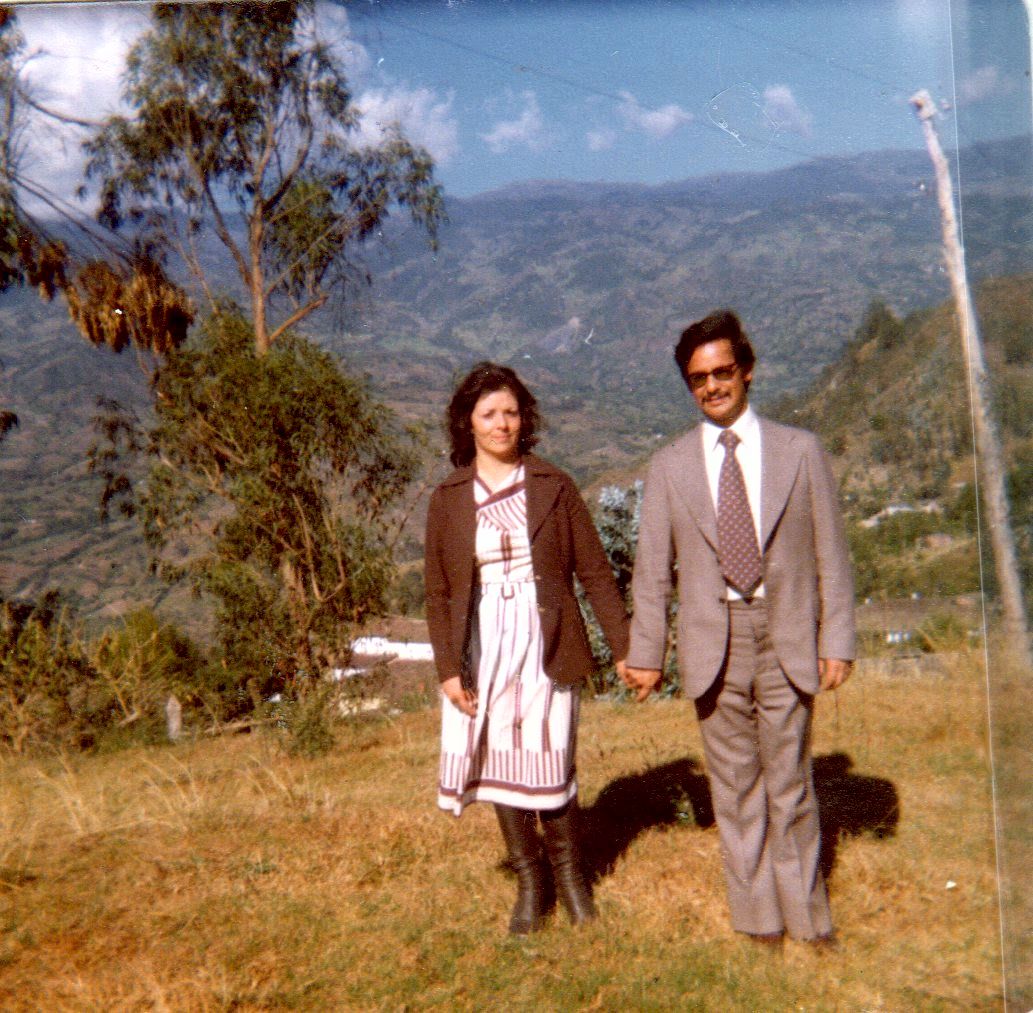
My mother Julia Elena Rincón Martínez was born in Fómeque, east of Cundinamarca, very close to Bogotá, fifteen years later than my father, in a less turbulent era than the one he had to live through in his childhood. Unlike my father, my mother has better memories of her childhood, despite the difficulties she and her family had to endure.
Her story is also tied to the poverty of the twentieth century in the Colombian countryside, but happily without the violence my father had to witness, in a family with a marked European and indigenous heritage. My grandmother Ana María Rosa Martínez was white, with light eyes. My grandfather Luis Alfredo Rincón had the typical features of the Muiscas, the original inhabitants of the Colombian territory. The Muisca indigenous people are the ancestral nation I will speak about in greater depth in another chapter.
Some of the stories I most enjoy hearing from her are those related to the ingenious customs with which the family had to meet basic needs, for which today we have easy solutions, thanks to technology and science. For example, when traveling to town took more than three hours on foot — to go to Chiquinquirá, my grandparents organized expeditions of more than fifteen days of walking there and back, carrying food and provisions. But even more, my grandparents were poor farmers who had to provide for their nine children, when they could not simply go out to the corner store to buy what they needed. In fact, my grandparents could only afford to pay cash for things that were absolutely impossible to grow, process, build or create with their own hands. One example my mother remembers is the making of sleeping mats and reed beds to sleep on instead of mattresses, which the family did not know. They were made with the dry layers of the stalk of the banana plant grown near the house and of the reed, a plant that grew in the wetlands, using a loom as a guide. Mattresses arrived at their house long after my mother's childhood had passed. My grandmother was in charge of preparing the materials for making the mats and reeds; she cut the stalks, loosened their layers and cut them to the same length to let them dry. She prepared the fique and made the cords with which she tied two canes at a certain distance to go tying the rolled-up layers of the stalk.
One might think that at least the rope would have had to be bought at the market, but even that was done at home. My grandparents marked the boundaries of the farm with fique and borrachero leaves. Fique is a monocotyledonous plant native to the Andean regions of Colombia, similar to the agave plant, with leaves whose structure is formed by strong strands of fiber[1]. My grandmother trimmed the leaves, crushed them with a defibering tool, washed the fiber and left it to dry to later weave it into braids or cords of various gauges, not only for the mats, but also as ropes, espadrilles, laces and anything else that had to be tied. Nowadays, if someone needs a new mattress, they only have to log on to Amazon, choose one that fits their budget, wait a couple of days for it to arrive and put it on their bed. For my mother's family, even some of the things we currently consider the simplest and cheapest were a demanding task that required the participation of several people over several days to complete. One advantage in those times was that very little garbage was generated. Almost everything was biodegradable, although it was not always composted; sometimes it was burned, thus reducing the eco-friendliness of peasant life. Even so, country life was much less aggressive toward the environment than our current life in the cities.
All this self-sufficiency was not only the result of economic constraints, but also the legacy of our Muisca indigenous people. The grandparents' house was made mainly of wood, adobe and rammed earth, similar to those used by native communities 500 years ago. There were also some earthen floors, others wooden, and zinc roofs, which in the past would have been replaced by stones and thatch.
I have already mentioned the difficulty involved in getting to the municipal seat in my grandparents' time. That, added to the precarious quality of the Colombian health system of then (even today it is quite deficient), made traditional naturopathic medicine hold first place in home health care. My grandmother was a walking pharmacopoeia and knew the most effective remedies for treating everything from stomach aches to scorpion stings. The house was always surrounded by aromatic and medicinal plants such as rue, chamomile, dandelion, plantain, wormwood, borage, fennel, aloe vera, thyme, eucalyptus, elderberry, willow and many others.
An interesting story regarding my grandparents' medical skills is that once, the owner of a neighboring farm, who was clearing the pasture with his machete, sliced off the thumb of one of his hands. He arrived at the house and asked my grandfather to sew it back on. Looking at it, he calculated that the severed thumb would not survive the long trip to town, so he did not hesitate to look for needle and thread, have everything sterilized and proceed to sew it. The distraught neighbor kept insistently asking my grandfather, 'will it take or won't it take?' To everyone's surprise, with time and care the thumb took, and although it completely lost its mobility, it saved him from a life with one less finger.
The neighbors of the hamlet sought out my grandfather to castrate their male animals. He did not operate on females, nor was it customary to do so back then.
There was, of course, also a long list of superstitions that complemented, whether through placebo or still unknown physical effects, the medical arsenal of the countryside. This included urinating on stones so that children would stop wetting the bed, bathing with urine from the navel down to bring down fever, saying prayers to remove the evil eye, rubbing the children who, from falls or frights, had their guts dislodged, and other practices recommended by relatives or village herbalists.
Most of the foods that made up the menu at my grandparents' house grew, roamed, walked or swam on the farm. Most of the meat the family consumed came from animals slaughtered and prepared at home. As part of my grandfather's veterinary activity, especially the castrations, he contributed the animal testicles to feed the family.
The foods also reflected the blend of indigenous and European traditions. For example, my grandmother baked unleavened bread using wheat bought in town; she made bread from corn flour harvested abundantly on the farm, threshed, first on the grinding stone, then with a hand mill and, much later, in town in a motorized mill. A third flour used by my mother's family is extracted from a tuber called achira — a term that comes from the Quechua Achuy, which meant 'sneeze' — or sagú, scientifically called Canna Indica, which was domesticated by the Muiscas, the first inhabitants of the territory that today is Colombia, and is a good source of starch and potassium[2].
The eggs, dairy products and sweets that my mother and her siblings consumed during their childhood were also homemade. For those of us who live in the city, we only need the small ritual of visiting the nearest store, but on the farm it also involved the participation of several family members over several days. From milking the cows at dawn, which was done just after releasing their calves from the nightly enclosure, to the numerous tasks in the kitchen to produce butter, cheese, curd, yogurt or my favorite: piches. This last one, whose official name, if it has one, I do not know, resulted from heating the curd that formed when the milk was left to rest for two days, after removing the cream that gives rise to butter, and which, after putting it over the fire and squeezing out the whey, was mixed with grated panela[3]. A true delicacy!
The natural juices, sorbets and sweets that were consumed came from the many varieties of fruits that grew, cultivated or wild, on the farm. These included water apple, lulo, tree tomato, granadilla, papayuela, pears, brevas and cuacha, a small violet-colored berry that some of the farm's trees produced once a year. My grandmother liked to attend to visitors with these exquisite preparations.
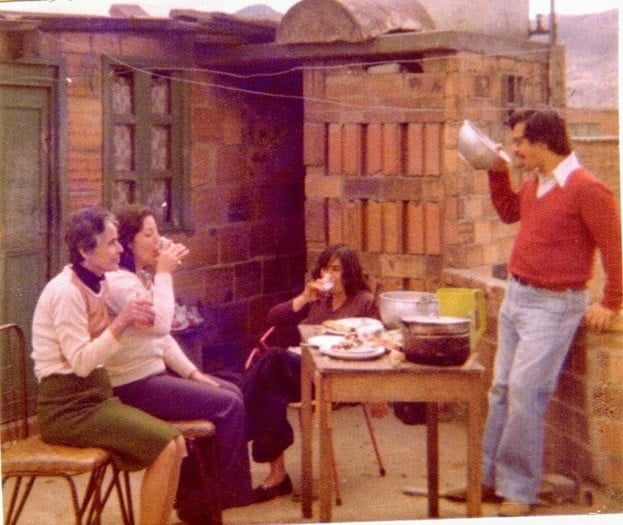
The most common alcoholic beverages of the era were also, of course, homemade, and they demonstrate the confluence of European and Native American traditions. Guarapo is a fermented sugarcane drink of Spanish origin (probably from the Canary Islands), drunk almost daily, particularly by the day laborers who worked in the fields. It was prepared with panela water — the most popular traditional drink of Colombia — but fermented with a special yeast known as “cunchos”, which used to concentrate in the last residues of guarapo left in the barrel, leather pouch, calabash or demijohn used to ferment a new batch of guarapo. This gave rise to the colloquial term “cuncho” to refer to the last remains of any drink or to the youngest child, widely used in central Colombia. Guarapo could be left to ferment so long that drinking it could get you drunk.
The other typical alcoholic beverage of my grandparents' era was chicha. This one, in contrast, is of indigenous origin, and the Spanish chroniclers already reported it in their first chronicles of the conquest. It is prepared from cooked and ground corn, sweetened with panela and also fermented in a barrel or cured calabash. It is known that its use among the Muiscas was ceremonial and therefore, even in the times of my mother's childhood, it was drunk on special occasions such as baptisms, weddings or hamlet dances. A curious fact about chicha is that its ancestral fermentation process involved the women of the community chewing the cooked corn and then spitting it into the clay jar. It is said that the Spanish, already fond of chicha, were not enthusiastic about the ancestral spit, so they incorporated the cunchos into the mixture. They never managed to obtain the flavor and fermentation that Muisca saliva injected into it[4]. In any case, the chewed ferment did not reach the twentieth century, but the spirit of its almost ritual use did, as a tradition passed from mother to daughter.
Masato also held a very important place among the alcoholic beverages in my mother's family. It was prepared with corn or rice flour. It was and is softer and thicker than chicha and guarapo. It was made for family parties and shared accompanied by mantecada, empanadas, pastries, cakes and bread.
Everything above marked my mother's life and therefore mine. However, the part I consider most important of her legacy is the foundation of two precepts that define her life: the importance of education as an enabler of personal transformation, punctuality, and the need to offer help to those around us.
Despite the difficulties described and the limited practical application of much of the theoretical knowledge taught in the academy, my grandparents were rigorous in their certainty that education would be the tool to secure the future of their nine children. All of them received primary education, which, although free and easily accessible, only an hour's walk away, was not much taken advantage of by a large part of the peasant community. My grandparents considered that knowing how to read, write and perform basic math operations was fundamental to prevent their children from being marginalized by society. My grandfather, who barely completed the third year of primary school, was a great autodidact all his life. He took care of providing for the family and of ensuring that his children studied, so much so that he sent them to school already knowing how to read and write. He was the one who kept an eye on the children's homework. He always said that studying was the inheritance he was going to leave them when he died.
Secondary education was more difficult to access because, to obtain it, one had to travel to town, which, as I mentioned earlier, was 3 and a half hours on foot when the weather was good, or half that if the route was done on horseback. High school was not free, but my grandparents considered the possibility that all their children would finish their studies — if they so wished.
For my mother, who is one of the three youngest daughters of the family, the situation was already more favorable than for her older siblings, and so she could afford the luxury of studying at the boarding school of the Colegio de la Presentación de Fómeque, partly thanks to my grandfather's skill and political friendships in obtaining aid such as full or partial scholarships.
She arrived there as a teenager in the second half of the sixties, unaware of the cultural and social transformation taking place in the cities and willing to honor the effort that providing her six additional years of academic training meant for my grandparents, and she finished her training as a Normalista Superior at the Colegio de la Presentación de Ubaté.
My grandfather, despite not having finished formal studies, stood out for his academic knowledge. The inhabitants of the hamlet went to him to seek advice, recommendations for farm trades or to resolve conflicts of various kinds. They also visited him to get haircuts, which apparently he did with great talent. My grandmother, despite the heavy work of the week, dedicated Sunday afternoons to teaching the catechism of Father Astete to the women of the hamlet. What still impresses me about her is the humility with which she parted with her own resources or possessions to help others. On one occasion she came to have a significant amount of money of her own, which she contributed to the training of a nephew as a priest.
In my grandparents' house events took place that my mother remembers with great affection; such is the case of the celebration of the feast of Saint Paul and Christmas, occasions on which my grandmother used to prepare delicious treats for the family and to share with relatives and needy people of the hamlet. My mother loved carrying out the mission of distributing the food. They also frequently held community gatherings in which the neighbors of the hamlet were invited to share food, a good totuma of chicha, sometimes a religious service and cultural activities such as readings, games, dancing and singing by the light of a gasoline lamp.
Thanks to an environment as exemplary in service as it was strict in academics, most of my grandparents' children became community leaders. My aunt Laura Rincón, who dedicated her life to serving her neighbor through her work as a nun of the Presentation. My aunt and uncle Alicia and Álvaro joined the Juventudes Agrarias Campesinas JAC (Agrarian Peasant Youth) and became representatives of the Colombian peasantry before the UN; leaders in the hamlet's academic training process and coordinators of cultural activities in the municipality. On the other hand, Luis, Rosa, Otilia and my mother would find their vocation in teaching.
After my grandmother's death, my mother and her siblings agreed to meet annually around my grandfather, gatherings in which he enjoyed sharing with the family. Of this, the most memorable things were the a cappella choirs of popular songs such as “Matemos el gallo” or “La bella primavera”, sung as a canon of two or three voices, the trips around Colombia and the feasts, especially at my grandfather's house.
My mother belongs to that rare species of educators truly passionate about their craft, who are not limited to imparting knowledge but commit to the integral formation of their students. Since her graduation as a Normalista Superior, she began a career of more than 40 years, forming girls and boys in knowledge as important as reading, mathematics and sciences, but with special dedication she inspired in her students the importance of being creative, honorable, respectful, ingenious, curious and punctual. Expressions such as 'you must be a good student and an excellent person', 'put yourself in the other's shoes', 'the problem is already there, let's look for the solution', 'you cannot demand from students what as teachers we are not willing to give' were part of her jargon, with her students and fellow teachers.
Her maternal teaching style was reflected in her concern for the family problems of her students, her care in cultivating values rather than filling heads with knowledge; she had small but important details such as hugging and comforting a child during a moment of sadness or occasionally fixing a child's uniform or hairstyle to keep them from becoming a target of bullying.
My mother worked as a teacher in the city of Bogotá only. She, like my father in his beginnings as a teacher, was assigned to a school located in a marginal neighborhood with a vulnerable population. She began work in January 1975, at the Van Huden district school in Fontibón HB, near El Dorado airport, where she had to use an abandoned bus in a lot that flooded as her classroom, and from which she had to carry her first-grade students in her arms to take them to the bathroom, out to recess or back to their homes at the end of the day. All of this before allowing the little ones to go without schooling. That is how her first year of work passed, because she managed to transfer very soon to a school near her home.
As I said earlier, despite the poverty in which my mother grew up, she did not have to live the dramas of twentieth-century Colombia that my father knew firsthand from his childhood. However, through the eyes of her young students, just like him, she had to come to know the worst miseries of the human being. Situations that are only lived in marginality and poverty, far from the media spotlight and that are only recorded as statistics: child abuse, malnutrition, sexual abuse, drug addiction and exploitation, among other outrages against the most vulnerable people in society.
Despite all of the above, teaching also represented enormous satisfactions for my mother. Many of her students, particularly those she could accompany during the five years of basic primary education, reached secondary school with outstanding reading, writing and math skills. However, she remembers with more affection the students who managed to overcome learning problems or episodes of violence at home. For them I am sure my mother was an important emotional support and, in many cases, a maternal figure. I know this because I was her student in third grade of primary school and I remember well that my classmates did not notice any differential treatment of “the teacher” toward me, not because my mother treated me like a stranger, but because she treated the others almost as if they were her own children.
One of the cases my mother remembers from those years of work in a little school in the “Las Colinas” neighborhood is that of a beautiful blonde-haired girl she had as a first-grade student on one of the many occasions. She does not remember her name, but she does remember that she was academically excellent. It struck her as curious that she was very quiet, never left her brother's side, and during recess she did not play with the other children but remained motionless, serious and with her hands behind her back, leaning against the wall. The school's teachers knew that her mother had house arrest after being captured and convicted of participating in one of the gangs that, already since that time, had as their modus operandi drugging unsuspecting men in bars with burundanga, especially in the north of the city. Her father was also convicted of other crimes, but he served his sentence in prison, so the children spent long periods in the care of an elderly man who lived nearby while the mother was away, for who knows what reason.
The girl's distant and melancholy attitude awakened my mother's suspicions, who sensed that there was something more serious than absence in the little girl's story. Her accounts and those of her brother did not convince her. According to them, nothing was happening, but their family reality was very complex. The concern was great and, since nothing could be clarified, my mother referred the case to the institution's pedagogical guidance and counseling team, made up of specialists in psychology, social work and pedagogy, who became very interested in the case and designed a very careful strategy to succeed, through drawings, questions and other techniques, in unveiling what tormented the girl.
The plan worked; it was confirmed that the girl had been the victim of recurrent abuse by her father. Her short life had been a hell of abandonment, abuse and distrust, where the only bastion she could cling to was her brother. The counselors who handled the case also taught my mother how to manage cases like this one of post-traumatic stress, to gain the child's trust and understand her fluctuating moods.
With my mother's joint and ongoing work with the group of professionals, the girl gradually integrated into the group and began to participate more in activities with the other children and, most importantly, she played and laughed. She was withdrawn from school to go live with her maternal grandmother in the city of Villavicencio, and my mom never heard from her again. However, her memory would remain engraved in my mother's heart, who understood that the priority of her teaching work would not be imparting knowledge but being attentive to cases like the one narrated above and providing whatever help was within her reach. In her own words, she decided to be for her students, more than a teacher, from then on she would be a “Life Companion” for them.
My mother tried to focus on the children who showed disinterest, indiscipline or emotional problems, and on not a few occasions she managed to become the decisive factor in 'straightening out' the lives of children who, perhaps otherwise, would have ended up in the clutches of crime, drug addiction, prostitution or suicide.
The social environment of the late seventies was highly politicized and, as I have already noted, the teaching guild was at the spearhead of the revolutionary ideological struggle. My mother, who did not identify with any existing political party, sympathized with some socialist ideals of the era, particularly those related to the equitable distribution of public goods and the state's responsibility for satisfying the basic needs of the population. Because of this, she accepted the invitation to participate in a left-leaning study group, in which several enthusiasts met to discuss what the role of the public teacher should be in the context of the moment and, eventually, in a socialist government.
The study group was called “El Nuevo Educador” and there the participants discussed for long hours the revolutionary experiences of Cuba, Nicaragua or El Salvador and the role that educators played in those processes. The best model to be applied in Colombia was debated, and the educational models outlined by León Trotsky, José Martí and Quintín Lame were studied. Tasks were also assigned to the members of the study group, which sometimes bordered on the subversive, such as distributing leaflets or painting walls with revolutionary messages. In any case, “El Nuevo Educador” was nothing more than a pretext for young professionals to socialize and connect with people who shared their own ideals. Hence, quite frequently, the group scheduled social events where music and drinks were also the protagonists.
It was at one of these parties, at her sister's house, that my mother fell for my father. Without knowing it, it would be the point of convergence that would unite the stories of two children of the province who came to the city to dedicate their lives to the formation of childhood in a country of injustices and violence, but also of mysticism and big dreams. My mother, who was 15 years younger than my father, was undoubtedly captivated by the bearing and eloquence of Professor Víctor Ávila, but what truly aroused her curiosity was a detail that many men in his place would have been careful to hide: at the mentioned party they danced for the first time, and at one point he called my grandmother Dolores so that she would not worry; he told her he was fine but would stay a little longer and then go home. He was a grown man and yet he had so much consideration for his mom!
I am sure that, had she not confessed it to him, my father would never have guessed that the short call to his future mother-in-law had been what stole my mother's heart. Yes, Octavio had put him on the right path to reach that gathering; my grandmother Dolores, his other angel, had put him on the right path to reach my mother's heart. Thank you, grandma!
[1]Chacón-Patiño, Martha L., Cristian Blanco-Tirado, Juan P. Hinestroza, and Marianny Y. Combariza. “Biocomposite of nanostructured MnO2 and fique fibers for efficient dye degradation.” Green Chemistry 15, no. 10 (September 24, 2013): 2920-28. https://doi.org/10.1039/C3GC40911B.
[2]Cultivariable.com. “Growing Achira.” Cultivariable (blog). Accessed February 28, 2019. https://www.cultivariable.com/instructions/andean-roots-tubers/how-to-grow-achira/.
[3] Unrefined sugar obtained from sugarcane, sold in compact loaves of rectangular, round or prismatic shape, depending on the region where it is produced.
[4] Cordero, “GUARAPO: LA BEBIDA DEL PUEBLO COLOMBIANO.”.
Listen to the first part: