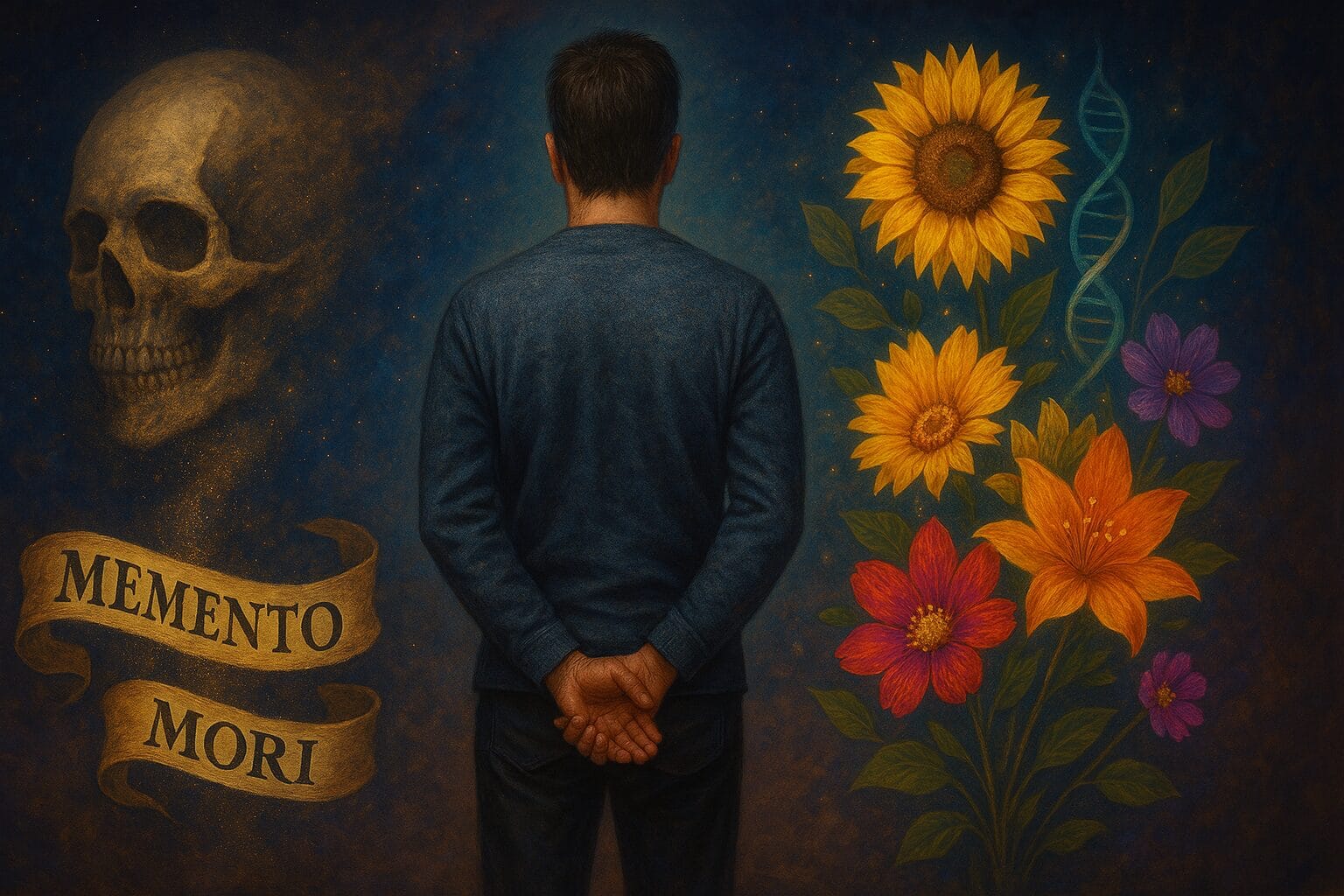
It seems that we live in an era of denial. There is a palpable lack of appreciation for death, not just as an inevitable and often sorrowful fact, but as something necessary, even beautiful, within the great cycle of existence. Our survival instinct, logically, rejects the idea of an end, but have we taken this rejection to an unhealthy cultural extreme?
Let's contrast this with ancient wisdom. The Latin phrase "Memento Mori" ("Remember that you must die") was not an invitation to morbidness, but a call to live with awareness of our finitude, to value the present precisely because it is limited. Ancient cultures, faced with much closer and more frequent mortality (without vaccines, without advanced treatments, without knowledge of germs), developed a resigned but profound acceptance of death as an intrinsic part of life.
Scientific Progress and the Alienation from Death
Our scientific and medical advances, while wonderful achievements that have improved and prolonged life, seem to have had a side effect: they have distanced us from the reality of death. By being able to "combat" it more effectively, we have begun to see it less as a natural process and more as an enemy to be defeated, a system failure to be corrected.
This struggle manifests not only in the search for cures for diseases, but also in research that treats aging itself as a "disease" curable, seeking to reverse the cellular processes of aging. Is this something we truly desire as a species? Should we do it if we could?
Cultures That Still Embrace Their Dead
Not all cultures share this vision of distancing themselves. Let's think about Mexico and its celebration of Day of the Dead, so beautifully portrayed in films like "Coco." I recently had the opportunity to visit the cemetery on Isla Mujeres again, a fascinating place where graves have small display cases. There, families leave offerings, birthday or Christmas gifts for their deceased loved ones. It is a way of keeping them present, integrated into family life, even if it may seem macabre from our Western perspective, where we tend to process death quickly and move on. In the West, even the custom of visiting graves seems to be in decline.
Individualism vs. Collectivism: Does It Impact How We View Death?
It is interesting to observe a map of individualistic versus collectivist cultures. More individualistic societies (North America, much of Europe) tend to place enormous emphasis on personal experience, on the "I." From this perspective, death becomes the ultimate obstacle, the annihilation of what is most valuable: individual experience. Humanism, centered on the individual, may be the dominant "religion" of the 21st century.
In contrast, more collectivist cultures (many in Latin America, Asia, Africa) seem to have a stronger intuition that the end of an individual is not the end of the collective's experience. There is a greater naturalness in letting go of the individual to return to the community, to the source. The group's life continues, enriched by the life that has passed.
Denial in Pop Culture and Science
This modern denial is reflected everywhere:
The Personal Cost of Avoiding Death
This evasion carries a spiritual and psychological cost:
Toward Reconciliation: Embracing Finitude
How can we heal this relationship?
Perhaps, instead of becoming obsessed with conquering death, we should learn to accept it as an integral part of life. Recognizing our finitude does not have to be depressing; it can be profoundly liberating and motivating. It drives us to live more fully, to value each day, to connect more deeply with others and with the mystery of existence. Let's stop fighting the natural cycle and start flowing with it, finding beauty both in blooming and in withering.
What do you think? What is your relationship with the idea of death? Do you believe our society needs a shift in perspective? Share your reflections in the comments!