Barely two weeks had passed since my exorcism with the yagé and my life no longer resembled in any way the life I had led until then. Now I had a girlfriend, with whom, despite having known each other for such a short time, I felt a connection and a bond stronger than what I had felt with other women. Our notable age difference and the handling of my relationship with my daughter were matters to be resolved, but now I had a power I hadn't counted on before. I believed that with my new spirituality I could navigate these and any other challenge that came up in my life.
There was something, however, that kept me restless: how was it possible that a tea could transform someone's life in such a way and, above all, how was it possible that it showed such specific prophecies to two people who barely knew each other. My innate curiosity made me long for an explanation for the experiences I had lived, but the answers Mara had given me hadn't completely satisfied me.
Mara told me that the yagé was a very wise power, that it takes one to other levels of existence and that upon receiving it, the elemental becomes an ally and a guardian that protects the yagenaut from any danger or external attack. I didn't understand it then, but Mara spoke from feeling and what I was looking for was answers for my mind. I wanted to understand the mechanisms operating behind the magic of the ayahuasca, to learn to move at will through the subtle worlds.
This is what I told my friend Martín one afternoon when we met after I left work. My friend and companion on the path knew me better than anyone and knew what I was looking for.
"I think it's time you meet the elder; he'll surely resolve all those questions for you" — he told me with a slight smile.
We agreed to meet that same Friday at the elder's house. Martín, who enjoyed adding mystery to any situation, hadn't told me much about the elder we would visit except that he was "the wisest person he knew."
I arrived at his house after leaving work at around six in the evening. It was a simple two-story house in a populous neighborhood in the northwest of Bogotá, near the Juan Amarillo wetland. The front door was ajar but I still knocked softly, since I could hear the murmur of people inside chatting animatedly.
A few seconds later I was invited to enter by a white man with a yellow beard and long hair, dressed in white and wearing necklaces on his chest. With a slow voice and gracious gestures he pointed me to one of the old pieces of furniture in the living room and asked me if I had come to consult the elders.
The question unsettled me because I would have believed he was the elder I had come looking for. I answered that I had come to meet my friend Jairo Martín and that we had an appointment with the elder. Martín, who had managed to hear my voice, came out of the next room and greeted me with a hug.
"Manolo, wait here in the living room; the elder will be free in a moment. I'm helping him with some things he needs on the computer" — he told me as he went back the way he had come.
I sat down in one of the chairs of the living room and began to observe the
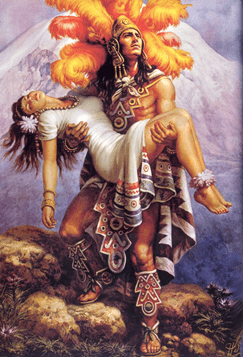
many peculiarities of the place where I found myself: dominating the decoration of the room there was a beautiful painting showing an Aztec warrior carrying in his arms a woman dressed in white.
On the other walls of the small room there were objects I identified as indigenous: bird feathers, maracas or rattles and some necklaces. In addition, there were a couple of scrolls with Egyptian images and, on several of the pieces of furniture in the place, a great quantity of documents and folders that didn't seem to have any particular order.
The smell of the place was also very characteristic: I could mainly identify the smell of tobacco, but also incense smells that mixed with the smell of the food that was undoubtedly being prepared in the kitchen, somewhere on the same floor where I was.
The minutes passed while I entertained myself with my observations, when the kind gentleman who had attended the door sat down in another chair in the room and asked me, in a leisurely manner, what twists of fate had brought me to that place. I told him briefly about my experience with the yagé, to which he responded with vague comments that nevertheless denoted a clear reservation with the medicine of the yagé.
"You have to be very careful with grandfather yagé because it can also confuse. It's better to start with other, less strong medicines" — I remember he told me then.
Probably about 20 minutes had passed since my arrival when I saw him for the first time: he was an imposing man in his late fifties, with notable excess weight, long gray hair and strong indigenous features.
"Choa, my brother, I am Suaga Gua" — he told me as he approached.
I was about to extend my hand to him when the elder embraced me in a way I perceived as respectful, but at the same time affectionate.
The elder sat down with his back to the interesting image of the Aztec warrior and began giving orders to several of the people in the house; most of them young people dressed in white with indigenous accessories on their arms or necks.
"Noreña, bring me the box of tobaccos... César, what's up with the report I asked you for... Carlos, go upstairs, the grandmother needs you for the cleansing..."
Everyone moved immediately following his indications and some frequently interrupted our conversation with specific questions about the tasks they were doing.
The elder entered and left our interrupted conversation without any problem and answered the questions he was asked quickly, although frequently taking the opportunity to make some joke or tease his interlocutor.
I immediately realized he was a man with an aura of leadership and serenity around whom all the people around him gravitated. His ability to go from one topic to another with total naturalness caught my attention. It was clear he was used to doing several things at once, but I didn't feel entirely comfortable with the arrangement. I tried to communicate my concerns to him and the elder nodded his head, made some comment with a mysterious air about what I was telling him and apologized for the constant interruptions while playing with the smoke of a tobacco he held in his left hand.
At one point in our conversation, he asked me if I knew how to smoke tobacco. Faced with my denial, he took a new tobacco from the box that one of his assistants had brought him and handed it to me.
"Look, light it here and while you do, keep sucking on the other side, but don't pass the smoke to your lungs; it's like giving little kisses to your woman, with love."
The truth was that an American engineer I had met a few months before for work reasons had taught me to smoke tobacco, since it was a habit he enjoyed while on business trips. I, however, had said I didn't know how, to avoid coming across as arrogant or because I didn't know if there was a "spiritual" way of doing it.
"Be happy because the elders gave you tobacco tonight. That almost never happens! In other words, you came here to do something important"
With these words, elder Suaga-Gua had given me a first glimpse of what I had come looking for. I felt that being in that place, in front of a person who clearly had vast knowledge of the spirit world, was part of the path that the yagé had traced for me since that Saturday in October.
I felt the need to ask him many things, but I didn't know where to begin; besides, I looked at my watch and realized it was almost 11 at night and the area where the elder's house was located was known for the presence of gangs of muggers and drug dens. I stood up to indicate my intention to begin my retreat, but Martín, who was nearby, stopped me and told me:
"Wait, don't leave without meeting the grandmother."
Elder Suaga-Gua agreed and told me:
"Go upstairs and greet the grandmother, but don't worry, this is just the beginning. Go to the maloca on Wednesday so you can start learning."
"Maloca? Ah, okay, I'll arrange it with Martín. Goodbye elder, thank you very much for your time."
The elder stood up and embraced me again.
"Good path and good breeze, brother."
This phrase captured my attention from that day and remains with me, as part of the farewell I use today in the episodes of my podcast.
Martín guided me to the third floor of the narrow house, through equally narrow stairs that were between the living room and the kitchen.
The third floor of the dwelling was still in rough construction and therefore had no floors, ceilings, windows, doors or plaster. In one of the rooms of the structure we found a group of people seated around the dim light of a votive candle resting on a plate on the floor. The seats were simple improvised stools made of boards over piles of bricks that served as legs.
The "grandmother" was actually a woman of barely a little over 40 years of age with long, but completely black hair. Beside her was a woman who, in my view, did match the image one can have of a grandmother. The two women rapidly sucked on their respective tobaccos while around them the other people — a couple of boys and an older couple — remained in grim silence that they only interrupted sporadically to burp, complain or gag.
The scene immediately sent a chill through me. I must say the picture seemed gloomy and even malignant to me. Grandmother Yanguma, whose name I learned from Martín that night, was the wife of elder Suaga-Gua and was directing what is known as a tobacco cleansing, a ceremony of spiritual liberation in which the participants intoxicate themselves with different types of tobacco and whose purpose is to break sorceries, crossings and other kinds of evils according to the tradition of some indigenous communities.
I left that house with mixed emotions. On the one hand, the ceremony I had witnessed had given me a very bad feeling and the disorder in elder Suaga-Gua's management of time had seemed to me at least uncomfortable. But on the other hand, my experience with the tobacco had been very pleasant, and the little I had chatted with the elder made me think that that man was, definitively, the person who could guide me through the new world of the spiritual that I had begun to traverse.
The elder had managed to tell me that he and grandmother Yanguma were the spiritual authorities of an indigenous community that was in the process of becoming an indigenous cabildo, that is, a legal entity recognized by the government of Colombia with the possibility of self-determination and self-government. The name of that community was "Pueblo Nación Muisca – Chibcha" and, according to what he told me, more than 300 people throughout the cundiboyacense high plateau were part of it, committed to "re-signifying" ancestral Muisca thought.
"You are of Muisca-Muisca lineage; you came here to recover your customs and traditions" — the elder had declared after I told him my full name and my place of birth.
The elder alternated between the formal and informal forms of address, and between an uncomplicated, friendly tone of speaking and a slow, grandiloquent one. The last sentence he said to me resonated in my head precisely in this last tone.
As could be expected, I made my first visit as soon as possible to the "maloca" that elder Suaga-Gua had mentioned in our first conversation. According to his indications, that was the sacred place where the community gathered to learn from the elders, receive medicine and prepare for their initiation as Muiscas.
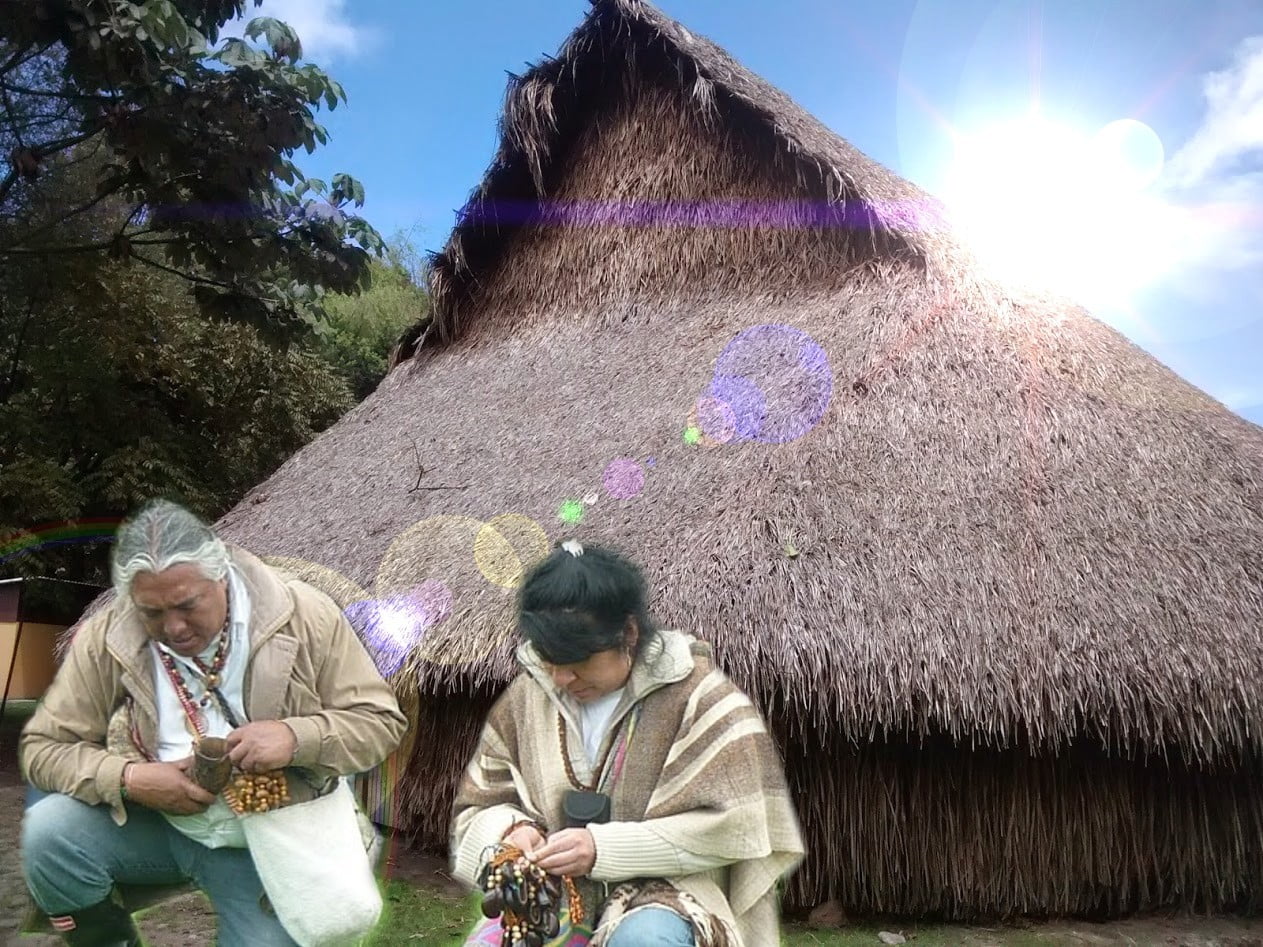
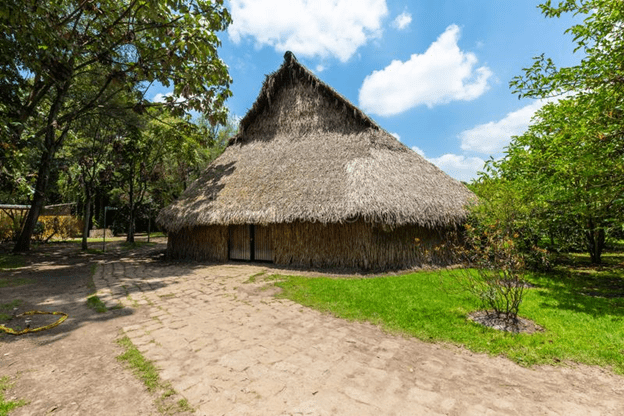
The maloca was a wooden construction with a thatched roof of about 300 square meters. It was located in the center-west of one of the most beautiful places in the city of Bogotá: the Jardín Botánico. My first visit to this place happened on a Wednesday at around 7:00 PM. Because it is very close to the equator line, the sun sets in Colombia practically at the same time throughout the year. Therefore, by that hour it had already gotten dark and I had to sharpen my sight to find my destination through beautiful but poorly lit paths surrounded by plants.
My scarce talent for orienting myself geographically, added to my slight myopia, made me arrive almost 15 minutes late from the hour when the activities of the maloca began. A kind young man carrying a long staff adorned with red and yellow ribbons received me at the entrance of the place and indicated that I would have to find my spot quickly because the elders were already speaking. When I set out to cross the threshold, he himself stopped me and asked me if it was my first time attending. I nodded and he explained that I had to enter walking backwards, but after greeting the two fire logs at the entrance.
I must say that far from seeming ridiculous or strange to me, that protocol seemed exquisitely attractive. I loved the mystique that could be breathed in that place and the earthy aroma of tobacco that flooded the space.
I did as the boy had indicated and entered taking three or four long steps in reverse. Then I turned around and found a large gathering of probably more than 100 people, most of them young, forming a semicircular crowd around the center of the maloca. I noticed that some of them were seated on pieces of log that served as stools, but most were standing.
I could also observe that toward the center of the group — and they were all seated — there was a group of about 30 people, men and women dressed in white who wove, smoked tobacco, nodded frequently and sometimes exclaimed "Ejeeeee!" at the words of the elders.
In the center of the place, in front of all the attendees, were the elders. I quickly recognized Suaga-Gua and Yanguma, whom I had met a few days before, but next to them there were 4 other individuals who evidently held a high rank in the community. I no longer remember the topic the elders were discussing that day, but during the few years that that process of re-signification of indigenous thought lasted in the maloca of the Jardín Botánico, topics of what the elders called "Human Ecology" were usually treated, or the relationship of the human being with himself, with his fellow beings and with nature.
Another recurring topic was the Law of Origin, which is the system of ordinances and agreements with which the community defines its belonging to the cosmic, planetary and personal order. This includes the relationship with the vital territory, oral tradition, the circle of word and the life plan, both personal and family and community. The Muiscas of Pueblo Nación sought recognition by the State as an Indigenous community and for that they prepared themselves by defining their internal organization, uses and customs that, they trusted, would lead them to fulfill their goal of inhabiting — someday — a resguardo or own territory in which they would self-govern and develop as an indigenous nation.
The third group of topics that I remember the elders discussing frequently was what we could call "spiritual topics", although strictly speaking, topics of personal growth, esotericism, metaphysics, folk healing, occultism and magic were covered. Generally, these topics were discussed with great reserve on the part of the elders, always making clear that they could barely touch the surface of this knowledge since these were highly sensitive topics that were only treated in depth within the bosom of the community.
Little by little I found out that by attending the maloca meetings on Wednesday nights, I had become part of the "extended" or "external" community, made up of irregular visitors, sympathizers and candidates to become part of the Muisca community of Pueblo Nación. The latter became a personal goal, since even with the little that the elders allowed themselves to share with the community, I was convinced that becoming part of the community would give me access to the mystical knowledge I longed to have.
Every time I left the maloca, sometimes after midnight, I felt even more motivated to keep learning from the elders. Each talk with them answered a few of my questions and generated many more, but it kept contributing new mystical and ancestral elements to add to my life. The elders recommended having a mochila bag to carry the personal ritual elements. Initially it could be a bought one, but if I entered the community I would have to learn to weave my own mochila. I had started carrying my own tobaccos, which I bought for the first time at a market square near my house, and I was learning to use it to slightly alter my consciousness.
In the community, especially those who were already formally part of it, almost everyone smoked tobacco, or rather didn't smoke but "offered" it, since according to the elders, smoking was a profane action of abuse of the plant, while when offering, what one was really doing was raising an oblation of tobacco to the very center of the universe.
Tobacco was, for the Muiscas, their main tool of spiritual work, medicine, teacher and guardian. I didn't understand these concepts then, but with time I was able to verify that it wasn't a simple stimulant but an entire ritualistic and entheogenic system, as could be the yagé itself. Grandmother Yanguma in particular used to offer five or six tobaccos in a single night, always accompanying with her smoke her own words and those of the other elders. Elder Suaga-Gua, on the other hand, didn't offer tobacco so frequently, but he did suck ambira in almost all the gatherings.
The ambira was a black substance with the consistency of wet clay and a tobacco smell so strong that smelling it up close normally gives one a shiver. This medicine, extracted from tobacco, is actually a pure nicotine extract that the Muiscas prepared in long nights of community work that I will describe in another chapter. This is the medicine I came to appreciate the least during my years on the path with the Muiscas. Bitter flavors are especially difficult for me since, as I recently learned, I have a genetic predisposition to feel bitter flavors that most people can't perceive. This is the reason why it's hard for me to enjoy pickles, figs, broccoli and other vegetables that have bitter notes.
The yagé is certainly predominantly bitter, but as I told before, one only has to endure the taste for a few minutes after ingesting the drink. The ambira, on the other hand, had to be sucked in small quantities for hours, so the tongue ended up going numb and it wasn't uncommon to have to endure fits of hiccups for long periods of time. Its effect, however, was much more immediate and perceptible than offering tobacco in smoke. In some cases it could cause vomiting and produce deeper states of altered consciousness in which the sensations could be of mystical ecstasy, expansion of consciousness, momentary weightlessness, connection with nature or, in the least fortunate cases, chills, trembling all over the body, fear, nausea, or even paranoia.
There were several years during which I tried to learn to suck ambira with the tranquility with which the elders did it, and the truth is that I never managed it. I still have half a jar of the last ambira preparation in which I participated more than four years ago and it's possible it will still be there in the next four. I tried different types of ambira, but all of them seemed repulsive to me, with a single exception: the medicine of elder Víctor Martínez, spiritual father of the Muiscas, of whom I will speak in detail in the next chapter. His tobacco medicine wasn't properly ambira but a variant that is part of the uses and customs of the Murui people of the Amazon called ambil. It was equally a nicotine extract, but unlike ambira, ambil contains yarumo salt which, in my opinion, neutralizes a little the characteristic bitterness of nicotine and makes it less repelling to the taste.
In fact, I tried several types of ambil, but the only one I truly felt like asking for and swallowing, and which always produced pleasant sensations in me that facilitated speech, was the one elder Víctor prepared.
The Muiscas offered tobacco smoke, swallowed ambil, made poultices with tobacco leaves, and drank tobacco tea in their difficult cleansing ceremonies, but I only connected with tobacco in smoke, which I still use today. Besides that, the community prepared and used another tobacco medicine that could be said to occupy the third place of importance in the Muisca vade mecum, and that one did become my preferred ancestral medicine: rapé.
Rapé is the Western name of powdered tobacco, or yopa hoska, in the original dialect of the Muiscas. It is prepared by grinding dry tobacco leaves that have been left in the sun for several weeks. Some wise men mix the resulting powder with vegetable salts, plant essences or even chili, but for me the best experience is obtained with pure tobacco, well selected, dried for the propitious time, ground and sifted with due patience.
The first time I received hoska was during my first visit to the maloca of the Jardín Botánico. On one side of the congregation there was a short line of boys waiting their turn to receive a "blow". The ceremoniousness of both the participants and the community members who administered the medicine reminded me of the parishioners of a Catholic mass in line to receive the sacred communion.
Without hesitation I ventured to line up for a turn without really knowing what to expect, but eager to get to know a new medicine. When I reached the front, the young community member indicated that I should part my lips slightly, hold my breath for a few seconds and breathe through my mouth after receiving the hoska. I followed his indications and the boy inserted into my left nostril about two centimeters of a thin wooden cane in the shape of an 'L' that had beautiful indigenous decorations.
My initial impression upon feeling this unexpected invasion of my nasal window disappeared in an explosion of pain that I felt in the center of my head when the boy blew firmly through the other side of the cane and projected the tobacco powder directly into my paranasal sinuses. I don't exaggerate when I say that was the sharpest pain I had felt in my life, after the time a surgeon made an incision with his scalpel on my right leg before the anesthesia took effect.
The pain immediately erased any thought I might have had at the moment, but it quickly began to diminish until it became an uncomfortable internal pressure that in reality wasn't as annoying as the sensation of having the nasal passages full of powder.
The worst part was that I had only completed half of the procedure, since according to the elders, the hoska always had to be insufflated through both nostrils. Otherwise, an imbalance would occur that could cause headache, dizziness or other undesired effects.
The second insufflation, however, was much less painful than the first and after receiving it, I made my way with difficulty to the place where I was standing. I kept my eyes closed for a while while my nostrils drained and my eyes watered copiously, and I noticed that my mind remained silent. It was just the tobacco and I, getting to know each other and celebrating that ancestral encounter. The voices of the elders became a murmur that lulled me, and suddenly I began to feel my body rising from the floor. A soft sway rocked me back and forth while my mind filled all the space of the maloca. I felt that the elders spoke inside my head and that the other attendees of the gathering were my body.
Suddenly I felt an expansion of energy that started from the center of my chest and a sensation of love and familiarity ran through me from head to toe. I came back to myself little by little after an experience that probably lasted only about five minutes, and when I opened my eyes I saw the elders shining with a halo of light around them. The community members also glowed, and then I felt at home. That was the place I had been looking for; that was the place the yagé had shown me to continue the path of my initiation.
Paula accompanied me to the maloca a few times, but she didn't identify with that group of city indigenous people. She was a white woman with green eyes and light hair born in Medellín, and the elders frequently spoke of the Muisca lineage of those of us born in Bogotá or the cundiboyacense high plateau, the pride of having indigenous features and the wisdom of our peasant grandparents of the region. She also didn't like the ambira and hoska medicines and perceived a degree of fanaticism, a whiff of sect, in some of the claims the elders made.
We had some discussions about it, especially because I had started alternating my visits to the maloca with visits to the elders' house and occasional additional visits on weekends to wetlands and parks to meet with the community. She reproached me for the time I now devoted to my initiation as a Muisca, and I reproached her for her lack of support in something as important as spirituality.
Be that as it may, I was totally determined to become a member of the community and for that reason I made an effort to make myself known to the elders. Not only Suaga-Gua and Yanguma but also other elders of the community, especially elder Nemequene and grandmother Jairsa. My friend Martín was a sympathizer and "honorary" member of the community. More of a personal friend of the elders than an active member, and therefore he didn't wear white vestments or participate in most community meetings, but he actively helped with tasks assigned by elder Suaga-Gua and participated in various special events held in the wetlands and natural parks.
With my new routine the months passed and I was already a recognized member of the community. As was usual in the organizations I participated in, I used my knowledge of computer science to become a valuable resource for the elders. I took control of the website www.muiscas.org and was already the de facto systems engineer of the community.
The elders appreciated my collaborative attitude, my discipline during the ceremonies and my curiosity for the spiritual. In my visits to the elders' house I began to share more with grandmother Yanguma, who was the one who showed the most willingness to transmit her knowledge, even when her way of doing it was stern and sometimes even slightly aggressive. Even so, I liked to sit with her to "mambear", which is the word used for "conversing" when the topic was spiritual.
One of those afternoons of "mambia" with the grandmother, already intoxicated with ambil and after having received probably three or four insufflations of hoska, the grandmother stared at me in the eyes and told me:
"Manuelito, I think you're already ready to do your rite of passage. If you want, I'll nominate you before the council of elders."
My heart raced and without hesitation I answered yes. I had heard about the rite of passage and some community members had told me it was a ceremony with unparalleled power, one of those experiences that change your life, and the gateway to the true hidden knowledge of the elders.
That same Wednesday, after finishing the talk at the maloca of the Jardín Botánico, elder Suaga-Gua approached me, embraced me and told me:
"The elders consulted the Spirit and unanimously decided to allow you to apply to do your rite of passage. Congratulations, my brother"
What I had heard about that event fell short of what I lived, but in one thing they had been right: the rite of passage changed my life.