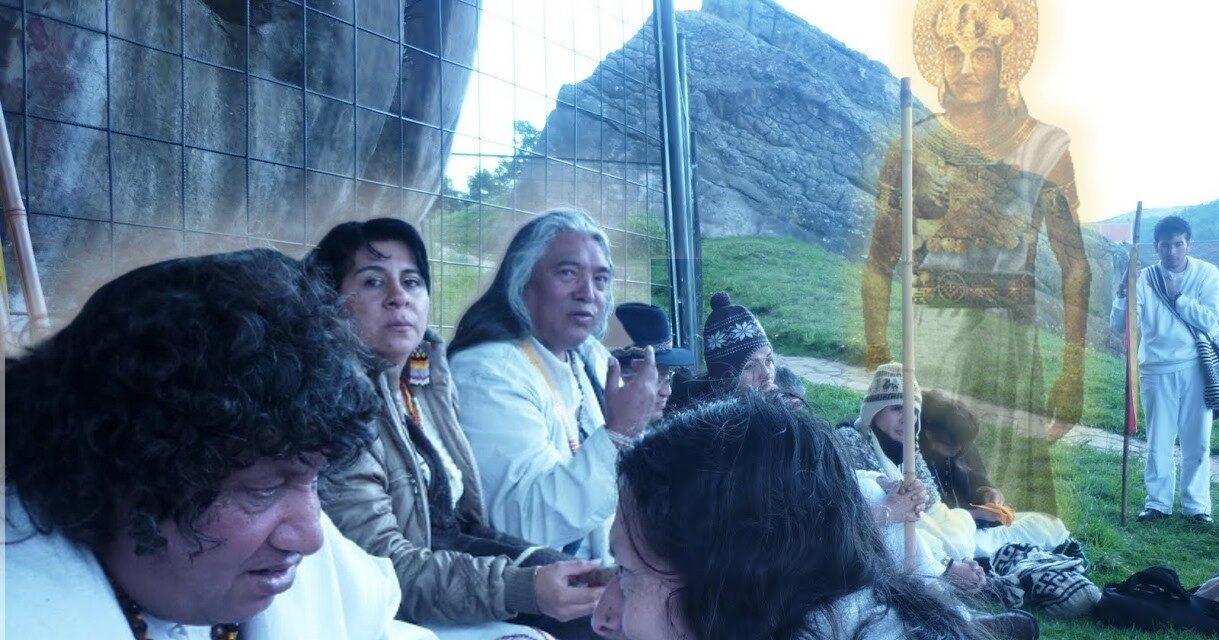
Grandfather Suaga-Gua approached me, hugged me, and told me:
– “The grandparents consulted in the Spirit and unanimously decided to let you apply to perform your rite of passage. Congratulations my brother.”
Those words of grandfather Suagagua made my heart race. During several of the last community gatherings of Pueblo Nación Muisca-Chibcha, the grandparents had spoken of the importance of the rite of passage, which they said was the true entry into the world of ancestral spirituality. The references they made to said event were always surrounded by mystery because, according to their accounts, the details should only be known by people who had already completed their initiation.
Sometimes, the community members who had already been initiated spoke about their initiation without directly mentioning any part of the ritual, but expressed how the rite of passage had changed their lives, had awakened lucid dreams, prophetic visions, or other powers. The grandparents also commented that we were fortunate because it had been much harder for them; waiting years to become eligible to receive their rite of passage and then passing through difficult tests that lasted days and nights before being able to achieve the longed-for initiation. They reminded us that having been invited to participate in the rite of passage did not mean passing it, and that many candidates were left along the way. To achieve the initiation, one had to make merits of the heart, pass the tests of the ritual, and achieve the approval of the spiritual grandparents.
This concept of the spiritual grandparents was something I had recently come to understand. For the Muisca, nature was full of inferior and superior consciences. Among the inferior were what they called “parasitic spirits”, which were the personified manifestation of internal evils like hatred, greed, destructive thoughts, and anger, or external ones like plagues, earthquakes, and diseases.
The superior spirits would be the guardians of the lagoons, mountains, and other sacred places, the ancestral spirits of the lineages that each person represents, and the ruling spirits of the four cardinal points, of the four elements: earth, air, fire, and water, of the center of the Earth and the center of the Cosmos, the spirits of the sacred plants, and the spirits of the power animals like the jaguar, the macaw, the condor, the eagle, or the bear.
The Muisca had the custom of greeting several of these spirits at the beginning of the multiple ceremonies they performed, using the following chant in the native language:
Placing their gaze and body posture toward the north, they sing: “Ata fíhizca, naque Hicha, chogua chogua…pyquy hicha, puyquyhicha, cubum hicha, ye” (great spirit, power of the Earth, that is good, very good… thought of earth, heart of earth, word of earth, path of the spirit of the Earth). The singers then look toward the east and intone: “Ata fíhizca, naque Fiva, chogua chogua… pyquyfiva, puyquy fiva, cubum fiva, ye” (great spirit, power of the Wind, that is good, very good… thought of wind, heart of wind, word of wind, path of the spirit of the Wind). They continue turning toward the south and sing: “Ata fihizca, naque Fo Gata, chogua chogua… pyquy fo gata, puyquy fo gata, cubum fo gata, ye” (great spirit, power of the Fire, that is good, very good… thought of fire, heart of fire, word of fire, path of the spirit of the Fire). Now they position themselves looking west: “Ata fihizca, naquele Sie, chogua chogua… pyquy sie, puyquy sie, cubum sie, ye” (great spirit, power of the Water, that is good, very good… thought of water, heart of water, word of water, path of the spirit of the Water)[1].
There was, however, a very special category of superior spirits, since these did manifest themselves frequently on the physical plane: they were the “spiritual grandparents”. They were the master spirits or guide spirits of the grandparents. According to them, after many years of spiritual work, their guide spirits revealed themselves to them, showing them their spiritual name, which includes a secret part that only each grandfather knows, their life's mission, and in some cases the day of their death.
During the long nights of spiritual mambia, a little before ending the work, which frequently happened shortly before dawn, sometimes one of the grandparents would start speaking with a notably different voice, as if it were a completely different person. They said it was the moment when their spiritual grandfather was making himself present, and those who already knew the performance understood that, from that moment on, the words of the elder would contain a special power, and they considered themselves fortunate to be in the presence of the elder, or the elder in trance.
I witnessed this event on several occasions. Most frequently it was grandmother Yanguma, the wife of grandfather Suagagua, who, in addition to changing the tone of her voice and sounding like an elderly woman (let's remember she would barely be reaching 50 years old at the time), would usually start speaking in an unintelligible dialect, of which I never managed to catch any of the words of the Muyscubun language, of which I already knew a good number of words.
Another grandfather who frequently entered this trance was grandfather Javier Méndez, better known as Nemequene. He did not speak in tongues, but he did change his tone of voice and sound like a person much older than the 67 years he would have at the time. I never remember having heard grandfather Suagagua in that trance, but those who had heard him said that the times it happened, his word made the skin of those who listened stand on end.
I must say that the times I heard the spiritual grandparents of grandmother Yanguma and grandfather Nemequene speak, I didn't find their words particularly inspired or revelatory. Instead, they seemed like sweetened sermons in which they repeated stock esoteric or religious phrases and spoke with the reverential ‘vos’ that the Bible uses: “Verily I say unto you…”
However, I ended up believing in the theory of the spiritual grandparents since, on two occasions, I was able to verify the mysticism of these channelings. The first was when grandfather Xieguazinsa, brother of grandfather Suagagua and co-founder of Pueblo Nación Muisca-Chibcha, spent the night at my house, on one of his sporadic visits to the city, coming from the city of Tunja where he was based.
On that occasion, which I considered in itself a unique opportunity, grandfather or guexica Xieguazinsa, as he preferred to be called, and I, sat down to chat during most of the night. Initially, the topic would be the community's web page, which I had been running for a few months, and some administrative matters of the cabildo in formation, with which the grandfather wanted me to help. But little by little, as I expected, the conversation started centering on spiritual topics.
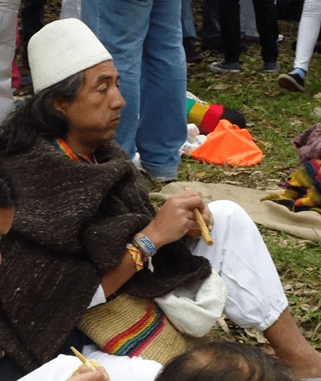
At that moment the jars of ambil and coca mambe were opened, and the grandfather prepared to chew coca leaf while working on his poporo. The poporo is a slender gourd, with a shape that reminds one of the magic potion bottles of cartoons, which the men of the indigenous communities of the Sierra Nevada de Santa Marta use in adulthood as a form of meditation and spiritual work.
The grandfather started instructing me in the mysteries of tobacco, the poporo, and other spiritual practices. At about three in the morning, grandfather Xieguazinsa was talking about the importance of our work for the cosmic plan of humanity when he turned his gaze from his poporo and looked at me, but without looking at me, rather piercing through me with his gaze, which was lost in the infinite.
He kept talking while moving his chucuno, which is the stick with which he coated his poporo with lime and coca, like an orchestra conductor. He quickly began weaving ever deeper and more mystical concepts. It was by no means the string of clichés I had heard in my previous experiences with “spiritual grandparents”. Xieguazinsa was threading esoteric concepts with Freudian psychoanalysis, sociology, and ancestry with an impressive dialectical coherence. Unquestionably, before me was, if not a true spiritual grandfather, at least a wise man in an unusual state of consciousness.
I realized that the phenomenon of the spiritual grandfather was not just a unilateral manifestation, but required a kind of tuning on the part of the interlocutor or interlocutors. While Xieguazinsa spoke, images he was describing would arise in my mind as if it were a yagé vision. In this sense I must acknowledge that my initial disdain for the manifestation of the spiritual grandparents Yanguma and Nemequene may have been due to my lack of connection with their state of consciousness at that moment. Those who sat with them frequently said that the depth of their channelings as spiritual grandparents could bring tears to those who listened to them.
Perhaps I connected more with the word of Xieguazinsa since he was, in addition to an indigenous authority, a consummate student and academic of anthropology and humanistic topics, as well as the bearer of a prodigious memory.
In addition to that time with Xieguazinsa, I had the opportunity to experience the phenomenon of the spiritual grandfather in my own flesh. It happened during a yagé dose in which the “vine of the soul” had been especially benevolent with me. Shortly before dawn, while most of the ceremony attendees were resting, I felt the impulse to sit in lotus flower position, and after feeling a peaceful state of relaxation for a few minutes, I felt myself becoming heavy, I hunched over, and suddenly I felt like a nonagenarian.
I looked around and saw that I was wearing a cloak of red velvet, then I heard my own voice transforming into the trembling voice of an old man, and for several minutes I whispered songs of praise to the Father, I spoke about the path of spirituality through humility, the totality of love, and other moving lines. Then the presence left as it had come, leaving me with a profound feeling of gratitude and awe.
The truth is, when I recalled the words emitted by my “spiritual grandfather”, they were much more similar to the sentimental inspirations of grandfather Nemequene than to the learned dissertations of grandfather Xieguazinsa. Perhaps the phenomenon of the spiritual grandfather belongs more to the domain of the heart than of the head.
That visit of my spiritual grandfather was repeated later in two other yagé ceremonies. Each one of them was a moving experience. On both occasions, the general sensation of being an elderly old man was repeated, but unlike the first channeling, the grandfather would inspire me some beautiful songs – at least beautiful to me – that simply came out of my throat with a trembling but warm voice. I no longer remember the details, but they were songs about the love of the Father and the perfection of the Creation.
I never received this pleasant visit again, but with time I discovered that every time I am given the opportunity to offer my counsel or comfort someone, I adopt slight changes in the tone of my voice and use words of empowerment and motivation with which I seek to touch the heart rather than the mind of the one who comes for my help. Now I know that that tender and wise grandfather who visited me on three occasions is part of me and comes to meet me every time I invoke his wisdom and counsel. Perhaps it is he and not I who have written several of the lines of this account.
I was convinced that the rite of passage would be a milestone in my spiritual path, so I made a considerable effort to gain the favor of the members of the council of grandparents. I participated in all the community events, I collaborated as a volunteer helper of the grandparents whenever I had the opportunity, and I submitted myself to the long days of mambia, offering tobacco smoke and receiving without a whimper the medicines they offered me.
In addition, I presented myself for my first tobacco cleansing on a Friday in the maloca of the Botanical Garden. This was one of the requirements to be able to receive the rite of passage and, according to grandmother Yanguma, the only way to see if I was totally prepared for the important ceremony.
I sat down in the small circle of log seats that served as chairs, and next to me sat a small group of aspirants to the rite of passage: Santiago Salazar, that pleasant psychologist with a Nazarite appearance who had attended me in his rustic office, and the Méndez sisters, a pair of twins a little over sixty years old and university professors who frequently accompanied the spiritual activities of the community but did not dress in white nor were they interested in the social or administrative activities of Pueblo Nación.
Leading the ceremony were grandmother Yanguma and grandfather Nemequene. Without further delay, they proceeded to insufflate hoska on all the attendees. This was done by grandmother Yanguma, who was known for having a strong and short “blow” that pushed the tobacco powder up to the top of the nasal sinuses, often leaving the receiver stunned if they weren't prepared.
Then grandfather Nemequene distributed tobaccos and announced that during the night one had to finish four complete tobaccos. Each person had to consecrate the tobacco, which was done by blowing on it three times to “cleanse” it of spiritual impurities and negative thoughts. Then it was placed on the brow, and the purposes the offerer had were imprinted on it, and only then could it be lit and the raping or offering begun. These were the words accepted by the grandparents for the act of carburing the tobacco with breath, since the word “smoke” was considered worldly and far from the sacred meaning of the Muisca tradition.
Before starting to rape the tobacco, however, grandmother Yanguma passed in front of each of the attendees, asked us to open our mouths, and placed a piece of tobacco about an inch long between our molars and cheek. With which, we had to offer tobacco while having a piece of tobacco in the cheek and tobacco powder in the nasal sinuses. As expected, the dizziness didn't take long to arrive, but even so, grandfather Nemequene announced he would start passing the ambil to “sweeten” the word… As one will recall, the ambil is the pure extract of concentrated nicotine.
A couple of hours later, I could no longer understand the words of the grandparents, and the only thing passing through my mind was the awareness of the growing state of unease that was starting to invade me. I thought I wouldn't manage to reach the end of the ceremony, and that was before we even reached the most difficult part of the cleansing: the ingestion of the tobacco chicha.
The tobacco chicha, or muiscola as the community members jokingly called it, was a tea prepared with a good number of tobaccos crushed in boiling water. Grandmother Yanguma started distributing the brew one by one, serving it in a gourd bowl. The first to receive it were the Méndez sisters, who hurriedly drank it as if it were sugarcane water, then came Santiago, who was already quite pale and had to overcome several retches before being able to ingest the liquid.
Then it was my turn. Like Santiago, it was enough to bring the gourd to my mouth to start feeling retches, and I barely managed to swallow the repulsive liquid, which lasted barely two minutes in my stomach when I could no longer contain it and vomited violently. The muiscola went to land at the bottom of the black garbage bag I was holding in my hands.
After expelling all the liquid, I was left in an even more deplorable state, if that was possible. My visual field shrank, my heart was racing, and I felt chills, nausea, and vertigo. I had forgotten to keep raping my tobacco, so grandmother Yanguma reminded me to do so with a gentle blow of hoska through my nasal cavities. The sensation of the clogged nose, the mouth full of saliva and tobacco, and the general weakness produced in me a feeling of desperation that nearly forced me to abandon the ritual.
The objective of the cleansing, as with the yagé ceremonies, is to find the origin of the suffering, face it, and expel it in some way, usually through vomiting. I was found too weak and confused to make the effort of any inner search, so I focused on enduring the torture and finishing my tobaccos. I looked to my sides and the guys who were with me had the same expression of anguish and helplessness, but the Méndez ladies remained unscathed and even had a second portion of tobacco chicha.
My effort to keep myself calm was starting to bear fruit little by little; I started controlling my breathing and decided to stop thinking about what was left until the ordeal ended, and to focus on the present moment. I kept receiving insufflations of hoska and sucks of ambil, enduring the hiccups, the retches, and the dizziness until they became part of a strange normality. At that point, I was able to start feeling a sadness that I had carried with me. Moreover, I knew exactly where it was located: it was in the lower right part of my abdomen, near the liver. I focused on that sadness and tried to perceive its origin. Little by little it was revealed to me that it was a sadness of my mother. It was a mixture of anguish, despair, and loneliness. I tried to understand more about that feeling, whether it was a feeling of mine toward her or one I perceived from her side. In any case, I asked for light to illuminate that darkness, and soon I understood what I had to do: I had to help my mom heal her sadness, to serve as a guide to free her from those chains.
When I became aware of that mission, I raised my face, which until that moment had been planted between my chest, and I said to the grandparents:
As soon as I said these words, a new access of vomiting came over me, which I once again directed to the heavy black bag between my legs. I got up feeling exhausted but renewed. The dizziness had dissipated and now I could clearly see the grandparents, even though their faces were dimly lit by the light of some candles. The grandparents celebrated my return with a loud “Ejeeeeeeeeeee” that they emitted while raising their arms. Soon the participants of the cleansing were coming out of the trance one by one, and we closed the circle with the traditional greeting to the four winds of the community. I hugged the grandparents firmly before leaving the maloca, and grandfather Nemequene told me with enormous tenderness, “Son, I congratulate you enormously; today there is a children's party in heaven, because you are going to receive your rite of passage.”
[1] Transcription and translation taken from the book “Pyquy Puyquy Cubum” by Pablo F. Gómez. Link
4 years ago. What a beautiful narrative and episode, thank you so much for sharing your experience with us 💛
Comentarios (archivo, solo lectura)
Mostramos 1 comentario guardados de la versión anterior del sitio. Ya no se aceptan nuevos comentarios.
Qué linda narrativa y episodio, muchas gracias por compartirnos tu experiencia 💛