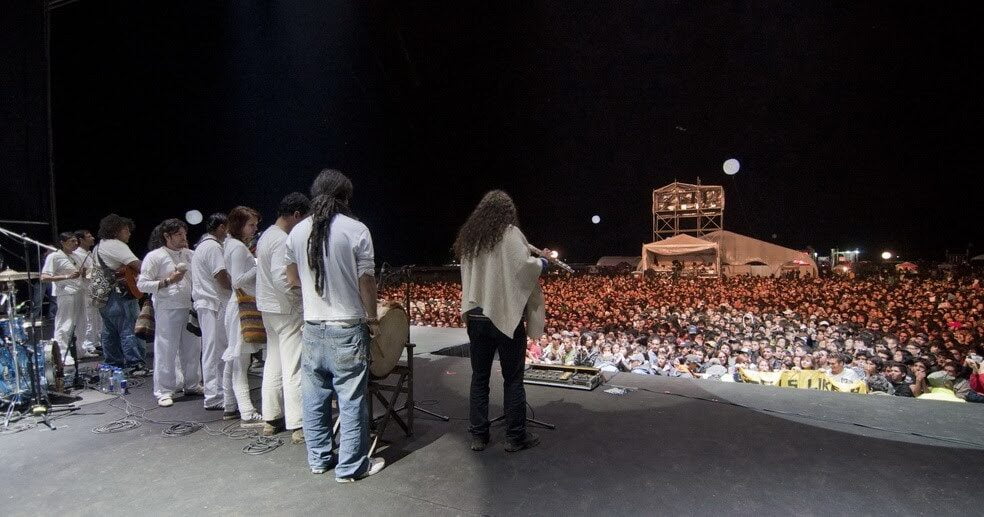
After receiving my rite of passage, I could finally feel completely part of the Pueblo Nación Muisca-Chibcha community. I was already wearing white vestments for the community gatherings, I started letting my hair grow and little by little I added elements of indigenous identity to my clothing and my home. This included bracelets woven by indigenous communities of the Amazon and my first feather necklace, which I acquired for a few pesos at an artisan fair in the city center.
For the first time in my life I felt completely accepted and valued in a social group. The closest thing until then had been when I belonged to the boy scouts during my childhood, but even then I never quite became part of the inner circle, as it's colloquially called in Colombia. With the Muiscas, on the other hand, I had found friends, guides, buddies and in a certain way another family. The affection of the elders, mainly Suagagua, Yanguma and Nemequene, was genuine, warm and familiar; the other young members of the community were, despite the social and cultural differences, closer to me in their worldview and purpose than most of my extended family.
An event that brought me much closer to the elders came about after a strong argument I had with Paula as a couple. We had found, for the first time, a serious test for our relationship and it was the first time we were truly close to putting an end to our project as a couple. We both knew that the elders were especially protective of the couples in the community, since they always said that working as a couple was the most important part of spiritual labor from the ancestral perspective. Besides, the family was the way to cultivate and spread the customs and traditions that the elders worked so hard to rescue and give new meaning to.
I told elder Suagagua that Paula and I were in the middle of an irreconcilable situation and that we would probably end our relationship. He immediately put himself at our service and soon they both invited us to talk with them at their house. Grateful for the gesture, we went to the elders' home, the same place where I had met them several months earlier. During a few hours of conversation, the elders behaved with us like true parents; they spoke to us from their ancestral wisdom but also as a couple of people just like us. They shared with us some of the difficulties they had overcome as a couple and we found that some were very similar to the ones we were facing.
The elders, just like us, had started their relationship when grandmother Yanguma was as young as or younger than Paula. The difference in age and experience between them was similar to the one between the two of us and, just like Paula, the grandmother had had to adapt to the accelerated pace of her partner's spiritual search. In time, she told us, she would come to match and even surpass the elder in her commitment to spiritual and community matters. That conversation didn't solve our problems, but it did give us another perspective and made us see that perhaps our situation wasn't as serious as we thought.
A few days later, it was elder Nemequene who, at the end of a community gathering, invited Paula and me to talk privately. Like the elders before him, Nemequene spoke to us mainly as an older adult with experience in couple life and not as an indigenous wise man. His advice was very down to earth and he even made use of strong words with which he was perhaps underlining his pragmatic position on the matter. We thanked him for his valuable opinion and, with a significant effort from both Paula and me, we managed to overcome that test and strengthen our relationship.
In retrospect, despite how useful the elders' advice turned out to be and the evident affection that motivated them, the event would become a new red flag, similar to the one I perceived with my oath of loyalty in the rite of passage: the elders were a spiritual authority but also a social and administrative one, so the fact that our couple problems were discussed among them and then they intervened directly carried dangers that at the time we didn't even sense.
During that year, something happened that would ultimately transform the dynamics of the community over the following years: the new district administration decided that the maloca of the Jardín Botánico would no longer be administered by the Muisca community, as it had been until then by recommendation of elder Víctor Martínez, who directed its construction, but would instead have to be shared by all the indigenous communities present in the capital. The coordination of activities would then fall to the Organización Nacional Indígena de Colombia (ONIC).
ONIC is an organization that brings together a large number of indigenous cabildos from around the country, but only those legally established and recognized by the Colombian government, something that at the time neither the Pueblo Nación Muisca-Chibcha nor the cabildos that were barely forming had achieved. Besides the lack of recognition, Pueblo Nación lacked a good relationship with the Muisca cabildos that were recognized by the government and were part of ONIC. I'll talk more about this later.
In any case, the net result of the change of administration was that we could no longer keep using the Maloca of the Jardín Botánico and the community was left without its most important beacon for finding new Muiscas, sympathizers who wanted to be part of the project of re-signifying ancestral Muisca thought led by the elders. The elders immediately started looking for legal resources and political support to achieve a return to the Maloca, which never came about, at least not under the previous conditions. In the meantime, the alternative was to look for suitable places for the community gatherings, which usually brought together between 30 and 50 people, and for the public calls made to give visibility to the process and attract new members.
The solution for the latter was to use the "environmental classrooms" or spaces in natural parks and public wetlands belonging to the Bogotá district, which could be used without the need for formal permits. These spaces mainly included the "Mirador de los Nevados" park in the locality of Suba, the "Santa María del Lago" park and the "Jaboque" wetland in Engativá, and the Neuta wetland in the locality of Soacha. In these places, which were beautiful open-air nature reserves, the elders convened talks, ceremonies and lectures that were sometimes held with the sole purpose of spreading Muisca thought, and other times were framed as part of cultural outreach contracts that elders Suagagua and Yanguma managed with the district government through a private foundation called Funaza, which belonged to them as private individuals, but not to the Muisca community.
For the community gatherings, a closed and private space was indeed needed, since matters of the community's internal order were discussed and cleansing ceremonies like the ones I've described were held, which had to stay away from the public eye. There were always sympathizers of the movement offering locations to hold the meetings, but they weren't always convenient from the point of view of location or comfort.
The first meeting place the community used after leaving the maloca of the Jardín Botánico was a community hall located in the Nicolás de Federmán neighborhood toward the center of the city. This is a place I remember with special appreciation because it was relatively close to the first apartment Paula and I lived in together. The Friday night meetings continued there and although it didn't have the majesty and ancestral atmosphere of the maloca, we managed to adapt to the new reality and I believe the meetings didn't lose in quality and emotion, although it must be acknowledged that the elders standing in front of a whiteboard with a marker in hand didn't look as mystical as sitting by the fire in the maloca.
One of the funniest memories I have from the months we spent attending Pueblo Nación meetings in the Nicolás de Federmán hall was the invitation the elders received, along with a group of community members, to "work" at an important musical event that would take place on the outskirts of the city.
Around those days, the story had become fashionable in Colombia about a shaman hired by the team that prepared the inaugural ceremony of Juan Manuel Santos' presidency. The goal of the controversial contract had been to use the shaman's ancestral knowledge to keep the rain away during the presidential inauguration event.
The truth is that during Santos' inauguration not a single drop of water fell, despite the rain forecast. What did rain down were the criticisms of the new president for turning to pseudoscience for a contract that taxpayers would perhaps end up paying. Despite the reproaches, many businesspeople turned their gaze to the charming shaman, and to shamanism in general, as an alternative to get a supernatural boost and help the cash register.
A group of those businesspeople was about to organize the first edition of a new music festival, which they planned to hold every year during October, a month known on the cundiboyacense high plateau for its frequent and torrential rains. I don't know the exact way the businesspeople got in contact with the Muiscas, but elder Suagagua used to move among all kinds of organizations due to his work as a business consultant, a personal activity he alternated with his duties as an indigenous leader.
In any case, the festival businesspeople hired Suagagua and other elders for an undisclosed sum, and they offered several of us community members the chance to help at the event, in exchange for food, transportation and, of course, the possibility of enjoying at least some of the concerts that were scheduled. The purpose of the contract was to perform ceremonies and rituals to keep it from raining during the setup of stages and equipment, and during the concert.
Paula, who wasn't so fond of the long Muisca ceremonies but was indeed fond of Green Day's music, one of the bands that would perform at the festival, agreed to accompany me on the adventure, even though the price would be long hours of tobacco ceremony, ambira and the elders' word.
Elder Suagagua told us that the businesspeople sought him out after three consecutive days of downpours at the event site and that he had spent the night there, negotiating with the spirits of the territory the terms of a climatic truce for a few days. After deliberating in the internal worlds, the conditions of the agreement were established: an undisclosed sum, a dressing room for the community, and that the festival would bear the name of a deity of the Muisca pantheon. The chosen one would be Nemcatacoa, protector of blanket weavers, the arts and ancestral festivities.
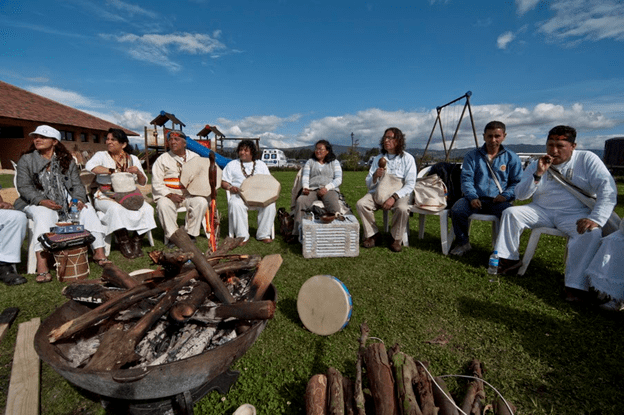
With that, the event organization provided a bus to transport the Muiscas, a large tent and enough food for the community members during the two days the event lasted. Paula and I only attended the event for a day and its night, since what really excited us was seeing one of our favorite music bands up close. However, honoring the commitment we had acquired, from early on we were sitting next to the elders and the other Muiscas, raping tobacco, sucking ambira and talking by the fire about our organizational and spiritual matters.
Every so often a big cloud would appear in the sky and grandmother Yanguma would immediately hand out new tobaccos, ask us to light them and offer them to the spirit of Sie (water), asking it to take the rain elsewhere. If the cloud resisted, the grandmother would start chewing the tobacco with more determination, and if things got difficult, she would take the tobacco out, turn it with the lit tip toward the inside of her mouth and blow it forcefully while with her gaze she admonished the rebellious cloud to go back where it came from.
Without being able to confirm whether it was the effect of the agreement elder Suagagua made, the grandmother's reverse tobacco blowing or the chaotic dynamics of the savanna wind, the truth is that during the weekend of the event only brief drizzles fell, which didn't manage to scare off the festival attendees, even though, because of the rains of the previous days, the ground was indeed a complete mud pit and everyone was walking around with mud up to their knees.
What must be acknowledged is that every time the incipient drizzle let up, we claimed the success as our own. After everything I had lived through, I wasn't in a position to doubt the power of the sacred plants... Even though my rational mind secretly mocked me.
Nemcatacoa was, for us, a pleasant experience overall. The company of the Muisca friends and the elders was always enjoyable and we had the opportunity to enjoy the best concert we had witnessed up to that moment, despite the terrible state of the grass and the numerous sound problems that came up. We were even very close to seeing our musical idols when we found ourselves next to the dressing room that had been assigned to them and saw a van leaving the tent-like structure. Inside it, shadows with hairstyles we immediately recognized were moving, but when we approached with the idea of using our status as indigenous guardians of the elements, we were stopped by a couple of burly bodyguards.
The only discordant point of the night happened just at the moment that, for the elders, would be the best part of the deal. Shortly before Green Day went on stage, elder Suagagua told us the surprise he had in store: the most important of the conditions that the elders of the territory had set to exempt the troubled festival from storms was that the elders and members of the Muisca community would have the chance to go up on the main stage before the most important act of the night, to address the audience.
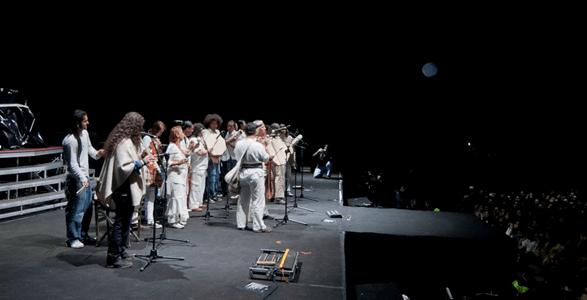
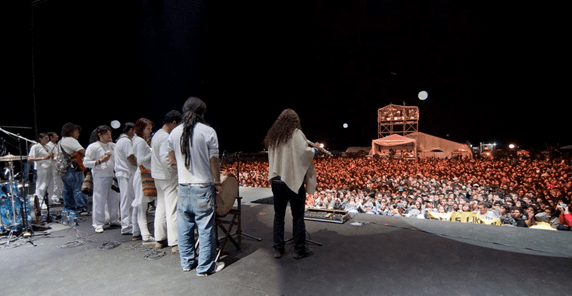
Needless to say, we had prepared nothing and the artistic talents of the group were very far from what could be considered even slightly sophisticated. Even so, we ended up standing in our white vestments, behind the elders, in front of no fewer than 10,000 people, eager — like us — to see the legendary band from California. Elder Suagagua took the main microphone and enthusiastically greeted the attendees, showing off surprising skills as an emcee.
The audience received the greeting with euphoria and burst into a strong round of applause that, to tell the truth, surprised me. The elder announced that we would perform a greeting to the four winds to commend everyone to the guardian spirits of the territory, and then we would leave them with the main act of the evening. The applause was repeated and the elders smiled, probably sensing the longed-for massive awakening of the Muisca spirit. Immediately grandmother Yanguma took the main microphone and began to intone the traditional chant "Ata fihizca", which I transcribed in an earlier chapter.
That's where the problems started. To begin with, I must say, with all due respect to the dear grandmother Yanguma, that her voice and pitch are not privileged, and to make matters worse, she also wasn't skilled at handling a sound system of that level, so she pressed her mouth against the microphone and sang at the top of her lungs, adding to the off-key singing the shrillness of gain saturation. I suppose the sound technicians reacted immediately by lowering the input levels, but what they achieved was silencing almost completely the timid drums that my companions were trying to sound at the level of the grandmother's singing. On top of that, the "Ata fihiska", which under normal conditions took about five minutes in total, became a recital of no fewer than 15 minutes that felt endless to Paula and me.
Between each verse of the chant, elder Suagagua would take the microphone to explain to the already impatient audience the profound meaning of each word. Needless to say, a few minutes into the ancestral auditory punishment, the audience rebelled and traded the affectionate applause of the beginning for furious boos and jeers. My sister, who was in the audience that day, later told us that the insults were also the order of the day and that the few applause heard from the stage only had the intention of informing the picturesque Muisca band that it was time to clear the stage to make way for the rockers. It still makes me laugh to think that the famous band of "Basket Case" and "Wake Me Up When September Ends" had to wait patiently for us Muiscas to finish dispatching the greeting to the four winds.
I don't know if it was the boos on stage, or that the festival organizers, increasingly busy and exhausted by numerous setbacks, no longer had the patience to attend to the Muiscas' demands, but the fact is that grandmother Yanguma went into one of her proverbial fits of bad temper and started blowing tobacco furiously into the noses of the Muiscas within her reach. I also saw her blowing tobacco in reverse, as we knew she used to do when she used the smoke of the plant in attack mode. She said those organizers weren't going to walk all over grandmother Cagüi, which was the name of the alter ego that possessed her when her spiritual grandmother arrived, and she let out a few angry sentences in the unintelligible tongue she used as part of that performance.
Again, just as with the fulfilled prophecy that it wouldn't rain during the festival, Yanguma's warning that the elders would punish the organizers for their insolence also came true. The rain truce only lasted until shortly after the last day of the festival and wasn't enough to be able to collect the equipment, stages and tents, so the businesspeople's losses kept piling up. And the worst part was that, in a reckless exercise of dismantling equipment under the downpour, one of a contractor's employees fell from a rigging, suffering serious injuries.
Just as we Muiscas proudly claimed the absence of rain during the two days the event lasted, the grandmother claimed as her own the accident that almost cost an innocent worker his life. In her attitude when the situation was discussed, I could notice a mixture of sorrow for the fate of the unfortunate man and pride in the "power" of her spiritual grandmother. I, to tell the truth, didn't know what to think.
Shortly after Nemcatacoa, the community was once again left without a place to hold the Friday meetings and again the elders had to start working their contacts to secure a new meeting place. In this case, the numerous consulting and coaching contacts that elder Suagagua maintained as part of his professional activity once again bore fruit.
The new sanctuary for Muisca re-signification came through the family of the late Colombian sculptor Héctor Lombana, creator of the famous monuments of the Zapatos Viejos and the India Catalina in Cartagena, and of the Arhuaco indigenous people in Santa Marta. The artist died of cardiorespiratory arrest in October 2008, but he was survived by his widow and three sons whose names revealed master Lombana's fascination with Greek mythology: Perseo, Ulises and Aquiles.
I don't know the reason why elder Suagagua had met the Lombana family, but the truth is that all of them, especially the widow and her son Perseo, fell in love with the Muisca cause and without hesitation offered their beautiful house near the main square of the old municipality of Suba to hold the community meetings. Of all the places where we gathered after leaving the Maloca of the Jardín Botánico, Perseo's house, as the old white-walled mansion came to be known, was the place I have the best memories of and where we held the most ceremonies and rituals, including my spiritual marriage to Paula, which I will describe in the next chapter.
The house, full of works of art, unfinished sculptures and beautiful flowers, was an invitation to reflection and rest, and Paula, my daughter Ana María and I attended there for several months. During many afternoons, nights and dawns we shared words of wisdom, medicine and sacred rituals there. The Lombana family was a paragon of generosity and it wasn't unusual for them to attend to us with cookies, snacks and drinks. Mrs. Lombana soon hit it off with grandmother Yanguma, who set out to turn her into a grandmother and therefore began devoting special effort to her so she would learn the arts of tobacco, the preparation of chicha, weaving and other traditional women's activities.
The lady devoted herself with constancy and determination to receiving this knowledge and bearing with stoicism the hard trials that receiving empowerment in these ancestral practices frequently entails. Grandmother Yanguma was known for being at once affectionate and demanding with her women, sometimes even going so far as to scold and cause a few tears, which of course were nothing compared to the ones she herself had to shed when she received instruction from her mentor grandmothers.
One of the ceremonies we held at Perseo's house that I remember with the most affection was an ambira preparation, one of those that used to last between 36 and 48 hours and involved the participation of almost all the members of the community. A few people were in charge of buying bundles of tobacco leaf at the city's market squares. They were gathered at the Lomanas' house and the community came together to carry out the preparation of the medicine.
For this, the women were in charge of washing the leaves, removing the central vein and boiling them. When they were ready, we men took charge of removing the leaves from the enormous pot and proceeded to squeeze them with manual presses improvised from two strong sticks and a polyethylene sack. The canvas was sewn between the sticks as if it were a hammock with rails, and the boiled leaves were placed in it. Then, two men took charge of turning the sticks in opposite directions while a third pressed the canvas with his hands to extract the last drop of nicotine-rich sap.
This last task was the most coveted by those of us in the process of initiation, since we saw it as an honor to burn our hands extracting the blood of the tobacco. With four or five trios of tybas (men) squeezing tobacco, the extraction could be finished in about six hours, after which one finally had the raw material for the longest part of the process: the cooking.
Each group of pressers presented the fruit of their effort to the elders, who evaluated the liquid, the remaining bagasse of the leaves and judged whether the work had been well done. Otherwise, the apprentices had to repeat the effort with an additional batch of leaves. The juices extracted from several bundles of tobacco leaf usually added up to only a few liters of liquid. This then had to be boiled over medium heat until most of the water evaporated and a dark, thick molasses remained. This process could easily last eight to twelve hours, during which no one could sleep. Whoever fell asleep was kindly awakened by a puff of tobacco generously applied by grandmother Yanguma. It was a hard test to pass, but the compensation was the pleasant conversation that frequently reached its point of greatest spiritual depth just as the cooking was about to finish, which also tended to coincide with the appearance of the morning star. Venus for the West, and Cagüi for the Muiscas.
Finally, after the elders determined that the preparation was ready, the thick liquid was passed to a smaller pot, where it would finish evaporating, although this time over low heat. This phase could last another six to eight hours and was the part where most of us were overcome by sleep, and only a few elders and the most experienced wise men managed to stay to see the exact moment when the mixture turned into ambira. At that instant, the elders say, the tobacco reveals the type of ambira it is and the work it has come to do in the community. It could be couple healing, prosperity work, closing of cycles or other similar matters.
The process the community lived at Perseo's house came to an end after the Lombana family took their generosity to the extreme. They took advantage of a contract they obtained with the government of the department of Cesar, to assemble a giant sculpture that master Lombana left unfinished at the time of his death, to help several impoverished members of the Muisca community of Pueblo Nación, including elder Xieguazinsa.
A group of about six or eight Muiscas, none of them with experience in
sculpture, although several did have experience in construction, headed to Valledupar with the Lomanas and set out to assemble the enormous Ecce Homo.
To make a long story short, and because I wasn't there so what I know about that event came from some of those who were, suffice it to say that the Muisca intervention in the mega-project was a failure. They told that the Muiscas spent more time raping tobacco and courting the local ladies than putting together the pieces of the sacred puzzle.
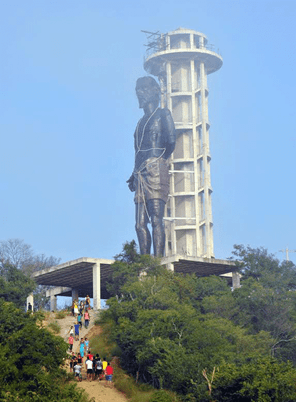
According to one of the participants, elder Xieguazinsa didn't lift a finger to mix plaster or assemble parts because, as he said, his work was spiritual and from his poporo he was watching over them so everything would turn out well. That wasn't what the Lombana family had in mind, and after trying to bring the unruly contractors into line, they ended up declaring them dismissed and packing them back to the capital.
The corollary was that some of the hired Muiscas ended up suing the Lomanas for breach of contract and, I believe, labor exploitation. Perseo's family had to make new hires and finish, this time with professionals, the imposing structure, being on the verge of having to pay breach-of-contract clauses because of the unacceptable delay in the work.
That was the end of our meetings in the beautiful house of the father of the India Catalina. That was also the end of the search for private spaces for the community meetings. From then on, we limited ourselves to the open spaces in natural parks and wetlands for public activities and the elders' house for community meetings. It was also the moment when the elders decided to give priority to the political organization of the cabildo and the realization of the community's life plan, which according to the elders consisted of getting a piece of land in the countryside where, in a few years, all the families of Pueblo Nación Muisca-Chibcha would enjoy a space to build our bohío, we would have our cusmuye or central maloca and we would generate our livelihood through agriculture, crafts and spiritual work.
A beautiful dream that would never see the light of day and that would ultimately become a mirage behind which the spirit of the movement of re-signification of Muisca thought, the brotherhood of the Ingatyba Neusa and the spirit of common unity that came to exist among us all faded away. Behind the smoke and the rubble, the true nature of the movement would be revealed. A project that wasn't born in the hearts of two brothers, sons of Muiscas, by the side of the Fúquene lagoon as I believed, but in occultist fraternities of Bogotá in the 1930s.