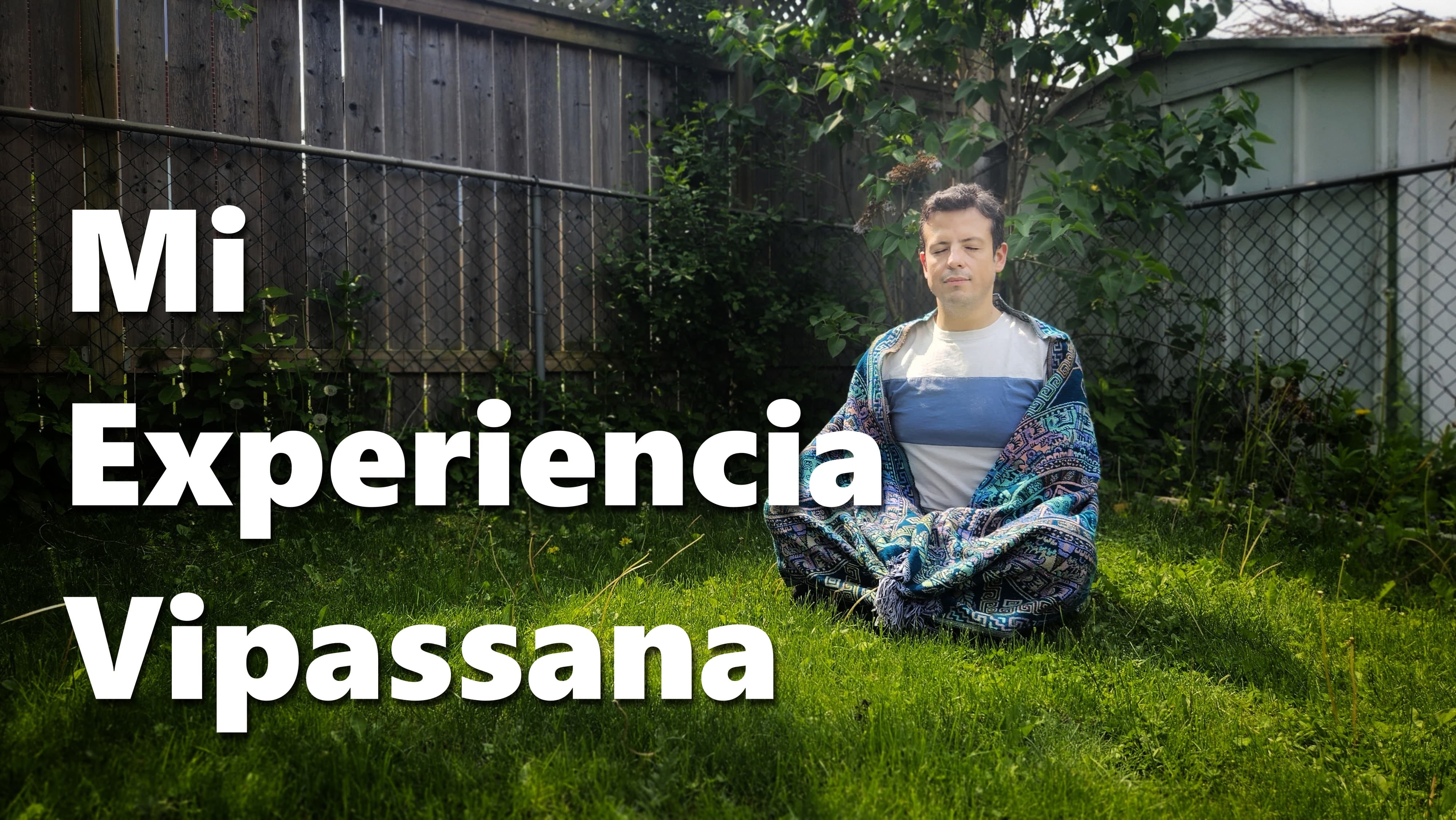
Many of you know of my spiritual path, which has included experiences such as the Yagé and the word circles. This time, I felt the call to explore a different path, one that had been resonating with me for almost 15 years, since I first heard S.N. Goenka's talks on this technique. In this post, rather than going deep into the philosophy of the Dhamma (which will deserve its own detailed space), I want to narrate my personal experience, the challenges, the revelations, and how this ancestral practice intertwines with the search for understanding that we share in this channel.
For those who are not familiar, Vipassana is a meditation technique that, it is said, was rediscovered and taught by Gautama the Buddha more than 2,500 years ago. It is important to clarify that «Buddha» is not a name, but a title that means «the enlightened one», the one who has reached a state of wisdom that allows transcending pain, suffering, and the ignorance about the true nature of reality.
Vipassana meditation is, in essence, a path, a technique to get out of suffering. But, from this perspective, what is suffering? It does not refer merely to inevitable physical pain (such as a scrape on the knee, which hurts and then passes), but to that added pain, that mental unhappiness that we prolong and magnify in the face of adversity. It is the trauma of an abused child that lasts a lifetime, or the decision to «never fall in love again» after a disappointment, limiting our capacity to be happy. As a phrase that resonates in this path says: «Pain is inevitable, but suffering is a choice» (though I would nuance that it is more a choice than a reaction).
The great revelation of the Buddha, or his «philosophical novelty», was identifying that this self-imposed suffering comes fundamentally from two automatic reactions of our mind: attachment and aversion.
Vipassana proposes training the mind to observe these sensations without creating «bonds» of desire or rejection.
My Western conception of meditation –relaxation, blank mind, inactivity– clashed head-on with the reality of Vipassana. At least, the one taught by the organization founded by S.N. Goenka (a prominent Myanmar businessman who, after overcoming a severe migraine with this technique, dedicated his life to spreading it). What I found was an intense mental work and a constant effort, which is not always pleasant, since it involves confronting both pleasure and pain.
I decided to do the retreat at a moment of stability and joy in my life, feeling prepared for the discomfort that I knew it would imply: 10 days of total silence («Noble Silence»), no communication, and dietary and sleep restrictions. The center, near Toronto (Egbert, Ontario), is a beautiful farm, a campus perfectly organized by volunteers who have completed the course. It is an NGO that operates 100% on donations from former participants.
Upon arriving, we began with «Sila», the moral foundation of the Dhamma (the way of life that encompasses the meditation). This includes precepts such as not killing (which implies a vegetarian diet during the retreat, and which they suggest as an integral part of the practice), not lying, not engaging in inappropriate sexual conduct, etc. Although some aspects may generate debate, they are presented as fundamental for an effective practice.
The Dhamma describes three stages of wisdom:
It is also explained that the mind processes stimuli (from the five senses plus the mind itself as a sixth sense, receiving thoughts and emotions) in a sequence:
Vipassana seeks to train us to be aware of this process and, with practice, to stop before the automatic reaction, cultivating equanimity.
The first three days are devoted to Anapana, a meditation to sharpen the mind. It consists of observing the natural breath as it enters and exits through the nostrils, feeling the subtle sensations in the triangular area between the nose and the upper lip. I confess that these days were a bit «boring» for me, and I even had a few microsleeps.
On the fourth day, called «Vipassana Day», the main technique is introduced: a systematic scan of the entire body, from the crown of the head to the toes, observing whatever sensation arises (warmth, cold, pressure, tingling, pain, tickling, or even the absence of sensation) without reacting to it, maintaining equanimity.
The meditation sessions last one hour, several times a day, seated on the floor (with cushions and benches if necessary). For someone like me, rather kinetic, remaining still was a trial. The pain in the back, the knees, the numb legs… all of this is part of the method. It is not about masochism, but an opportunity to observe physical pain without the habitual reaction of wanting to escape from it. It was surprising to discover how, when observing the pain calmly, it would often decrease or even disappear on its own.
This training in tolerating physical discomfort has a direct correlate with the capacity to face emotional pain in daily life.
Meditating is not «blanking the mind». Thoughts come, like clouds in the sky. The practice consists in not clinging to them, in letting them pass and returning the attention to the object of meditation (the breath or the bodily sensations).
However, I took advantage of the one-hour walks after lunch through the beautiful forest to actually think: about my loved ones, projects, this podcast. I discovered that separating the time of «not thinking» (meditation) from the time of «focused thinking» made me more efficient at both. In fact, one of the benefits that Goenka mentions is that meditation increases efficiency in daily life, and I am already noticing it.
The only application I did miss was ChatGPT, ¡for all the questions that arose and I couldn't jot down!
The last day, when the Noble Silence was broken, it was beautiful to connect with the other companions. Listening to their experiences was very enriching.
During the deeper meditations, I experienced sensations and subtle visions, close to what I had known with the Yagé, but without its overwhelming intensity. I felt how traumas and sadnesses that I believed resolved emerged, but the meditation offered me a calm and measured way to observe them, returning to the breath if necessary. While the Yagé is like an «autopilot» from which you cannot get off, Vipassana gives you more control. I believe that having known Vipassana before the Yagé would have given me more tools for that experience.
Vipassana is a powerful tool. I was surprised by my own capacity to face discomfort and pain with a calm I did not expect. The fine observation technique, if practiced, has an enormous potential to change our reactivity in everyday life.
My intention is to keep meditating (ideally one hour in the morning and another in the afternoon, though I will be flexible). And, of course, I will prepare a future episode going deep into the Dhamma and the teachings of Goenka, extracting the wisdom from those long talks to share it in a more digestible form.
This retreat was a confirmation that the inner journey is vast and full of wonderful tools for self-knowledge and the search for a more equanimous and conscious life.
And you, have you practiced Vipassana or some other deep meditation technique? How was your experience? ¡I would love to read you in the comments!
Good path and good breeze!