I have been meditating on the current situation of general disbelief that we are living through in the world. There is a crisis in the trust toward all established systems, mainly toward religion, politics, corporations, and science — that is, basically toward all the powers that have traditionally held the monopoly on “truth”. And well, we have to be sincere and start by accepting that all those institutions have deceived us with greater or lesser frequency; but then, if we are not going to believe in the institutions that are part of those systems, then who are we supposed to believe in? Ourselves? That seems to be the way.
But let's go step by step; I think we have to analyze the phenomenon of manipulation and deception, because it is not homogeneous in all cases. The motivations and methods for lying depend a lot on the objectives of each entity and, ultimately, of each individual who belongs to them.
In a previous episode I shared that there have been social experiments proving that human beings have a tendency to form elites that take advantage of the less favored to ensure their survival or simply the maintenance of their dominant position. It is evident that lying is almost a prerequisite for the simple existence of those elites. Politicians lie to convince their voters that they are the right ones to govern them, and then to whitewash the pettiness they commit. The ultra-rich tell us that their privileged position is due entirely to their effort and leadership, without counting their silver-spoon origin or the influence they exert with their money over the other powers to enlarge their wealth.
In short, this has always been known and is already considered a necessary evil: democracy and capitalism perpetuate certain vices, but at least they are not as terrible as almost all the other forms of government and organization we have known: dictatorships, communism, feudalism, colonialism, and most autocracies; even most indigenous communities have such a record of injustice and irrationality and/or backwardness that they convinced us that the current system is the only sensible alternative. As Winston Churchill said, “democracy is the worst system of government, except for all the others that have been invented”.
The consensus seems to be that, with all its lies, corruption, and inequity, capitalism and democracy are the best we can have, so we swallow their lies with resignation. It could be much worse!
But then we are left with two systems that have traditionally been sold as custodians of the truth: religion and science. Both are today the target of the masses' disbelief and are often blamed for many of the evils of the modern world.
With most religions that base their cosmogony on divine revelations, there are only two possibilities: either deities that can communicate with human beings and reveal the truth truly exist, or everything recorded in the sacred texts is created by humans who either believe they were inspired by the divinity or deliberately deceived to give power to their ideas.
If the first possibility were true, we would have to accept that there is only one true religion and that the others are false, as well as accept many theories that go against what science has proven in recent centuries. If the reality is that there were people who wrote the sacred texts knowing full well that it was their own inspiration and not God's that guided them, then there are also two possibilities: that the deception sought a personal or elite interest, or that it genuinely sought some kind of well-being for the community to which it was directed.
Well, this last one is precisely what Yuval Noah Harari proposes in his book Sapiens: religion is the way through which primitive societies got many individuals to collaborate for the common good. It goes something like this: When we lived as hunter-gatherers, human beings formed small groups of 10 or 20 individuals who moved constantly in search of food and other resources. That is how it was for hundreds of thousands of years, and so our brain evolved with the capacity to maintain a handful of relationships with other people, create bonds of trust, and the ability to quickly determine bad intentions or deception in those people.
This is the reason why, even today, we humans are more or less efficient at judging the sincerity of people we have known for a long time, like the members of our family.
The thing is that 10,000 or 15,000 years ago, human beings discovered agriculture and went from nomadic hunter-gatherers to settling in small plots of land. Over time these plots became communities, then villages, and suddenly, after millions of years of evolution in small herds, we had to learn to deal with communities of dozens, then hundreds, and then thousands of individuals.
Well, our brain had not developed the capacity to create bonds of trust with so many people. Quite the contrary: instinctively we distrust individuals who do not belong to the same herd, the same tribe. Note that I do not say “we distrusted”, I say “we distrust”, because in a few thousand years such a complex organ manages to evolve relatively very little.
The thing is that suddenly we had the need to cooperate no longer among a few, but among thousands, and distrust was the predominant relationship. This is the reason why war became our companion from the very beginning of civilization: our instinct tells us that we can only trust our close group, that the “others” will necessarily try to take advantage of us, if not exterminate us altogether.
And so it was; conflict after conflict we began to decimate each other until a solution began to emerge: the leaders of the tribes started telling stories about Gods who watched them from the sky, who had chosen them as their children, and who demanded total loyalty in exchange for providing food, health, and long life. That would seem something hard to believe, but there was a powerful argument: every time a member of the tribe died unexpectedly, or a plague attacked crops, animals, or people, the group's wise man decreed that such tragedy was the punishment for having failed to fulfill the will of their god. What had the sin been? Well, that had to be investigated, so they set about reviewing the community's latest actions, and something had to be found. It could be that some couple had had sexual relations without the blessing of the elders, or that a menstruating woman had been cooking, or that they had forgotten to make an offering to the divinity.
Anything that was not routine in the community could be suspected of having caused divine wrath. But in any case, something had to be found to strengthen the belief in divine power, and above all to maintain order in the group.
This sounds terrible, but the truth is that the fear of divine punishment and respect for authority made it possible to overcome the instinctive distrust between tribes. If the neighboring tribe feared the same God, then we could rest easy that they too obeyed the same laws. One of those laws was invariably: “Thou shalt not harm thy fellow man”. The problem came when tribes with different creeds met, but in that way, by dint of wars, invasions, and the expansion of certain creeds, the circles of trust grew until they had millions of members who could cooperate to a certain extent.
Without religion we would not have been able to achieve a global civilization.
However, little by little another kind of knowledge made its way. Throughout most of our history, the only tools we had to know the truth, apart from divine revelations, were our senses, our mind, experience, and cooperation to discuss and discern through debate. This last one is what the philosophers of ancient Greece did when they brought their observations about the world to the central agora, to debate and try to reveal the truth that way.
In that way, many advances were achieved, especially in the field of the humanities and some scientific principles, because debate served to refine, to a certain extent, the fallacies and biases that were inadvertently introduced into their analyses.
Surely there must have been philosophers who deliberately proposed lies to obtain some personal benefit, but it was very likely that their tricks would be dismantled by other philosophers with better arguments. In any case, no matter the effort and goodwill, there were topics that escaped the discernment possibilities of the mind. Things like quantum physics, the theory of relativity, or even mechanical physics, do not correspond to the intuitive logic of the human being, nor can they be analyzed with the simple use of common sense. For this reason, the Greeks did not manage to find answers to important questions like the origin of life, or the nature of consciousness, or our place in the universe.
But the methods of experimentation, debate of ideas, and verification of results as a way of understanding the world kept allowing important achievements. The Greeks, and in particular Pythagoras, Euclid, and their pupils, adopted mathematics as a tool for understanding the Universe, upon observing that many observed phenomena seemed to correspond with the results predicted by equations. We have all studied their principles of geometry and trigonometry, which are still applied in architecture, physics, astronomy, navigation, and many other disciplines. Archimedes understood the concept of volume and buoyancy of bodies while bathing in his tub, but thanks to mathematics he was able to explain and support his discoveries before other scholars.
But the case that has always caught my attention the most is that of Eratosthenes, around the year 225 BC, who was able to measure almost exactly the circumference of the Earth using stakes, sunlight, and a lot of patience.
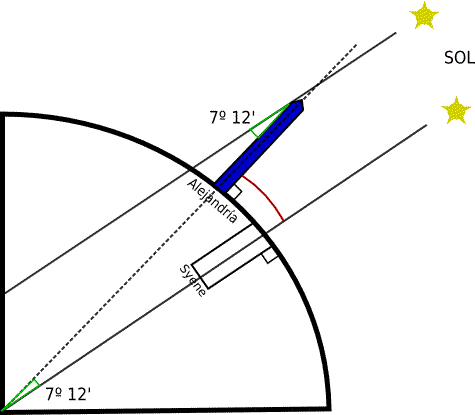
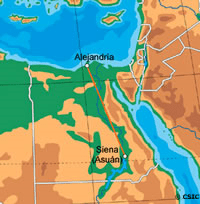
While at the Library of Alexandria, he found a report of observations on Syene, a city located about 800 km south of Alexandria, in which it was said that on the day of the summer solstice (June 21) at noon, objects (such as obelisks) cast no shadow, and the sunlight could be seen at the bottom of the wells. This is because that city lies on the line of the tropic (actually, 33′ north of the Tropic of Cancer).
Eratosthenes realized that in Alexandria, on the same day and at the same hour, this same phenomenon did not occur. He correctly assumed that the Sun was at a great distance and that its rays, upon reaching the Earth, did so (practically) parallel. This confirmed his idea that the surface of the Earth was curved, because, had it been flat, this difference between the two cities would not have occurred. The next step was to measure in Alexandria the angle formed by the sun's rays with the vertical, which by construction is equal to the angle whose vertex is at the center of the Earth (see the diagram above). This angle turned out to be 7º 12′ (= 7.2º). The other thing he had to find out was the distance between Syene and Alexandria, which was not known exactly, so he paid an assistant to measure on foot the distance between the two cities. He found the distance to be 5,000 stades. He performed the calculations with the help of Pythagoras' mathematics and concluded that the circumference of the Earth measured 360·5,000/7.2; that is, 250,000 stades. Although there is no exact data, it is known that a stade is equivalent to about 160 m (currently 158 m is usually taken). Therefore, 250,000 stades are approximately 250,000*160/1000 = 40,000 km. This is equivalent to a radius of 6,366 km, or 6,286 km if we take the 158 m, against the 6,371 km that are accepted today.
This story is particularly interesting because it shows that in Ancient Greece, the power that a single person can have when they are willing to seek the truth was understood, as well as how important it is that there be a system to corroborate, discuss, and confirm theories. But above all, the power that doubting the predominant knowledge gives us, and accepting different truths when the necessary proofs are provided and protocols are followed to reduce the effect of our biases. By the way, if a flat-earther took it upon themselves to repeat Eratosthenes' experiment, studied optics, did their own experiments with telescopes, and cross-checked the numbers, they would find the same results on which modern science is based.
Of course, this power in the hands of the masses was very dangerous for the predominant powers of the time, so as soon as the Roman Empire extended into the territory of Egypt, Julius Caesar himself set fire to part of the Library of Alexandria, and a couple of centuries later, the library would end up falling completely amid clashes between Jews and Christians — that is, one more of so many wars between “them and us”.
From there, more than 1,000 years of obscurantism awaited us in what is known as the Dark Ages. For 10 centuries, humanity resisted the advance of science, and the only truth accepted was that of the sacred books. Of course, wars between the followers of each text were the order of the day, and we had to go through the infamous crusades, holy wars, and other atrocities.
We had to wait until the Renaissance, which was called that precisely because it was the rebirth of the ideas of Ancient Greece, to keep advancing and evolving toward a modern society. But what was known at the time as the knowledge revolution was, rather, as Harari says, a revolution of ignorance. We accepted again that there were things we did not know, that there was no book that had all the answers, and that we could be wrong. That was the door to the advance toward knowledge. It is doubt, and not certainty, that pushes us toward the light.
So, after all this journey through history, we can recognize that our skepticism toward official knowledge has very deep and well-justified foundations. By nature we distrust those in power, and we have the instinct to investigate on our own and find the truth. But this investigation cannot outright disregard everything that millions of people have discovered before us. Imagine that every doctor had to invent penicillin on their own, or learn to remove tumors by trial and error. Would you be willing to let yourself be operated on by a “skeptical” doctor who does not believe in the theory of modern surgery? Would you entrust your money to a bank that does not believe in modern economic theories or in financial mathematics? Would you buy a phone from a company that does not believe in the physics of semiconductors, or that decided to invent the processor or LED screens on its own?
We have achieved all our advances as a species by resorting to knowledge accumulated over thousands of years, but also by doubting at all times and being willing to accept new truths when they are supported by a rigorous method, strict proofs, and the backing of the academic community. For two and a half centuries we accepted Newton's mechanical physics as the absolute truth governing physics in the Universe, but then Einstein arrived and rethought many of those laws in the light of new observations, very complex mathematics, and the support of hundreds of researchers who worked with him. Many resisted, but the weight of the evidence prevailed.
This brings me to the last point I want to address: skepticism is our most powerful tool, but only when it is used by rigorous, disciplined people who are also skeptical of themselves. To investigate, one must doubt one's own observations, contrast them with other researchers, look for strategies to reduce the biases of one's own mind, test alternative theories to rule out other possibilities, and so on.
The good thing is that this system is not the monopoly of the great universities or of any government. If we want to know the truth about vaccines, or about the economy, or about global warming, it is not enough to spend many hours on Internet forums or watching YouTube videos. You have to go to academia, invest years in studying accumulated knowledge, rack your brains with advanced mathematics, with chemical equations, invest hundreds of hours in laboratories, field experiments, conducting clinical studies. Knowledge is not exclusive to anyone, but neither is it within everyone's reach.
In the next episode I am going to talk about ancestral knowledge, because as I say, nobody has the monopoly on knowledge, and our Amerindian ancestors, the ancient peoples of Asia, and others developed similar systems and were able to develop complex knowledge of medicine, astronomy, and chemistry, and in topics such as psychology and sociology, it could be said that they developed even more sophisticated systems than Western societies.
I went on a bit long, but that is all for today, see you soon..
Good path and good breeze!
https://en.wikipedia.org/wiki/Eratosthenes
https://ehistory.osu.edu/articles/burning-library-alexandria
PS: Do you know who the person in the photo is? Write it in the comments!
6 years ago Cordial greetings Mañe. Chapter 4 is quite interesting; in fact, the interconnection of our brain with the universe is no mystery……without going further……all humans, as children, imagine travels and states outside our atmosphere….and the beyond that we imagine is quite similar to reality…and nobody explained all that knowledge to us. The example of the experiment with the objects in the drawers and the choice made by the hemispheres is really interesting. One would have to delve deeper into the topic of those experiments……… Hugs from La Samaria.
Comentarios (archivo, solo lectura)
Mostramos 1 comentario guardados de la versión anterior del sitio. Ya no se aceptan nuevos comentarios.
Cordial saludo Mañe.
El capitulo 4 es bastante interesante; pues de hecho La interconeccion de nuestro cerebro con el universo, no es misterio......sin ir mas lejos......todos los humanos de niños, imaginamos viajes y estados fuera de nuestra admosfera....y el mas allá que imaginamos es bastante parecido a la realidad...y todo ese conocimiento nadie nos los explico.
El ejemplo del experimento con los objetos en los cajones y la elección que realizaron los hemisferio es realmente interesante.
Habria que ahondar mas en el tema de esos experimentos.........
Abrazos desde la Samaria.