So far we have taken the first steps toward understanding the true nature of reality through a couple of very simple but illustrative examples. We live in a world where we not only perceive reality through our senses, but we also create a reality through our actions. This reality is known simply as culture. Wikipedia defines culture as a term that encompasses the social behavior and norms found in human societies, as well as the knowledge, beliefs, arts, laws, customs, capabilities and habits of the individuals in those groups.
This simply means that culture is that collective mental construction that gives context and meaning to the physical reality we experience. If the brain of a human being is like a computer, then the mind is the operating system and culture would be like the office suite we work with. The Office of life! Following this analogy, we can add that human relationships are the networks that connect those computers.
Isn't it interesting: through technology we have built a replica of our cognitive system to use as an extension of our own capacities, and even today our scientists and engineers are working to give that technology the ability to think. The famous Artificial Intelligence. Could it be a coincidence that the biblical text speaks of a creator who made man in his own image and likeness? In that same story, the serpent tells Adam that if he eats from the tree of knowledge, he will become like God.
Well, it's possible that some believing listeners will get off the bus right here, because it seems I've just insinuated that humanity is following the devil's instructions and trying to turn ourselves into Gods. Well yes, I believe there's no doubt that human beings chose a while ago, fortunately, to eat more from the tree of knowledge than from the tree of blind faith. However, as you'll hear when I share the true origin of the Bible, it's very possible that the famous serpent of the Bible was originally an ally of humans, trying to free us from the slavery of the gods. To lead us out of the cave, if you will.
But let's go back to my analogy of human culture with computing. The business about the mind being the operating system may have sounded a bit odd, so allow me to explain that part: the mind is not something physical but a phenomenon that emerges from consciousness and encompasses the cognitive faculties of thought, including imagination, perception, thinking, judgment, language and memory. It also encompasses non-cognitive aspects such as emotions: fear and love.
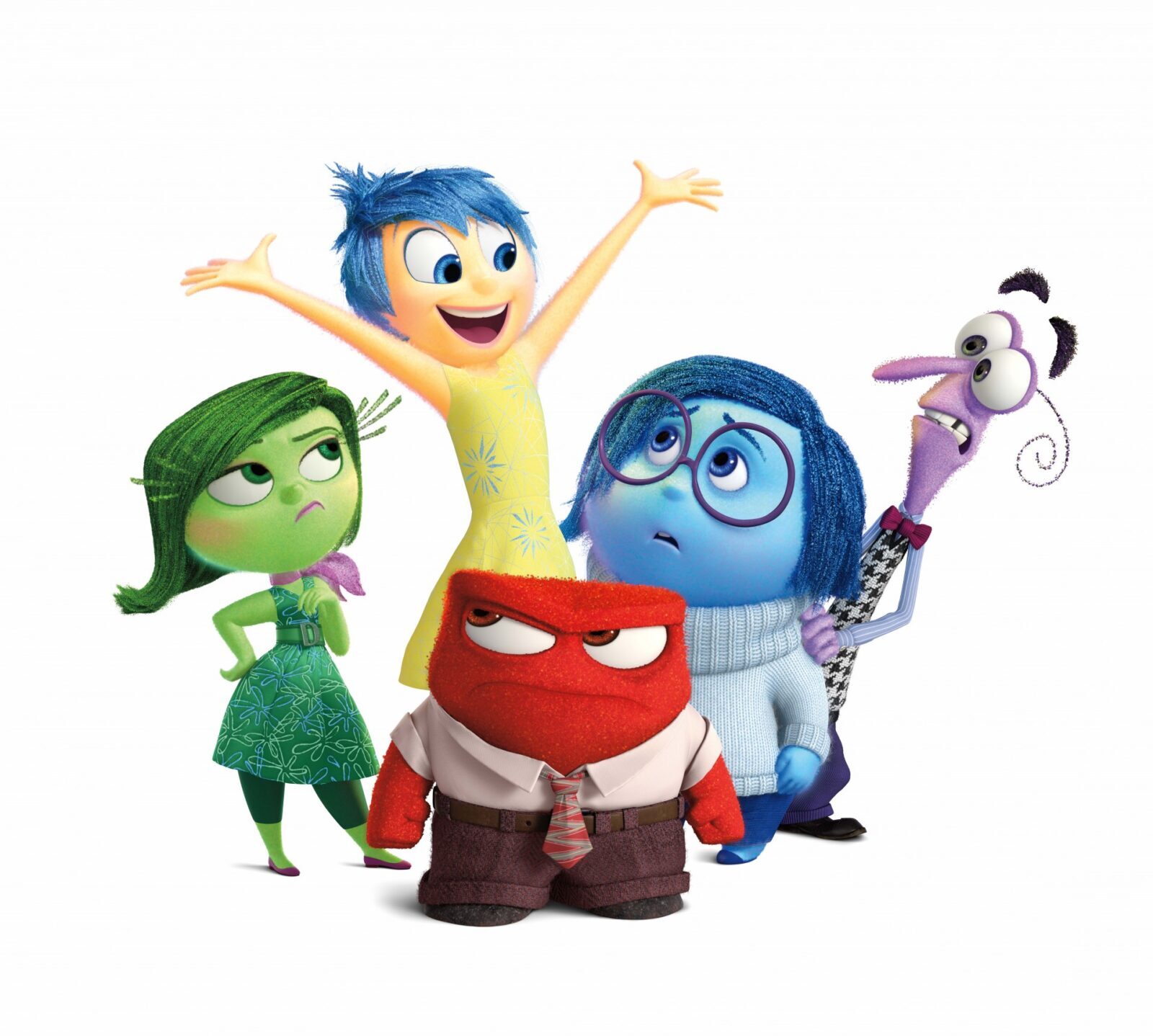
By now you'll have noticed that I love making references to cinema, so at this point it's worth bringing up the 2015 Pixar animated film “Inside Out”. In that film, the mind of Riley, an 11-year-old girl, is represented as 5 characters who live inside her head: Joy, Sadness, Disgust and Anger. We already saw that these characters are part of the non-cognitive part of the mind, but the story had to be simplified so as not to get tangled up. The thing is that Riley at the end seems to actually be a puppet managed by those 5 characters of her mind. In fact, in the film, the emotions have a control panel with a joystick and everything to manage the girl's actions.
One of the things I love about Pixar is that in their films they have dared to propose deep and controversial themes that children's movies had never touched before. In this case, besides showing how sadness is an emotion as valuable as the rest and necessary for emotional balance, Inside Out touched on a theme that until now was taboo in popular culture: the myth of the inner self. Inside Riley there is no Inner Being that is the true Riley. At first it would seem that Joy was the most important emotion, but then it becomes clear that each one adds an important part of what Riley is. Other characters appear in the girl's mind, like dreams, fears and even an imaginary friend, but nowhere is there a soul or an Inner Self.
Oops, I think someone else just got off the bus with that claim, but don't worry, later on I have a solution for the conflict.
For now, let's get back to the film. Obviously it's an artistic representation of the mind, but what many don't know is that there's real science behind it. In a New York Times article, Dacher Keltner and Paul Ekman, both psychology professors at the University of California, tell how the film's director sought them out to get their scientific help in representing a girl's mind in an animated film.
These professors, researchers specialized in the study of the mind for several decades, threw themselves fully into the project and from their collaboration came the scientific support for the story of Inside Out. They based themselves on modern theories of how the mind works, which correspond more accurately with clinical observations. While from Aristotle to Freud it was considered that emotions were something like reflexes hardwired in a fixed way in the brain, modern research shows that emotions are an individual experience that forms from the beginning of brain development and can be trained, adapted and transformed. So in the film, Joy learns to let Sadness do her thing so that Riley can express her frustration and reconnect with her parents.
So today's neuroscience tells us that our mind doesn't have an instinctive Id, a conscious ego and a Super-ego representing moral values. No, what we interpret as the SELF, the center of our consciousness, is really the sum of the consciousnesses of many different parts of our brain.
This theory has been supported by many experiments and neural observations around the world, but an interesting proof comes from a somewhat chilling study carried out since the sixties on a dozen epilepsy patients who underwent radical surgery.
It turns out that epilepsy is like a storm that happens in the brain when, for some reason, the electrical activity of the neurons synchronizes and a kind of overload occurs that makes the patient lose consciousness and fall to the floor convulsing. Thanks to the computed tomography, it was possible to verify that these electrical brain storms spread from one hemisphere of the brain to the other, and that's when the patient loses consciousness.
It was then that the neurosurgeon Roger Wolcott Sperry developed a technique to sever the connection that exists between the two sides of the neocortex, in an area called the corpus callosum. It was believed then that each hemisphere of the brain controls different systems and processes of the body and mind, but there wasn't much information about the relationship between those two halves. So some patients who suffered from the most violent seizures and who met certain conditions were chosen to try the surgical therapy.
The immediate result was a resounding success, since all the patients who were operated on stopped suffering those terrible seizures, and the best part was that all their mental and physical functions and abilities seemed intact.
In any case, Dr. Sperry and his colleagues kept strict follow-up on the patients and began to document their observations systematically.
These observations cleared up many doubts about how the brain works. One of the things discovered was that, contrary to what was believed, and many still believe — that each hemisphere controlled different things, speech for example in the left hemisphere and visual-spatial processing in the right, or that the left hemisphere is logical-mathematical and the right hemisphere is creative-artistic — the split-brain experiments showed that both hemispheres are almost equally competent for most things.
This partly demolished the analogy we made of the human brain as a computer. Because the computer has parts dedicated exclusively to certain tasks: the hard drive stores, the processor computes, the video card projects. The split-brain studies showed that the brain is more like a network of interconnected computers that share information and workload. If a connection is cut, even the most important one, the two networks that remain keep operating at full speed.
Now, the unsettling part of the study came when the participants were shown an image covering half of their visual field and then the same image was shown covering the other half. When they saw the image for the second time, they didn't recognize it as the same one from the first part of the experiment; it was as if they were seeing it for the first time.
The participants couldn't give a description of the image that was presented on the left side of the visual field. Or they didn't perceive the image; it seemed like a flash to them. Although they could respond non-verbally, pointing with their left hand at a similar image or selecting an object that was in the image among a group of other objects. This, curiously, only worked with right-handed participants.
If two symbols were presented simultaneously, one on each side of the visual field (for example, a dollar sign on the left and a question mark on the right) and the participant was asked to draw with their left hand what they had seen (without being able to see what their hand was doing), the patient drew the symbol from the left visual field (that is, the dollar sign). If asked to say out loud what they had just drawn, the participant named the symbol from the right visual field (that is, a question mark).
There were other experiments, like blindly handing them a different object in each hand and then asking them to look for the two items, also blind, in a drawer full of many objects. Well, each hand looked for the object it had touched, and even if it touched the object the other hand was looking for, it let it go and kept searching.
The results of these studies, which on the other hand earned Dr. Roger Sperry the Nobel Prize in Medicine in 1981, seem to confirm the theory that consciousness is not a cohesive unit that dwells, whether physically in the brain or spiritually in the soul, but rather the sum of sub-levels of consciousness that in any case manifest in different parts of the brain.
Perhaps the ancient sages of India were closer, who identified 4 parts of the mind: Vinha Anha – Consciousness, which is formed from the separate consciousness of 6 senses: sight, hearing, smell, taste, touch and mind. The second part of the mind, for those who know the Buddhist path of the Dhamma, was known as Sanha Ara – Perception, which is in charge of recognizing the meaning of whatever has arisen in the senses or in the mind and transferring it to the third part, called Vedha Ara – Sensation. This part would be the one in charge of providing a pleasant or unpleasant sensation according to the meaning defined by Sanha Ara. The last part, Sank Ara, is in charge of the reaction of the mind, the inner action that leads us to seek more pleasant sensations and reject the unpleasant ones. Sank Ara in Buddhism is the origin of all suffering: attachment or rejection, because it becomes the seed of the actions that drive us to remain in the wheel of karma.
But I'm not going to delve into this teaching yet, because for now we keep analyzing reality from the point of view of science to see how we face it from a spiritual point of view.
I referred to the Dhamma because I wanted to show that there is ancestral wisdom that comes very close to scientific knowledge, but not by coincidence or divine revelation, but through centuries of observation, analysis and experimentation. I want to discuss this in another audio where I'll talk about spiritual experimentation inspired by the scientific method.
Before finishing, I promised I'd give you a proposal that reconciles these factual observations of a consciousness divided into many parts with a spiritual principle of Being. To do that I'm going to lean on a concept by the American theoretical physicist Sean Carroll called “emergent properties”. What Carroll tells us is that there are characteristics in systems that don't exist in the parts that make them up. For example, he tells us that biology is a property that emerges from chemistry, and chemistry is a phenomenon that emerges from physics. Life as such doesn't exist in the proteins and amino acids that our cells are made of, but cells do have life. Now, cells don't possess consciousness, but when they form a living animal organism, then consciousness emerges.
And when consciousness emerges, then society, love, money and many other things arise that may not exist at the level of physical reality but do exist in the operating system of the mind.
So, knowing that human consciousness is not one but many doesn't take away our right to think of ourselves as individual beings, but it does oblige us to contemplate consciousness as a phenomenon of many levels, perhaps even levels higher than the individual. Can it be said that there is a collective consciousness? Social? Planetary? Perhaps Universal?
Well, I'll leave you there to think about the possibilities. For now, I say goodbye. Don't forget to subscribe to the podcast through my page lucidsapiens.com, send me your comments or questions, and see you in the next episode.
https://www.forbes.com/sites/jvchamary/2015/08/30/inside-out-science/#72a7d90c5184
https://neurofied.com/what-you-need-to-know-about-emotions-now/
https://www.nature.com/news/the-split-brain-a-tale-of-two-halves-1.10213
https://psychology-help.weebly.com/split-brain-theory-sperry–gazzaniga.html