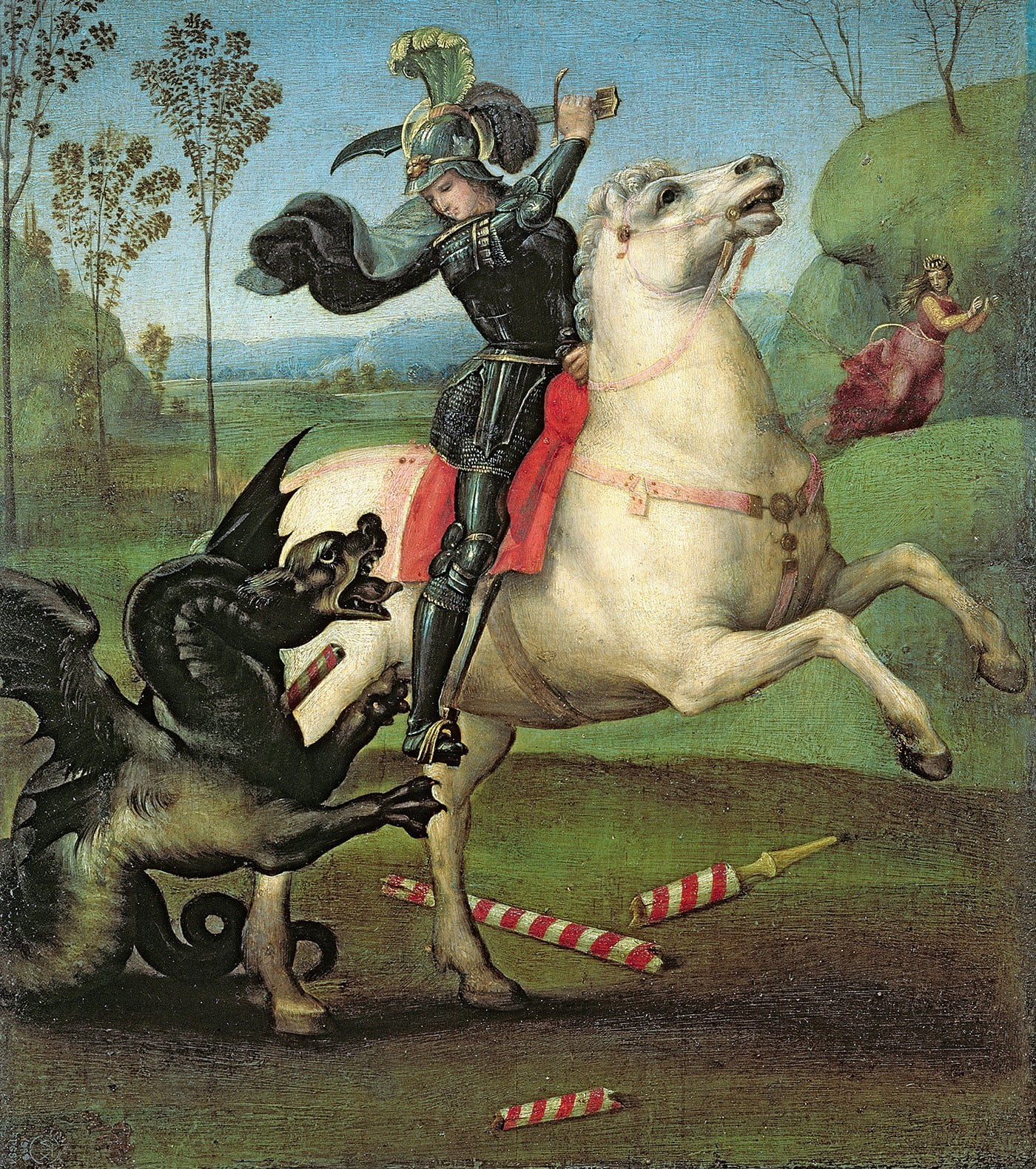
Religions and spiritual creeds share the vision that there is a war between good and evil and that we are the battlefield. Even politics agrees with this vision and takes sides with the forces of good or evil depending on the perspective from which it is seen.
What is the true origin of this struggle, and what does it mean for each one of us? A vision based on Spirituality and Science.
There are three great themes, present in all human cultures, that awaken equally passion, loyalty, and fanaticism. Three themes that, taken together, have caused some of the greatest advances in society, but also its most heinous aberrations and shedding of blood. The three topics you are supposedly not supposed to talk about at the table: religion, politics, and sports.
What do those three topics have in common that makes them so powerful and so polarizing? Essentially almost everything: all three use uniforms and symbols to rally their partisans, charismatic and eloquent leaders who are frequently attributed supernatural powers, mass events where followers gather to sing, chant, and witness ceremonies, legendary enmities with similar groups, usually originating in the same geographic area. But the most important thing that religion, politics, and sports have to offer is a sense of transcendence, the one we talked about in episode 8 on The Science of the Spirit, the feeling of being part of something superior and greater than oneself.
This is no coincidence. In fact, Yuval Noah Harari in his book Sapiens says that politics is simply another form of religion in which the god they worship is the idea of a nation, which likewise demands loyalty, devotion, tithes, and sometimes sacrifices—or war heroes, as they are called in politics.
However, there is an additional characteristic component in religion, politics, and sports that makes them so prone to violence: the need for an opponent, a contradictor. For these aspects of society to make sense, they must have an enemy whom they have to combat and destroy, but who ironically is needed for their own ideas to be contrasted.
From here on I'm not going to refer to sports anymore, because sports, just like art and entertainment, are controlled forms of giving an outlet to this human instinct for partisanship and confrontation, knowing that it is a "friendly" contest with rules accepted by the parties and the awareness that the rivalry is limited to the spaces where the confrontations take place. Well, there have been many cases where this awareness dissolves and the fans of two teams attack each other to the death, but let's say that is not the trend.
With religion and politics, on the other hand, even though they are equally fictitious cultural systems created by humanity, most people consider them "real" or "serious," and even worse, most people consider the religion or political party of their choosing to be the one that has the truth or the best moral values, and consequently that the partisans of the other factions are wrong, or even worse, that they are the representation of evil.
Well, this is the main point I want to address today: religion and politics constantly tell us that their struggle is against evil, that we are living a war between good and evil. Very often religion and politics form alliances to defeat that invisible enemy, and we see how presidents and dictators of every ideological hue invoke God, sometimes the Virgin Mary and other divine beings, for their questionable crusades.
But what is evil, and where does it come from? Like almost all the concepts we have covered so far, there is no universal consensus on what evil is. It could be said in general terms that evil is the absence of good, although that leads us to define good, which is something just as ambiguous as evil. These concepts vary from culture to culture and from religion to religion; even from person to person. However, it is clear that both good and evil are spectrums of human behaviors that, at one end, can be considered obvious to almost anyone, but at the other end they overlap in shades that some people consider good and others consider sin or negative.
I say it is a spectrum of human behavior because those same actions, when observed in other sentient or non-sentient beings, are normally not judged the same way. We know that lions kill their cubs as a strategy to obtain their own pride, and zoologists explain this as a valid resource from the point of view of natural selection, but it is not common to hear that lions are evil.
Earthquakes, floods, volcanic eruptions, and other natural disasters are also not considered evil. In fact, curiously, many religions and cults consider these events the work of a benevolent god punishing his disobedient creatures. Those same deities are also credited with natural events favorable to the human being, such as a good harvest, a fish boom, the appearance of a spring of water, and so on.
Which means that everything that happens in nature is in some way "good" but attributable to the divine, while all wickedness, on the other hand, is eminently human, even if caused by the seduction of a malicious being. Let's go, then: what is good and what is evil?
At the end of the good spectrum, we can place what would be kindness, which, although very similar, is not the same thing as good. Kindness would encompass everything that is indisputably positive, like protecting life, defending the defenseless, pursuing justice, practicing equity, kindness, humility, and so on. At the end of the bad spectrum we find pure wickedness or depravity, which analogously would be the behaviors that are universally condemned as negative, like killing for pleasure, deceiving without reason, stealing, abusing the less fortunate, causing unnecessary suffering, and so on.
All these things resonate with most of us, and I don't think it's necessary to find arguments to explain why we classify them this way. That's why cinema and popular literature have always portrayed their most famous heroes and villains with these characteristics: Superman's unquestionable goodness against Lex Luthor's indisputable wickedness.
The problem is the other end of those two spectrums, where that gray zone lies, where the actions that are neither good nor bad for most people, and the ones that are good for some and perverse for others, churn together. It is in this gray zone that most of the human experience happens. Fortunately, most of us will never feel an impulse to kill, torture, hurt, or destroy another human being, but we will also have few opportunities to show true heroism or to defend the defenseless.
Instead, yes, we have to decide every day whether we criticize a neighbor, whether we eat beef or rather tofu, whether we give in to laziness or eat one dessert too many. There, right there, we come face to face with the concept of sin, and more specifically with the seven deadly sins compiled by Saint Thomas Aquinas. It's likely that if I asked you what the Ten Commandments of Moses are, you'd get five or six of them right, but you do have the deadly sins crystal clear, because they are much closer to our daily life: pride, greed, lust, wrath, gluttony, envy, and sloth.
Of course, there are many cultures that don't base themselves on Thomas Aquinas's list, but in general lines they censure the same behaviors. Buddhism, for example, only specifically speaks of greed and wrath, but adds ignorance as part of the three poisons, which are the fundamental cause of karma. Islam is more general in how it names sin and speaks of sayyia, khatia: errors, itada, Junah, dhanb: immorality, haram: transgressions, ITHM, dhulam, fujur, su, fasad, Fisk, kufr: evil and depravity, shirk: believing in another God besides Allah.
The conflict in all these cases is that the definitions of those sins are almost always so vague and ambiguous that there is also a whole spectrum of behaviors that fit into each definition, which for some people are acceptable or even good and for others the exact opposite. For example, is pride in oneself or self-love a form of pride?, How far can I be ambitious in my projects without reaching greed?, Does lust only exclude relationships between heterosexual spouses?, What about the LGBTI community, masturbation, or pornography?, Is wrath really so bad if with it we motivate ourselves to fight against injustice or abuse?, What is gluttony?—eating without hunger, or from what quantity of food onward?, Is there "good" envy? And finally sloth: if I stay in bed all day on a Sunday, or if I decide to leave for tomorrow a task I could do today, am I falling into this deadly sin?
Jews and Muslims have the "advantage" that their guiding books specify with much more detail what is pious and what is sin. With the disadvantage, on the other hand, that their guiding books were written a couple of, or a good many, thousand years ago, and therefore they give little light on what to do about the internet, social networks, multilateralism, globalization, space exploration, climate change, psychoactive substances, and so on. Apparently Muslims receive all of this mostly as sin and Jews mostly as a divine gift, but either way, we can see why there is such a huge ideological abyss between the worlds of the East, the Middle East, and the West.
The spiritual war that each one of us fights on the personal terrain of human behavior has thus, for centuries, been transferred to battlefields in the external world, where the holy war, the Crusades, and more recently the war on drugs or the war on terror wave the banners of good, where with the help of God the forces of evil will be defeated.
And then here religion and politics meet again, because religion tells its faithful: "You must cultivate faith and temperance so as not to fall into the temptation of committing these sins, or your souls will be condemned," but at the same time it tells politicians, "We must not allow people to commit these sins; we have to prohibit this or that, otherwise people will do it unchecked and we will live an inferno on earth." And if it's a matter of members of another religion, then they can already be annihilated directly, just in case.
Well, but if the statistics show that only about 20% of the world's population does NOT belong to an organized religion, the question would be: how do we manage to advance ever further toward a secular world in which religion no longer has the same influence on most governments that it had just 50 years ago?
Well, it turns out that in the very heart of this preservative, law-making religious thought, there has always existed a progressive, libertarian, and humanist seed that has opposed the governance of society based on religious precepts. Preservatives against Libertarians… does that sound familiar? Yes: Conservatives against Liberals.
In the biblical account, God, or "the governor," placed Adam and Eve in the center of the Garden of Eden and offered them all the benefits of law: housing, food, security, health, clothing… Well, he didn't give them clothing, but he did set the condition that, in order to keep receiving their pension and other subsidies, they had to obey what they were ordered and, above all, not "eat from the fruit of the tree of knowledge," meaning not to think.
Then the snake, or "the opponent," appears and tells Adam and Eve that if they eat of the forbidden fruit (that is, knowledge), then one day they will be able to become like God, dominating the world, traveling to space, manipulating DNA, and so on.
We already know what happened next: Nietzsche declared God dead, and we are on our way to becoming Homo Deus, as Noah Harari pronounced.
No matter the title or color they put on it, or the number of political parties they want to set up, the whole spectrum of political thought lies between these two tendencies and can be split in half. On the left side there are the libertarians, and on the right side the religious.
Damn, we've already gotten ourselves into laterality… left and right, doesn't that sound familiar from something we've dealt with before? Well, yes: the left and right hemispheres of the brain. But no, that's not how it goes; the definition of political left and right has nothing to do with the functions that were mistakenly assigned to each hemisphere of the brain. But in fact, left and right, humanism and religiousness, do have to do with the brain, only in a different way:
The human brain has evolved from the inside out, and the deepest part, the brainstem, manages vital functions like breathing and the beating of the heart. Around this primitive brain, higher mental functions began to develop, starting with a small bulge that sits at the top of the brainstem, called the R complex (the R comes from reptiles, where it has also been observed, and with whom we share a common ancestor). This area of the brain controls territoriality, aggressiveness, ritual, and hierarchy.
Around the R complex, the limbic system developed, which is our mammalian brain. There arise very strong emotions, like the care of young, and other social behaviors that can be observed in all mammals. Finally, around the limbic system, we primates developed the cerebral cortex: the place where consciousness, intuition, analysis, logic, language, art, and science emerge[1].
Finally, to not lengthen the anatomy class, one of the areas that has evolved most recently in Homo Sapiens is the frontal lobe. This interesting area of the brain manages very complex processes like meta-thinking, which is abstract thinking about things that only exist in our imagination, long-term planning, but what I want to focus on is these two: control over one's own behavior, and empathy. That is, this modern brain is what has allowed us to get out of the savage life and build a civilization. The frontal lobe allows us to control the emotions that arise from the limbic system and to modulate them, to avoid outbursts and impulses that go against our short-, medium-, and long-term goals, and it also gives us the possibility of attributing emotional states to our fellow beings: feeling pain at the pain of a fellow being, even a stranger, or rejoicing at their displays of happiness[2].
It has been proven that people who have lesions in the frontal lobe, or who have it atrophied in some way, do not control their impulses and are prone to psychopathy or to having sexual behaviors in public without feeling shame.
But this modern, empathic, self-controlling brain did not replace the limbic system and the R complex; it coexists with them. Therefore, human beings are animals who experience at the same time an enormous sense of cognition and social cooperation, along with animal emotions and instincts, and the aggressiveness, ritualism, territoriality, and respect for hierarchy common to reptiles.
In other words, in our brain coexist, cooperate, and sometimes come into conflict, the whole spectrum of forces that drive and restrain us. At the same time we fear authority, react with violence if our territory is invaded, protect our young, feel ourselves part of a herd, feel the impulse to procreate, to hoard, and to enjoy pleasure, but also the capacity to control all the above, to respect the differences with our fellow beings and unite with them to achieve a common goal, and to selflessly help a stranger.
One of the most common and erroneous ideas of those who are highly religious is that only the fear of punishment or vehement prohibition can ensure that human beings don't become corrupted, don't turn licentious, and don't decline into an animal state. They consider that within us there are demons that tempt us and that we are prone to evil, and only the strength of will with divine help can repress those instincts and allow us to live a life in peace.
Maybe it was like that for thousands, or even hundreds of thousands, of years. Perhaps our primate ancestors had to mark their territory and kill the young of anyone who challenged authority in order to have a minimum of coexistence. But science, and above all the experience of many human cultures, has shown that it is possible to coexist in peace and collaborate in large groups without the yoke of fear.
But we cannot deny what we are, and deep inside each one of us, that reptilian instinct that frequently fights with our libertarian and exploratory nature still exists and will keep existing. That is the true nature of the battle between good and evil: we are afraid of ourselves. There is a part of our brain that tells us that, if we don't respect authority, if we are not implacable with ourselves, we will descend into an abyss of wickedness. And another part that invites us to explore the world, to trust our instincts, to discover and create, even if to do so we have to break structures and abolish norms.
That's why Kahlil Gibrán said in The Prophet:
"And what if it is not fragments of your own self that you wish to discard in order to be free? If what you wish to abolish is an unjust law, you must know that that law was written by your own hand upon your own forehead. You will not erase it by burning your codes or by washing the foreheads of your judges, even if you pour an entire sea upon them. And if it is a tyrant whom you wish to dethrone, beware that the throne you have erected for him in your interior is also destroyed. For how can a tyrant subdue the free and the lofty, if in their own freedom there is no tyranny, and in their own pride no shame?"
The spiritual war is feeling guilty every time we give in to our natural instincts: love, sex, sensuality, leisure, and yes, sometimes also a desire for destruction and selfishness. All those emotions of our limbic system are between a rock and a hard place: the cerebral cortex needs those impulses in order to discover, comprehend, and create, and the R complex has to serve as a check to maintain a social order, an efficient and safe social structure.
When we are children and our brain is being formed, we are free for the first and last time. Children up to a certain age laugh at other people's misfortune and masturbate in public without a shred of shame, but they also hug and laugh without limits, without worries; they walk around naked carefree, as Adam and Eve did, but then, when pre-adolescence arrives, they realize they are naked, they discover that sex and death exist, and they begin to feel the need to create their own story, to know the world, and to distinguish good from evil.
Then, little by little, they are expelled from the Garden of Eden and have to start fending for themselves. They understand that Mom and Dad were not gods, and that causes them a deep frustration; from there comes the rebellion against the deception, the norms, and injustice. They need to write their own story, and that's why most young people are liberal, challengers, progressive.
The idealistic struggles come, they shake the foundations of society with their peace and love, student movements, springs of discontent, and then, already immersed in the everydayness of making a living and tired of the disappointments and unfulfilled promises of their liberalism and uninhibitedness, they begin to see the consequences of the mistakes committed and to understand and appreciate a little more their now old parents.
Spiritual war is feeling guilty every time we give in to our natural instincts: love, sex, sensuality, leisure, and yes, sometimes also the desire for destruction and selfishness. All those emotions of our limbic system are caught between a rock and a hard place: the cerebral cortex needs those impulses in order to discover, understand, and create, and the R-complex must serve as a barrier to maintain a social order, an efficient and safe social structure.
When we are children and our brain is still forming, we are free for the first and last time. Children up to a certain age laugh at other people's misfortunes and masturbate in public without any shame, but they also hug and laugh without limits, without worries; they walk around naked unconcernedly, as Adam and Eve did, but then when pre-adolescence arrives, they realize they are naked, they discover that sex and death exist, and they begin to feel the need to create their own story, to know the world, and to distinguish good from evil.
Then little by little they are expelled from the Garden of Eden and have to start fending for themselves. They understand that Dad and Mom were not gods, and that causes them a deep frustration; from there comes the rebellion against deception, norms, and injustice. They need to write their own story, and that is why most young people are liberal, defiant, progressive.
The idealistic struggles come; they shake the foundations of society with their peace and love, student movements, springs of discontent, and suddenly, already immersed in the daily grind of earning a living and bored with the disillusions and unfulfilled promises of their liberalism and excess, they begin to see the consequences of the mistakes made and to understand and appreciate a little more their now old parents.
The circle is completed when, older now, those rebels of the past discover that there is a new generation that wants to tear down everything they built with so much effort, and who knows, they will end up endangering the stability they have achieved for their children, and that is why they feel the need to preserve as much as possible. That is why almost all old people are conservative, even if they call themselves liberals, because the liberals of the past resemble the conservatives more than they resemble today's liberals.
And that is how we have managed to advance: two little steps forward and one little step back. We are finally beginning to understand that there are no human races, but a single human race with several colors; that women have the same value and importance as men; that women have the right to decide over their own bodies; and that love between people of the same sex is as important and meaningful as love between heterosexual couples; much to the chagrin of the fact that almost all of this, even today, is objected to by most of the most popular religions.
What will the struggles of the future be? Perhaps the right to choose how and when to die, polyamory, genetic engineering, relationships between humans and machines, respect for all forms of life.
In the meantime, the question is: how do we deal with this war within each of us? I have some ideas to share with you, but that will be in another episode.
I say goodbye for today, a hug from heart to heart. Good path and good breeze!