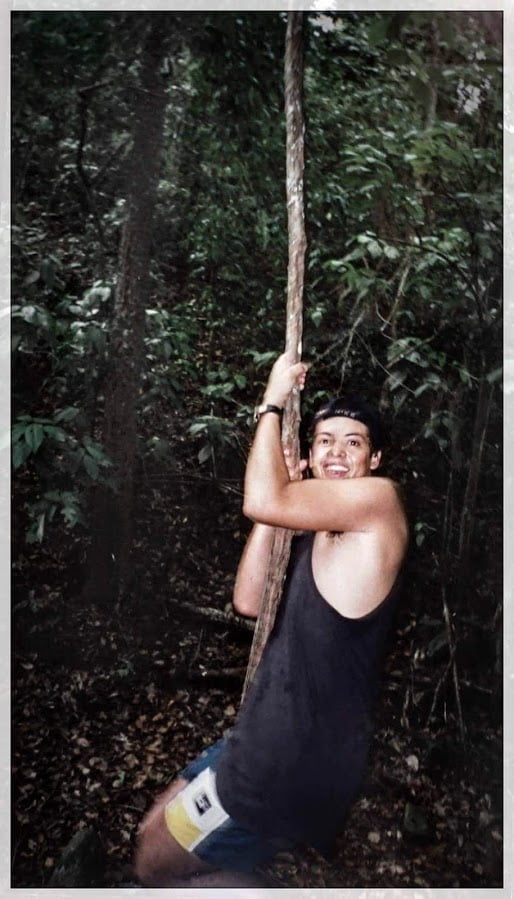
Before I turned 20, I had already completed my first degree as a Telecommunications Technologist and had had my first daughter, Ana María. As they say in Colombia, I had "matured a viche" (gotten a kid before my time). Still an adolescent, I had become the head of an incipient home that I was trying to form with my daughter's mother, and although, as was to be expected, I lacked the maturity for such a responsibility, at least the doors had opened for me to be able to provide what Anita and her mother needed.
Thanks to having obtained an outstanding grade on my degree project, the institution from which I graduated, which was part of the largest telecommunications company in the country, made me a good job offer, which however would mean an important change in life, since none of the available positions were in Bogotá. Therefore, I had to choose my destination from a list of ten or twelve intermediate-sized Colombian cities, none of which had any family or even friends of mine in it.
Under those circumstances, I let myself be carried by intuition, or perhaps I should say by emotion, and I chose the city that was also the most attractive tourist destination on the list: Santa Marta.
Santa Marta was at that time a city of about 700,000 inhabitants, located on the shores of the Caribbean Sea, with the fame of being the "most beautiful bay in America" and the most lush tourist destination in the country, but also of being a city that was behind the times, run by corrupt gamonales (landlord bosses) as if it were their own private estate.
For me, it was also the stage of my first experience as an immigrant, since although it belonged to Colombia, the customs and culture of Santa Marta struck me as totally foreign and strange. However, it was not hard to fall in love with the provincial city, with its spectacular beaches, teeming nature, and a slow, peaceful rhythm of life that I had not known before.
There I initially landed in the company of a study companion who had chosen the same city to begin his career, and a few months later Anita and her mother arrived to meet me, to begin the family experiment that we had started in a room of my parents' house.
In Santa Marta I also received the new millennium, along with its paranoia about the disaster that was supposedly going to happen at 0 hours and 0 minutes and 1 second of January 1, 2000. I had my first office job, a well-located house, a wife, and a restless but loving daughter who was about to turn two. I was still the same religious, innocent, and arrogant young man eager to make a stellar career in my new company, happy to be living in a paradise of tranquility and sure I had already arrived at the family stability I desired. But Santa Marta would take care of tearing down each of those dreams and certainties during the next six years.
The first blow of reality was the quick understanding that, no matter how much I tried to convince myself that I had made the best decision in trying to give my daughter a family with her mother and her father together, my relationship with Liliana was destined to fail. Not only had we ended up pregnant at a moment when we were just getting to know each other and cracks in our relationship were already visible, but I was thinking more and more about the experiences I would have liked to live before embarking on such a commitment.
Santa Marta is a city of cheerful, festive, drink-taking people. Its women were much more extroverted and coquettish than the ones I had known in Bogotá, and there I found myself fighting against my instincts in order to try to maintain the Christian values I believed I had fused like steel into my heart. But there was nothing to be done; the distant Sunday masses and my nun aunt's advice could do little. I was decided to sample the forbidden fruit and allow myself to experience those parties, to get to know other women, and, as they say, "to take advantage of my youth."
Not even the pain of separating from my daughter, whom I adored with my whole soul, nor the tears of her mother begging me that we try to save our home, managed to dissuade me from resuming the path of bachelorhood, this time living in paradise and with the money and independence I had never enjoyed.
Very soon I found myself without family and without friends in a city consecrated to enjoyment. My house, in which my little daughter had only recently been about, leaving a mess of toys, was now the house of two bachelors to which "friends" frequently arrived with bottles of liquor and women I barely knew, with the intention of having a good time for a while.
I can't say that I turned promiscuous or an alcoholic. Fortunately I never got to the point of abusing alcohol, and my fear of rejection was always an obstacle to being a hopeless womanizer. In fact, a few months later I fell in love with a beautiful woman from Samaria, whom I would eventually come to marry for the first time. In one of those screwy turns of destiny, where when you don't learn the lesson you end up back at the same destination, I found myself once again forming a home without having the maturity or the conviction of wanting to do so, dragging my daughter into it.
Ana María returned to Santa Marta to live with me, and although things worked out apparently well for a longer time than I had managed by her mother's side, the truth is that the immaturity, both on my part and on my new wife's, led us to the place where I had been with Liliana a couple of years earlier.
At that time, moreover, my spirituality had already been reduced to its minimum expression. The moments of mystical ecstasy I had lived at the beginning of my adolescence felt more and more distant, and my relationship with God had become an internal dialogue of formality in which I asked for protection for myself and my family and, in exchange, he would receive his weekly Sunday visit. What had come back with force was my desire to meet other women and live more experiences, convinced that a résumé with barely two women wouldn't be enough to... Well, I have never known why one needs to meet many women, but the truth is I was certain I needed more experiences.
In this case, however, I felt that despite everything that wasn't going well, I really did love my wife, and I didn't want to have to separate from Ana María again, so I made what could be called a Solomonic decision: I didn't leave Angélica, but neither did I refuse to live experiences with other women.
I had mentioned that one of the things I liked most about Santa Marta was its tranquility. It was very different from Bogotá, where just setting foot on the street made me feel insecure, where I had been the victim of two or three armed robberies, and where, as I narrated in an earlier chapter, the nights could become a calvary when gunshots went off a few meters from my window. Santa Marta was another reality; one could walk down the street holding one's cell phone without fear of having it snatched at any corner. You could party until late at night without the fear of ending up beaten up and robbed, and then abandoned in a pasture.
It was the tropical paradise anyone would want to live in. Except that it wasn't. In fact, it was quite the opposite. I soon learned that the prevailing tranquility didn't come from the absence of social injustices or from the efficient presence of the State at all levels. What Santa Marta had was a black hand that kept order by force of trigger and terror. Drug trafficking money kept most of the region's thugs and criminals on its payroll under the figure of "private security." Everyone knew them as the "Chamizos," a private army under the orders of the most powerful capo in the region: Hernán Giraldo. Giraldo made the endless drug money flow, and all the underworld of the city obeyed his command and kept the city "clean" of crooks.
This included everything the capo considered inadmissible, including homosexuals, potheads, metalheads, and of course communists. It was known that union leaders, left-wing candidates, and anyone who showed sympathy for them had their days numbered in Santa Marta. Either they got out or they ended up floating in the Manzanares River.
In turn, Giraldo, who wasn't really from the region but from the department of Caldas, was sponsored and protected by the ruling class of the department of Magdalena. They looked the other way at Giraldo's abuses, his multiple rapes of young girls, executions, and drug trafficking, and in exchange Giraldo took care of exterminating their political enemies, watching over their estates, and "energetically suggesting" that the population vote for the usual suspects.
In Santa Marta everyone told me the city had always belonged to people with the same surnames: Vives, Lacouture, Cotes, Dávila, Zúñiga, and recently the Gneccos from La Guajira. They divided up all the State entities among themselves, managed contracts and hiring as they pleased, generally as electoral spoils, but people lived calmly, had enough for the market and for the rum, and everything worked fine.
But this harmony, just like my puerile marriages, soon came to an end. From the department of Córdoba came the United Self-Defense Forces of Colombia (AUC), the paramilitary group that had been expanding throughout the country, apparently as part of the black hand of Álvaro Uribe's "Democratic Security" government, and which was led by the bloodthirsty Carlos Castaño, mastermind of the murder of Jaime Garzón.
It's said there were power negotiations between Hernán Giraldo and Castaño, but the murder of a Chamizos leader, answered in turn by another couple of AUC deaths, ended the paradise and turned it into a theater of war between the two armed groups.
Soon pamphlets from one group or the other began to circulate ordering "armed strikes," that is, days on which one couldn't go out into the street or open for business. Other times, the pamphlets — always with terrible spelling and full of macabre threats — threatened bombs and terrorist attacks on businesses whose owners were believed to finance the opposing side.
And so, in 2002, the rumor circulated that Giraldo had ordered the K-fir store to be "blown up," a place I frequented with my family to do the grocery shopping. The owners of the store, who in a pamphlet were called "cachacos" for being, like me, from the interior of the country, were pointed out as AUC allies. For this reason, the pamphlet said that we "cachacos" would have a black Christmas.
At that time, my sister Julia also lived in Santa Marta, in a neighborhood on the outskirts of the city, with her best friend. Neighbors came to her door telling her it was better that they stop dressing in black, because the "chamizos" had announced they were going to kill all those metalheads and witches around there.
The war would only get worse over the following months. The AUC opened two battle fronts: one against the "Chamizos" and another against the left-wing guerrillas in the area. By then I had to travel frequently across the department to do equipment maintenance, and what used to be a trip of contemplating the natural beauty of the area became a journey of anxiety and paranoia. Not unfounded, unfortunately.
The FARC guerrillas kidnapped three coworkers of my company and kept them for a couple of weeks in the mountains while forcing them to repair communications equipment. My boss's brother was killed in crossfire between two paramilitary groups in one of the clashes between Giraldo's men and Castaño's. One of my office coworkers returned one day from one of his trips to a municipality of the department with an expression of fear as if he had seen a ghost. He told us the paramilitaries had returned a flatbed truck they had stolen a couple of days before from the Ciénaga office. His terror was because the entire bed of the truck was covered in blood. Blood that he himself had to clean, because they warned him not to go filing any reports or anything like that.
My encounter with the reality of the violence I thought I had left behind happened during my return from a trip I made to El Banco, Magdalena. I had managed to fall asleep when, after five hours of travel and with about three left to reach Santa Marta, I felt the bus stop suddenly. I opened my eyes and saw how three men armed with rifles, kneeling in the middle of the road, were aiming directly at the driver, behind whom I was sitting.
The "pescas milagrosas" were famous back then: fleeting armed checkpoints that the guerrillas used to kidnap people for extortion purposes. You didn't need to be wealthy to be "kidnappable"; it was enough to have access to a credit line or own a house or a vehicle. However, what made me doubly kidnappable was my job as a telecommunications technician, a trade in high demand in the mountains!
They didn't make us get off, as I had heard was customary in those cases; instead, one of the armed men, with a red bandana covering his face from the nose down, got on the bus I was on and simply told us, "Compatriots: the bus up front is loaded with explosives. We're on an armed strike, and remember that the E.L.N. carries you in its heart."
A few minutes later the armed men disappeared into the thicket, and the bus driver, ignoring the "strike" order, maneuvered the vehicle passing just a few centimeters from the bomb-bus during a couple of the longest minutes of my life, in an act that I don't know whether it was brave or stupid, but that finally spared me the agony of staying in that place and gave me the possibility of returning home safe and sound.
It wasn't the last highway scare that beautiful region had in store for me. A year later, during a routine trip I made between Santa Marta and Barranquilla, where I was pursuing my studies in Electronic Engineering, I was the victim of an armed robbery by a gang of assailants who had boarded the same bus I was traveling on. It was an occurrence that had been repeating itself more and more frequently, and in which the assailants often didn't limit themselves to stripping passengers of their belongings but had sometimes perpetrated rapes and serious injuries on some passengers.
On that occasion I had the bad judgment to try to hide my cell phone, and as a consequence I had a revolver pointed at my head along with the first — and I hope the last — death threat of my life. The robbery lasted between 10 and 15 minutes and ended with me walking along a desolate road at 38 degrees Celsius, with no shade, until a good Samaritan picked me up and took me back to Santa Marta.
That day I abandoned my Electronics studies and avoided returning to Barranquilla at all costs.
I don't know if it was the closeness of death, the anxiety over the prevailing violence, or my discontent at not having lived what I believed I had to live. In any case, I adopted as my mantra "seize the opportunities." I also used to say at that time, "I prefer to regret having done something than to regret not doing it." So I began to create a space of freedom between my wife and me, which I filled with new friends, both male and female, businesses, and parties.
I also distanced myself from my daughter, who ended up spending more time with her stepmother than with me, and from my parents, whom I now called only a few minutes a month. It was as if I needed to be another person when I was away from home. When I came back I kept behaving as always, but both my wife and my daughter knew I wasn't completely there.
Between drinks with my coworkers and long conversations with female friends, my first infidelity arrived. Something that had always produced in me much curiosity and fear at the same time turned out to be much easier than I thought. My father's words — he still says today, "I have never failed your mother" — had generated inspiration in me at first, then indifference, and lastly fear.
My lover was a woman of good heart, noble and devoted. She fell in love with me, though I didn't with her. In the end I was using her to live my experience, to seize my opportunity. I got used to lying every day, doing it while looking into her eyes, and ignoring the suffering of everyone around me: my mother and sisters, who suspected what I was up to; my wife, who was certain; and my daughter, who no longer saw her father.
Since I wasn't in love with my lover, it was easy for me to leave her when I found a new romantic interest — or rather sexual, I should say. I met Nátaly, a beautiful girl from Santa Marta, a dancer, a flirt, and one of the most self-assured people I have ever known. I had heard a lot about her because some mutual friends considered her the sexiest girl in the group. She knew about me because she had heard I was the husband of the prettiest girl in the group. I decided to conquer her because I wanted to prove to myself that I could get whatever woman I wanted. She decided to conquer me because she wanted to show everyone that even the husband of the one they considered the prettiest was after her. I learned this through a mutual friend and confidante.
There I was, naive, believing I had control of the situation, and she — who, despite being only 21 or 22 years old, already had much more experience than me — knew she had won from the beginning, or so she thought.
She could see my inexperience from a mile away and knew how to seduce a man as superficial as me. She undid me with her details, her flattery, her sensuality, and her unpredictability. Sometimes she disappeared for days without a trace; suddenly she would show up at my office in a dress that left very little to the imagination and a box of flowers for me. Sometimes I only received stories of having seen her at a bar with another man. She was an enigma, but above all a challenge to my ego.
On the other hand, I noticed her main emotional void: the pain of her father's absence, and I knew how to exploit it for my benefit. My strong paternal dimension opened up for her, and I offered her all the affection and tenderness I could fake, until it became real. I believe we both fell in love with each other at the same time that my wife was leaving my heart, and I kept drifting away from hers.
It was then that I understood that what my mother had told me was true: in my house there was no longer a home. It occurred to me that turning the page would be easy; I had already done it once, and that was with the mother of my daughter — besides, now I had Nátaly, for whom I already had very strong feelings, so I could quickly process a new separation. The only real pain I felt was that I had again had to separate from Ana María, who had left for Bogotá with my mother.
What I didn't have was the guts to tell Angélica that I no longer wanted to be her husband. Instead, I became more and more dismissive and distant, as well as careless with my lies and my pretense. One night I answered a call from Nátaly knowing full well that the phone had an extension and that Angélica frequently used it to listen in on my conversations.
When she heard my declarations of love to Nátaly, she couldn't take it anymore and came down to tell me she was leaving the house. We gave each other back our wedding rings and she left. I felt nothing; there was no joy but no sadness either. I think I didn't dream anything that night; it was as if nothing had happened, as if my life of the last 4 years hadn't just been shattered right there.
The next morning I called Nátaly and told her I wanted to see her. I assumed it was a good time to tell her the news and talk about the changes our relationship would undergo. That morning I didn't feel joy yet, but I did feel excitement. I imagined being able to enjoy my romance with Nátaly without the restrictions of lies and appearances.
When I got to her house I told her what had happened, and her expression was one of mere pity — "Oh, darling, don't worry, I'll take care of you." However, she seemed busy. She asked me to wait in the living room while she finished something she was doing. A few minutes passed, and suddenly I saw, a few meters away, a woman of about 50 with short hair and a slovenly dress. In her hands she had a two-liter Coca-Cola bottle filled with a yellowish water and some herbs. I remember she looked me straight in the eyes with a stern expression and kept walking.
I felt something I had never felt before. That look awakened in me an immediate terror, similar to what I felt that day when I saw the guerrillas face to face or when the robber pointed a gun at my head. I ran to find Nátaly and asked her who that lady was — "She's a lady who helps my mom, why?" I didn't answer her, but I felt the need to leave that place immediately. It was as if something had changed inside me from one moment to the next; I felt like I was waking up in an unknown place.
I think I made up some excuse and left with a single idea in my head: I had to talk to Angélica and convince her to come back to the house. I had just realized I had made a terrible mistake and that I loved my wife as much as or more than ever.
That was the beginning of my calvary. I told Nátaly I couldn't be with her and that I was going to win back my marriage. I think she herself must have also been surprised by her reaction, because it was without a doubt much stronger and more painful than she had surely imagined. But as usually happened, her pain, or my wife's, mattered little to me; what mattered greatly to me was my own pain, which only kept growing and becoming more desperate.
There's no need to enumerate the many times Angélica refused to come back to my side. I felt I was losing control more and more: not being able to win her back, I tried begging, and since that didn't work, I also insulted her or walked away for good... Until I despaired at not having her by my side and went looking for her again. For her it was clear that what she had in front of her was nothing more than a poor imitation of the good man she had once known, and perhaps she too had her own dreams of flying, living other experiences, being the protagonist of her life.
Even so, she didn't walk away completely. She stayed there like a ghost that is present but doesn't exist, and I kept falling apart in what I now understand was my first anxiety crisis. I couldn't conceive of the possibility of having completely lost control, of having lost what had been most important to me, and all through my own fault.
At night I began to have recurring nightmares of the ghost of a woman who reproached me for having ended her life, for having robbed her of her happiness. Often those dreams were very vivid, and in them I found myself possessed by spirits that immobilized me or made me levitate. On the other hand, I sought refuge in other women, parties, and liquor.
At one of those parties I had a somewhat creepy encounter. I met a member of the "Chamizos," Hernán Giraldo's paramilitary army. He was probably someone of a low rank, and the truth is he seemed like a pleasant guy to me. We chatted about any topic, and when a mutual friend called me by my name, the boy changed his expression and asked me: "Are you Manuelávila?" (people from the region often omit the pause between first name and last name). When I said yes, he looked me in the eyes and told me, "I was going to kill you. I'm a very good friend of Alix (Nátaly's other name), and when I saw her destroyed because you left her, I offered to kill you if she wanted. She told me no, that if anything happened to you she would die, so the girl saved your life."
6 years ago Being close to death so many times makes us more prudent; perhaps those experiences are the impetus to value life much more than living in full comfort zone. Having some friction, cold, and hunger toughens the spirit and prepares it for those difficult moments.
Comentarios (archivo, solo lectura)
Mostramos 1 comentario guardados de la versión anterior del sitio. Ya no se aceptan nuevos comentarios.
Estar cerca de la muerte tantas veces nos hace mas prudentes; tal vez esas experiencias, son el impulso para valorar la vida mucho mas que vivir en plena zona de confort.
tener algo de fricción, frió y hambre, curte el espíritu y lo prepara para esos momentos difíciles.