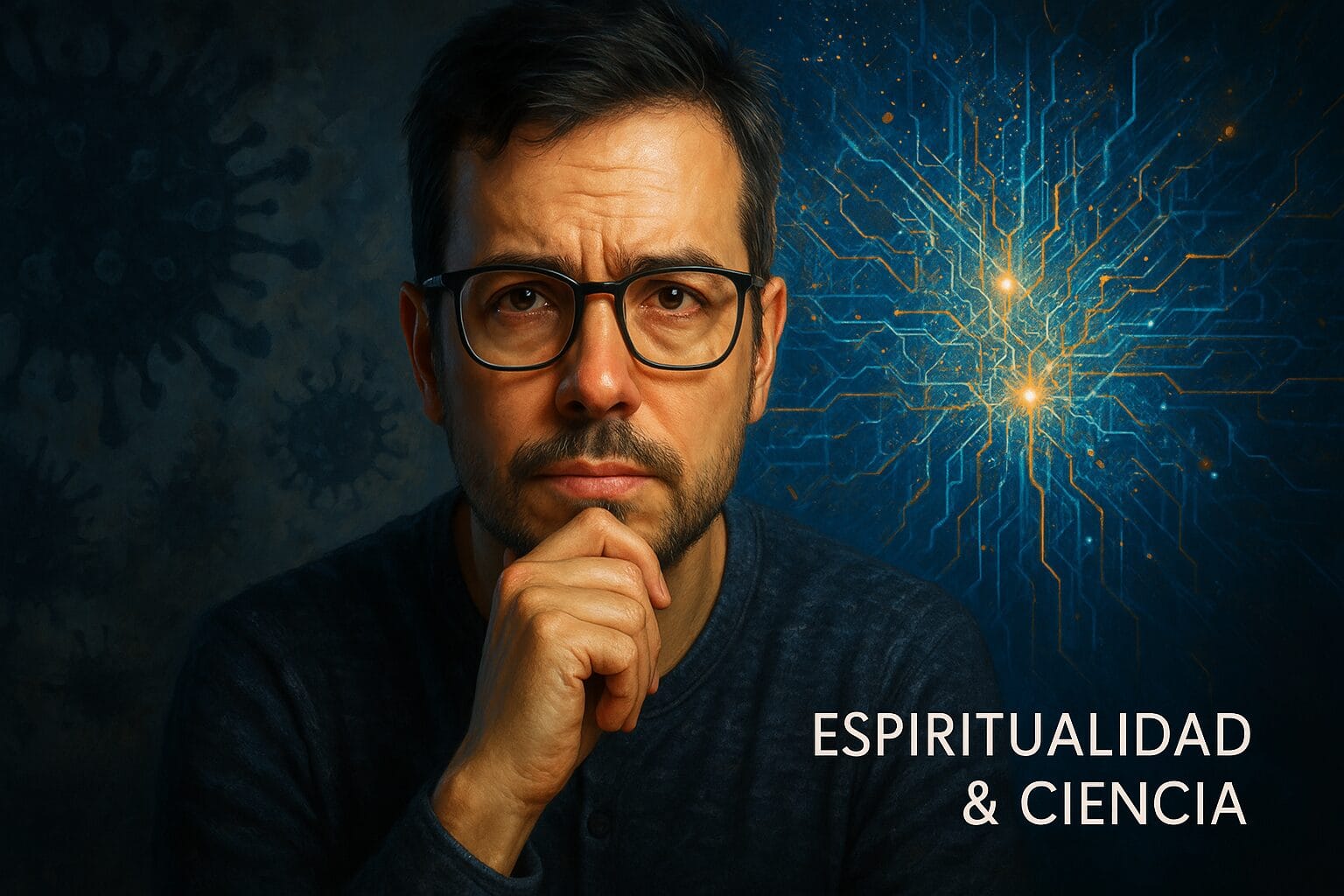
A while has passed, right? Well, to be exact, almost a year since my last podcast episode, that one about the cultural war published in March 2023 (how does time fly!). I didn't remember it had been that long, but the truth is, I needed to come back to this space. I feel there are many things to talk about; the world keeps moving and I think it's pertinent to chat a little about what's going on.
A New Format, the Same Essence
The first thing you'll notice is that I'm trying out a different format. Even though I love writing, preparing detailed scripts, refining every thought and making sure I say exactly what I want, the truth is it's a process that consumes a lot of time. Writing a script could take me between 4 and 6 hours, not to mention recording and editing, especially for episodes that easily reached 45 minutes or an hour.
That effort, although rewarding, is very demanding, and editing isn't really what I want to devote myself to. What I do love is having this opportunity to share with you, to offer a slightly different vision of spirituality, which is what I've tried to cultivate in my own life: that communion between skeptical and scientific thinking, but with a less materialist vision of the world, of life, of our reason for being here.
The World Climate: Fear, Distrust and a «Mental Virus»
With that idea I want to resume today. Let's talk a little about what has happened in the world over this past year. They have been strong changes. I feel the world, in general, is at a moment of waiting, of fear, perhaps similar to what we lived through during the pandemic. We no longer have (let's hope) a biological virus going around all countries in the same way, but I do believe we face a mental virus.
This virus was born, or at least became enormously strong, during the pandemic, and now it seems to be reproducing wildly. I'm referring to the conspiratorial mindset, superstition and, in a way, a toxic religiosity. The latter is no longer so much reflected in the proliferation of traditional cults, but in political ideologies, exacerbated nationalisms, patriotisms that, as Yuval Noah Harari would say, function as another kind of religion.
We know our brain has levels, and at the deepest level, in the reptilian brain, lies our tendency toward religiosity. I don't see it as a flaw to fight, but as a characteristic that makes us seek common causes, that makes us group ourselves. Religion fulfilled that cohesive function for centuries. But as technology and access to information grew, religion has been losing that central role. Its place has been occupied, to a great extent, by political thought and, above all, by humanism and individualism, which we could call the «religion» of the 21st century.
The mantra is no longer «do the will of God», but «follow your heart», «achieve your dreams». This is not inherently negative, but it has consequences: we have become beings who value above all else our own happiness, comfort, pleasure. This makes it hard to think and act for the community, for the other, for something bigger than ourselves.
The Psychological Legacy of the Pandemic
I believe this is the context in which the recent phenomena have developed. The pandemic broke many things. As I read in a New York Times article based on studies, the pandemic isolated us, took away our contact, but above all, it taught us to distrust the other. Not necessarily because we consciously thought they would harm us, but because the neighbor, the person beside you, could be a carrier of a disease, could infect us, even cause our death.
Our primitive mind, which doesn't distinguish complex nuances, learned a simple pattern: «the other is dangerous». That involuntary training, although justified from a health standpoint at the time (despite current debates, the initial evidence on the reduction of contagions is clear), left a mark. Five years later, we are more distrustful people toward those around us, except perhaps the closest family core, which was strengthened (although we also know that intra-family violence increased, unfortunately).
We became more individualist, more protective of «ours» and more suspicious of «the outside». Without being fully aware, we became more distrustful of everyone, especially of those who think differently. During the pandemic, we saw how «anti-vaccine» or «anti-mask» people were seen as a danger to public health by some, while they saw health measures and vaccines as an imposition or a threat (with all kinds of theories behind them: population control, reduction of society, etc.).
The final effect is brutal: we started to think that those who don't think like us are not only wrong, but a danger that potentially has to be eliminated. We see the fruits of this today: wars, invasions, growing extremism, political polarization (as in the US, where autocracy is debated as a supposed solution), nationalism that isolates us economically (let's remember that trade used to be a brake on wars between nations that trade). The social disconnection of the pandemic seems to continue now as a global disconnection, leading us to a state of latent or open war, as we tragically see in Ukraine, which has become the stage for a new cold war where Russia is directly involved and the West acts through Ukraine.
And what about spirituality in all of this? I remember the words of Taita Gregorio Castro: «We must be prepared and we must be firm as rocks so that those around us can hold on and remain at peace as well». Because everything is cycles. Even if we head toward difficult scenarios (crisis, poverty, war), it's not the end of the world, but a new learning that we will have to overcome.
The Other Great Revolution: Artificial Intelligence
The other unavoidable topic is Artificial Intelligence. I also talked a little about this in my last episode, but how much has changed in a year! We no longer just have AIs that converse, but ones that generate hyperrealistic images, works of art. Today itself I was playing with the new version of ChatGPT that creates images. I asked it to create something inspired by a photo of my grandmother Ana María Rosa (whom I talked about in the episode about my mother). The result is artistically impressive, even if it doesn't much resemble her.
I also gave it a photo of me as a child with my parents in the Tunjuelito neighborhood. It's incredible how it captured details, it even guessed my dad was probably wearing blue jeans (which weren't visible in the original photo)! And the style, like an oil painting. We see everyone creating Ghibli-style, South Park, Simpsons-style images… it's a madness.
Where Does the Convergence Lead Us?
I don't think it's a coincidence that we're living this intersection: on one hand, an economic and demographic decay (birth rates falling in almost the entire world, populations aging like in Italy, China, Russia), and on the other, the exponential rise of an increasingly capable AI.
I myself used it this year to develop a web application purely out of whim and learning. It's impressive how it can replace the work that previously required a team of at least two or three professionals (designer, senior developer, junior…). As someone said: «The AI isn't going to take your job, someone who knows how to use the AI will». And I believe that's true.
There isn't much we can do about it; it's the advance of the times. But this is much more radical than the Industrial Revolution or the arrival of the Internet. We are witnessing the birth of the first non-human intelligence, of inorganic intelligence.
We are probably seeing the future of humanity. And I don't mean civilization in the abstract, but the biological human being. I believe we are destined to integrate with artificial intelligence, to become a single kind of intelligence that combines the organic and the inorganic. And, eventually, perhaps only the inorganic. Why? Because the organic rots, dies. The inorganic, even if it has a life cycle, is much more durable.
Living beings are condemned to return our physical substrate to be recycled. Computing, in theory, can last almost indefinitely.
If it sounds like science fiction to you, look around. You're probably listening to this with earphones connected to your cell phone, a device without which you can barely function anymore: you move around with Google Maps, you communicate by WhatsApp, you get entertained with YouTube or Netflix, you work on it or on a computer. You carry it in your pocket or in your hand almost all day. It's already an extension of you, a cybernetic limb that enhances your senses and capabilities.
It's only a matter of time before this extension integrates directly with our body. As Harari said in Homo Deus: once we defeat diseases (cancer, AIDS…), we won't stop. The next goal will be defeating death itself. And we will realize that the most viable way might be abandoning the biological body.
Technology becomes that extension: the earphones almost inside the ear, in the future perhaps contact lenses with hypersight, direct interfaces to the brain… This isn't for tomorrow, perhaps for hundreds of years (if we get there), but the path seems drawn. I don't want to judge whether it will be good or bad, whether the AI will have consciousness, but it seems almost inevitable.
I want to leave it here for today. There's much more to unpack, especially on the topic of death, which I want to address in a future episode (and I promise it won't be a year later!).
I felt comfortable with this more spontaneous format. I hope it has also been pleasant for you. I know it doesn't have the millimetric precision of a script, but perhaps it adds more naturalness and closeness. That said, my commitment remains the same: to be rigorous with the information I present as facts (backed by data and evidence), clearly distinguishing it from my conjectures and personal opinions.
If any of what I said resonated with you, if you disagree, if you detect any error or imprecision, please, leave it in the comments or send me a message. Let's keep the conversation going. I'm very interested in receiving your feedback and learning together.
That's all for now. I bid you farewell.
Good path and good breeze.
Join the conversation! What do you think about these topics? Do you also feel that «virus of fear»? Does the future with AI excite you or worry you? Leave your opinion in the comments.
If you liked the video, don't forget to give it a LIKE 👍, SUBSCRIBE to the channel and turn on the little bell 🔔 so you don't miss the next episodes. Share if you think it might interest others!
#SpiritualityandScience #ArtificialIntelligence #PostPandemic #HumanityFuture #SpanishPodcast