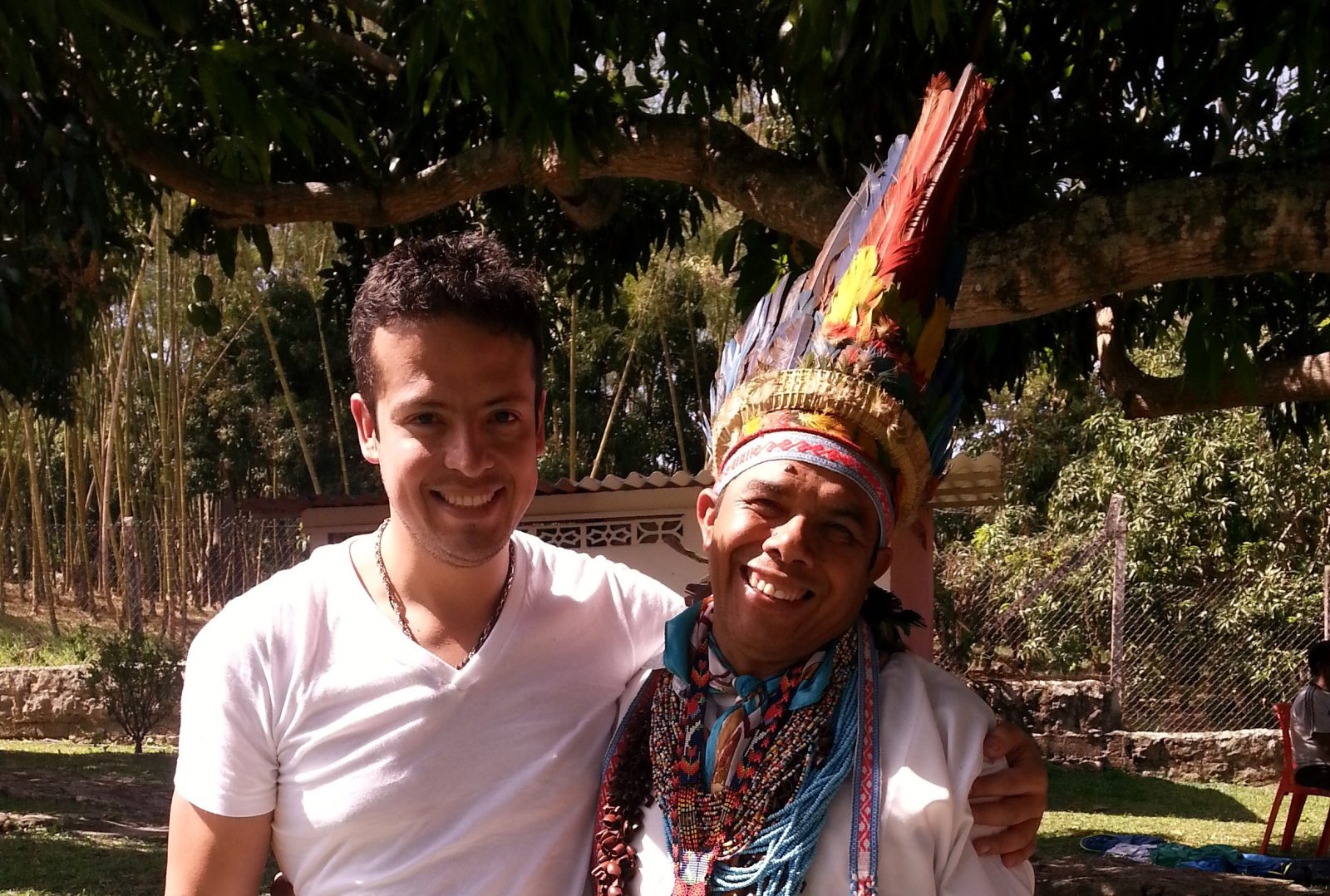
Another thing that Grandpa Luis and I had in common was that, unlike the other elders I met in Pueblo Nación Muisca-Chibcha, Grandpa Luis also saw yagé as a fundamental tool for advancing on the spiritual path. In several circles of the word he had shared with us some mystical experiences from his ceremonies, and he even once accompanied us to a ceremony with taita Fernando in La Mesa.
We talked frequently about yagé, and I told him about my concern over the growing number of dark, mortifying experiences during my ceremonies. Grandpa Luis, who has always been careful when referring to the medicine or teachings of other wisdom keepers, told me that in his opinion, the taita who leads the ceremony should be very careful with the energies that move and protect the attendees, especially the most sensitive ones, from bad yagé trips, which in his view happen when there are attendees with witchcraft or very strong healings to go through.
Until then I had never thought of changing taitas, because it seemed to me that yagé is something too delicate to try here and there, like someone testing a subscription to a service for 30 days and canceling it if they don't like it. Besides, Fernando was Mara's taita and the only one she recommended to her patients. Even so, my parents and I took yagé with a Uitoto grandmother, near the town of Leticia, during a visit we made to the Amazon jungle in southern Colombia. On that occasion, my idea was to try the ancestral medicine in its territory of origin, something I imagined would be more intense than doing it near the city.
Many tourists travel to the jungle seeking ancestral spirituality without really knowing the depth of the work with sacred plants or the risks associated with ingesting ayahuasca, so it's common for taitas to give very small or diluted amounts of yagé. This way, they keep tourists from having bad trips and ending up getting them into trouble. In any case, this is what I believe happened that time in the Amazon, because I barely felt the effect of the yagé.
Apart from that, I had never taken yagé with another taita, but the truth was that my yagé experiences were no longer as beautiful as in the beginning, and I often found myself fighting so the plant wouldn't take me too far, "not letting it catch me," as they say in shamanic jargon. I longed for the mystical experiences I had had so many times, but I was also very afraid of having to feel that darkness inside me, the closeness of death, or connecting with dense archetypes of pain and loneliness.
Grandpa Luis had suggested that I confront yagé and tell it that I hadn't come to meet it to be mistreated or tested, but to seek healing and enlightenment. According to what he had told me, that was how, many years ago, he had managed to change the way yagé related to him. I had followed his advice, but my impression was that yagé wouldn't let me reach nirvana without first having to go through the hard trial of fire.
It could be that that was the nature of yagé, at least with me, but there was also the possibility that there was something in the way taita Fernando prepared the medicine, or in how he led the ceremony, that made it particularly rigorous. Besides, taita Fernando was going through a streak of personal problems that kept him from holding ceremonies as often as before, so I took advantage of the situation to ask Grandpa Luis to tell me about the taita with whom he took the remedy.
That's how I first heard about taita Gregorio Castro, of the Cofán people. The elder had known him for about seven years, and although he had taken yagé with other wisdom keepers, taita Gregorio — or "Grego," as he affectionately called him — was, in his opinion, the one who best reflected the values of coherence, discipline, and service that we considered paramount in the Solar Clan.
We agreed to go together to the next ceremony with taita Grego, which at the time was held once a month at a small spa near one of the entrances of the town of Mesitas del Colegio, southwest of Bogotá. The first thing that caught my attention about my new entheogenic destination was the logistics of the place. Unlike Yai Bahi, taita Fernando's community, where everyone arrived on their own and an average of 20 to 25 people at most gathered, getting to the ceremony with taita Grego involved a bus hired exclusively for the event, a person in charge of registering participants in advance, and several helpers at the destination site who handled organizational tasks like collecting the financial contribution, handing out a slip of paper that gave attendees authorization to enter the ceremony, and guiding those of us who arrived so we could settle in while the ceremony began.
Another novel thing with taita Grego was that his ceremonies were held exclusively at night. I had heard that this was the most widespread custom in other yagé centers, but I had never taken it at night, except that time in the Amazon, and I felt apprehensive about having to face my fears and tribulations in the darkness of the night.
Spending the night at the farm added some extra complications: you had to bring and set up your own tent, hammock, or sleeping pad, and try to sleep enough to be ready for the return trip the next day. But on the other hand, it allowed the experience to be enriched with the intimacy of a bonfire at night surrounded by spirit walkers, the starry skies of the new moon and the clear nights of the full moon, plus the gift of receiving the first rays of light of the new day.
My biggest surprise, however, was neither the details of the ceremony nor the fact that it was held at night, but the incredible human quality I found in that place. To begin with, taita Gregorio was a man of about 50, short in stature, with light brown skin, a bushy mustache, and an honest, overflowing joy that infected everyone around him. The taita was accompanied by his wife, mama Carmenza, and a group of helpers who assisted him at all times, but who, I realized, didn't see him as an enlightened one or a leader but as a father, a counselor friend.
It was the first time I found a group of young people experienced in ancestrality and shamanism with whom I felt so identified. Our group from Engativá was made up mostly of beginners and occasional visitors, while the more experienced members were just a handful. In La Mesa, on the other hand, many of the attendees at taita Fernando's ceremonies were celebrities, businesspeople, and upper-class people with whom I never managed to form bonds of friendship.
Taita Grego's friends, on the other hand, were mostly middle class — employees and independent workers — with whom it was easier for me to socialize. Some of them are still dear friends to this day, despite the time and the distance.
In the account of my first yagé ceremony I narrated how the sound of the drums seemed to have a direct influence on the plant that was in my organism. As the rhythm and intensity of the percussion increased, my body began to move in sync without my having any awareness of initiating the movement or the ability to stop it. Something similar happened when I heard the notes of the harmonica with which the taita and his helpers accompanied certain moments of the ceremony. In that case, the sensation was always of being lifted toward the sky or moved in circles while the images of geometric shapes and colored grids became more intense.
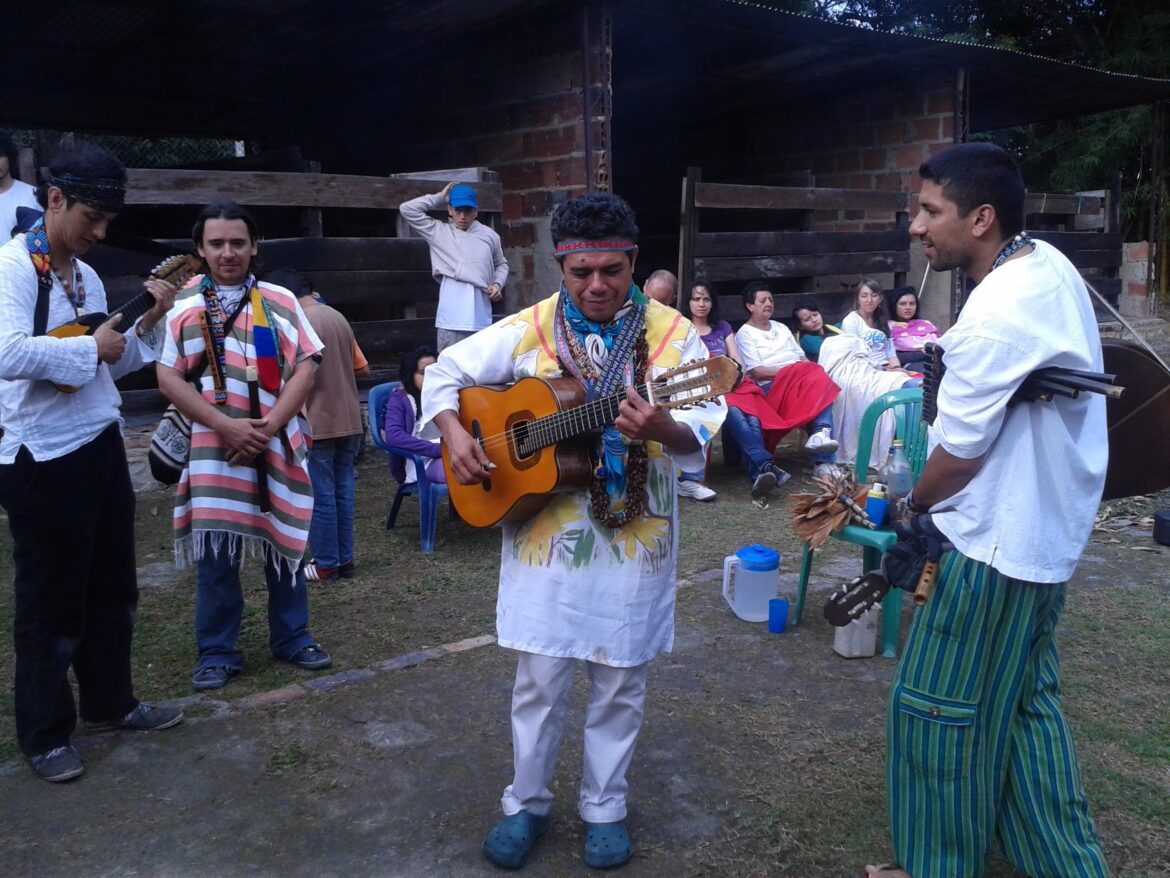
It was clear that music had a powerful effect during the yagé trance, but I didn't come to know the magnitude of its influence until I began taking yagé with taita Gregorio Castro. Not only was he himself a virtuoso guitarist and baritone, but a good number of his helpers were also outstanding composers and performers of a style of music they called "Conscious Music" or "Medicine Music." Musically speaking, it couldn't be considered an independent genre, since it was made up of a wide spectrum of rhythms and melodies, from ballad and bambuco to waltz and even rock, but the sounds I heard most during the many yagé ceremonies in which I participated with them were the ícaros, sanjuanitos, pasillos, and tunes of the folklore of the Colombian-Ecuadorian Andes, popularly known as "Andean music." What made this amalgam of sounds special and different was that its lyrics dealt with spiritual and shamanic themes and that it frequently included the sounds of Eastern instruments.
If the influence of the notes of the drum or the harmonica on the way yagé acted seemed magical to me, the effect of a whole band of wind instruments, percussion, strings, and multiple voices took the yagé experience to a new level. Each instrument seemed to enter into resonance with some aspect of the trance: the visions, the smells, the movement, the effusiveness, the introspection, the recollection, or the ecstasy.
Taita Grego knew precisely the type of music, the intensity, and the cadence with which to accompany each moment of the ceremony, to bring the participants to the exact point of exaltation, as if he were the Pied Piper of Hamelin leading the rats out of town. The taita began the ceremony with a consecration of the yagé at the altar, similar to the one taita Fernando did in La Mesa, but the melodic complexity of his harmonica playing revealed a greater musical ability. After giving the portion of yagé to all the attendees, who often exceeded 100, Grego took the guitar and played a soft melody that could be a masterful rendition of Ballade pour Adeline, Love Is Blue, or Schubert's Ave Maria.
That smiling gentleman walked slowly among dozens of ceremony participants lying on the grass under the moonlight, and as he passed he left behind those beautiful notes that invariably ended up dissolving my usual fear of the unexpected after ingesting yagé. The harmonious lullaby managed to get most of us attendees to settle in the best way to receive the healing of the medicine.
After a few instrumental pieces, the taita gave way to a ceremonial silence that brought with it the sounds of the night: usually crickets, cicadas, and frogs, although not infrequently also popular music and the voices of the attendees of the street parties held at the spas of the area. When there were festivals in town or long holiday weekends, the taita made an extra effort to cover those noises with his music as much as possible.
In a similar way to what I had experienced in La Mesa, at some point in the ceremony many of us attendees synchronized in reaching the most intense moments of the trance, in which vomiting, crying, and sometimes screams asking for help were common. In that phase of the ceremony, the musicians who almost always accompanied the taita made their appearance. Depending on the mood or "energy" of the climax of the ceremony, one could hear guitars, charango, drums, pincuyos, or zampoñas, typical of Andean music, but playing shamanic rhythms alongside didgeridoos, jaw harps, Tibetan bowls, and other exotic instruments from Australia, India, or China.
Something that astonished me enormously about these midnight shamanic music performances was that, although some of the musicians knew each other and were even part of the same musical group outside the ceremonies, other musicians often participated who had never rehearsed or even spoken with them before, and yet they managed to integrate perfectly in rhythm and harmony. Even more surprising was that many of those musicians were, themselves, in a yagé trance while playing their instruments.
On more than one occasion, the shamanic rhythm lifted me from my static trance and got me dancing as I roamed the farm or around the fire, where I could see the musicians, who were often swaying their heads with blank eyes while playing their instruments with unchanged skill.
While the musicians did their thing, taita Gregorio, mama Carmenza, his helpers, and often Grandpa Luis attended to the ceremony participants who needed help in their process. Over time, I myself became a helper of the taita and also helped those having difficult moments... when the yagé allowed me to.
This was the part of the ceremony that demanded the most effort from the taita, and it was common to see him cross the farm several times attending to whoever needed it, but when the effect of the yagé began to become less intense, Grego had the chance to rest a little in his hammock. There were always one or two musicians who took advantage of this part of the night, which was usually after 3 in the morning, to share their melodies, generally of their own authorship.
That was, in my opinion, the most beautiful part of the night and one of the things I miss most about my life in Colombia: the sky filled with stars, the night turning a bit cold, whoever was in charge of the fire devoting themselves to feeding the bonfire, and while most of the ceremony attendees slept in their tents, the rest of us gathered around the fire to listen to an intimate and moving recital of strings, winds, and voices.
It was in moments like that one that I first heard some of the most beautiful songs I have ever known, which are still part of my playlist of songs that accompany me everywhere. Among them, "Corazón de Estrella" holds a special place, composed by a shaman friend and disciple of taita Gregorio named Héctor Raúl González Mazo. Héctor Raúl had been a rebellious teenager from Bucaramanga, a member of the ultras of the Bogotá football team "Los Millonarios," a fan of ska music and a frequent drug user who had no problem picking fights in the street and getting drunk on any excuse.
His father, tormented by the idea that Héctor Raúl would end up in jail or a hospital, took him to a yagé ceremony precisely with taita Gregorio. The unruly Raúl attended out of consideration for his father but mainly out of curiosity to try the famous "hippie drug," but as has happened to several of us, one thing is hearing about the miraculous transformations of yagé and another is living it firsthand. While the first dose of yagé barely produced curious kinesthetic sensations in him, the second dose took him out of his own body.
Héctor Raúl tells that an incorporeal being like an angel took him to a decadent part of the city. He told him he was going to show him where the road he was traveling would end, and he pointed to a dirty, ragged vagrant lying on a sidewalk. Raúl approached the vagrant and could smell the stench emanating from him. He looked into the alienated eyes of the beggar and felt vertigo and a stab of panic when he realized that that wretch was none other than himself.
In a scene that reminded me of Charles Dickens's A Christmas Carol, Héctor Raúl told me that he asked the angel to take pity on him and not condemn him to such a horrible fate. The angel answered that it wasn't a punishment but the inevitable consequence of his actions. However, he told him, there was an alternative path, one that would spare him the sad outcome he had just seen. The problem was that in order to change his destiny, he would have to change his life completely.
The troubled Héctor Raúl answered the angel that he would do whatever it took, if he had the chance to avoid becoming a dead man walking. Then the angel took him out of the dark corner where he was and carried him to a clearing in the jungle where Raúl saw himself again, but this time dressed in white, with necklaces and a headband, helping others fight against fearsome demons.
The transformation of the young musician was immediate. Gone were the drug-fueled parties until dawn, the violent encounters with the football ultras, and other excesses. From that day on, Héctor Raúl became a helper and apprentice of taita Gregorio, and when I met him, he was already not only an experienced shaman but a charismatic performer of beautiful conscious music songs.
"Corazón de Estrella" wasn't only the first song of Héctor Raúl's that I heard but his greatest success, probably even to this day. Its melody conveys hope, illusion, and joy, and its lyrics speak of the gratitude felt upon knowing the love of God through a woman. That full-moon night, under a royal blue sky, I closed my eyes while Corazón de Estrella transported me... yes, to the stars; and then I thought of Paula, my rainbow, my most beautiful sunflower, and the craftswoman who weaves my heart.
Besides Héctor Raúl, I met other excellent musicians and even better people who left me something I consider invaluable: a soundtrack with which I accompany my meditations, ceremonies, and moments of sadness, joy, and nostalgia. Jorge Rojas, with his classical guitar and lyrics full of mysticism that speak of freedom, the harmony of the universe, and ancestral legends. Jorge Iván Currea, a serious, pleasant guy whom I only saw once in Mesitas, left me his album "La Nación del Arcoíris," which I consider the best-produced conscious music album to ever reach my hands. There were also several women who adorned the warm medicine nights with their soft voices. The one I remember most is the young Jineth Alarcón, who did beautiful versions of the songs of Soledad Pastorutti and other Latin American troubadours. And in the last yagé ceremonies I participated in at Mesitas, I had the honor of working with the medicine accompanied by the majestic chords of maestro Diego Bonilla, who could make the guitar trill as if it were a bandola and arpeggiate in such a way that it sounded like two guitars in unison.
At the edge of the night, when the morning star made its entrance and the birds began their uproar, taita Gregorio would take up his guitar again and gift us with the notes of some of the songs closest to his heart. Some were heartfelt pieces from the popular repertoire of his beloved Putumayo, but others were of his own authorship. Those of us who had managed to overcome sleep to stay with the taita until that hour had the chance to ask him to sing our favorite songs.
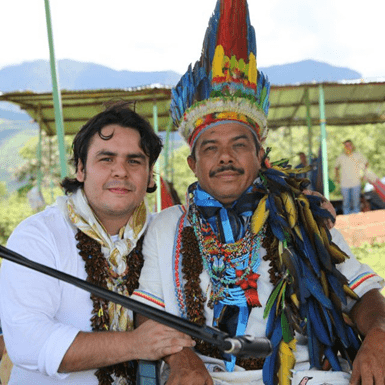
Some of the songs most requested by the yagenautas were "Taita Cofán," "Sindamanoy," and "Amazonas," but the one I always longed to hear in those moments of spiritual communion was "Estrellita de Mar," which still seems to me one of the sweetest songs I've ever heard, and with which Grego also showed off his prodigious voice and interpretive quality.
Besides listening to the taita's lovely music, the dawn gatherings served to hear the stories, teachings, and anecdotes of the taita, his people, and his teachers. That's how I heard the story of taita Querubín Queta's transformations into a jaguar, the time taita Alfonsito got scared believing a tiger had appeared while he was cooking yagé and had ended up with a white face from the ashes he had fallen into during his clumsy flight, or the account of a dream of taita Grego in which he had transformed into a hummingbird that tried fruitlessly to fly among the thickets that cover the Hornoyaco River, just as the other hummingbirds did, only to end up battered and muddied before an elder hummingbird who majestically decreed:
"That's what you get for being a liar, because to fly like us, you have to be a real hummingbird."
When he finished the story, taita Grego burst into loud laughter, lifting both feet and leaning back in his chair, putting his hands over his face. As he laughed, he told us:
"There I was thinking I had fooled you all, and for being a liar I ended up muddier than my shoes, all battered and plucked... hahahahaha"
Then he wiped a couple of tears from his eyes with the back of his hand, exhausted the last couple of laughs he had left, slowly looked at those of us gathered around, and said with a majestic air:
"My little ones, to be able to fly one cannot pretend to have wings; you have to be a real hummingbird."
I will never forget that lesson.
When the sun's rays completely defeated the night, most of the yagé drinkers began to appear coming out of their tents, sleeping bags, and hammocks, and little by little they gathered around the taita to hear the last part of his stories. Then Grego, mama, and his helpers prepared to close the ceremony.
All the chairs available at the place were arranged in a circle in the lower part of the farm, next to the stables, which was also the flattest part of the place. The musicians got their instruments and began a final number of the spiritual gathering. It was the turn of the most joyful and festive music of the ceremony, in which Nelson Dorado, the best charango player I know and an admirable shaman, shone especially with his energetic sanjuanitos. Héctor Raúl returned to the ring with his most cheerful songs and frequently joined taita Grego in duet, performing with him one of the most requested songs during the closing of the ceremony: "Wayririri."
When the group's energy was at its peak and all that could be seen were smiling, sleep-deprived faces, the taita and mama Carmenza walked past the often more than 100 ceremony attendees and, one by one, gave us an energetic cleansing with the wayra, a touch of the harmonica, ícaros of their people, perfumes of the jungle, and sometimes liquors sprayed from the mouth.
This walk-through, which could last between an hour and a half and two hours depending on the number of attendees, was accompanied by the musicians, who, just as during the climax of the night, resorted to the most shamanic instruments and sounds, which on more than one occasion led me to experience — even hours after having received the yagé and long after having come out of the trance — visions, spontaneous movements, and states of samadhi.
On one occasion, thanks to the shamanic sounds and the mystical atmosphere generated during the morning closing, I felt a state of spiritual rapture during which I clearly saw a multicolored candle that emitted sparks around its flame. I also heard a voice saying that that candle of several colors was the key to the ceremonies I wished to hold to open paths of prosperity and abundance.
The two years of ceremonies and teachings at the side of Grandpa Luis, taita Gregorio, Héctor Raúl, Nelson, Maiker, Andresito, Jorge, and the other spiritual friends I met in Mesitas were one of the happiest and most fruitful periods of my spiritual path. My first yagé ceremony in that place was in January 2012, and because of the great expectation of spiritual transformation that many of us believed would take place in December, I decided to take yagé every month of that year.
Grandpa Luis accompanied me in almost all of those ceremonies, and in a short time I managed to become one more helper of the taita. The elder and I led a small tobacco ceremony before the start of the yagé ceremony, in which we shared our Muisca and Solar Clan word, resolved the concerns of those attending for the first time, and, with the taita's authorization, shared the medicines of hoska, ambil, and mambe.
In December 2012, none of the planetary transformations that New Age conspiracy theories foretold finally happened, but I was so convinced I was going through an energetic transformation that my family and I did live an awakening and an evolution in the personal, family, professional, and spiritual aspects that deserves its own chapter.
As for my relationship with yagé, I discovered that there was indeed something different about taita Fernando Lezama's yagé. Fernando's yagé was much more concentrated or strong than Gregorio's. That doesn't mean it was better, only that when comparing similar doses, Gregorio's yagé allowed me — except in a couple of exceptions — to have control of my body and mind. In La Mesa, the yagé frequently stripped me completely of my free will, which was at once terrifying and sublime, because it was in those moments of total surrender that I lived both the densest and the most mystical experiences.
And it's not that in Mesitas everything was rosy. On more than one occasion I felt the closeness of death, the call to sacrifice myself for humanity, or the presence of evil within my being. Once I even reached the point of psychosis when, at some neighboring farm, they began launching firecrackers while I was totally caught by the yagé. The familiar crack of the firecrackers, repeated frequently, became in my head the rattling of rifles in a clash between guerrillas and army soldiers around the farm.
My heart beat rapidly and my mind even created the shouts of soldiers asking for ammunition and coordinating their actions. That day my mom and my daughter had accompanied me to the ceremony, and I couldn't stop thinking about war tearing them away from me that very night. Rarely have I been so terrified, and yet I stayed there motionless, my eyes fixed on the infinite and tears running down my face.
Despite these experiences and a couple more of the kind, with taita Gregorio and Grandpa Luis nearby I felt safe and protected. I was able to explore the introspection of yagé much more, even coming to clarify my position on death, service, love, sex, and happiness. I saw my grandparents, great-grandparents, and great-great-grandparents supporting me in my spiritual work; I felt I could help my mom heal a large part of the pain she had kept in her heart for many years because of the hardships we had to go through in times of scarcity; and I even healed a pain I didn't even know I had.
It was about the death of a university friend who was also my coworker in Santa Marta and who lived in Leticia, the Amazon town where I took yagé with my parents. His name was Jassir, and the only thing I learned, through a mutual friend, was that on the night of a December 31st, while returning home on his motorcycle, he was fatally struck by a pickup truck traveling at high speed. He had left behind a young widow and a baby girl under two years old.
I didn't know why, but despite not having been such a close friend, Jassir came to my mind frequently, and one yagé night in Mesitas, right after a beautiful vision of colors, I felt I was lying by the side of a road during a dark new-moon night. I tried to move but couldn't, and I knew I was badly wounded. I felt great fear and, again, the closeness of death. But this time, I recognized that it wasn't me I was feeling; it was Jassir.
I could feel the helplessness of seeing life slip through his fingers while vehicles passed by his side, slowed down, heard his weak voice asking for help, and decided to keep going, perhaps so as not to miss the New Year's party at their homes. I felt that Jassir couldn't believe there was no one with a good heart to help him, and that they were going to let him die there, lying like an unfortunate animal of the jungle.
I felt his father's pain at the thought of leaving his little baby orphaned, and I couldn't hold back the tears. I didn't know what to do; I felt I myself was like those indolent drivers — I was witnessing my friend's pain and not helping him. Then, like a gift from heaven, I heard Jineth Paola's sweet voice singing "Corazón Americano" by la Sole:
"Fly, heart, fly higher,
like the condor of the mountain range,
for our destiny is marked
and freedom is our inheritance."
Then my heart filled with hope; I addressed the ghost of my friend, whom I now saw three meters underground but still suffering from sadness, and I told him, without knowing anything about his life:
"Jassir, life is not over; you keep existing in that beautiful girl who has your same eyes. You keep existing in the heart of that noble woman who now helps so many people in need, but above all, you keep existing in that huge, wild jungle you loved so much. Come out of that burial and fly, fly higher, fly, American heart, no more pain will stop us, before God we are all brothers."
Then I saw him as a colorful macaw flying above the treetops, feeling the wind in his plumage. My tears were of happiness, because I don't know how, but I felt that that night Jassir had finally been able to be free. At least the Jassir who lived, and who lives, in my heart.
In the yagé ceremonies in Mesitas, I never came to see angels and beings from other dimensions, receive cosmic revelations, or feel unity with the All, but neither did I have to feel like a demon, be scorched by the fires of hell, or weep for the perdition of my soul. It's possible that without going through hell one cannot reach Heaven, but thanks to Taita Amor and Grandpa Luis I discovered that neither heaven nor hell are the places to which I belong. I do give thanks for having gone through them, to be able to understand that it is here on Earth, under the stars, around the fire of friends, and dancing with the music of life during this brief instant that existence has gifted us, that we can find eternity.
5 years ago I was looking for information about the ayahuasca ceremony, asking around here and there, trying to find the best place, the best reviews, and this led me to the name of taita Grego. Searching about him, I came across this episode.
It's hard for me not to use the term "sign" for the fact of having found the information I needed on the blog of an old acquaintance of mine.
It's a shame the episode is cut short. Although it's transcribed, I was enjoying listening to it a lot.
I'm glad to know about you and the paths you're walking
1 Reply manuelr Author Reply to Rafael 5 years ago Hi Rafa, what a pleasant surprise to read your message! How nice that you give yourself the gift of a ceremony with my taita Greguito, and I'm at your service from now on if you have any questions before or after. A hug, my brother!
Comentarios (archivo, solo lectura)
Mostramos 2 comentarios guardados de la versión anterior del sitio. Ya no se aceptan nuevos comentarios.
Me encontraba buscando información sobre la ceremonia de ayahuasca, preguntando aqui y allá, tratando de buscar el mejor lugar, los mejores reviews y esto me llevó a dar con el nombre del taita Grego. Buscando sobre él di con este episodio.
Me es difícil no usar el término "señal" al hecho de haber encontrado en un blog de un viejo conocido mio la información que necesitaba.
Es una pena que el episodio esté recortado. Aunque está transcrito, estaba disfrutando mucho al escucharlo.
Me alegra saber de ti y de los caminos que estas recoriendo
Hasta pronto
Rafael (de ITEC)
Hola Rafa, qué agradable sorpresa leer tu mensaje! Qué bueno que te des el regalo de una ceremonia con mi taita Greguito y desde ya quedo a tus órdenes si tienes alguna pregunta antes o después. Un abrazo mi hermano!