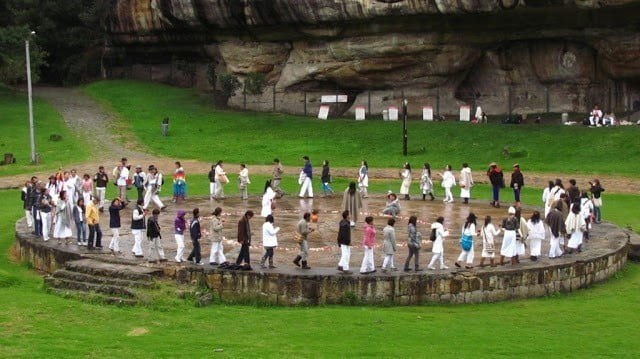
The two brothers born in the territory of Fúquene, in the department of Cundinamarca in Colombia, grew up watching the golden reflections of the sun on one of the most important lagoons for the ancient indigenous peoples who inhabited the entire Cundiboyacense highlands since time immemorial. From their elders they heard tell that the Indians would sink into that lagoon and not return to the surface until many hours later. They said that beneath the lagoon there were portals to other lagoons that the Muiscas used as a transportation network to travel throughout the world.
Their father also told them stories about their ancestors and the hardships they had to endure to keep their traditions and customs alive in times when the Spanish colonists punished, sometimes with death, those who refused to abandon indigenous ways and follow the commandments of the Holy Catholic Church. That is how the invaders, with the Bible in one hand and the carbine in the other, turned the mystic Chibchas into day laborers and slaves on their own land. These stories of subjugation against their ancestors kept sowing in the hearts of the two brothers a seed of nonconformity in which the memory of that forgotten people shone, just like the gold, or “kumni uni” — as the ancients said.
The young men wondered why no one anymore wore the white blankets or the bags woven with bone needles. It was in this way that from an early age, Sigifredo and Rodrigo began a tireless search for the true Muiscas, who they believed almost certainly must still exist, with their gods, their medicines, and their magical powers, like the ones their father and grandparents had told them about.
Once, in the nearby town of Ubaté, during the patron saint festivals held every year, the population was called upon to celebrate the Muisca heritage and remember the lost traditions. With great excitement the two brothers set off wearing attire similar to what they had heard and read that the Muiscas wore. Perhaps that would be the opportunity to meet others who, like them, were in search of the true Muiscas.
But the scene they found was not the one they had longed for. To the beat of carrilera music and amid generous rounds of beer and strong chicha, dozens of farmers from the region laughed out loud, mocking a few spontaneous attendees who had come to the event dressed as Indians, just as American western movies and comic magazines showed them. A few others, clad in fique sacks, old rags, and chicken-feather headdresses, danced and brawled, alienated by alcohol.
The Niño brothers stayed on the sidelines of that event when, suddenly, they shared a revelation: everyone there was in costume, except the two of them. The intoxicated “Indians” had deliberately dressed up in what they believed were indigenous outfits. But the other locals who were there socializing, who carried in their blood and on their faces the indelible Muisca phenotype, were also in costume, though not as fake Indians like the others, but with the disguise the Spanish invaders had bequeathed them when they took away their blankets, liquiras, and tutusumas. Only Sigifredo and Rodrigo, dressed in white from their ankles to their feet, with their bags and their necklaces, were not disguising themselves but wearing the attire their people had worn since time immemorial.
From that moment on, Sigifredo and Rodrigo Niño Rocha — the names with which, without their authorization, they had been baptized in the Catholic faith — began a long path in search of the true Muiscas. By then they had already understood that that search would not flourish in the towns and their plazas, but in their own hearts. Hidden within themselves must lie the secret of “El Dorado”, that ineffable gold the Europeans were never able to find.
Sometimes together and sometimes on different paths, they began their walk, or “suna” — as the ancients said. Academia had little to offer except some old texts by Vicente Restrepo, José Domingo Duquense, and many other compilers and more recent historians. Nevertheless, as diligent students, they began their research there, although they knew that what they wanted to find had nothing to do with the biased vision of the chroniclers. Their search was spiritual.
Along the course of that path, they came to know several schools of thought, philosophy, and esotericism. Each door that opened allowed them to delve deeper into their own awakening of consciousness and increase the power of inner observation that, sooner or later, would end up revealing to them the secrets their ancestors had left planted in their blood.
Christianity, Buddhism, Tao, Zen, Gnosis, metaphysics, nihilism, and even Hinduism were the schools they walked through over the years, always seeking the inner connection with the spirits of their territory and with those of their Muisca ancestors. As they deepened their exploration of the esoteric — the subtle inner universe of the human being — they also cultivated relationships with authorities of indigenous groups from all over Colombia. There they hoped to find the second key: exoteric knowledge, that is, of the universe external to the individual, which included the tradition and customs of old, which they believed were safeguarded in the malocas of other ethnicities.
Many years before Sigifredo and Rodrigo were born, and hundreds of kilometers south of the Fúquene lagoon, in the Amazon jungle, a huitoto cacique and curaca, patriarch of the Murui lineage, looked into the eyes of his son Víctor Martínez Taicoma. The boy was already old enough to understand the importance of the secret he was about to entrust to him, so after putting a spoonful of sweet mambe and salty ambil into his mouth, he said:
“Far to the north, far from this jungle and up in the mountains, there was a people that was like us, but they did not know how to take care of their word and they fell ill. That is why the white man came and exterminated them. But before disappearing completely and departing with Buinaima, a few elders came here and asked our ancestors to keep their word of life in our community. I received that charge from my father, and he from my grandfather, so now I am going to entrust it to you, because the spirits say that when you become cacique, you will have to go to that mountain and give them back their word, their medicine.”
Young Víctor committed himself that day to caring for the word of origin of that vanished people and promised to wait until Buinaima himself showed him the precise moment and place to fulfill such an important mission. Several decades passed, along with wars, cultural revolutions, and social transformations, until the now-elder Víctor Martínez Taicoma received the call he had been waiting for for so long.
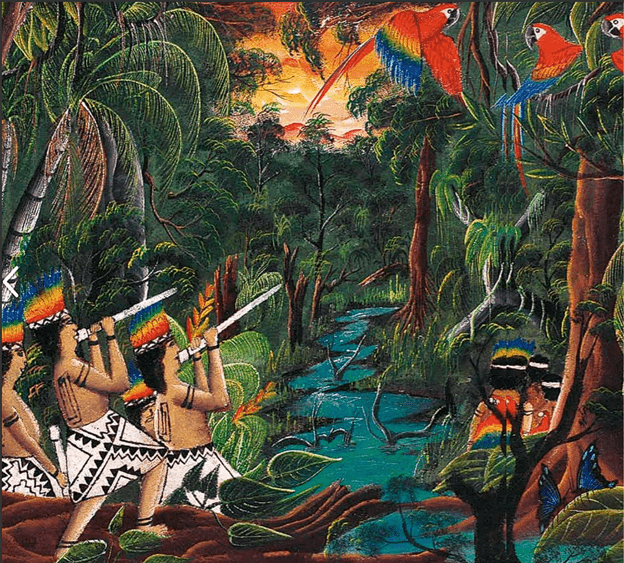
It was the year 1997, and elder Víctor had just bequeathed to his eldest son the responsibility of governor of his huitoto resguardo. The eldest had handed over the position leaving his people with a level of prosperity, health, and peace they had not enjoyed in many years. With the satisfaction of a job well done, he headed to Bogotá to fulfill the charge his father had bequeathed him many years before: to give back to the Muiscas their word, their traditions, and their medicine so that they could be reborn.
The septuagenarian patriarch did not know the exact place where he would find the Muiscas, nor how to identify them, but it did not matter, because the Spirit had shown him a way: a strategy so that it would be the Muiscas who found him. He had to build a house of power to awaken the spirits of the territory and open a portal through which the Muisca spirits would arrive. This house of power is a millenary construction of which the Huitoto are masters and guardians: the Maloca. The cacique, as the seasoned senior maloquero of his community, knew the secrets and the techniques to raise, on Muisca territory, the first Maloca of the Jungle in the very heart of the great capital. Its construction would take place in a natural sanctuary: the José Celestino Mutis Botanical Garden.
In his own words, Elder Víctor told me that the maloca was born to search for the Muiscas.
“Because I searched and could not find them. Some would come who said they were Muiscas, but I looked at them and they were not. So I asked the spirits of the territory to bring them, and well, at last some came who said they were Muiscas, and they truly were, but I still could not see them…”
Some years after the construction of the maloca, the two brothers of this story answered that call of the spirit: Sigifredo and Rodrigo, but no longer with their baptismal names, rather with the names the Earth had given them: Suaga Gua Ingativa Neusa, which means “The son of the sunbeam that comes out from behind the mountain”, and Xieguazinsa Ingativa Neusa, which means “Son of the rain over the lagoon”. Xieguazinsa is also the ancestral name of the Fúquene lagoon, the one where the Muiscas submerged themselves to travel through the Cosmos.
Along with the two brothers came some walkers who had identified with their cause and longed to recover the lost word. By then, the maloca was a place of intercultural encounter where several indigenous communities gathered to practice rituals and ceremonies around the wisdom of the elders and the sacred plants. However, elder Víctor emphatically stated:
“I raised the Maloca to search for the Muiscas; that is the intention that was placed upon it, and that was its purpose.”
When Elder Víctor met the Ingativa Neusa brothers and the small community they had built through effort, he felt that to them he could entrust the secrets his father had given him. The word of life and of love, as the elder referred to that secret, is the straight word of Tobacco and the wisdom of mother coca.
From that initial encounter, elder Víctor Martínez began teaching the new Muiscas the secrets of how to cook the ambil, which is the very blood of tobacco. He also taught them to prepare the mambe, from the harvesting of the coca leaves, through the toasting, the pounding, the sifting, and the mixing with yarumo salt, all the way to the mambeadero, or the circle of word in which it is shared along with the ambil to receive the guidance of the Great Spirit.
The first part of Elder Víctor's mission was already complete. But Elder Víctor, who was a healer and an experienced man of peace amid numerous conflicts, knew he had to help open the path and protect the nascent process.
“That process has many enemies, but I came to give the word of life and teach the path of tobacco and mambe; I did not come to fight. My son Víctor Ramón does know how to fight, and he is the one who must continue my work.”
The Muiscas had appeared and sat in the maloca every week to remember their tradition and honor their spirits. However, the Elder realized that it would not be easy for the Muisca People to return to their splendor. Intoxicated with ambil and sometimes with yagé (ayahuasca), he could perceive that in the territory of Bacatá, today known as Bogotá, there was great spiritual opposition to the return of the “people dressed in white”. Beings of sleeping consciousness that fed on the unconsciousness of the city's inhabitants would try to prevent the Muiscas from reclaiming what was theirs: corrupt politicians, manipulative religious leaders, greedy construction and mining businessmen, and many others would strongly oppose the new movement.
It was then that one of Elder Víctor's sons, the wise man Víctor Ramón Martínez, connoisseur of the magical arts and spiritual warrior, arrived in Bacatá to open the path so that the Muiscas could return in Peace.
“I came after my father opened the maloca and awakened the Muisca spirits, because he realized there was a lot of darkness that did not want to let the work go on, and I do know how to handle those things. I went to the lagoon they call Iguaque, because they told me it was the great lagoon, and there I knew I could find what I was looking for. I sat in front of it all alone and began to drink yagé. I had to drink 3 times because they would not let me see, and then they answered me.”
I asked what the mambe of the Muiscas was, and then the water of the lagoon began to dry up until a great number of big, beautiful corn plants surfaced, with ears of corn pointing to the sky. Then I realized that the Muisca medicine is made with Corn.
Then I told the Lagoon that I wanted to see the original Muiscas, but the lagoon told me I had to drink more yagé to see them. I had to drink another three times until, behind the cornfields, many men, women, and children dressed in white came out. How beautiful the clothes were; they were like blankets and they had a chumbe at the waist. The men had a tutusuma, but not like those of the mamos of the Sierra Nevada; rather they looked like bonnets. There I saw them happy, waiting for their living brothers but worried about so many problems that were coming.
Then I told the lagoon to show me the hidden enemies of the Muiscas, but the lagoon told me I had to drink more yagé to see them. Another 3 doses of yagé I had to drink, and I saw four hundred people dressed in black who did not want to let the Muiscas live. And all of them were in Bogotá. Some came from Medellín and other places.
It was then that I told all those spirits that I came to open the path for the Muiscas, and I asked my guardians to help me. I asked my holy Father to give me strength, because I came to clean, but they were not going to crucify me like they did with Jesus Christ. It was God himself who sent me, and he was going to give me the power. So I had to drink yagé again. Twelve times I had to drink that night, and like that: alone and cold, as I was, I had to fight against those spirits of death. But my Father gave me the strength, and in the end I heard a voice from the sky saying that all those beings had to leave this territory.
Some fell ill, others died, and for others things began to go wrong in the city, so they had to go back to their homes. But that filth was cleaned up. At least the work could go on, but we cannot fall asleep, because darkness does not sleep either, and they will keep trying to ruin things.”
With the foundations laid by elder Víctor and his spiritual guidance, the Muisca Community began to walk. Little by little more people kept arriving at the mambeadero of the Botanical Garden and at the wetlands where they gathered. All of them sat down drawn by the desire to re-signify their roots and remember their tradition. By 2009, hundreds of people already participated with some frequency in the community's activities. These included walks through the territory, circles of word, cleansings, pagamentos, and other ceremonies that had been forgotten for centuries and that, thanks to the work of the Elders, were now remembered and began to be part of the daily life of many individuals and their families.
It is important to clarify that at that time, some Muisca cabildos registered with the Ministry of the Interior already existed in Bogotá, and that, despite living in a metropolis, they had recognition as indigenous communities and enjoyed the few privileges that the Colombian Constitution of 1991 had granted to the indigenous peoples inhabiting the territory, but they also suffered the same deprivations and marginalization as the indigenous communities of the rural territories.
These already-recognized Muiscas were basically some families of the highlands who, taking advantage of the fact that they preserved surnames in the Chibcha language and predominantly indigenous features, had organized themselves into the major cabildos of Suba, Cota, Bosa, Sesquilé, among others. Their identity, uses, and customs, however, were diluted in the Catholic syncretism and the noise of modernity. They maintained some traditions, but they too were in search of their own identity as Indigenous people and the recovery of their ancestral traditions. Some of them even came to participate in the process of re-signification of the ancestral Muisca thought of the Suagagua and Xieguazinsa brothers, but the searches of the recognized Muiscas and the emerging self-recognized Muiscas advanced along different paths that over time would prove irreconcilable. I will talk about this in a later chapter.
The new Muiscas did not have surnames in Muyskubun, the ancient pre-Columbian dialect, and many of them were white-skinned and even had light eyes and hair. However, they recognized themselves as indigenous, had begun to adopt ancestral uses and customs, and professed a spirituality centered on the Law of Origin, the ordinances of the territory, and its myths. But none of this was enough for the Colombian government, for whom the identity of an indigenous people was based, until then, on an undisputable blood lineage and a cohesive community rooted in a territory for generations.
However, the 1991 constitution had opened the door for indigenous communities extinct as an ethnicity and even as a community to be able to rebuild themselves based on the figure of self-recognition, that is, that mestizos who identified with the cosmogony, the traditions, and the indigenous life plan could eventually constitute themselves as an official cabildo.
With this objective in mind, the elders Sugagua and Xieguazinsa initiated the formation of two new major cabildos in the localities of Bacatá/Bogotá and Tchunza/Tunja, and from them, the Ingativa Neusa began to alternate their process of spiritual remembrance with public policy and the regular activities of the community, which by then began to be known to society as the Pueblo Nación Muisca-Chibcha, an organization that championed as its banner the re-signification of ancestral Muisca thought in the Colombian territory.
The organization was fulfilling its mission, and Colombian society, especially in the departments of Cundinamarca and Boyacá, began to hear in the media and through environmental organizations the ancestral word of the elders. Many other elders joined this process, such as Chimini Ingatyba Gagua, elder of the Muisca community of Engativá (Ingatyba), Nemequene, elder of the Muisca community of Soacha (Suacha), Tymy Cagüi Yanguma, senior grandmother of the community and companion of Elder Suaga Gua, Gloria Morán, Pedro Melo, Elder Gualcalá, Comba Nimy Quene, Juver Osorio, Elder Guasín, Jairsa Gua Furativa Neusa, and Florentino Monroy, in addition to many wise men and community leaders who joined the cause… At least for a while.
Some years later, at the beginning of the new millennium, the Pueblo Nación Muisca-Chibcha movement received important support and backing for its process. Coming from the Sierra Nevada de Santa Marta, a group of Mamos, or Senior Elders, descended, who, similarly to what had happened before with Elder Víctor Martínez, traveled to the center of the country to look for the ancestral Muisca people, who, as they narrated, had been singing to the Sierra, asking the Great Serankua that the wisdom the Muiscas had kept in the Sierra Nevada when the Spanish arrived would reach the territory.
Five centuries before, the tchiquys, or Muisca priests, facing the imminence of defeat and subsequent annihilation at the hands of the Invaders, divided into several groups and undertook a long journey toward the secret sanctuaries of the ancestral wisdom of the Chicha Nation: the first ones toward the Amazon Jungle, the only sanctuary that was not located on a mountain, and the rest divided with destinations to the highest snow-capped peaks of the Andes mountain range, where the elders who guarded each snowy summit awaited them.
And so they marched toward the Nevado del Tolima Volcano, the Nevado del Cocuy, the Nevado del Huila Volcano, and also toward the perpetual snows of the Sierra on the shores of the Caribbean Sea. In each volcano they kept the Muisca knowledge so that their descendants could remember when the appropriate moment arrived for the people dressed in white to resurge, just like the ears of corn emerging from the lagoon in the vision of the curaca Victor Ramón. The mamos of the Sierra Nevada say that among the steep peaks of their territory lies the ear of the Earth, and that from there they had heard the stories and the songs of that people of Corn that had finally awakened.
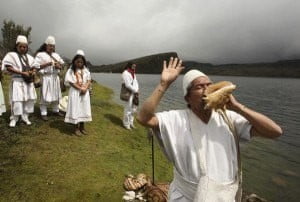
The important visit of the Mamos did not come as a surprise among the Elders of the Pueblo Nación Muisca-Chibcha, since elder Víctor Martínez had told them that soon other guardians of Muisca wisdom would come to deliver the knowledge hidden for centuries among the wise men of the mountain peoples. It was in this way that, in an encounter of cultures rarely seen in history, the exchange of knowledge began, in which the physical maloca that elder Víctor built became the spiritual crucible in which an ancestral people was being forged amid coca leaves, tobacco blood, and long days of vigil and word.
As a result of those encounters between the past and the present, between the wisdoms of the jungle, the lagoons, and the mountains, five Muisca elders were anointed by the mamos as custodians of each of the astillos, or major columns, of the spiritual Muisca maloca that was being raised in the world of the Spirits. Five elders from five localities of the Cundiboyacense highlands, empowered with the medicine and rituals of their ancestors as guardians of the Muisca territory.
After exhausting but beautiful sessions of knowledge delivery and sacred ceremonies, the spiritual connection of three territories of Colombia was completed: the Amazon Jungle, the Cundiboyacense Highlands, and the Sierra Nevada de Santa Marta. Some elders said that in this way an ancient prophecy began to be fulfilled, which said that the gods of Native America would awaken when the Eagle of the North united with the Condor of the South to bring to the Earth the New Man who would walk upon it.
By the year 2013 it was already estimated that more than 8,000 people had participated in the activities and processes of the Pueblo Nación Muisca-Chibcha, and from among them dozens of leaders emerged who initiated and coordinated Muisca, Indigenist, indomestizo, ethnic, and activist systems, not only in Colombia but in other countries around the world, including the United States, Spain, Argentina, Chile, Peru, and Bolivia. Many continued with the line of thought cemented by the Ingativa Neusa brothers, others moved away for different reasons, and still others already came with their own processes that, in one way or another, were validated, contrasted, or strengthened in the light of the experiences and the process of Pueblo Nación.
Many of those who sat in the Maloca of the Botanical Garden, in the environmental classrooms of the district's wetlands, in the lecture venues in which the Muisca communities of Bacatá and Tchunza participated, later became detractors of those processes. Despite this, most of the detractors continued practicing the Law of Origin, the ordinances, the uses, and the customs that arose from the dream of the Ingatyba Neusa brothers and that were patiently built by women and men of noble heart who contributed their grain of sand to see the people of people-people dressed in white reborn.
Today many families in central Colombia have altars in their homes with corn, totumas, tobacco, hayo, and maracas. They sit down to mambear and perform confiesos to heal their differences, they carry aseguranzas and necklaces made by themselves, and they care for the Earth and its natural processes. Not because being an environmentalist is fashionable, but because they live intensely a direct relationship with their territory.
There are children who, before entering a sacred place, close their eyes, introduce themselves to the spirits of the place, and ask permission to continue. Women who recognize their power as healers and give their moon, or menstruation, to the Earth in simple ceremonies they perform individually or with their partner.
Sue, Suati, or Suani, among others, are some of the names that little Muiscas bear, whose parents have buried their placenta and performed pagamento to secure them with the Spirits of the Territory. In many homes chicha is drunk, and quinoa, amaranth, and corn are added to everyday recipes.
Hundreds of men and women dress in white to remember their ancestors and reveal their spiritual identity without needing to affiliate with one organization or another.
This is the account of a Muisca who thanks from the heart the brothers Rodrigo and Sigifredo for their struggle, so that it may endure and be preserved in the memory and heart of all the beings to whom the teachings of our ancestors have reached. So that the whole world may know how a people believed extinct returned to the Earth. The process of Pueblo Nación Muisca-Chibcha was full of lights and shadows, but regardless of the pettiness or opportunism of a few, the pages of its history were written with love by hundreds of people who pursued a pure ideal.
At the time I wrote this chapter, around the year 2014, I was an active member of the Pueblo Nación Muisca-Chibcha movement, and the testimonies I have shared were given to me first-hand by the protagonists of each episode in this fascinating story. Today I dedicate this chapter to the memory of Elder Víctor Martínez Taicoma, who, a few days before I wrote these last lines, passed away in his home in the corregimiento of La Chorrera in the Amazon Jungle. In his spiritual children, the legacy of righteousness, responsibility, community work, care for Nature, and service to humanity that the Elder taught us will live forever.
Unfortunately, the elder left us without getting to see that people dressed in white in all its glory, as he and many others dreamed. However, I believe that the Muiscas did return, but not to repeat the history they had already written hundreds of years ago, but to be part of a globalized civilization and give the world a wisdom, a mystique, that no longer belongs to one ethnicity or a single territory but to all of Hiska Guaia, Mother Earth. Those of us who awakened keep this wisdom and share it not only in the malocas and cusmuyes of the ancestral territory but in academic forums, exchanges of knowledge, and even podcasts all over the world.
Farewell forever, dear elder Víctor!
3 years ago You, brother, offer perhaps the only account of interest about the history of the Pueblo Muisca Nación process, thank you very much.
Comentarios (archivo, solo lectura)
Mostramos 1 comentario guardados de la versión anterior del sitio. Ya no se aceptan nuevos comentarios.
Usted hermano ofrece quizá el único relato de interés acerca de la historia del proceso Pueblo Muisca Nación, muchas gracias.