I told you back in episode 7: Embrujo about the time I lived in Santa Marta, a small city by the Caribbean Sea. They were almost 7 years with many pleasant experiences and many very difficult ones. Among the latter was my awakening to the bloody reality of my country, when I had to witness many violent events related to the absurd war between left and right, drug trafficking, and in some cases also ordinary violence.
I remember that when I started hearing about these events, of which nothing was heard in the country's capital, perhaps to maintain the illusion of a tourist paradise, a haven of peace on the Colombian coast. At first I thought they were extraordinary events, but little by little I discovered that violence in Colombia was a many-headed monster, without a single discernible cause or a solution in sight.
Reflecting on that topic with my office coworkers, I told them that the image that those of us from the interior of the country have of Santa Marta was of a quiet, safe place. One of them told me —“And that's nothing, my brother, things used to be worse before. I still remember when the Cárdenas and the Valdeblánquez were shooting it out right in the middle of downtown.” I asked him who they were, and he answered that they were two guajiro families that had settled in Santa Marta during the years of the marijuana boom, a period in the early 70s when the Sierra Nevada de Santa Marta became one of the world's most important producers of marijuana.
I did not gather more about that story at the time, but over time I heard many other people talk about the war of the Cárdenas and the Valdeblánquez, so my curiosity about those two families grew much greater. I believe it was the father of my first wife who told me more details about it.
No one knows for certain how the enmity between the two families began — families that, on top of it, were related to each other. Some say it was because Hilario Valdeblánquez did not accompany his cousin José Antonio Cárdenas to kill a police commander in the department of La Guajira; others believe Cárdenas killed Valdeblánquez over the love of Rebeca Brito, whom both courted; but the book Crónica de una Vendetta, by Álvaro Cotes, says that everything began because Roberto, Toño's brother — Toño being what they called José Antonio Cárdenas — left a young woman of the Valdeblánquez family standing at the altar of a church in Dibulla, in La Guajira.
A brother of the dishonored lady confronted Toño Cárdenas, the argument escalated, and since the guajiros are famous for carrying weapons daily, they ended up exchanging gunfire, and in the middle of the confrontation the member of the Valdeblánquez family lost his life. The now doubly aggrieved Valdeblánquez swore to avenge the death and dishonor they had suffered and began a bloody revenge from which, it is said, around 100 fatal victims resulted.
The first Cárdenas to die was Emiro, Toño's older brother, but he would not be the last. In the 11 years that this absurd vendetta lasted, all the males of the Cárdenas family died, along with 12 members of the Valdeblánquez family and 60 of their men. There are those who say that both the move from La Guajira to Santa Marta and the Cárdenas family's entry into the marijuana business were motivated by the start of the war against the Valdeblánquez. The Cárdenas felt they had to fortify themselves in a territory their enemies did not know as well and seek every possible economic resource, even through illegal businesses, to finance their war.
Why would they do something like that? Well, in La Guajira they have a saying: “Favors are written in the sand, but offenses are carved in stone.” I once heard that the guajiros not only collect the offense from whoever offended them, but from their descendants up to three generations ahead. When I heard that aphorism, I thought it was a hyperbole, but this story showed me it was rather true to reality.
On April 11, 1989, a 13-year-old boy waiting for the bus to go to school died riddled with bullets in Santa Marta[1]. It was Nelson Cárdenas Cárdenas, son of Toño Cárdenas and his cousin Libertad Cárdenas. The city's newspapers reported the murder as the death of the “Last Cárdenas”. By that time, the Valdeblánquez's revenge had already finished off all the other males of the family, and the Cárdenas women, who knew their little boy would be next, did not believe their enemies would be capable of killing a child, that at least they would let him grow up.
As far as I was able to investigate, Nelson was indeed the last death of that war “for honor”, although tranquility never came to those grieving women, since some of them carried in their wombs new descendants of the offenders in question.
The Cárdenas lost the war, among other reasons, because they were never as disciplined or as good strategists as the Valdeblánquez, but also because they were the first to break the tenuous code of honor of the guajiro affronts. Besides aggravating the dishonor of the abandoned bride with the murder of her brother, the Cárdenas killed some women of the Valdeblánquez clan. Something that was considered dishonorable.
It was perhaps for this reason that the only attempt to agree on peace between the two families was frustrated, when Roberto himself, the one who had committed the first offense, accepted the intermediation of a common friend to reach an agreement with the Valdeblánquez. That was in May 1974, in a house in Santa Marta owned by the intermediary, who was also a well-known trafficker in the city. Roberto Cárdenas arrived at the meeting with a first cousin of his, and it is known that they did not manage to exchange a word with the delegates of the other family, since as soon as they arrived at the place, they opened fire on the two Cárdenas. Roberto died there, but his cousin managed to escape alive, only to become one more victim shortly after the frustrated attempt at dialogue.
The Cárdenas' first counterattack came three months after Roberto's funeral, when some of the Cárdenas brothers, along with some friends, massacred two members of the other family as they strolled along an important avenue downtown. The Valdeblánquez's response was not long in coming, and that very day they planned an attack with 12 men that lasted 45 minutes, in the area where the Cárdenas lived. In that shootout, the longest of that war, no Cárdenas died, but the second innocent victim did, among the many who fell for being in the wrong place.
One of the sad anecdotes of those years was that the Valdeblánquez were the first to use the famous car bombs with which Pablo Escobar would terrorize the country years later. In that attack, by the way, none of the Cárdenas died either, but the two people they had hired to drive the car bomb to its destination did, along with a passerby. This event, moreover, turned the vendetta into national and international news and prompted the then mayor of Santa Marta to order the two families to leave the city. The Valdeblánquez obeyed the order and moved to the neighboring city of Barranquilla, but the Cárdenas challenged the ordinance and remained in the city.
In any case, the war continued, and members of both families kept falling, along with many of their employees and several civilian victims. The Valdeblánquez prepared their attacks from Barranquilla and sent hitmen to carry them out. But even so, and 10 years after the confrontations had begun, Toño Cárdenas remained alive after surviving several assassination attempts.
This luck would not last much longer, since the one-by-one slaughter of his brothers, cousins, and friends also meant the decline of the family's illicit activities and, therefore, of its source of resources. The Valdeblánquez, on the other hand, grew stronger and stronger and did not hesitate to intensify their revenge when they learned of the financial vulnerability and decline of Toño and his Father, who were increasingly seen as more careless with their security and more given to drinking and partying.
Toño was riddled with bullets at the entrance of his house, finished off by a police lieutenant who had been his friend years before and who had been bought by the Valdeblánquez to betray Toño and finally collect the blood debt he had evaded for so long. His son Nelson would be the one to seal the cruel revenge, with which the war between these two families ended, and Santa Marta breathed again with the hope of recovering the peace of old.
This hope, unfortunately, would be only an illusion, because shortly after the new war would begin when the drug lords arrived from the interior to plant coca in the Sierra Nevada and form the paramilitary armies known as the “Chamizos”, to defend themselves from the guerrilla groups, mainly the ELN, which had arrived attracted by the marijuana boom, determined not to be left behind in the new coca boom.
This story has many aspects worth analyzing. What moves an entire family to declare war over a cause as absurd as a love affair? Or to avenge a death by killing innocent women and children? There are several examples in history; perhaps the most famous is the battle of Troy, which is said to have been over the love of the beautiful Helen, abducted by Paris, prince of Troy, from the hands of Menelaus, brother of Agamemnon, the king of Argos.

Similar vendettas have also been recorded in almost all the mafias of the world: the Sicilian camorra, the five families of the New York mafia, or the modern Colombian and Mexican drug lords. However, it is hard to believe that two families that were barely starting their illegal businesses sustained such a war for so many years.
It is in part the sad reality of my country, Colombia, where violence has been normalized and we have gone from war to war for 200 years without ever finding a definitive solution. Even today, four years after celebrating the signing of the peace agreements between the Government and the oldest guerrilla in the world, we are witnessing the return of massacres, the extermination of political rivals, and the empire of fear established by criminal gangs and drug traffickers.
But it is also in part the sad reality of humanity, which, despite having advanced in almost every aspect of life — technology, education, poverty reduction, life expectancy, and prosperity — seems lost when it comes to the most fundamental of human needs: inner tranquility.
From my point of view, after having gone through an episode of depression many years ago and, more recently, one of anxiety, the most important achievement we can reach as human beings is emotional balance, inner peace. This sounds a bit cliché, but if you have lived through an experience of mental health disturbance, even a mild one like stress, loneliness, or frequent sadness, you know that in those moments one does not even aspire to happiness or even joy, but to the simple possibility of not feeling pain, of not suffering.
Perhaps you are thinking that aspiring to something as mundane as tranquility, rather than something more sublime like happiness, is not very ambitious. You may even feel that you already have tranquility but that you still need to reach happiness, and that that is what would lead you to make the effort that the path of initiation requires. Well, then we have to start by defining what happiness is.
Like all the other terms I have defined here, happiness is not a universal concept with a single definition, so we can start with what the dictionary says: “State of pleasant spiritual and physical satisfaction”. The problem is that if we cling to it, it would mean that people who suffer from a disability or illness cannot be happy. Each person has their own idea of what happiness is; for many it is a state of consciousness in which one feels rejoicing, cheer, or joy. For others, it is a series of ideal internal and external circumstances: having health, money, love, purpose, etc.
Spirituality does not offer a path to find any of those kinds of happiness, because almost always the expectations we create about what would make us happy either fall short or have the opposite effect. How many people pursue those dreams that supposedly will give them the longed-for happiness, and when they achieve them they still feel just as empty as before, or even worse: that happiness they sought becomes a golden cage they cannot leave out of loyalty to so many years of wishing it would arrive.
For this reason, what spirituality offers us is not happiness but peace, the harmony of the mind. Happiness can be different for each person, but peace is a concept that is indeed universal, because harmony, or balance, can be defined by opposition as the absence of suffering.
The story I narrated about the war between the Cárdenas and the Valdeblánquez reflects in a dramatic way what suffering is and the effects it causes. I know that a situation like that is, fortunately, very unusual, but as we will see in a moment, it shows us with great clarity the drama that we human beings live at many different levels.
I believe you will agree that all the blood spilled over a simple personal offense is something monstrous and unjustifiable, and probably all those who took part in that war would have agreed if they had known the final outcome: 11 years of fear, death, and suffering. What happens is that the great tragedies of humanity rarely begin with a big explosion. What generally occurs is that problems escalate little by little until they get out of control and reach a point of no return. This has happened or will happen to almost all of us in one way or another in different aspects of life: being fired from a job, a romantic relationship that becomes a toxic relationship, a neighborly quarrel that ends in lawsuits and threats, parents and children or siblings who stop speaking to each other, lives that end in decline because of drug use, apparently successful people who end up in a psychiatric clinic or in suicide because of a silent burden that becomes a stone too heavy to carry.
All these examples resemble the story of the Cárdenas and the Valdeblánquez in that things begin with something small that is not stopped in time and becomes a snowball. A firing begins with an unpleasant comment from the boss. Many relationships go down the toilet because of an assumption that was never clarified. There are families that end up divided over a money loan that was not handled delicately. The most destructive vices often begin with an act of rebellion or with using a substance to fill a lack of affection, and many suicides could have been avoided if the person had chosen a slightly different path.
What would have happened if the Valdeblánquez had taken advantage of that lady's abandonment at the altar to dissolve a relationship that surely would not have brought her the happiness she desired, and perhaps to distance themselves from a family that maybe it would not be advisable to keep frequenting? Nothing more is known about the abandoned bride, but it is very possible that some time later she found love in a person totally committed to her. If that was the case, surely she must have thought at the time that that abandonment was the best thing that could have happened to her, or otherwise she would not have found true love.
But what happened with these families happens to all of us at other levels: pride, fear, and distrust end up being stronger than the capacity to let go of what causes us suffering, turn the page, and continue with our lives. Every day situations arise that, if we do not handle them with wisdom, can become the first link of a heavy chain with which we end up dragging the past, the pain, and the suffering.
But then, what is the origin of suffering, and how can we avoid creating those chains? Of course there can be many answers depending on each case, but after 12 years of exploring spiritual paths, the most convincing answer I have found comes from one of the oldest spiritual traditions: Buddhism.
The story goes that Prince Siddhartha Gautama, born into a life of luxury and privilege, left the royal palace to get to know the world and confronted the reality of almost all human beings: deprivation and suffering. On his way he met the sick, the elderly, holy men, and corpses. These encounters with death, suffering, and transcendence led him to renounce his life in royalty in order to discover the truth about birth, death, and peace of mind.
He began practicing yoga with several teachers, but continued his journey through fields and villages seeking different techniques to find that truth. They say that for six years he practiced a life of extreme asceticism; he flagellated himself, held his breath until he was on the verge of fainting, and fasted until he could almost feel his spine touching his stomach.
During the hallucinations produced by those bodily and mental tortures, he remembered when he was a child and sat under the shade of an apple tree on a sunny day. It was the first time he felt a state of complete calm and had a spontaneous experience of dhyana, which means “deep state of meditative absorption”. That memory made him decide that, to free himself from the limitations of the physical body, instead of punishing himself, he would try to work on his own nature and practice mental purity to achieve enlightenment.
A girl passing by saw him and felt compassion seeing him in such a lamentable physical state, so she offered him a cup of milk and rice (curiously, one of the Colombian desserts I like the most!). When his followers saw Siddhartha break his prolonged fast, they believed he had given up his search and abandoned him.
Gautama had realized that the path to awakening was a “middle way” between the extremes of the self-restriction he had been practicing with his group of ascetics and the self-indulgence of the life into which he had been born.
All this happened in Bodh Gaya, which is where the state of Bihar in India is today. Siddhartha Gautama sat under a fig tree and began to meditate, and according to some traditions he reached enlightenment in one day. Others say he sat meditating for three days and three nights, and still others say he meditated for 45 days before becoming enlightened and becoming the Buddha, which means “the Enlightened One”[2].
For the Buddha, enlightenment consisted of a series of insights that appeared with clarity in his mind, not delivered by any deity, not even received from anywhere, simply revealed within himself. I must say that some of these insights, like those of reincarnation and past lives, are difficult, if not impossible, to verify, and it would take an act of faith from each person, or else seeking one's own enlightenment to confirm them; but the third great insight can indeed be put into practice, and I personally consider it the best, if not the only, path to get out of suffering.
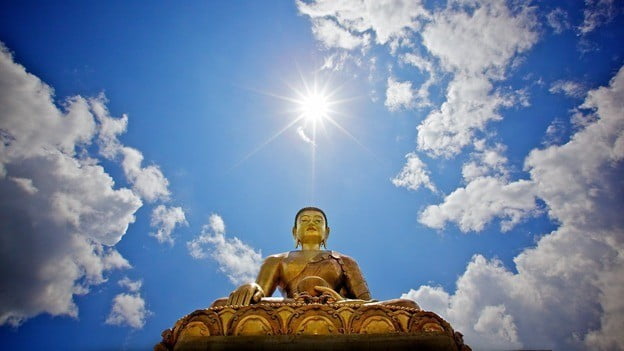
The knowledge of the truth of suffering is divided into the four noble truths:
2. The causes of suffering
3. It is possible to end suffering
4. The path to end suffering
The first revelation tells us that everyday life as we know it is full of suffering. However, the original word the Buddha used was dukkha, which has several connotations. One is suffering, but it also means “dissatisfaction”. I personally believe the latter is a more accurate translation than “suffering”. What Buddhism means by saying that life is suffering is that wherever we go, a feeling of dissatisfaction will always pursue us, the feeling that there is something that is not quite right.
Yuval Noah Harari says in his book Sapiens that human beings are not programmed to be happy but to seek happiness. The anthropological and philosophical observations of human history show us that we are always in a constant search for something better: a more satisfactory romantic relationship, a better job, more money, better physical condition, more approval from others. However, these goals are like a mirage that recedes as we approach it.
That is what the enlightened one discovered, and he says that that constant dissatisfaction and the consequent suffering from failing to fill that void come from what he called avidya, or ignorance: ignorance of our connection with all other human beings and with nature, ignorance of the true nature of the mind. This ignorance, according to the Buddha, leads to the two main causes of suffering: attachment and aversion.
In episode No. 4, La Experiencia de la Realidad, we already talked about these two causes of suffering. We said that, according to Buddhism, the processes of the mind are divided into four phases: Consciousness, Perception, Sensation, and Reaction. The Sensation phase, or vedha ara, receives the sensations of the previous phase and decides whether each sensation, each stimulus, is pleasant or unpleasant, and based on this unconscious decision, the fourth part of the mind, or sank ara, reacts in two ways: attachment or aversion.
The cradle of suffering is, then, this sank ara process that leads us to react, not always physically — physical reactions can appear minutes, hours, or years later — but the constant reaction is attachment to pleasant sensations and aversion to unpleasant ones. Notice that the third stage, or vedha ara, happens in an instant and disappears. “This is pleasant, how nice”, or “This is unpleasant, how bad”, and it goes on with the next sensation, and so on.
But the sank ara becomes a demon. Right now I am not using the religious sense of the word demon, but the computing meaning. In the Unix operating system, a daemon is a process, or a small program, that runs in memory indefinitely and is there constantly performing some task. Well, attachment or aversion is not like the vedha ara, which disappears; it stays in the mind and begins to feed on our consciousness.
If it is attachment to something pleasant, then the demon of attachment constantly asks us for more of that pleasant sensation. —“Oh, that dessert is so good, I have to eat that again”, —“I like that car, I have to have it”, or “I feel so good with this person, I have to spend more time with her”. The sank ara of aversion, on the other hand, works constantly so that we avoid that unpleasant sensation at all costs: “I didn't like this eggplant, so I never want to taste it again”, or “I didn't feel good on my first day of work; I think I don't like this job.”
I don't know if you saw the movie “Inception” by Christopher Nolan. The protagonist said that the most resistant and most dangerous parasite is an idea, and that once an idea takes hold of the brain it is almost impossible to eradicate it. Well, that is what the sank aras are about: subconscious ideas, very simple but very clear. An attachment or an aversion can begin with something relatively mundane, but over time become a heavy chain, a cause of constant suffering.
For the guajiro families of our story at the beginning, the attachment to a traditional code of honor that was totally useless and destructive, and the aversion to the feeling of humiliation or fear of the counterpart's revenge, turned a broken heart, like the ones so many of us have had to live through, into a nightmare for an entire city for 11 years.
As I said before, the case of the Cárdenas and the Valdeblánquez seems like an extreme case, something that would not happen to “normal” people, but from my personal experience I can testify that in my yagé sessions, ceremonies, and other life experiences I have had to fight very hard to try to overcome attachments to religion, to people, places, projects, ideas, beliefs, or habits, and also my aversion to the lack of approval, to not having everything under control, or to the idea of aging and dying.
Always, behind every suffering there is an attachment or an aversion. Even if it is attachment to something or someone we are supposed to be attached to: honor, a family member, our career, our country, our beliefs. Or even if it is an aversion to someone or something we are supposed to reject: death, loneliness, injustice, or pain. In fact, it is the aversion to pain that is the origin of one of my favorite spiritual phrases: “Pain is inevitable, suffering is a choice.”
Look there in your heart, where the suffering or dissatisfaction in your life is. You are going to find an attachment or an aversion. Then imagine simply letting go of that attachment or accepting what you reject. Almost surely your reaction to that thought will be “How am I going to let go of this or that if it is something very important in my life” or “How am I going to accept such a thing if it goes against my principles, or against what I am.” This is always the first step; there is not a single attachment or aversion that has turned into suffering that is easy to let go of. Our mind will always battle to maintain the status quo, because if there is one thing common to all humans, it is that we are not willing to accept that our suffering was in vain. We prefer to keep suffering rather than open our eyes and recognize that everything began with a stupidity we should have let go.
This is the reason why the parents of soldiers who have died in useless wars like those of Vietnam, Afghanistan, or Iraq keep voting for the same ones who sent their children to their deaths. They are not willing to accept under any circumstances that their children died in vain. They could send another child to war before recognizing that the first one died without meaning.
This is exactly what happened to the Cárdenas and the Valdeblánquez, who sacrificed dozens of lives, subjected dozens of women to abandonment and a life of pain, and murdered civilians, women, and children, before letting go of the resentment, accepting they had been wrong, and moving on.
The good news is that the Buddha also found that it is possible to stop suffering, and he left a path to do it. It is not an easy path, but it is worth walking, and the benefits can save lives, not only in the present but for many generations to come, and have a global impact. That is how important this message is. But we will see it in detail in the next episode of Espiritualidad & Ciencia. For now I say goodbye,
Good path and good breeze.
[1] https://historiasdelmagdalena.blogspot.com/2016/09/guerraentre-las-familias-cardenasy.html
[2] https://www.learnreligions.com/the-enlightenment-of-the-buddha-449789