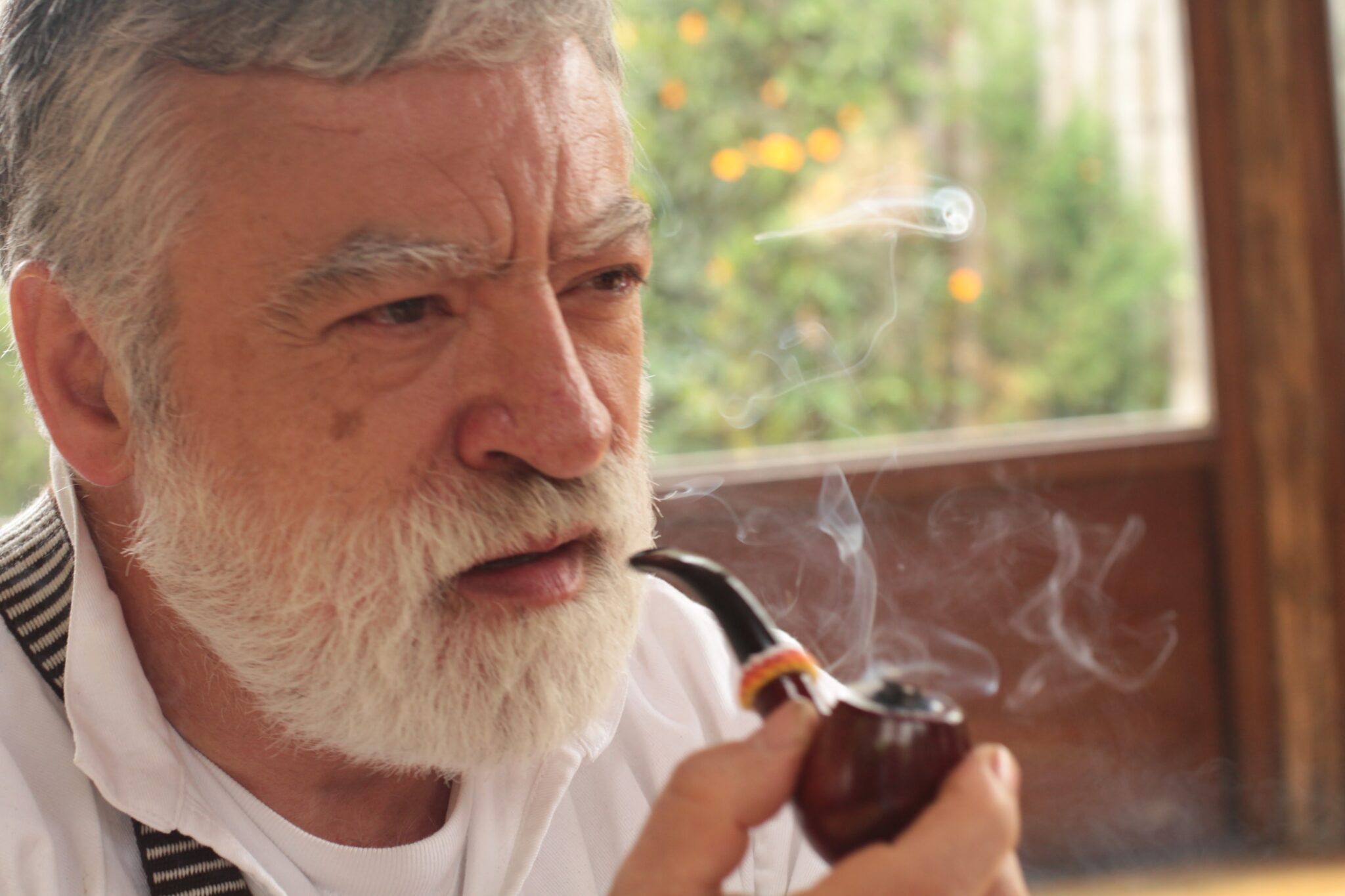
The Muisca re-signification process, which in theory was the basis for the birth of the Muisca-Chibcha Nation People, was doomed to failure from the start, because despite the good intentions of the Ingatyba Neusa siblings, the community that managed to form, at least in Bogotá, never stopped being a vehicle for spreading the Gnostic teachings of Samael Aun Weor and a means for the commercial activities of the FUNAZA foundation, owned by grandfather Suagagua and grandmother Yanguma.
But that does not mean that, besides the above, there was not also a genuine effort to awaken indigenous thought and make the Muisca identity visible to society, an identity that a good number of inhabitants of the Cundiboyacense highlands preserved without even knowing it. In fact, it must be recognized that for better or for worse, there is no person who has managed to represent the Muiscas of the 21st century the way grandfather Suagagua has.
His bearing as an ancestral wise man, with long gray hair and marked indigenous features, along with his personal magnetism and oratory skills, has taken him to many international stages, from Chile to the United States. His presence is recurrent in Colombia's media outlets, and he has been the reference point of ancestral knowledge with which many young people have connected with their indigenous legacy and begun a process of spiritual search through ancestry.
Another merit that must be acknowledged in grandparents Suagagua and Xieguazinsa is their power of convocation. Not only of young people in search of their identity, but of wise elders with the potential to expand the work of awakening the Muiscas of the 21st century. As I have narrated before, through the process of the botanical garden maloca, a good number of grandparents came to sit around the central fire of the maloca, grandparents whom unfortunately I never got to know in depth, since at the moment I joined Pueblo Nación, many of them were already on their way out. Some in open opposition to the leadership of the Ingatyba Neusa, and others because they no longer found in Pueblo Nación enough support to have their own voice and exercise their own leadership.
As I experienced myself, when some community leader began to develop their own criterion about the doctrines or other community processes and it diverged from that of grandparents Suagagua and Yanguma, the latter took it upon themselves to cut off the oxygen from the rebels until each one ended up leaving on their own.
There were some grandparents I only came to know by sight or spoke with a couple of times, like grandparents Comba Nymy Quene, Gualcalá, and Guasín; others with whom I did have the opportunity to share but who shortly after stopped participating in Pueblo Nación's activities, like the dear grandparents Jairsagua Furativa Gachetá and her husband grandfather Florentino Caicedo; and others who accompanied the community even after my departure from the movement.
Among the latter is grandfather Nemequene, who accompanied Pueblo Nación's process until shortly before his death in December 2019, in part, to counterbalance the influence Suagagua exerted over the community members. But there was another grandfather whom I have not referred to until now and who is, more than ten years after my joining the Muisca-Chibcha Nation People, the only one I still consider my spiritual elder and, even more, a second father.
Grandfather Luis Elbart Sánchez Rubiano, also known as Chimini Ingatyba Gagua for being the ancestral name he himself discovered in his process of indigenous self-recognition, was, from the moment I met him and along with grandfather Florentino Monroy, one of the few elders of the community who did not seem to be putting on a performance to look like an indigenous priest brought from the times before the conquest.
Grandfather Luis and grandfather Florentino, or Floro as we affectionately called him, also had in common that they did not have the typical physical features of the mestizaje of the Muisca territory, that they did not usually dress in indigenous attire, and that, like me, they held traditional office jobs during the day. Grandfather Florentino, however, was already retired from the community, so I had the honor of sharing with him outside the community, more due to chance than to our ties with Pueblo Nación.
Grandfather Luis Sánchez, on the other hand, remained in the process of grandparents Suagagua and Yanguma until shortly after my retirement from the cabildo, just like grandfather Nemequene, feeling the responsibility of counterbalancing the negative influence that grandfather Suagagua exerted over the community members.
The reader will wonder why the surname Ingatyba repeats among the grandparents' ancestral names. According to grandfather Suagagua, the ancestral name of a Muisca is formed by an inner name, equivalent to a given name, which is revealed to each one in a moment of divine inspiration. The second name or first surname corresponds to the ancestral name of the territory where the person was born, and the second surname to that of the place where the mother was born.
Grandparents Suagagua, Xieguazinsa, and grandfather Luis coincidentally were born in the Engativá locality in the northwest of Bogotá. This territory, which holds the Eldorado international airport and the Botanical Garden where grandfather Víctor Martínez built the maloca to search for the Muiscas, was in the past an independent town from Bogotá that was also called Engativá. This name comes from the Muisca word Ynga-tyba, which means “Lord of the Pleasant” or “Lord of the Delicious”. I myself identified during my years as a Muisca wise man as “Guane Sua Fumeque”, which means something like “Alder Tree under the Sun in the Forest of the Fox”.
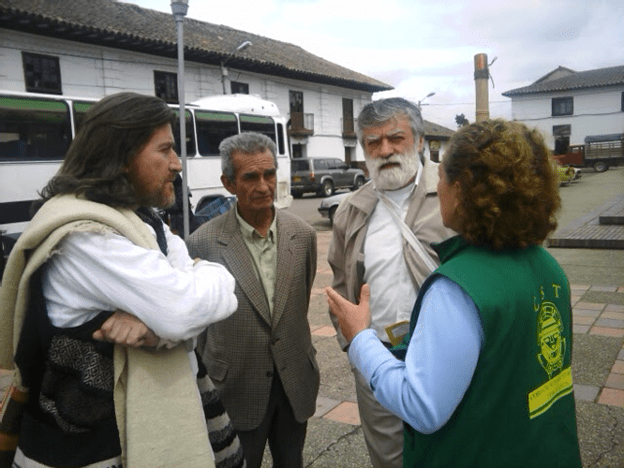
The thing is that, unlike the other grandparents, grandfather Luis still lived in the Engativá locality, so he was commissioned by grandfather Suagagua to lead the formation of a partiality of the Muisca Cabildo of Bacatá — or Bogotá — in the Engativá locality. I remember the day this happened because it was right after one of the many occasions when we gathered at the Botanical Garden maloca. After closing the circle of word, grandfather Suagagua asked those present to divide ourselves according to the locality of Bogotá where we lived. Several groups formed: one of those who lived in the Suba locality around grandmother Yanguma, those who lived or were closest to the Soacha locality with grandfather Nemequene, and those of us who lived in Engativá with grandfather Luis. The Fontibón and city-center groups also formed, but I don't remember who led them.
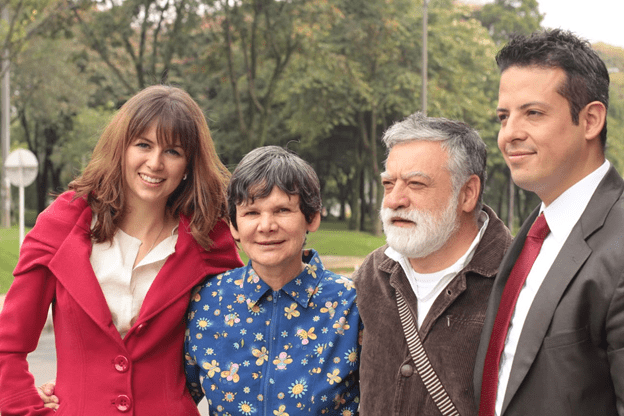
The first impression I had of grandfather Luis — apart from not having Muisca features and, on the contrary, looking like a neat Santa Claus — was that of a very respectful, warm, and serene man. I immediately felt trust in him, and we both began planning the organization of our ancestral working group in Engativá.
The first meetings took place in the environmental classroom of the “Santa María del Lago” natural park, thanks to the agreement that the district environmental secretary had with the FUNAZA foundation. We began meeting every two weeks, and little by little a group formed that not only counted on visitors from the maloca, but also included curious people who for the first time sat down to listen to the teachings of a Muisca grandfather.
Thanks to grandfather Luis I came to know in depth the dynamics of the ancestral circle of word, which, by the way, was more a teaching of the indigenous communities of the jungle — and in particular of grandfather Victor Martínez Taicoma — than of the Muisca grandparents. Seated in a circle around the light of a candle, which served as the central fire, and a glass of water that stood in for the sacred lagoon, we prepared ourselves at each gathering for a healing process that sometimes involved tears but always ended in hugs and smiles.
According to the tradition that grandfather Luis received from his elders, the circle opened with a greeting to the four winds, different from the one grandmother Yanguma led in Pueblo Nación; then, the grandfather made an invocation to ask permission from the guardian spirits of the territory, the ancestors of the people present in the circle, the spiritual elders of the conscious Muisca circle, and finally the great Mother-Father God.
Those attending the circle could offer tobacco, and I usually officiated as an assistant, blowing the hoska, or powdered tobacco, into the attendees who wanted to receive it, along with other tasks supporting the grandfather's work. The grandfather, for his part, always had ready at the moment of the ceremony a small vegetal bowl, usually of unpolished coconut, into which he poured a portion of tobacco ambira diluted in water. Before beginning his word, the grandfather would dip his index finger into the bowl, turn it three times clockwise, and then suck it. In that way, he received the spirit of the tobacco in his mouth before speaking.
Once his initial intervention concluded, the grandfather ended with the phrase “cubuta ocasa”, which means “the one who speaks the truth”, and handed the bowl to the person seated to his left. That person had to take the bowl, dip their finger into it, and do the same as the grandfather had done. Then, they proceeded to express their thoughts, intentions, doubts, or feelings as their heart dictated. When their intervention ended, they also repeated “cubuta ocasa” and handed the bowl to whoever was seated to their left.
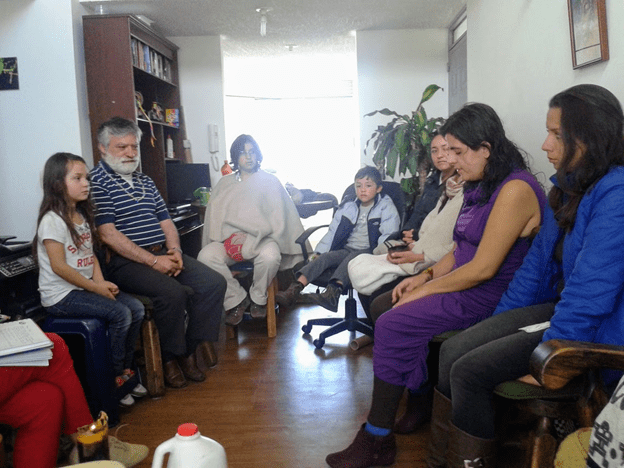
Depending on the number of participants, a full round of the circle of word could last an hour or sometimes more, especially considering that grandfather Luis's interventions usually lasted 20 or 30 minutes each. I must admit mine were not much shorter, which is why I had to stop sitting next to the grandfather and sit on the other side of the circle instead. That way, the other attendees would have more opportunity to participate, or at least not have to endure 45 minutes or more as mere listeners. In total, the circle of word usually lasted about 3 or 4 hours.
The dynamics of the word in the circle were framed by certain agreements that the grandfather taught to each new guest:
The circles of word with other grandparents with whom I sat during my years on the Muisca path revolved around the word of the officiating grandfather or grandparents. The dynamic consisted of listening to the elders' teachings while offering tobacco, chewing mambe, weaving, or working with the poporo. With grandfather Luis, we learned that the teachings, the answers, and the healing did not always come from the elders but were often obtained from the experience and stories of other attendees of the circle. Sometimes, even from those participating for the first time, or from people who at first glance would not seem to be the holders of great ancestral knowledge. More than once it was the children, who delighted us with their presence and their words, who had the right answer that someone needed to hear.
It was common for healing wisdom to emerge during the circle through the “weaving”, that is, when someone built on what others had said before, and this in turn served as the basis for completing someone else's ideas. There were many moments in which, amid the weaving of the word, someone felt the impulse to reveal intimate and delicate matters that moments before they would not have imagined sharing with a group of strangers.
In such moments, depending on the emotional state of the person in question, grandfather Luis and I used the shamanic working tools of our personal vade mecum to help complete difficult healing processes. This included songs, perfumes, tobacco smoke, indigenous musical instruments, hoska, ambira, and sometimes spraying herbal water from the mouth over the grief-stricken person.
When the attendees' words grew scarcer and we perceived that the circle's “energy” was reaching a closing point, we suggested that each participant make a final offering, expressing their personal conclusions, the teachings they would take into their lives, and any additional ideas they wanted to add. When the last round ended, the grandfather made an invocation of gratitude to Mother-Father God for the healing received, a summary of the teachings that could be drawn from the ceremony, and a beautiful farewell ritual for which we attendees stood up, joined hands with our eyes closed, and followed inspired words with poetic overtones that the grandfather improvised according to the occasion.
Then we released our hands, raised them toward the sky, and repeated after grandfather Luis:
– “I declare myself a child of the stars, child of the central sun from which life emanates, child of the Cosmos, child of Mother-Father God, Great Spirit, and I declare myself Muisca, Muisca, Muisca.”
This prayer also varied according to the grandfather's inspiration and often became much longer. Over time, grandfather Luis entrusted me with the task of maloquero of our partiality, so from time to time I made the initial invocation and the closing. Then I decided to include, after the grandfather's final prayer, that beautiful prayer I learned from Taita Omar Barreto through his conferences that came into my hands:
– “May all beings be happy, may all beings be joyful, may no one lack food, shelter, or warmth.”
Finally, the grandfather guided a beautiful visualization in which he asked us to imagine receiving from the Cosmos a white vestment, a golden chumbe or sash, and a ribbon on the forehead. We had to pretend to put on the vestment, gird ourselves with the chumbe and the sash, and prepare to return to our daily lives as solar warriors.
After some months of gathering at the beautiful Santa María del Lago wetland, the district administration changed, and with it ended the agreement that the environmental secretary had with FUNAZA. From then on we had to look for other places to meet and hold our circles of word. At first we did it outdoors in the locality's parks, but indigenous ceremonies, especially when they involve lighting tobacco, still carry the stigma that the Catholic religion created of them being witchcraft. So we decided to hold the meetings in the apartment where Paula, Ana María, and I lived at the time.
Although the space was small and we did not have such close contact with nature, the spirit of our ceremonies remained, and we even saw significant growth in attendance, on more than one occasion exceeding 25 people. Since it was a family home, some of the participants arrived with offerings of fruit, bread, or sweets, following the ancestral tradition of the “present” that is given to the hosts when one visits their dwelling. So at the end of the circles of word, we shared the food, and that generated an even greater connection and unity among the group members.
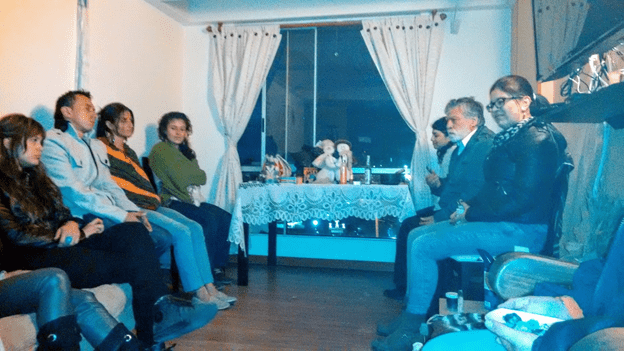
We also added a new tradition to the closing of the circles that was the favorite of most: after dressing ourselves with the magic vestment received from the cosmos with the power of imagination, we melted into a series of strong, affectionate hugs. Each of us received the embrace of every attendee of the ceremony, and we said goodbye so that each one returned home with a smile on their face.
This was the dynamic for as long as our group lasted. However, in parallel with the development of the circles in Engativá, things with Pueblo Nación were getting more difficult, and it became increasingly complicated for us to identify as part of that movement. In any case, once we lost the Santa María del Lago classroom, we no longer formally depended on the cabildo, so it made little sense to keep calling ourselves a partiality of that institution. Nor were we a purely Muisca group, since, as I said before, we were all open to recognizing the origin of the knowledge we shared. The grandfather then suggested that we call ourselves “Encuentro de Saberes de Engativá”, and that is the name we adopted for a while.
One day a visitor from very far away arrived at our circle of word: a young man born in Macedonia who professed Islam but was interested in learning about other spiritual wisdom. He attended the ceremony very seriously, followed the group's rules, and participated actively, making use of the excellent Spanish he spoke after many months of traveling through Latin America. After the circle, our Macedonian friend stayed chatting with the grandfather and me for a long while, so long that he ended up sleeping at our house for a few hours before leaving the next morning. During our conversation, we were surprised to realize how similar we were in our searches, longings, and spiritual experiences, despite how different our customs and histories were.
We also realized that, despite never having met before, the Macedonian and we were traveling the same path, working toward the same goal, and perhaps supporting each other in some way across time and distance. This experience repeated itself with the sporadic visitors we received from other countries and other cities. They arrived at our meetings, shared their stories, we shared the medicine and the word, and then we embraced as if they were relatives we had not seen in a long time.
I thought a lot about this because until that moment, I had the obsession that our group should grow, perhaps to the size Pueblo Nación reached in the Botanical Garden maloca, and that one day we could reach a critical mass of spiritual walkers who could have a positive effect on the course of history. Grandfather Luis shared that dream, and we constantly talked about strategies to reach more people, increase the size of the group, maybe open more circles.
But the occasional visitors to our circles made me change my perspective: the task of awakening humanity is not our personal responsibility. We simply do our part, the part that corresponds to us, in a cosmic work that is much greater than our small healing group. A small part, but not insignificant because of it; on the contrary, vital for the awakening of consciousness of all humanity.
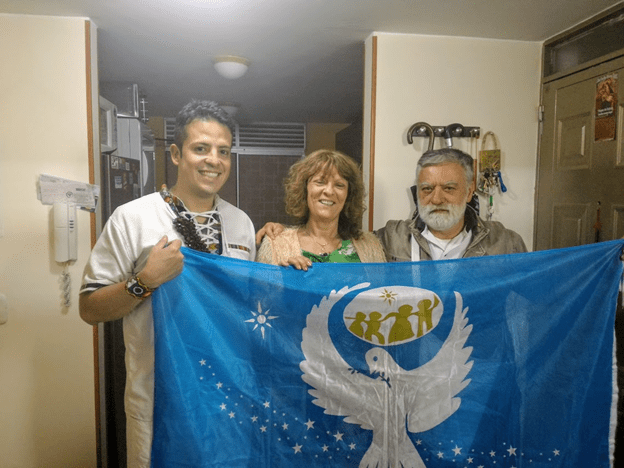
At that time, I was very interested in the theories of the awakening of planetary consciousness that Sixto Paz Wells spoke of with his “Plan Cósmico” and Drunvalo Melchizedek with his “Flower of Life”. From there came to me the idea that perhaps a universal consciousness network existed, formed by all those who, to some degree, had reached a level of spiritual awakening. Each of us would be a node in that network, and our function would not be to gather hundreds of people to push them into a massive awakening, but simply to light the way and attract others who were asleep so that they would awaken, receive the light of consciousness, and join that network.
If each of those awakened beings did their personal task to free themselves from the chains of unconsciousness and attracted one, two, or three more people, they would become united through an invisible but powerful bond of love and fraternity, channeled toward the common good of humanity. There would be no need to know all the other nodes; there would not even be a need to maintain constant contact with the people we had helped awaken.
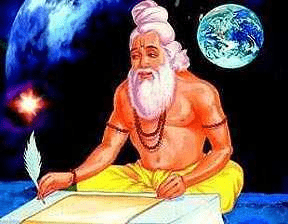
I explained this vision to grandfather Luis and told him that the idea of being the leaders of a giant movement was a trap. That was the path the Muisca grandparents had tried to walk. A path in which one adopts the role of redeemer and guide, which inevitably leads to the exaltation of the personal ego: “I am the one who has the power to liberate you.” Being nodes of an invisible network of consciousness, instead, turns us into simple servants who do their task and follow their path. Apparently a path of less responsibility, but in my opinion, a more serious and humble alternative, since it implies that the focus is not on being powerful or persuasive enough, but on being a kind of lighthouse, a light that radiates love and trust so that those who walk in darkness can follow that light while they find their own light and become a lighthouse for someone else. Grandfather Luis immediately agreed with my vision and told me he had had that same revelation in yagé, although he had not fully ordered it. He then asked me what that network of consciousness would be called. I had had a recent vision in yagé, in which the first ancestor of my lineage, the one connecting me with ancient India, had been revealed to me. In my vision, that ancestor had been a king named Manu — probably because that has always been my favorite nickname — although he had been shown to me as a king who had made many mistakes. In any case, I researched on the Internet and, surprisingly, found that there had indeed been a king named Manu, who had been the first human being on Earth and the first king of all humanity. His legacy, besides ten sons, would have been founding a dynasty of kings devoted to sun worship that was called the “Solar Clan”.
Showcasing one last act of immodesty before renouncing my aspirations to the Muisca priesthood and declaring myself a simple node in a Universal network of conscious beings, I told the grandfather that that network of consciousness was called the “Solar Clan”.
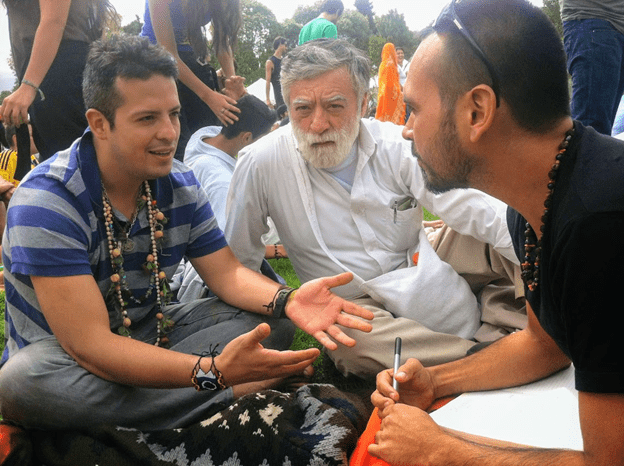
The more I got to know grandfather Luis, the more I reaffirmed my admiration for his nobility, wisdom, and above all his coherence. Many other grandparents I met during those years spoke of prosperity, abundance, enlightenment, and spirituality in public, but when I came to know their private lives I found many contradictions: family division, abuses of authority, improper behavior with women, disorder in personal finances, failure to keep their commitments, lies, and in general an incoherence between what they preached and what I saw in their personal lives.
Grandfather Luis, on the other hand, without being a perfect person, always showed coherence between his word and his values. I never heard any complaint about his behavior in public or in private. He always kept his word to the letter, and I can attest that he did the impossible to help whoever needed it, even if it meant disrupting his personal affairs. Perhaps that is the only criticism of the grandfather I heard from his family: that he frequently stayed up late, risked, or changed his plans to help people.
As a Muisca wise man, however, he had the same problem as the other Muisca grandparents I met: his knowledge about ancestry came more from Western sources than from authentic indigenous roots. Like the other grandparents and even like myself, grandfather Luis came from Samaelian gnosis. His mother even reached a high level within a Gnostic church, at the degree of Isis. However, unlike the other grandparents, grandfather Luis was already aware of the perversions and sectarian vices of the Gnostic doctrine, and when I met him, he no longer considered himself a Gnostic, although some of his convictions and beliefs remained the same as those professed by Samael Aun Weor.
His most important influence, however, came from Catholic Christianity, although quite tempered by Coptic and Sufi esotericism. If grandparents Suagagua and Xieguazinsa had the “sin” of having been Gnostic priests, grandfather Luis would have to assume the cost of having been not only a priest but a bishop of the Old Catholic Church of Colombia. He also recognized himself as an heir of Jewish lineage, witnessed not only by his physical features but also by his second name “Elbart”, his surname “Sánchez” of Sephardic Jewish origin, and the names of his children Joseph, Alexander, and Sadday.
This “sin”, however, is one over which I never met any Muisca, or even any indigenous person, who could cast the first stone. Colombian indigenous people, whether in the jungle, in the Sierra Nevada, or on the highlands, by birth or self-recognized, are all an amalgam of races, cultures, and knowledge, on whom the Catholic religion, superstition, esotericism, and sects have left an indelible mark. What grandfather Luis's character showed is that I never saw him deny his roots or try to deceive anyone about the origin of his beliefs. He recognized himself as mestizo and ancestralist, not only because of his Muisca origin by birth but because of his multiple universal lineages.
Within his cosmogony one would also have to include “Luisismo”, since many of his beliefs and teachings did not come from any of the sources mentioned but were candidly recognized by him as the product of his own musings and inspiration. From the origin of all humanity being in the lagoons of the Cundiboyacense highlands, to yagé meaning “the Father's beard”, and other harmless speculations about which we had numerous debates and entertaining co-creations. Knowing the dreamlike nature of his visions, grandfather Luis always added: “I only tell stories, don't believe me.”
The only problem I personally found in grandfather Luis's endless capacity to dream up theories about everything is that it seemed to me his credulity toward his own fantasies could make him vulnerable to believing in less harmless fantasies, like conspiracy theories and sectarian dogmas. However, over time I realized that he knows well how to distinguish between imagination in the service of esoteric dialectics and pragmatic reasoning when it comes to earthly matters.
On the other hand, an additional virtue of the good grandfather Luis is that, despite being an elder initiated by some of the most respected ancestral wise men of the country, I never saw in him delusions of grandeur; on the contrary, he always empowered me and everyone who sat at his side to discover our own wisdom, get to know the medicine, and become teachers and guides. He is the only spiritual grandfather who gave me enough confidence to debate his opinions and question his beliefs without taking it as an offense or using his dignity as an elder to disqualify criticism. On the contrary, on more than one occasion he acknowledged being wrong and changed his points of view accordingly.
His example of life, his commitment to service to humanity, and his humility are reasons enough for the admiration many of us feel for grandfather Luis, but what made him worthy of my affection and gratitude is that during the more than ten years we have shared the ancestral path, he has always been there in the most difficult moments, unconditionally. In several yagé sessions in which I had to cross abysses of darkness, he took my hand and stayed by my side reminding me who I am and everything I can achieve.
There are only two people in the world, apart from my parents, my daughter Ana María, and my wife, on whom I know I can count unconditionally when I need them, and they are Mara and grandfather Luis, or abuelito Luis as we affectionately call him. If Mara is my spiritual mother, grandfather Luis is my father.
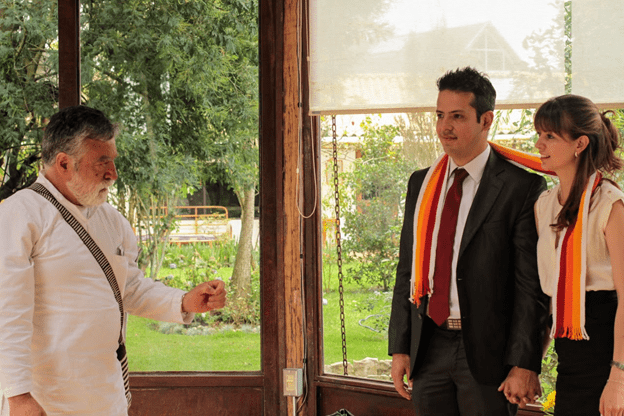
Paula and I had a first spiritual union ceremony when we built our aseguranza of the Sierra Nevada together, but that ceremony had no validity before the law. So a couple of years later we decided to get legally married, but due to the circumstances of the moment, we did not have a big wedding or a party with all the friends we would have liked. Instead, we married at a notary's office in downtown Bogotá with only my parents present, but then, before a reception at a restaurant with a few friends, Paula and I traveled alone to a beautiful yoga temple on the outskirts of the city. There, abuelito Luis, who, as I said before, was consecrated as bishop of the Old Catholic Church, joined us in sacred matrimony with a sip of yagé instead of a host and two beautiful bracelets hand-woven by my sister Julia Gineth instead of rings.
Even today, as I write these lines, I maintain a strong friendship with abuelito Luis, and from time to time we hold circles of word using videoconference technology, in which several of the people who ten years earlier sat around a candle and a glass of water at the beautiful Santa María del Lago wetland participate. That is the Solar Clan.
5 years ago Good afternoon. I've been listening to this podcast for a while now and I'm crazy about everything Mr. Manuel has told; it's that every one of the topics he covers and the point of view he gives is very interesting. I also got hooked on the podcast a lot because Manuel doesn't talk as if he were right and leaves the door open, and that is very….. I don't know how to say it, I mean, as a Catholic they only give you one path and it feels bad to know that that's all there is, and well, I don't even know what I'm saying anymore, I only know I'm crazy about everything he tells in the podcast and that every week without fail I check to see if a new episode has been uploaded hehe. Greetings and blessings from Cómbita, Boyacá.
1 Reply manuelr Author Reply to Miguel Ángel 5 years ago Hello Miguel Ángel, I am very glad to read your message because the only objective I have with this space is to share the teachings I have found on the path and accompany with them people who, like you, are in search of their own path. Thank you very much for the motivation to keep sharing these topics. A big hug from Canada!
Comentarios (archivo, solo lectura)
Mostramos 2 comentarios guardados de la versión anterior del sitio. Ya no se aceptan nuevos comentarios.
Buenas tardes. Hace un tiempo que he estado escuchando este podcast y estoy loquisimo con todo lo que ha contado el señor Manuel, es que es muy interesante coda uno de los temas que trata y el punto de vista que da, también me enganché muchísimo con el podcast ya que Manuel no habla como si tuviera la razón y deja la puerta abierta, y eso es muy..... No se como decirlo osea es que como católico solo te dan un camino y se siente mal saber que solo es eso y bueno, ya no se lo que digo solo se que estoy loquisimo con todo lo que cuenta en el podcast y que cada semana sin falta miro a ver si ya subió un episodio más jeje. Saludos y bendiciones desde Cómbita, Boyacá.
Hola Miguel Ángel, me alegra mucho leer su mensaje porque el único objetivo que tengo con este espacio es compartir las enseñanzas que he encontrado en el camino y acompañar con ellas a personas que como usted se encuentran en la búsqueda de su propio camino. Muchas gracias por la motivación para seguir compartiendo estos temas. Un fuerte abrazo desde Canadá!