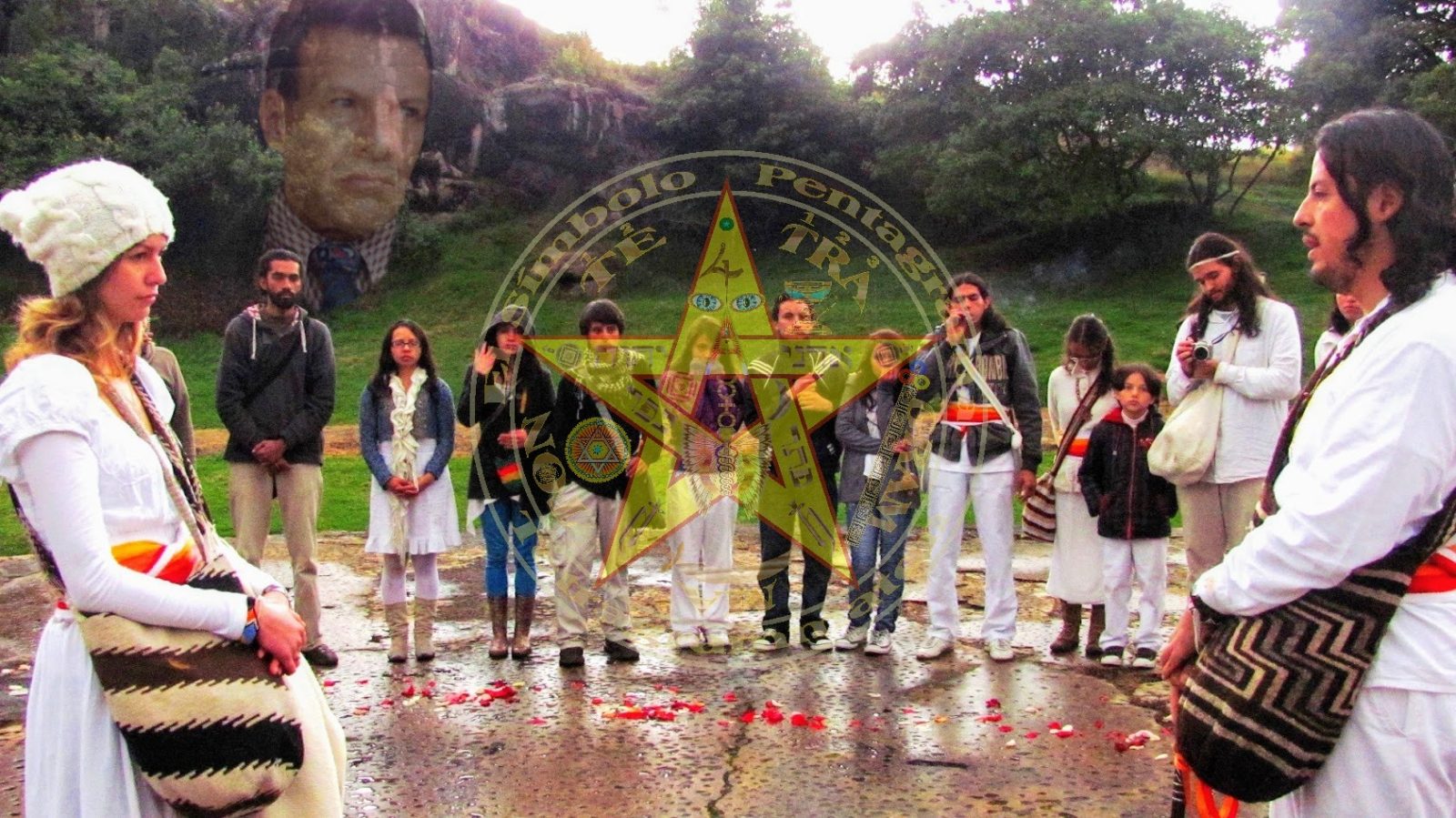
The handover of the husos and poporos meant an inflection point for Pueblo Nación Muisca-Chibcha. It was at once the deepest and most meaningful spiritual experience of my dealings with the movement of re-signification of indigenous ancestral thought, and the beginning of the decline of the process that the two brothers Ingativa Neusa had initiated.
After taking yagé frequently, practicing ceremonies, and sitting down to chew with the Muisca grandfathers for three years, my goal of knowing the hidden worlds of the spirit led me to focus on the work with the poporo, the ambil, coca, and lime. While it is true that I never became as dedicated as some of my fellow community members, I did strive for a time to sit down every day to paint my poporo, but unfortunately I never managed to have an out-of-body experience, an epiphany, or even a vision.
Besides slightly numbing my lips and cheek, there was no mystical revelation that motivated me to extend the poporo sessions, and on the contrary, a few weeks into repeating the routine, I set aside my nightly encounter with the poporo and limited myself to trying it during community gatherings or special ceremonies. Eventually, I ended up abandoning the ancestral gourd in favor of yagé and lucid dreams or astral travel, about which I will refer later on.
But the poporo was surrounded by a sexual connotation, and as I understood from mamo Andrés, in the work with the poporo to a large extent was defined the preparation for carrying out the most important task of spirituality, which was the one done with the partner during the hulu-hulu, which is what in the Sierra they called the sexual act. This was a point that worried me, and as I have narrated before, it caused me a great conflict due to the Catholic origins of my spiritual path and the feeling of guilt that accompanied me since adolescence for any sexual behavior that was not framed within the canons of the religion, including sex before marriage or masturbation.
It was because of this that I developed a growing interest in what I intuited was nothing less than the supreme teaching, the holy grail of the esoterism that was professed in Pueblo Nación: sexual magic.
From the moment I entered the Muisca community, I had heard from the grandfathers that there was a supreme knowledge, a magical key to open the inner worlds, to conquer knowledge, wisdom, health, and material riches, but that said secret knowledge could not be handed over in public or to non-initiates. Such that those of us who yearned for that power had to advance patiently through the Muisca hierarchy, first as a sympathizer, then as a member of the community, then as one initiated in the rite of passage, until conquering the huso or the poporo.
Although I did all this path with relative speed, the truth is that I did not have to wait until receiving my poporo to receive the great revelation. On the one hand, the community did not have an organization so strict as to keep track of who was in what part of the process to receive which information, and on the other hand, the grandfathers had such a desire to share their secret that they ended up leaking the precious knowledge themselves.
The first time I heard about "sexual magic" was at that holistic therapy that my friend Santiago Salazar offered me at his chalet-office in the mountain. Santiago let me know in advance that any expectation I had of spiritual growth passed through learning to transmute sexual energy with my partner, and he warned me that the dark experiences I had in yagé were surely related to the disorder of my previous sexual life.
As he had recommended to me, I read "El Misterio del Aureo Florecer" written by the "venerable master" Samael Aun Weor. The book contained a compilation of a wide variety of esoteric teachings, among which were found mystical dissertations against alcoholism, witchcraft, and other behaviors blameworthy for the author. However, most of the text was dedicated to describing in detail the supposed dangers and punishments to which promiscuous, lecherous, masturbating, homosexual persons are exposed, and in general all those who do not fit into a narrow spectrum of "normal" sexual behaviors. Even having sex with one's wife but without invoking God or only out of lust, is considered by Samael as fornication and therefore harshly punished in the inner worlds.
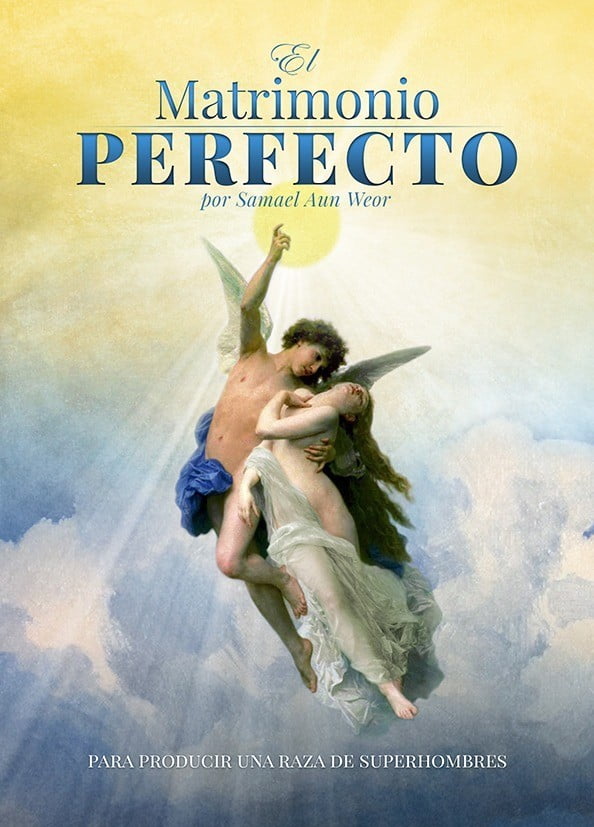
The second book I read by Santiago's recommendation was "El Matrimonio Perfecto," which well could be considered a continuation of El Misterio del Aureo Florecer, a treatise on the "correct" way to practice sex. In it Samael describes a battle between good and evil that is waged in the "inner worlds" of each human being, in which the forces of darkness seek to destroy the person's soul with temptations and carnal appetites, and the higher Self tries to awaken one's own consciousness and "annihil" the demons, or as Samael calls them "psychological aggregates," in the "Fragua encendida de Vulcano," in "el espléndido mundo del Tattwa Anupadaka," in "la Forja de los Cíclopes," in "el camino del filo de la navaja," in "el Arcano A.Z.F.," or simply in the "Gran Arcano." All of these, grandiloquent names or euphemisms for the sexual coitus.
The way to carry out this annihilation of demons would consist in the acquisition, through initiation, of the "flaming sword," a weapon with which the initiate, at the moment of orgasm and making use of some secret mantras, could incinerate his demons, illuminate himself, and achieve psychic powers like clairvoyance, astral projection, or even multilocation, which means being physically in different places at the same time.
The key to achieving all of this, nevertheless, lay in reaching orgasm without ejaculating, following the ancient Hindu technique of sexual tantrism. To me, the matter of finding the secret of spirituality between the sheets seemed powerfully attractive and also poetic. It was evident that many of the ills of humanity had their origin in the abuse of sexuality, and to me, as I have described earlier, my own sexuality had always seemed to me a test of will, a risk to my spirituality, so Samael's books did nothing but reinforce this conviction.
Eventually I consulted about Samaelian sexual magic with grandfather Suagagua, and he, without raising his eyes, told me:
"That is the mystery of maíz biche for the Muiscas. All of that is true."
Then I had the opportunity to talk about the same subject with grandfather Nemequene, before one of the last meetings that took place in the maloca of the Botanical Garden. I had asked the grandfather for the consultation because I wanted to be sure before starting to practice the techniques that Samael recommended. Nemequene, just like Suagagua, confirmed to me that the teachings of Samael Aun Weor were the basis of the ancestral spirituality, and advised me to start practicing "maíz biche," or sexual magic, immediately. Then he went on to tell me how, for him, said practice had become the key to healing himself from a chronic illness he suffered, although, at his almost seventy years, he confessed, he was still not sure of having already found the priestess who would lead him to the summit of the greater mysteries.
The matter of sexual magic had then been settled. From that moment on, and with Paula's help, I would set out to "the Great Work," another of the euphemisms that Samael used to refer to sex without ejaculation. As always, my spiritual wife, without really being convinced of the need to become involved in another strange ritualistic practice, had agreed to accompany me in the new adventure, which I had sold to her as the culmination of the process we had begun that November 15th at our first dose of yagé. Moreover, according to what I had read in "El Matrimonio Perfecto," gnostic sex was the key to conceiving highly evolved children, free of the chains of original sin, caused by the fornication in which Adam and Eve had incurred.
The woman's participation in the gnostic sexual techniques is passive and subordinated to the man's needs, who is the one who, in the end, has to "rise to the occasion" and complete the difficult part of the work. The woman, the grandfathers said carelessly, is born already knowing how to do the task; on the other hand, we men have to learn. Therefore, the feminine participation in the sexual work was limited to helping the man avoid ejaculation by stopping his movements or even reciting obscure Sanskrit mantras. On the other hand, Samael's recipe involved a daily practice of no less than an hour to achieve mastery in the art, so in any case the wife of a gnostic, who is usually a housewife, a mother, and frequently an employee, must also submit to that daily marathon.
Unlike the poporo, which as I already said is in itself an allegory to the sacred sexuality, the practice of "maíz biche," as grandfather Suagagua called it, felt to me more "natural"; that is, even though containing ejaculation was an act that did not at all correspond to the natural instinct, to me it seemed natural that achieving the evolution of the soul would require important physical, mental, and emotional effort in an area of life that clearly represents a great difficulty for most human beings.
What I did not have entirely clear was the mechanics of the "annihilation of egos" that "El Matrimonio Perfecto" described. The idea was that, by containing an imminent ejaculation, one should also hold one's breath and raise the sexual energy from the penis to the crown of the head, using one's own spinal cord as a means of transport. This, which in tantric sex is known as sahaja maithuna or sahaja yoga, is a technique that was practiced in India at least since the 12th century, and in Taoist China at least since the 8th century.
Since then, multiple schools of spirituality, alternative medicine, and sexuality have preserved, spread, and—as in the case of the Samaelian gnosiology—adapted this teaching to their particular cosmogonies. Therefore, it was not difficult for me to find information about the more procedural part of the matter, thanks once again to my friend Jay Martin. He, who also knew and recognized Samael's books as a source of spiritual wisdom, had had the same concern I had about the way to arrive at sahaja maithuna without failing in the attempt. So, he shared with me a book called "The Multiorgasmic Man" by the Chinese Taoist master Mantak Chia.
Armed with the teachings of Samael Aun Weor, the techniques of Mantak Chia, and Paula's help, I set out to walk the path of sexual containment, without knowing the consequences that would bring for my mind in the future. In the meantime, there was another matter that generated confusion in me: how was it that Samael Aun Weor, founder of an esoteric movement between the 1950s and 1970s, was the official source of the highest knowledge of the Muisca spirituality, a people that was decimated and syncretized more than 500 years ago?
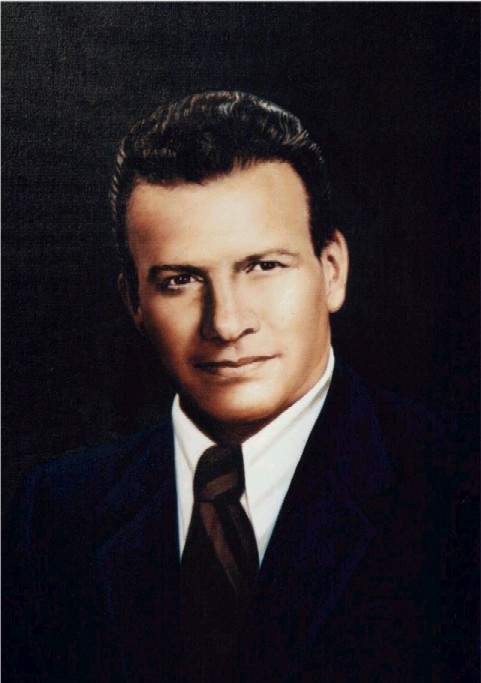
This question circled in my head since I first visited the house of the grandfathers Suagagua and Yanguma, because the interior room of their home was dominated by the reproduction of a huge oil portrait of Samael himself. With time, they themselves confessed to me that most of the grandfathers of Pueblo Nación Muisca-Chibcha had been followers, or even leaders, of the Universal Gnostic Movement, and most of them still were—secretly, since that was something they never said in public—followers of the gnostic teachings.
Eventually, all the members of the community's innermost circle, that is, those of us who received the rite of passage and/or the aseguranza of the Sierra Nevada, ended up becoming gnostics in some level. To explain to what extent the Muiscas of Pueblo Nación were gnostics, it is worth describing the Muisca subgroups I knew during the time I shared with the community:
The sympathizers: They were women and men of different origins and different interests who approached the community to know and share the teachings of the grandfathers, the ceremonies, and some rituals like the cleansings, without fully joining the movement. Among them there were university students and teachers, businesspeople, and public officials who resonated with the indigenist and environmentalist messages. To them they rarely spoke of the origin of the gnostic teachings, and except for a few exceptions, they did not come to know the word of the sacred sexuality, nor the magical rituals of gnostic origin.
From here on, the other groups were the ones we community members made up:
The hippies: This was a group of young people, mostly single, who came to the community through an affinity with the topics related to the care of nature, the peasant tradition, and art. Their members were very active on sociocultural and ecological topics, and I think they were the least interested in gnosticism. Many of them probably welcomed many of the gnostic teachings of the grandfathers without knowing their real origin, and as I remember, they did not gravitate toward topics about sacred sexuality techniques, but rather above all around topics of feminine empowerment and ancestral art.
The Ateneos: This was the colloquial way we referred to the members of a foundation called Atenea, who were restless young people, leaders, and committed, students of mystery topics and conspiracy theories who were eventually conquered and recruited by the grandfathers with the idea that they do their spiritual search within the Muisca ancestry. From what I conversed with some members of this group, they knew of the gnostic origin of many of the teachings of the grandfathers and considered Samael as a valid ancestral authority. However, their interest within the community was political and organizational. They saw the Muisca movement as a way to cause a change in society, and for that reason, almost all of them became actively involved in the formation of the Cabildo Muisca and the incipient political activities that the movement came to have.
The Gnostics: Yes, within the community there was a good number of members who came to the Muisca from gnostic churches, or departing from the gnostic knowledge, or particularly attracted by the gnostic content of the teachings of the grandfathers. This was not a homogeneous group, but rather within the Muisca gnostics there were subgroups; on the one hand my friend Santiago Salazar, the Muisca similar to Jesus of Nazareth, and his friends. They were upper class and very inclined toward Hinduism and Buddhism. Very close to grandfather Xieguazinsa, and they did not involve themselves in the political or social activities of the community. The other gnostic subgroup was made up of people of lesser economic capacity, very close to grandfather Nemequene, and one of the most disciplined members of the community during ceremonies and the cultural activities that took place.
Community of Soacha: These made up what was known as the parcialidad of Sua-cha, and they were among the most constant and committed members of Pueblo Nación. Some of the gnostics also belonged to this group, but most were family, friends, and followers of grandfather Nemequene. Although it was one of the groups with which Paula and I interacted least, it is very likely that most of them knew and shared the teachings of Samael Aun Weor, given the gnostic origin of grandfather Nemequene himself.
Indigenous and Peasants: Among the people I knew in the community, this was the smallest group. One of the premises of the founding of Pueblo Nación Muisca-Chibcha was the dignification and restoration of the indigenous identity of the peasants of the Cundiboyacense territory. One could expect, therefore, that a large number of members of the community came from that demographic, but in the community to which I belonged in Bogotá, barely a handful had an indigenous phenotype or surnames, or lived in rural zones. The most notable exception were the brothers who lived in the locality of Facatativá, with whom I made a great friendship. We were united by the search for ancestral spirituality, emotional healing, and the learning of the use of the sacred plants. And also united us was skepticism, not rejection, toward gnosticism.
Cabildo of Tunja: This was the territory of grandfather Xieguazinsa. Although he was, if you will, the greatest holder of Gnostic knowledge, I must say that Xieguazinsa was also the grandfather most committed to the indigenist cause and the inclusion of the peasantry. Therefore, his community in the city of Tunja was made up of a large number of peasants, in addition to university students, teachers, and other sympathizers. I must say that I did not personally know more than a couple of his members, so my reference is mainly from what grandfather Xieguazinsa shared with me and the graphic archive of the community, and I have no evidence of the level to which the grandfather spread gnostic teachings, or even if he did.
Most of the detractors of the Muisca movement of the grandfathers Ingativa Neusa know of its gnostic origin and use this as an argument to discredit the Muisca identity not only of the grandfathers as individuals, but also that of their organization and that of the members of their communities. For many of the indigenous leaders of the cabildos recognized by law, particularly of the Muisca cabildos like those of Suba, Cota, and Sesquilé (at least those I knew at that time), the usages and customs that the grandfathers of Pueblo Nación taught did not correspond to the true Muisca tradition, but to the gnostic teachings of Samael Aun Weor, based in large part on occultist knowledge from the East, ancient Egypt, and Europe.
The reality, however, is that a large part of the Muisca knowledge, usages, and customs were lost in time, so what today is known as Muisca is an amalgam of accounts from the chroniclers of the conquest, traditions that survived mouth to ear, cosmogonies syncretized by the Catholic religion and the esotericism, and new traditions that the current peoples have adopted from different cultures. The Muiscas are, far from it, not the only indigenous people who profess beliefs or carry out practices coming from the East or Europe. Most of the indigenous people I personally knew in the Putumayo and the Amazonas are directly Catholic or Christian, they venerate the Virgin Mary, and constantly make references to the Bible.
During those years, I consulted the topic of the retention of ejaculation with Siona, Cofán, and Huitoto indigenous, and all of them had some version of sexual dietation as a fundamental part of the spiritual development of the man. However, my greatest surprise was to learn that mamo Andrés and mamo Lorenzo, unquestionably indigenous and belonging to a community that was not destroyed during the conquest, were also followers of the teachings of Samael Aun Weor.
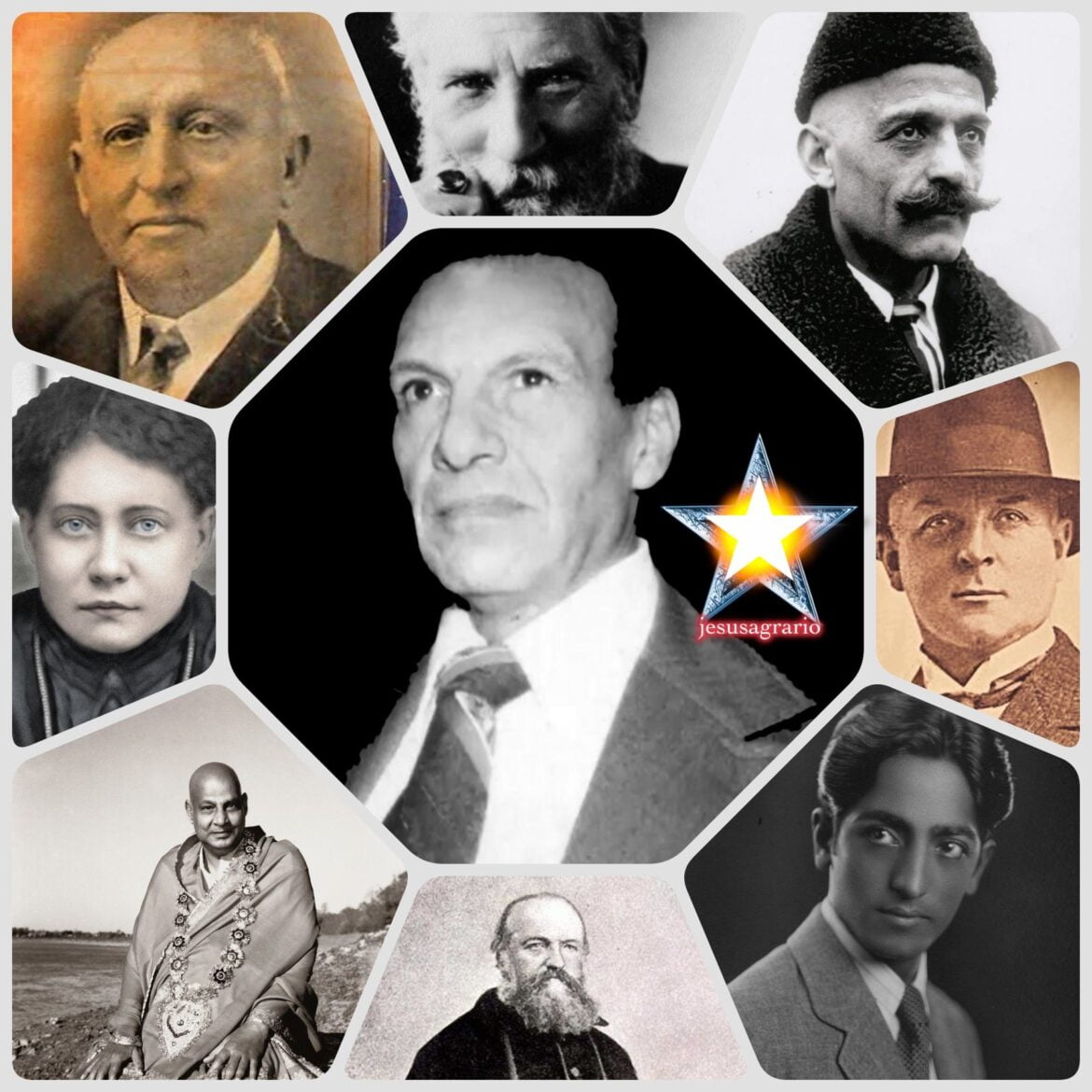
With all the grandfathers of the community we had many conversations about Samael, and all of them agreed to call him Master and Grandfather. According to what Suagagua told me, Samael's innermost circle affectionately called him "El Abuelo" (The Grandfather), and it was not only because of his age but as a reference to his quality as an ancestral authority. According to grandfather Xieguazinsa, the books "Antropología Gnóstica" and "La Doctrina Secreta de Anahuac" reveal the elevated knowledge that Samael had about Amerindian spirituality. Samael himself, who in his physiognomy revealed an evident Muisca heritage, lived in the Sierra Nevada de Santa Marta together with the Arhuaco Indians. There, he not only learned many of the customs and spiritual knowledge of this ancestral community, but he indoctrinated them with the teachings he brought from his passage through the Rosicrucianism and the immense amount of knowledge he had compiled over years of studying the treatises of Helena Petrovna Blavatsky, Arnold Krumm-Heller, Paracelsus, P. D. Ouspensky, Eliphas Levi, and other European occultists.
According to what I learned from an Arhuaco I met years ago, the arrival of Samael to the Sierra Nevada divided the elders of his people. Some who considered Samael a dangerous charlatan for the community, and others who saw in the young Victor Manuel Gómez Rodríguez— who was the real name of Samael— a mamo or spiritual elder that some prophesied would come from the interior to return to the Sierra Nevada the esoteric knowledge they had forgotten. If you will, a Muisca saber who had to bring back to the Sierra the wisdom they had let go.
I don't know whether that background had anything to do with the handing over of the poporos and husos that I took part in, but the fact is that both the Arhuaco mamos and the Muisca elders were followers of Samael and promoters of his teachings. In any case, the doctrine of the Great Work, or sahaja maithuna, was at the center and at the forefront of Amerindian spirituality in Colombian territory. With all this information at my disposal but still carrying my doubts, I pressed ahead with my purpose of achieving mastery in sexual magic and continuing my spiritual evolution down that path.
One of the lessons I remember most of everything I read about sexual magic in the books of Samael Aun Weor is the one that described sexual work as “the razor's edge path.” According to Samael, achieving enlightenment and the liberation of the ego through the sexual act is an extremely narrow path, full of dangers; like a tightrope with an abyss beneath it: one wrong step and you could lose even your life.
According to the samaelian doctrine, as I understood it, the true warrior of light had to magnetize his priestess, something like performing foreplay to “open the door of the temple,” and then the initiate, at the appointed moment, had to “enter the temple,” and from there on make subtle, gentle movements, never lewd or “irreverent.” In some books it could be inferred that in fact the man should remain still during the penetration, and as I said before, the woman's participation, at least in the physical, is quite passive.
The positions permitted for intercourse are also limited, and their main objective is to facilitate the transmutation of energy, or as Samael put it, the ascension of the kundalini serpent through the spinal cord, passing by the 7 chakras or sacred churches. This is the part I never understood in practical terms. I came across different versions of this practice that could be summarized as using active imagination and conscious breathing to make the sexual energy rise during the union. The man was to avoid at all costs that even the smallest amount of semen escaped, and to do that Samael prescribes a mantra that “calms the waters” to avoid the “falling of the initiate.” And where does the female orgasm come in? I never found a mention of it in Samael's books or in the teachings of the elders. Even some gnostic women acknowledge their role as being to help and control the man so that he can “do the work.”
Finally, when the “energy” reaches its maximum level, at the instant that sexologists call the “point of no return,” the initiate carries out the dangerous maneuver of “snatching fire from the devil to be enlightened,” taking the energy of the orgasm and, instead of letting it out through ejaculation, elevating it—or rather, completing its elevation—all the way to the crown of the head, where, according to the elder Suagagua, the initiate has to direct it toward a certain place in the Cosmos. How and where? I never received that part of the knowledge, and as far as I know it isn't found in Samael's books either, if that teaching even comes from him.
The dangers that beset the practitioner of the Great Arcanum are the evident ones: in the act itself, “falling” or failing to contain the ejaculation. One might think that achieving this more than a couple of times would be almost impossible, but the truth is that with enough practice it can be avoided easily (although in reality, what apparently happens almost always, according to science, is a phenomenon known as retrograde ejaculation, in which the semen ends up in the bladder instead of coming out through the urethra); after years of containing the ejaculation, it can even become difficult to regain the ability to ejaculate normally.

The other danger is letting lust manifest during the sexual act, and thus handing the liberated kundalini over to demons or spiritual parasites. From there on, the dangers only multiply and get more complicated: any release of semen or masturbatory act can give life to succubi or incubi, who are like proto-beings that live in the astral and attach themselves like larvae to the skin and the dwelling of the infra-sexual being. Having sex outside the sacred marriage brings illness and ruin; being promiscuous means contaminating oneself with the karma of the people you have sex with and of the people those people have had sex with, and so on up to seven levels.
Infidelity and homosexuality, according to the gnosis, constitute infra-sexuality and condemn those who practice them to growing a demonic tail that they call the “kundiartiguating organ,” and to little by little turning into demons in their astral body. According to Samael, when he sees these people in their astral body, they are seen with horns, the aforementioned tail, and goat legs. In the end, the greatest danger for anyone who does not practice sacred sex is not being able to build their soul and condemning themselves to wander in the world of the unconscious dead in a kind of limbo full of demons and penitential souls.
It goes without saying that that whole load of fears, tied to an area of my life in which I already had a good share of guilt and dread, was not going to do anything positive for my mind. And yet, the practice of sacred sex started producing good results. Perhaps because of the excitement of the road yet to be discovered, the expectation of the supposed benefits it would bring to our lives, and above all because, despite my doubts, I discovered that containing ejaculation was not only possible but also brought some immediate dividends: on the one hand, the orgasm, after practicing with discipline the game of avoiding, pausing, and resuming, can be—just as Mantak Chía describes it in “The Multiorgasmic Man”—much more intense and prolonged than average without using the technique. On the other hand, as the title of the same book describes, tantric sex endows the man with the capacity to experience multiple orgasms in a single session. Needless to say, the practice tends to be considerably prolonged with respect to the average duration without it.
But that is as far as the benefits of sahaja maithuna that I can objectively corroborate go. After months of replacing the couple's everyday life with its gnostic version, the negative consequences became increasingly evident, especially in the mental dimension. In practice, bringing religion into the bed becomes an invasion of privacy, where the methodology and the correct application of the techniques becomes more important than love. Not because any book says so, but because performing an activity that is usually associated with pleasure and love turns into a minefield when it has to be carried out in the midst of so many potential dangers, rules, and doubts. What happens if I'm not transmuting my energy correctly? Some say that an excess of accumulated energy, or transmuting it incorrectly, can cause cancer in different organs. And what if, by bringing the energy up to my crown, I'm handing it over to succubi, incubi, or demons who take advantage of the situation?
I never managed to pronounce the mantras that Samael recommended, because I was sure they would have brought on bursts of laughter from my wife, so it was also possible that without the mantras the practice wouldn't amount to much. But what truly turned my passage along the razor's-edge path into a calvary was that, despite my good intentions, my spiritual motivation, and all the fears I accumulated, I was still essentially the same imperfect man as always, vulnerable to the temptations of the flesh and prone to being carried away by lust, auto-erotism, and with some frequency the use of pornography, all of which is condemned by the gnosis and therefore by the Muisca elders, as causes of failure in the Great Work.
This emotional conflict, feeling of guilt, and level of psychological pressure gradually began taking their toll on my mind. In daily life I tried to distract myself from that guilt by justifying my actions as venial transgressions, or by trying to do so much good for my fellow human beings that perhaps the universal logos, as the gnostics say, or Father-Mother God, as the muiscas say, would forgive my failings and not inflict on me any of the terrible punishments Samael promised in his writings.
In the yagé ceremonies, it was a different matter altogether. Even though most of the time my visions and sensations were pleasant and revelatory, when I had to confront my own sexuality the demons appeared. On some occasions, like the one I described in my passage about the descent into darkness, I was the one who turned myself into a demon. Once I even saw myself with goat legs and felt horns on top of my head, just as I had read described in Samael's books. During those experiences my feeling was one of absolute failure. Over my soul weighed the guilt of not having had the willpower to keep the temptation at bay, and the terror of having to pay for those offenses with my life, or perhaps with something much worse: misfortunes upon the people I love.
Then, after passing through those calvaries, the light of the sky would always shine upon my face, and I felt that the good Father was giving me a new opportunity. From that moment on I would return to normal life, and by then yes, walk the path of the solar warrior with radical discipline. I would rise from my trance feeling a renewed power and the total conviction of leaving behind once and for all the appetites of the flesh, and I would return home with the good news that God, through the yagé, had finally freed me from my heavy sexual demons, and that now I would be a man who kept all the rules of the sacred work in the forging of the cyclops.
I think fifteen days was the longest period that an enteogenic liberation lasted for me. After a certain number of days, I would be the same as always again: a man in love with my wife, eager to find spiritual enlightenment but also enthusiastic about the sexual pleasure derived not only from the couple but from each of the senses and the mind. I was also once again the same man tormented by the guilt of not having enough willpower to subdue those instincts, even though for my sins I might lose even my own soul.
But there were a couple of yagé ceremonies during which, unlike the ones I described earlier, the sacred elemental showed me sexuality as something much more benign and liberating. On one occasion I saw that I could have sex with any woman I desired, that it was a kind of power at my disposal, and that using it would not bring me any punishment but rather that I would be fulfilling my mission on earth by loving the divine Mother through her human manifestations. I also saw on some occasion that obtaining pleasure from oneself was a form of divine adoration, since God gave us sex to enjoy it and not to be ashamed of it.
Needless to say, my confusion and the contradictions I lived through during those years were in themselves the punishment I was receiving for my weakness in the face of sexuality. But I am not referring to the weakness to comply with sahaja maithuna as Samael Aun Weor prescribed it, but rather my weakness to accept myself once and for all as I really was, and to denounce before my own brothers what I knew had become, for so many spiritual seekers, a heavy chain of guilt and fear.
I did not have enough strength to impose myself over the control that, in a subtle and seemingly innocuous way, the philosophical structures of religion and dogmatism had imposed on my intimate life. From those Sunday sermons in which a priest threatened with purgatory those who dared to break the sixth commandment, while in secret he perhaps harassed his acolytes. I say this not only because of the news now known of thousands of Catholic parish priests all over the world who for decades abused girls and boys with impunity, but because I myself, at 14 years old, consulted a Franciscan priest about my masturbatory sin and lived that abuse. The priest, who according to him was also a sexologist, asked me to pull down my pants and masturbate in front of him — to know “if I was doing it right and it wasn't causing me any harm.”
The good thing about my weakness to be able to fulfill the great arcanum is that by doing everything I was supposedly not supposed to do, I ended up proving that all the promises of gnosis were a lie. Apart from the benefits I mentioned of achieving better performance in bed and being able to have multiple orgasms, I never experienced a mystical rapture or a divine revelation. Nor did I ever come to receive powers of any kind, and in case there were any doubt that it was my inability to properly perform sahaja maithuna that deprived me of material riches, it is worth mentioning that none of the Gnostic practitioners, leaders, or grandfathers I met ever came to obtain such material riches. On the contrary, during the ten years I was in Pueblo Nación, none of them came to show a level of well-being, health, or even family harmony better than the one they already had when I met them. Even Samael Aun Weor himself, who said he had iron health thanks to the perfect marriage, barely reached 60 years of age when he passed away after a painful illness, probably cancer, that kept him bedridden for several weeks.
On the other hand, I did not receive any of the feared punishments either. There were difficult moments and trials to overcome, but all of them came from a cause that could be identified in matters less prosaic than the ability to hold back ejaculation or not. I did see, instead, several young people like me mortified by the obsession with achieving the Gnostic promises and tormented by their own natural instincts, seeking through yagé, tobacco, marijuana, or fasts to appease their humanity in order to attain the greater mysteries of the spirit.
In retrospect, I believe that my weaknesses could certainly have caused me many more misfortunes than those I lived through during my life in Santa Marta and that I expiated with my shamanic purgatory of yagé in La Mesa. What saved me was not holding back semen, nor occultist spells, nor any sacred plant. What saved me was that, despite all my darkness, I never stopped honoring the truth. Paula knew all along about my tribulations, my faults, my fears, and my struggles. She accompanied me with love and knew how to recognize my essence through all those layers. Her acceptance, in turn, strengthened my self-acceptance, and although I had the tendency to justify my faults, I always chose to love myself not only in spite of them but with all of them included. If Paula loves me and I love myself, then God loves me too, just as I am.
That new awareness turned me, from that moment on, into someone who no longer fit into Pueblo Nación, only I did not know it yet. My distancing from the Gnostic teachings was by no means an easy or quick process. It was in fact the most painful inner work I ever did, and many more things still had to happen for me to understand that what many detractors said about the Pueblo Nación Muisca-Chibcha was true: we were not a community, we were a sect.
5 years ago Good on you, Manuel, for your account of your experience during the Pueblo Nación – Chibcha Muisca process; as you may remember, when I was part of it I served as governor, Mrs. Yaneth (yanguma) as deputy governor, you as mayor, César Ordoñez served as chief bailiff, Mr. Oscar Piragua was the secretary, and Gustavo Vargas acted as prosecutor. Thus giving shape to the governing cabildo of the “movement”; which was headed by a series of grandfathers, grandmothers, and wise men; among whom were Xiguazinza, Suaga gua, Nemequene (RIP), the aforementioned yanguma, Jairsa, Tigua Sua Mora, Comba, Gualcala, Luis Sánchez, Tyuasuza (RIP), and these, among many others who used to accompany in a somewhat more sporadic way; but without a doubt the brothers Xiguazinza and Suaga gua were the guides and leaders of the process.
We, as a group of friends belonging to the Atenea foundation, entered the process through the activities that were being developed at the botanical garden in mid-2009; several members of Atenea were, without a doubt, conquered by the spiritual aura, the camaraderie, and the historical, social, and therefore political claim framed in figures of self-recognition and resignification that provided the support of identity — a support that was potentiated with the use, approval on the part of the “elders”, and appropriation of elements of ancestral cut, such as tobacco in its different medicinal uses, the hayo, in some cases yagé, and of course the poporo. (Regarding this particular matter, it is worth noting that although several members of the foundation went through the entire process to receive the poporo, having seen in advance its real spiritual imprint, we decided not to be disrespectful and therefore did not want to receive the poporo)
Seeing the amount of people who came to the botanical garden to sit and observe or participate in the development of the famous circles of word directed by the “grandfathers”, and how these people, at the end of such gatherings, used to leave the maloca with expectations and expressions of joy, was making a dent in us, stirring us to collaborate, to give of our time and energy to strengthen the dream recounted like a prophetic murmur of the great Muisca nation.
But as time passed the veils were drawn, distances and disagreements made themselves present; not creating an administrative model from a government program was one of the many drawbacks; in addition, questions arose regarding the spiritual sources of the elders; the loose word and the behavior of the guides left much to be desired; incoherence and contradictions abounded without cease; the process was in decline; those who were there before hardly showed up anymore, those who had a chair did not claim it, and so the cold and the absence gained strength.
Proposals were launched that were not heard, many ideas were sent to the broken sack, many efforts were frozen, and after a sitting with a beer in hand Tyuasuza gave the answer to their rejection, and the doubts were cleared: they are Samaelian Gnostics. The surprise was great; a double spiritual discourse was being used.
The matter was ratified when, days later, in the house of Sigifredo or “grandfather Suaga gua”, there was a painting by Victor Manuel; there was no doubt, the ditch had been dug. And here, Manuel, I want to be precise about the publication made by you: no, we have never considered Samael Aun Weor as a valid ancestral authority, so much so that in conferences given by the Atenea foundation before belonging to the Pueblo Nación process we had already touched on the subject of the dangers of the new age and how it was maximized in its effort of confusion thanks to exponents like the aforementioned Mr. Samael Aun Weor; rather, we have been and continue in the Gnostic study of the early Christians through the research of gentlemen like Antonio Piñero, Francisco García Bazán, and another series of academics of this sort.
Having made this precise clarification, I continue. Upon learning of Sigifredo's spiritual militancy, it was decided to clarify that situation; to that end, a meeting was sought between him and the Atenea foundation, a situation that never happened. But days later, at your house Manuel, a meeting did take place where Xiguazinza accompanied us and anxiously requested my resignation from the position of governor, justified by my poor execution with respect to the tasks proper to the possession of the cabildo before governmental instances; due to the pressure of the moment, to all the confusion that arose regarding the process, and to situations of a personal nature, I agreed almost gladly, for I felt a weight lifted from my shoulders.
A few days later we met with the Atenea friends to evaluate the situation; from that assessment we agreed that the Atenea members still active in the cabildo process would resign, and as such we would all resign from the community; to that end, a manifesto was drafted in the manner of a letter where our differences were stated, which were heard in a later meeting with the bulk of the community where the letter was read and complemented with a series of presentations stating, as already said, the dangers of Samaelian Gnosticism and certain ritualistic practices of orientalist order blurred through the new age; which is the reason why the distancing arose between Sigifredo, yanguma, Nemequene, and us, so much so that on that day elder Nemequene was questioned about his spiritual logic, for supporting a man who burned bibles when one accompanied him on his altar is, at the very least, a contradictory matter.
In this way, and starting in March 2012, the date the letter was read, Atenea resigned en bloc from any social, indigenist, or spiritual activism carried out by the mayor cabildo of Bacata, with the exception of Mr. Gustavo Vargas, who continued in a sidelong way in proximity to the movement, isolating himself from the bond of friendship with Atenea until completely detaching from our environment to this very day.
On the other hand, thanks to my work, I was given the opportunity to hold two congresses of Muisca culture in 2015 and 2019, where the recognized cabildos were invited, as well as some movements that are on the way to their recognition, such as the one in Tunja led by Xiguazinza, who has been taken into account by the city authorities, as well as Choachi, Teusaca, El Tunjuelo, among many others.
A fact that personally drove me to lead the process of ethnic-cultural recovery in the municipality of Turmequé, the place of my ancestors; an action that has meant a re-encounter with Xiguazinza due to the legal and social circumstances surrounding everything Muisca, but so far the word of clarification regarding his spiritual line has not been given; yet, obeying my commitments with the Atenea friends, if he, like his brother, turns out to be a follower of Samael, our difference will be not only marked but stated.
Time has passed since 2007, the year we first met with elder Carlos Mamanche of Sesquilé (RIP), who, if not directly, then unconsciously ratified the pillar of our spiritual search. A pillar that remains the same and upon which Atenea has been founded by its founders in 2002, beyond the fact that in our search we have come across different pseudo-spiritual movements and a whole series of guides, gurus, shamans, and a long etcetera, which have served in one way or another to confuse us, melt us down, lose us, and reunite us with our foundational commitment.
Once again, good on you, Manuel, for your account of your experience during the Pueblo Nación – Chibcha Muisca process; there is much to comment, but for now and to finish this pastoral, a fraternal embrace, for good memories of the moments lived come to me of your person; and now, with your permission, I finish as we finished the letter written in 2012, the year of our resignation from the mayor cabildo of Bacata.
Father – mother; Once again we are called to unify our walk without falling into homogeneity, to sit down and agree on what is fundamental in order to rise up in unity; let us not fall into the traps laid in the superficiality of our masks or those of the collective, let us not follow foreign trends alien to our territories, let us not chase trends, theories, approaches, or media frameworks; let us listen to the wise word of our elders, because the government that can place the human being in its real natural dimension of divinity is the government that is in affinity with the spiritual forces; thanks for the guardian, rectifying, healing, and custodial grandfathers of the territory, thanks for the ancestral and lineage spirits of our grandfather guides and physical and spiritual orienters, thanks Father and Mother God for having us here, in the here and now, where the immensity of times and spaces comes together on the stage of this great universal cosmic work.
Sincerely: Luis Leonardo Prieto Malagón
Legal representative of the social and cultural foundation for the development of human consciousness Atenea – Bague.
1 Reply manuelr Author Reply to Leonardo Prieto Malagón 5 years ago My brother! It is a pleasure to hear from you! I offer my apologies for my imprecision about your vision of Samaelian gnosis; I believe we never got to talk about the subject, and I assumed you had no problem with the grandfathers being Gnostics. What I did not know was that that could have had to do with the group's withdrawal from the cabildo; the truth is that when you stop to think about it, there were plenty of reasons to withdraw. I think this space has been a catharsis and a closing for those of us who took part in those processes without really knowing what intentions and interests were moving under the table. However, I remember with affection our encounters, our talks, and our get-togethers with you, because after all, the only transparent and true thing that happened in those times were the friendships that were formed and the experiences we shared. So Leo, many thanks to you and to the Atenea Foundation.
0 Reply Leonardo Prieto Malagón Reply to manuelr 5 years ago You are, once again, in the right; how to forget the get-togethers, the laughter, the camaraderie, and the shared experiences. They were decisive when it came to creating bonds, some for life; eminent friendships like yours will not be forgotten. On the contrary, my brother, thank you for your account of your experience, and for now, a fraternal embrace.
0 Reply Leonardo Prieto Malagón Reply to manuelr 5 years ago You are, once again, in the right; how to forget the get-togethers, the laughter, the camaraderie, and the shared experiences. They were decisive when it came to creating bonds, some for life; eminent friendships like yours will not be forgotten.
On the contrary, my brother, thank you for your account of your experience, and for now, a fraternal embrace.
0 Reply Drakus 5 years ago Greetings!
Coming across your blog has been very pleasant; the chronicles you write are very interesting, and for that you have me as a new reader.
Regarding what you talk about concerning the tantric practices of the Samaelian Gnostics, I think the problem is not the practice itself, because that is not their invention; there are many Eastern traditions like Tao or Tantra that speak of its benefits.
What I see as inconvenient is that these Gnostics are not very clear with their tantric teachings (perhaps because of the moral system of the era in which it was divulged, which gives it much harshness) and because of the feeling of guilt that can be generated in people, that if for the fact of not doing it in the proper way they could lose «initiations» or who knows what… Personally, I like this practice a lot, but if there is something for which I have come to esteem it more, it is for doing it out of pleasure and without any kind of guilt or anything of the sort, nor seeking anything in particular other than enjoying it, for that is what it is for.
What does seem particular to me, and even extreme, is that positions are taken regarding some people just because they like occultism (regardless of what it is called); the fact that someone thinks differently from you does not mean that person will be good, bad, or crazy. Because of this, my doubt remains whether, for the fact of being in the innermost circle, they would order you to practice tantra, or whether Gnosis was mandatory? Because wanting to subject someone to becoming half-Gnostic is not appropriate, especially if these practices or teachings do not resonate with oneself; but distancing oneself from a community only because these or those people (personally or privately) have a belief system different from one's own shows it is more of an inconvenience at the individual level, of oneself, than of these other people.
0 Reply manuelr Author Reply to Drakus 5 years ago Hello Drakus,
Thank you very much for your message and your kind comments. I think you are very right in your observations, and I share your appreciation for the authentic tantric practice, which, as you say, can be very pleasant, liberating, and beneficial. Indeed, I believe the problem lies in granting tantra attributions it does not have and, as you say, turning it into an obligation or an obsession. That is where I believe the problem of the sects that use tantra as their focal point lies: they never say they force anyone, but they convince you that it is the only way to vanquish your demons, save your soul, or achieve your goals; then tantra can become all the bad that has been seen with Gnosis and other sects.
In particular, with respect to Pueblo Nación Muisca-Chibcha, my position is that, in the first place, those who profess gnosis should make it openly known and clearly indicate when their word comes from gnosis and when from the Muisca tradition or the word of the native peoples. Secondly, some grandfathers ration the knowledge of tantra to keep community members intrigued, in a way similar to what sects do. Finally, there are also many cases of grandfathers and wise men who offer to «teach» the technique to single and married women of the communities. All of this, of course, has nothing to do with tantra but with the lack of values of unscrupulous people. Therefore, it is worth warning about the risks so that the ancestral knowledge of both East and America does not become contaminated.
0 Reply Luis Reply to manuelr 3 years ago Thank you thank you thank you Totally agree
0 Reply Xieguazinsa Ingativa Neusa Reply to manuelr 1 year ago Good day, Mr. Manuel Ávila. I believe I have settled my clarifications regarding relating my person to the Gnostic in an ethnic context in previous dialogues; I see you have not gotten over it; on your part and that of those who were not even at the party, yet dare to talk about the rumba; a gross error, and more so speaking behind people's backs. Your morbidity in including me in that unfortunate formula that seems, by your narratives — sincere but not honest — borders on insult and slander, distorting the ethnic frontiers not overcome by you and by those who found those doctrinaire cocktails, «neither chick nor lemonade». I ask you, please, do not keep including me in your morbid and tedious narratives; where, as you yourself well say in your subjective «classifications» of the Muisca(?), referring to my person, lines above your «literary» narrative, where you show your contradictions and incoherences, at least when you refer to my person: when you affirm:
«Although he was, if you will, the greatest knower of Gnostic knowledge»(?)
And then, at the end of the same text, you contradict yourself when you state:
«I must say that I did not personally know more than a couple of its members, so my reference is mainly what grandfather Xieguazinsa shared with me and the community's graphic archive, and I have no evidence of the level to which the grandfather spread Gnostic teachings, or even if he did»:
In conclusion, neither one thing nor the other, and that reflects your own personal, ambivalent contradiction in your texts, your way of thinking, which I respect; but please, if it is not proven to you, all that or many of the nonsense you have said about me, which should not be attributable nor prejudgeable on your part, associating our accompaniment as an ethnic process from Boyacá, carried out in Bogotá and other territories that require it; we have always been there; as a wise man it is my duty; and that, against all the lucubrations and indigenist ideologizations recreated by you at the head of Mr. Sigifredo, they are new age and pseudo-esoterisms to which I opposed myself from my tradition; and you constantly allude as if I had been the creator of said practices; I remember that you told me that the gentleman forbade you to speak with me; it would be good if you stated in your podcast why; that is how they made you believe, along with Mrs. Yanguma, wife of the former, and other compliant leaders. Subsequent comments from those who sought me out after withdrawing our support; there you are right, it was a sect; I don't know if Gnostic or not, but it was a process that happened to you, not to the Muysca Chibcha Nation People, nor to Xieguazinsa, nor to Boyacá; it was to you, rendering cult to personality, the imprint of sects and religions.
anthropological studies could characterize the «ethnic
frontiers» of these processes and those of other ethnicities in the country; studies that
are in debt to Colombia, to understand these sociocultural phenomena
lacking serious research; those who know me as an indigenous social leader
know of my critical thinking on the subject. From the 2005 census to that of 2018, the indigenous population increased
by more than 40% and new apparently extinct ethnicities appear.
Manuel Ávila, say, you and all present of your generation, when
I accompanied, from my word, whether I taught foreign and alien doctrines or practices
to my tradition and to those you allude to (due to my filial ties with Sigifredo
Niño) a myopic association; the truth is you never knew me, nor did the
companions of Boyacá. You are unaware of my struggle and journeying, even the very venerable one
to whom you rendered cult, he himself is unaware of my ancestral Muysca tradition
Chibcha (ignorance is more than daring, say the elders). You
are unaware of the historical moments of emergence (emerging) of what in Boyacá
we name Pueblo Nación Muysca Chibcha (1827, 1910, 1975, 1985, 1990, 2000,
2010) and that you never understood it, neither culturally nor politically
organizationally; I do not disregard the orientations and accompaniments that
we carried out from Boyacá when they invited us, and even in other communities
and academic institutions like the Universidad de los Andes, Sto. Tomás,
Externado, Nacional de Colombia, UPN, etc.
as a young man I prepared myself to lift up my indigenous people, and like every restless
young man I traversed the spiritual searches, inspired by my mother and the upbringing in
indigenous territories in my childhood with my grandmothers and elder aunts, something that
Mr. Sigifredo did not live; on the contrary, they rejected them along with my
other brothers and sisters.
I ask you, Mr. Manuel Ávila, to rectify your adventurous appreciations of my person and of my leadership, stop talking so much nonsense and confusing me with other people. Recognize what you lived more than 14 years ago as a process of your lives, but please stop involving me in your experiences, in which I had no incidence whatsoever, nor personal; I only tried to be a friend, and in my leadership dynamics I never stirred ideas with Gnosticisms, which your «grandfather» Suagagua oriented you toward; or check what that gentleman keeps doing with his sect, I have not located myself there, taking distances in a globalizing world. I have also been a researcher of the ancestral spirit, soberly and from the disciplines of the humanist letters, the science of law with emphasis on legal anthropology, with legal and academic contributions. But still, I am a direct descendant of the Muysca Chibcha ethnicity. And what is the problem with my condition? You have been mistaken about me.
Now I understand the wear of the myopic contribution to society and academia on the part of Mr. Pablo Felipe Gómez Montañez, intimate of Mr. Sigifredo; upon reading his «research» there was a lack of ethnographic rigor; perhaps he needed to get his master's and then his doctorate, the easy way, around these topics, and a great opportunity was lost to characterize this phenomenon, but his contributions were nefarious; committing the same error and fallacious narratives as you by compromising me in your narratives of the sect you created, which, as I tell you, I do not know if it was Gnostic or not; for that reason in my research I name them pseudo-esoterisms.
Gómez Montañez concludes, in his studies on the Muiscas, and referring to
the phenomena we are questioning, that they were never carried out with communities
indigenous to Boyacá «in situ» territorially; this character, as
a professor at U. Sto. Tomás de Bogotá, advised his students to do ethnographies
over the internet (?), deplorable. You can corroborate his approximations, because
they are nothing more than that; since he never included a serious field study with the communities
of indigenous peasants of Boyacá with more than 200 years of survival and resistance
of the Pueblo Nación Muisca Chibcha process. Without knowledge of the cause, plundered
by Mr. Sigifredo Niño and his followers, among them you. Was it not
perhaps you, Mr. Manuel Ávila, who set up the page http://WWW.muiscas.org, or did you
forget; and I ask, with what authorization from our communities and from the CIMCCB.
casually, again with these decontextualized comments lacking in
trust and good faith; it would be good to give the discourse height. Not from
literary, but from the scientific and from the politically correct, since
your podcast lends itself to speculation; it is not a contempt for literature, since
it is a genre that, from poetry, fiction, and speculation, reads like a
Frankenstein, as my literature teacher taught me. This space should be
good journalism, and that is my suggestion; there is potential; but it needs refining,
hopefully with critical and not dogmatic thinking. The insults and slanders already
obey the logics of the judicial courts and the damage to good
name. But the scientific has rigor and criteria, like finely
elaborated concepts; the literary lends itself to many things, to everything and to nothing,
Mr. Manuel Ávila, moderate your enthusiasms and please stop talking about what
you do not know, and truly you do not know, not even about the history of my ancestral
people. Another thing are the irresponsibilities of human conducts, reprehensible
and sanctionable; each one will answer before their conscience, society, and
justice. Or what was the example that, in my accompanying, you perceived of my
sociocultural (spiritual) and political work; finish your ghosts that you created.
I find meaning, when you name me, the meaning of your podcast, which you
you title it «Science & Spirituality.
Dissertations on the search for a spirituality based on science,
nourished by healthy skepticism, but at the same time by mysticism», strange,
strange, because I find neither science nor spirituality in it; there is no
scientific critical thinking nor high spirituality, only an anecdotal record of
unresolved emotional crises after more than 15 years; but without rigor.
Please, any concerns you may have, ask me, and I will gladly attend to you, from sincerity and honesty; but stop talking so much «macumba»; one must be serious, and more so when time is gold. There are many inconsistencies in what you write and say; you stayed with one version; the topic is much more complex and important. When I withdrew from accompanying between 2011 and 2013, it was already known that unfortunately there was nothing there; for that reason I know for a fact that the process of ethnic recomposition Pueblo Nación Muisca Chibcha was not born in Bogotá; but it was a usurpation; and that you have not seen nor investigated; you stayed with your traumatic anecdotal record caused by the mythomaniac and usurper Sigifredo Niño R., self-styled Suagagua Ingativa; and you never questioned him; you were equally accomplices of his rascalities. Learn to separate things in life; equally, I am not responsible, as Leonardo said lines above: it was Xieguazinsa who opposed it, and that is not said by him, nor by Manuel Ávila, nor by those who knew me in that accompanying. For that same reason you keep “morbidizing with the word”, keeping certain scaffolds of the character.
the stuff; tell it completely, you have your “accounting liabilities”; like
that one of playing at guaquerías and at “magical” archaeological objects in the
style of Indiana Jones, imposturing dangerous foundational myths; that should be told
by Mr. Leonardo and his NGO. I speak of what
I know for a fact, for that reason I also took distances at the time… Stop supposing;
that generates dysfunctions and unnecessary noise; but if there were to be an
intention of bad faith; I leave it to your consciences.
But I request, publicly by this means, Mr. Manuel Ávila and your co-partisans: if you are going to write something that includes my name and the Pueblo Nación Muysca Chibcha movement and the indigenous organizations I represent, please ask, do not suppose, nor invent; investigate: I have always been firm in my convictions and consistent with my life and my ancestral people; those comments should be withdrawn, including the indigenous movement, regardless of people like Mr. Sigifredo Niño and you who were his co-partisans; I do not know what the “alarum” is about whether one is Gnostic or not; whether one is Muysca or not, when what I conclude is that there was neither one thing nor the other; that was the scenario they theatricalized with the sect that you invented, and I see how you try to clean the image; when you were part of it; you were not children, you were adults.
QUESTION: In what did I take part of all that you so much instill and speculate about your alleged sect, which has nothing, nor ever had anything to do with the Pueblo Nación Muisca Chibcha, nor with Xieguazinsa Ingativa N., only for being the brother of the now questioned Suagaua Ingativa or Sigifredo Niño; settle it with him, but it would be good for you to understand if your questionings are fair, necessary, true, and correct. If someone has to ask, it would be my person. Ask the Cacique of Fúquene, Luis Neusa, who is over 100 years old, etc. Correct that rascality and stop messing around, stop including me in your past life in which I was not, as you make it seem. Be proactive, soberly, and overcome your life's mistakes.
As a conclusion to the present comment, to clarify our ethnic reality, one must recognize the real differences and the «in situ» research, and the reconstruction of ancestral memory. Recognizing that the real ethnic diversities are far from the ideologized ones, which implies a challenge for the ETHNIC RECOMPOSITION OF THE MUYSCA CHIBCHA of the 21st century.
We have understood our presence after 487 years, from the modern language, immersed in the majority society (for some, integrated into it); about the ruggedness of our memories and resistances; which, as far as possible, can be comprehensible and reaffirmed, from four suitable convergent sources of action, contained in a sustainable system of organizational, spiritual, philosophical, and political thought:
1) The spiritual, not dogmatic religious, nor eclectic nor syncretic; only, from the heritage of one's own natural assurance YBZAQUA, immanent.
2) The living memory in the territories and peoples, remnants
3) Intercultural dialogue of the ancestral memories, without assimilating into the other, YBZASQUA, be yourself, and
4) Research from Critical Thinking and from the Muysca Chibcha's own decoloniality of the epistemologies of the south.
See texts pp. 517 and 603 of Violencia, memoria y sociedad: debates y agendas en la Colombia actual. USTA 2013 https://www.tjer.org/UserFiles/File/2020/biopolitica/bibliografia/Libro%20violencia%20y%20memoria%20USTA%20Original.pdf
attention, I have recreated myself a bit; thank you,
Xieguazinsa Ingativa Neusa
Governor and Indigenous Counselor CIMCCB
Pueblo Nación Muysca Chibcha
cabildomayormuiscachibcha@gmail.com
0 Reply manuelr Author Reply to Xieguazinsa Ingativa Neusa 1 year ago I have received and carefully read your letter in response to my podcast episode. I sincerely thank you for taking the time to share your reflections and concerns with me. I deeply regret that my narrative has caused you discomfort and concern, and that you have felt that it misrepresents your person, your trajectory, and the work of the Pueblo Nación Muysca Chibcha that you represent.
My intention in writing [or recording] was to share my personal experience and my process of reflection on a specific period of my life, particularly my connection with the group in Bogotá led by Sigifredo Niño (Suagagua). I understand that my account, being a personal and subjective perspective, inevitably has limitations and may not reflect the total complexity of the facts nor the perspective of all those involved, including you. It was not intended to be a definitive history nor an exhaustive ethnographic analysis of the Pueblo Nación Muysca Chibcha movement as a whole, nor of its invaluable work in Boyacá and other territories.
I would like to address the specific points you mention:
Regarding the association with Gnosticism and the apparent contradiction:
You point out a contradiction in my text for referring to you as «the greatest knower of Gnostic knowledge» and then indicating that I had no evidence of the level to which you spread those teachings. I offer you a sincere apology for the lack of clarity and the possible confusion that this formulation may have generated. My intention was to reflect my perception, based on conversations and personal observations during the time we shared, of your deep knowledge of various esoteric subjects, including Samaelian Gnosticism (as when you yourself and other grandfathers referred to Samael as «Master» or «Grandfather», or discussed his texts). The second part of the sentence sought to honestly express the limits of my direct knowledge: although I perceived that knowledge, I personally did not witness nor have direct knowledge of the degree or the way in which you might have actively shared those specific teachings within the Bogotá group I interacted with, nor in your community of Tunja, which, as I well note, had a strong indigenist and peasant focus. I recognize that the phrase «greatest knower» may have been imprecise or sounded absolute, and I am sorry if this seemed to you an unfair or contradictory characterization. My intention was not to affirm something of which I did not have direct knowledge in terms of your teaching practice or active dissemination in that specific context.
I understand your frustration at feeling repeatedly linked to practices or ideologies (Gnostic, new age, pseudo-esoteric) that you claim to have questioned or from which you distanced yourself. My account focuses on the influence I perceived and lived within the Bogotá group, where Samael Aun Weor's teachings were certainly prominent, as you yourself seem to recognize when you mention that Suagagua oriented them. I am sorry if my text gave the impression of attributing to you the authorship or principal promotion of those currents within the group I knew, especially if you opposed them, as you mention. I appreciate your clarification about your critical stance and your distancing.
Regarding the accusations of «insult and slander», «nonsense», and «morbid» narrative:
With due respect, I must clarify that my intention was never to insult, slander, or be morbid. My purpose was to process and share a complex personal experience that was, in many ways, painful and confusing, and that included elements that I later came to consider sectarian in the context of the group led by Sigifredo Niño in Bogotá. I understand that you do not share this appreciation and that you feel it involves you unfairly. I offer apologies if the tone or content of my personal account seemed offensive to you or made you feel exposed in a way you consider imprecise or unfair. My narrative is based on my memory and my interpretation of the events I lived, and I recognize that other people, including you, have their own valid versions and perspectives.
You are right to point out that the experiences I describe were lived by a specific group of people (among whom I include myself) in a particular context (mainly Bogotá, under the influence of Sigifredo Niño). I accept and regret if my text did not delimit with sufficient clarity that those experiences are not necessarily extendable nor attributable to the whole of the Pueblo Nación Muysca Chibcha, to its work in Boyacá, nor to your person.
Regarding your leadership and trajectory:
I recognize and value your long trajectory as an indigenous leader, your commitment to the ethnic recomposition of the Pueblo Nación Muysca Chibcha, and your academic and social contributions. My text did not intend in any way to disregard or undermine your work or your identity. I am sorry you perceived it that way.
You mention that Sigifredo forbade them from speaking with you. That is important information that I did not know, and that, as you suggest, could shed light on the internal dynamics of the group.
Regarding the website http://www.muiscas.org:
You ask if I set up that page and with what authorization. Indeed, I participated in the creation of that website between 2010 and 2011, in the context of the Bogotá group and with the understanding (perhaps erroneous or limited) that we had the endorsement of that group's leaders at the time. I understand that from the perspective of the Cabildo Mayor and the communities of Boyacá, this may have lacked the necessary formal authorization.
Regarding Pablo Felipe Gómez Montañez:
Although I may have met Mr. Gómez Montañez in that environment, his academic research and his methodology are entirely his responsibility. My personal account does not seek to validate nor invalidate his work, nor am I responsible for his conclusions or methods. I am sorry that you feel he has also compromised you in fallacious narratives.
Regarding the podcast «Science & Spirituality»:
I appreciate your suggestion about the podcast's approach. The title reflects my personal search to reconcile those two realms. I understand that you do not find in it what you expected in terms of scientific rigor or «high spirituality». As I mentioned, it is a space of personal reflection on my own experiences, doubts, and learnings, including the crises and traumas you point out, whose processing I consider valid and necessary, even though years have passed. It does not pretend to be an academic treatise nor a dogmatic spiritual guide.
In summary, Grandfather Xieguazinsa:
I offer you sincere apologies for the lack of clarity in my writing that generated the perception of contradiction about your knowledge and dissemination of Gnosticism, and for any formulation that may have seemed to you unfair or absolute.
I deeply regret if my personal account caused you pain, made you feel unfairly associated with practices or dynamics from which you distanced yourself or which you criticized, or if it gave the impression of undermining your important trajectory and that of the Pueblo Nación Muysca Chibcha.
I accept your point that the experiences described are specific to a group and a time, and should not be generalized to the whole movement nor to your person. I am sorry if I did not emphasize this enough.
I respectfully reject the accusation of insult, slander, or «morbidity». My intention was to honestly share my personal process, with its lights and shadows.
I embrace your recommendation: in the future, if I had to refer to your person or to the work of the CIMCCB, I will seek to be more careful and, if possible and pertinent, to consult you directly to avoid misunderstandings, as you suggest. I value the possibility of a direct and honest dialogue.
I reiterate my respect for your person, your path, and your tireless work for the Pueblo Nación Muysca Chibcha. I hope this response helps clarify my position and mitigate the discomfort that my text has caused you.
Comentarios (archivo, solo lectura)
Mostramos 9 comentarios guardados de la versión anterior del sitio. Ya no se aceptan nuevos comentarios.
En hora buena Manuel el relato de su experiencia durante el proceso de pueblo nación - chibcha muisca; como recordaras cuando hice parte del mismo fungí como gobernador, la señora Yaneth (yanguma) como vicegobernadora, tu como alcalde, Cesar Ordoñez se desempeñaba como alguacil mayor, el señor Oscar Piragua era el secretario y Gustavo Vargas hacía las veces de fiscal. Dando así conformidad al cabildo gobernador del “movimiento”; el cual estaba encabezado por una serie de abuelos, abuelas y sabedores; entre los que se encontraban Xiguazinza, Suaga gua, Nemequene (QPD), la ya mencionada yanguma, Jairsa, Tigua Sua Mora, Comba, Gualcala, Luis Sánchez, Tyuasuza (QPD), ellos entre otros tantos que solían acompañar de manera un tanto más esporádica; pero sin lugar a dudas los hermanos Xiguazinza y Suaga gua; eran los guías y líderes del proceso.
Nosotros como grupo de amigos pertenecientes a la fundación Atenea, incursionamos al proceso a través de las actividades que se estaban desarrollando en el jardín botánico a mediados del año 2009, varios miembros de Atenea sin lugar a dudas fuimos conquistados por el aura espiritual, la camaradería y el reclamo histórico, social y por ende político enmarcado en figuras de autoreconocimiento y resignifación que brindaban el soporte de identidad, soporte que se potencializaba con el uso, aprobación por parte de los “mayores” y apropiación de elementos de corte ancestral, como el tabaco en sus diferentes usos medicinales, el hayo, en algunos casos el yagé y claro está el poporo. (En cuanto este asunto en particular cabe resaltar que a pesar de que varios miembros de la fundación realizamos todo el proceso para recibir poporo, por ver de antemano su real impronta espiritual, decidimos no ser irrespetuosos y por tanto no quisimos recibir poporo)
Ver la cantidad de gente que llego a jardín botánico a sentarse a observar o participar en el desarrollo de los famosos círculos de palabra direccionados por los “abuelos” y como estas personas al finalizar dichos encuentros solían salir de la maloca con expectativas y expresiones de alegría. Fue haciendo mella en nosotros, avivándonos a colaborar, a dar de nuestro tiempo y energía para afianzar el sueño contado cual murmuro profético de la gran nación muisca.
Pero pasado el tiempo los velos se corrieron, las distancias y los desencuentros se hicieron presentes, el no crear un modelo administrativo desde un programa de gobierno fue uno de los tantos inconvenientes, además surgieron las preguntas correspondientes a las fuentes espirituales de los mayores, la palabra suelta y el comportamiento de los guías dejaba que desear, la incoherencia y contradicciones abundaban sin cesar, el proceso estaba en decaimiento; los que antes estaban ya casi no aparecían, los que tenían silla no la reclamaban, y así el frio y la usencia tomaban fuerza.
Se lanzaron propuestas que no fueron escuchadas, muchas ideas al saco roto fueron enviadas, muchas gestiones fueron congeladas y después de una sentada con cerveza en mano Tyuasuza dio la respuesta ante la negativa de estas y las dudas fueron aclaradas, ellos son gnósticos Samaelianos, la sorpresa fue grande un doble discurso espiritual se utilizaba.
La cuestión fue ratificada cuando días después en la casa de Sigifredo o el “abuelo Suaga gua” un cuadro de Victor Manuel se encontraba, no había duda la zanja estaba trazada. Y aquí Manuel quiero ser puntual ante la publicación realizada por sumercé, no, nunca hemos considerado a Samael Aun Weor como una autoridad ancestral válida, tanto así que en conferencias brindadas por la fundación Atenea antes de pertenecer al proceso de pueblo nación ya habíamos tocado el tema de los peligros de la new era y como esta se maximizaba en su empeño de confusión gracias a exponentes como el citado señor Samael Aun Weor; Más si hemos y seguimos en el estudio gnóstico de los cristianos primitivos a través de las investigaciones de señores como Antonio Piñero, Francisco García Bazán y otra serie de académicos de este corte.
Realizada esta puntual aclaración, continúo. Al saber de la militancia espiritual de Sigifredo se opta por aclarar dicha situación, para tal efecto se busca una reunión entre él y la fundación Atenea situación que jamás se dio. Más si días después en su casa Manuel, se efectuó una reunión donde Xiguazinza nos acompañó y de manera ansiosa solicito mi renuncia al cargo de gobernador, justificada está en la pobre ejecución de mi parte con respecto a las labores propias de posesión de cabildo ante instancias gubernamentales; debido a la presión del momento a todo la confusión surgida con respecto proceso y a situaciones de índole personal, accedí casi que gustosamente, pues sentí quitar un peso sobre mis hombros.
Pasado unos días nos encontramos con los amigos de Atenea para evaluar la situación; de dicha valoración acordamos que los miembros de Atenea aun activos en el proceso de cabildo renunciarían y como tal todos renunciaríamos a la comunidad, para lo cual se redactó un manifiesto a manera de carta donde se enunciaron nuestras diferencias, las cuales fueron escuchadas en reunión posterior con el grueso de la comunidad donde se dio lectura a la carta y se complementó con una serie de exposiciones manifestado como ya se dijo los peligros del gnosticismo Samaeliano y determinadas prácticas ritualistas de orden orientalista desdibujadas a través de la nueva era; razón por la cual surgió el distanciamiento entre Sigifredo, yanguma, Nemequene y nosotros, tanto así que para tal día se cuestionó al mayor Nemequene en su lógica espiritual pues apoyar a un señor que quemaba biblias cuando en su altar lo acompañaba una, resulta por lo menos contradictorio el asunto.
De esta manera y a partir de marzo del 2012 fecha de lectura de la carta, se renunció en bloque por parte de Atenea a cualquier activismos social, indigenista o espiritual realizado por el cabildo mayor de Bacata, a excepción del señor Gustavo Vargas que continuo de manera soslayada en cercanías con el movimiento, aislándose del vínculo de amistad con Atenea hasta desligarse por completo de nuestro entorno hasta el día de hoy.
Por otra parte debido a mi trabajo, se me dio la oportunidad de realizar dos congresos de la cultura muisca en el año 2015 y 2019 donde se invitaron a los cabildos reconocidos, así como algunos movimientos que van en camino de su reconocimiento caso el de Tunja liderado por Xiguazinza quien ha sido tenido en cuenta por las autoridades de la ciudad, así como Choachi, Teusaca, el Tunjuelo entre otros tantos.
Hecho que me impulso de manera personal a liderar el proceso de recuperación étnica cultural en el municipio de Turmequé lugar de mis ancestros, acción que ha significado un reencontrarnos con Xiguazinza por las circunstancias de carácter jurídico sociales entorno a lo muisca, más hasta el momento no se ha dado la palabra de aclaración respecto a su línea espiritual, más obedeciéndome a los compromisos con los amigos de Atenea, si el al igual que su hermano resulta ser un seguidor de Samael nuestra diferencia será no solo marcada sino enunciada.
Ya ha pasado tiempo desde el 2007, año en que nos reunimos por primera vez con el mayor Carlos Mamanche de Sesquilé (QPD) y el cual sino directamente si inconscientemente ratificó la columna de nuestras búsqueda espiritual. Pilar que continua siendo el mismo y sobre el cual se ha cimentado Atenea por sus fundadores en el año 2002, más allá de que en nuestra búsqueda nos hayamos encontrado con diferentes movimientos pseudo-espirituales y toda una serie de guías, gurús, chamanes y un largo etc. Que han servido de una u otra forma para confundirnos, refundirnos, perdernos y reencontrarnos con nuestro compromiso fundacional.
Una vez más, en hora buena Manuel el relato de su experiencia durante el proceso de pueblo nación - chibcha muisca; mucho es lo que hay que comentar, pero por lo pronto y para finalizar esta pastoral, un fraternal abrazo pues buenos recuerdos de los momentos vividos me llegan de su persona, y ahora con su permiso finalizo como finalizamos la carta realizada en el 2012 año de nuestra renuncia al cabildo mayor de Bacata.
Padre – madre; Una vez más nos llaman a que unifiquemos nuestro caminar sin caer en la homogeneidad, a que nos sentemos a acordar sobre lo fundamental para levantarnos en unidad; No caigamos en las trampas puestas en la superficialidad de nuestras mascaras o en las del colectivo, no sigamos tendencias foráneas ajenas a nuestros territorios, no persigamos tendencias, teorías, planteamientos ni enfoques mediáticos, escuchemos la palabra sabia de nuestros mayores, porque el gobierno que puede colocar al ser humano en su real dimensión natural de divinidad, es el gobierno que se encuentra en afinidad con las fuerzas espirituales, gracias por los abuelos guardianes, rectificadores, sanadores y custodios del territorio, gracias por los espíritus ancestrales y de linaje de nuestros abuelos guías y orientadores físicos y espirituales, gracias padre y madre Dios por el tenernos hoy en el aquí y en el ahora donde la inmensidad de los tiempos y de los espacios se conjugan en escena de esta gran obra cósmica universal.
Atentamente: Luis Leonardo prieto Malagón
Cedula 7.174.295 de Tunja
Representante legal de la fundación social y cultural para el desarrollo de la consciencia humana Atenea –Bague.
Mi hermano! Es un gusto saber de sumercé! Le ofrezco mis disculpas por mi imprecisión sobre la visión de ustedes sobre la gnosis samaeliana, creo que nunca llegamos a hablar sobre el tema y asumí que ustedes no tenían problema con que los abuelos fueran gnósticos. Lo que no sabía era que eso hubiera tenido que ver en el retiro del cabildo por parte del grupo; la verdad es que cuando uno viene a ver, sobraban razones para retirarse. Creo que este espacio ha sido una catarsis y un cierre para quienes participamos de esos procesos sin saber realmente cuales eran las intenciones y los intereses que se movían debajo de la mesa. Sin embargo, recuerdo con cariño nuestros encuentros, palabreadas y chumas con ustedes porque después de todo, lo único transparente y verdadero que ocurrió en esos tiempos fueron las amistades que se formaron y las experiencias que compartimos. Por eso Leo, muchas gracias a ti y a la Fundación Atenea.
Sumercé, una vez más la razón lo acompaña; como olvidar las chumas, las risas, el compañerismo y las experiencias compartidas. Que fueron determinantes a la hora de crear vínculos, algunos de por vida, amistades egregias como la de su persona no se olvidaran.
Por el contrario mi hermano las gracias para sumercé por el relato de su experiencia y por lo pronto un fraternal abrazo.
Sumercé, una vez más la razón lo acompaña; como olvidar las chumas, las risas, el compañerismo y las experiencias compartidas. Que fueron determinantes a la hora de crear vínculos, algunos de por vida, amistades egregias como la de su persona no se olvidaran.
Por el contrario mi hermano las gracias para sumercé por el relato de su experiencia y por lo pronto un fraternal abrazo.
Un saludo!
El encuentro con su blog me ha parecido muy agradable, crónicas muy interesantes las que escribe y por ello me tiene como nuevo lector.
Con respecto a lo que habla con respecto a las practicas tántricas de los Gnósticos Samaelianos, yo pienso que el problema no es la práctica en si, por que esto no es un invento de ellos, hay muchas tradiciones orientales como el Tao o el Tantra que hablan de sus beneficios.
En lo que veo inconveniente, es que estos Gnósticos no son muy claros con sus enseñanzas tántricas (tal vez por el sistema moral de la época en que se divulgó, que le da mucha tosquedad) y por el sentimiento de culpa que se puede generar en las personas de que si por el hecho de no hacer de la manera debida esto pueden perder "iniciaciones" o quien sabe que... En lo personal me gusta mucho esta práctica, pero si hay algo por la que le he tomado más estima, es por hacerla por gusto y sin ninguna clase de sentimiento de culpa ni nada por el estilo, ni buscando nada más en particular que disfrutarlo, pues para eso es.
Lo que si me parece particular y hasta extremo, es que se tomen posiciones con respecto a unas personas solo porque les guste el ocultismo (independientemente de como se llame), el hecho de que alguien piense distinto de uno no significa que esta persona sera buena, mala o esté loca. Por esto, me queda la duda es ya si por el hecho de estar en el círculo más interno le ordenaran que practicar tantra o Gnosis era obligatorio? pues ya querer someter a alguíen a volverse medio-gnóstico no es algo adecuado, y más si estas prácticas o enseñanzas no vibran con uno mismo, pero ya alejarse de una comunidad solo porque estas o aquellas personas (en lo personal o privado) tiene un sistema de creencias distinto al propio, muestra es más un inconveniente a nivel individual, de uno mismo, que de estas otras personas.
Hola Drakus,
Muchas gracias por tu mensaje y tus amables comentarios. Creo que tienes mucha razón en tus apreciaciones y compartu tu apreciación por la práctica tántrica auténtica, que como dices, puede ser muy agradable, liberadora y provechosa. Efectivamente, creo que el problema radica en otorgarle al tantra unas atribuciones que no tiene y como dices, convertirlo en una obligación o una obsesión. Es allí donde creo que radica el problema de las sectas que utilizan el tantra como su punto de enfoque, nunca dicen que obliguen a nadie pero si te convencen de que esa es la única forma de vencer tus demonios, salvar tu alma o lograr tus metas, entonces el tantra se puede convertir en todo lo malo que se ha visto con la Gnosis y otras sectas.
En particular, con respecto a Pueblo Nación Muisca-Chibcha mi posición es que en primer lugar, quienes profesan la gnosis deberían hacerlo saber abiertamente e indicar claramente cuando su palabra proviene de la gnosis y cuándo de la tradición muisca o la palabra de los pueblos originarios. En segundo lugar, algunos abuelos dosifican el conocimiento del tantra para mantener intrigados a los miembros de la comunidad, de forma similar a como lo hacen las sectas. Finalmente, también son muchos los casos de abuelos y sabedores que ofrecen "enseñarle" la técnica a mujeres solteras y casadas de las comunidades. Todo esto por supuesto no tiene que ver con el tantra sino con la falta de valores de personas inescrupulosas. Por lo tanto, vale la pena avisar los riesgos para que los saberes ancestrales tanto de oriente como de América no se contaminen.
Un abrazo!
Gracias gracias gracias
Totalmente de acuerdo
Buen día Señor Manuel Ávila, creo que he dejado saldada mis aclaraciones en relacionar a mi persona con lo gnóstico en un contexto étnico, en diálogos anteriores; veo que no lo ha superado; de su parte y de los que ni siquiera estuvieron en la fiesta, pero se atreven hablar de la rumba; craso error, y más hablando a espalda de las personas. su morbo en incluirme en esa fórmula infortunada en que parece por sus narrativas, sinceras pero no honesta, rayan con la injuria y calumnia distorsionando las fronteras étnicas no superadas por usted y los que se encontraron esos cocteles doctrineros, "ni chica ni limonada". Le pido el favor no me siga incluyendo en sus narrativas morbosas y tediosas; donde como usted bien lo dice en sus "clasificaciones" subjetivas de lo muisca(?) refiriéndose a mi persona, renglones arriba de su narrativa "literaria", donde muestra sus contradicciones e incoherencias, por lo menos cuando se refiere a mi persona, : cuando afirma:
"Aunque él era, si se quiere, el mayor sabedor de conocimiento Gnóstico"(?)
Y luego al final en el mismo texto se contradice, cuando manifiesta:
"Debo decir, que no conocí personalmente a más de un par de sus miembros así que mi referencia es principalmente de lo que me compartía el abuelo Xieguazinsa y el archivo gráfico de la comunidad y no tengo evidencia del nivel al cual el abuelo difundía enseñanzas gnósticas, o incluso si lo hacía":
conclusión ni una cosa ni otra y eso refleja su propia contradicción personal, ambivalente de sus textos, su manera de pensar, la cual respeto; pero por favor sino le consta todas esa o muchas babosadas que ha dicho de mí, lo cual no debe ser atribuible ni prejuiciable de su parte, asociando nuestro acompañamiento como proceso étnico desde Boyacá, realizado en Bogotá y otros territorios que lo requieran, siempre hemos estado allí; como sabedor me corresponde; que frente a todas las lucubraciones e ideologizaciones indigenistas recreadas por ustedes en cabeza del Señor Sigifredo, son de new age y seudo esoterismos a los cuales me opuse desde mi tradición; y usted constantemente alude como si yo hubiera sido el creador de dichas prácticas; recuerdo que ustedes me comentaban que el señor les prohibía hablaran conmigo, sería bueno, manifestaran en su podscat; por qué; así los hicieron creer junto con la señora Yanguma esposa de éste y otros lideres complacientes. Comentarios posteriores de quienes me buscaron después de retirar nuestro apoyo; ahí tienen razón, se trataba de una secta; no se si gnóstica o no pero si fue un proceso que les aconteció a ustedes, pero no al Pueblo Nación Muysca Chibcha ni a Xieguazinsa ni a Boyacá fue a ustedes, rindiendo culto a la personalidad, impronta de las sectas y religiones.
Interesante si
los estudios antropológicos, pudieran caracterizar las "fronteras
étnicas", de estos procesos y otras de etnias en el país; estudios que
están en deuda con Colombia, para entender estos fenómenos socioculturales
faltos de investigaciones serias; quienes me conocen como líder social indígena
saben de mi pensamiento crítico sobre el tema. Del censo de 2005 al de 2018 se aumentó
en más de un 40% la población indígena y aparecen nuevas etnias aparentemente extintas.
Señor
Manuel Ávila, diga Usted y todos los presentes de su generación, cuando
acompañé, desde mi palabra, si enseñaba doctrinas o practicas foráneas y ajenas
a mi tradición y a los que usted alude (por mis vínculos filiales con Sigifredo
Niño) miope asociación; la verdad ustedes nunca me conocieron, ni los
compañeros de Boyacá. Desconocen, mi lucha y trasegar, hasta el mismo venerable
al que le rindieron culto, él mismo desconoce mi tradición ancestral Muysca
Chibcha (la ignorancia es más que atrevida dicen los mayores). Ustedes
desconocen los momentos históricos de emergencia (emerger) de lo que en Boyacá
nominamos Pueblo Nación Muysca Chibcha (1827, 1910. 1975, 1985, 1990, 2000,
2010) y que nunca ustedes lo entendieron ni cultural ni políticamente
organizacional; no desconozco las orientaciones y acompañamientos que
realizábamos desde Boyacá cuando nos invitaban, e incluso en otras comunidades
e instituciones académicos como la Universidad de los Andes, Sto. Tomás,
Externado. Nacional de Colombia, UPN, etc.
Desde muy
joven me preparé para levantar a mi pueblo indígena y atravesé como todo joven
inquieto las búsquedas espirituales, inspiradas por mi madre y la crianza en
territorios indígenas en mi niñez con mis abuelas y tías mayores, cosa que el
señor Sigifredo no los vivió, por el contrario las rechazaban junto con mis
demás hermanos y hermanas.
Le solicito señor Manuel Ávila rectifiqué ya sus aventureras apreciaciones sobre mi persona y de mi liderazgo, dejen de hablar tanta babosada y de confundirme con las demás personas, Reconozcan lo que ustedes vivieron hace más de 14 años como un proceso de sus vidas, pero por favor déjenme de involucrar, por favor en sus experiencias, en las que no tuve ninguna incidencia, ni personal, solo traté de ser un amigo y en mis dinámicas de liderazgo, jamás revolví las ideas. ni con gnosticismos, que su "abuelo" Suagagua les orientaba; o revisen lo que sigue haciendo ese señor con su secta, ahí no me he ubicado, ser tomar distancias en un mundo globalizante. He sido además un investigador del espíritu ancestral, sobriamente y desde las disciplinas de las letras humanistas, la ciencia del derecho con énfasis en la antropología jurídica, con aportes jurídicos y académicos. Pero igual soy descendiente directo de la etnia Muysca Chibcha. y cuál es el problema de mi condición. Se han equivocado conmigo.
Ahora comprendo el desgaste del miope aporte a la sociedad y la academia por parte del Señor Pablo Felipe Gómez Montañez íntimo del señor Sigifredo, al leer sus "investigaciones" faltó rigor etnográfico, a lo mejor requería sacar su maestría y luego doctorado, por la fácil; en rededor de estos temas y se perdió una gran oportunidad de caracterizar este fenómeno, pero sus aportes fueron nefastos; cometiendo el mismo error y narrativas falaces de ustedes al comprometerme en sus narrativas de la secta que crearon, que como les manifiesto, no se si era gnóstica o no; por ello en mis investigaciones les nomino seudoesoterismos.
Cuando el señor
Gómez Montañez concluye, en sus estudios sobre los muiscas, y refiriéndose a
los fenómenos que estamos cuestionando nunca se realizaron con comunidades
indígenas de Boyacá "in situ" territorial; este personaje como
docente de la U. Sto Tomas de Bogotá; aconsejaba a sus estudiantes etnografías
por internet (?), lamentable. Ustedes pueden corroborar sus aproximaciones, porque
no son más que eso; cuando nunca incluyó un estudio de campo serio con las comunidades
indígenas campesinas de Boyacá de más de 200 años de pervivencia y resistencia
del proceso Pueblo Nación Muisca Chibcha. Sin conocimiento de causa expoliado
por el señor Sigifredo Niño y sus seguidores. entre ellos ustedes. No fue
acaso Usted señor Manuel Ávila quien montó la página WWW.muiscas.org, o se le
olvidó; y pregunto, con que autorización de nuestras comunidades y del CIMCCB.
Me topé
casualmente nuevamente con estos comentarios descontextualizados y faltos de
confianza y de buena fe; sería bueno darle altura al discurso. No desde
literario, sino desde lo científico y desde lo políticamente correcto, ya que
su pódcast se presta para especular, no es un desprecio, a la literatura, pues
es un género que, desde la poesía, la ficción y la especulación se lee como un
Frankenstein, como lo enseño mi maestro de literatura. Este espacio debería ser
un buen periodismo y es mi sugerencia, hay potencial; pero hay que afinar,
ojalá con pensamiento crítico y no dogmático. Las injuria y calumnias ya
obedecen a las lógicas de los estrados judiciales y a la afectación del buen
nombre. Pero lo científico tiene rigor y criterios, como conceptos finamente
elaborados, lo literario se presta para muchas cosas, para todo y para nada,
esa es su lógica.
De manera
señor Manuel Ávila, modere sus entusiasmos y por favor dejen de hablar de lo
que no saben y de verdad es que no saben, ni sobre la historia de mi pueblo
ancestral. Otra cosa son las irresponsabilidades de las conductas humanas, reprochables
y sancionables, cada quien responderá ante su conciencia, la sociedad y la
justicia. O cual fue el ejemplo que en mi acompañar percibieron de mi
trabajo sociocultural (espiritual) y político; acaben sus fantasmas que crearon.
La verdad no
encuentro, sentido, cuando usted me nombra, el sentido de su pódcast, que usted
lo intitula "Ciencia & Espiritualidad.
Disertaciones sobre la búsqueda de una espiritualidad basada en la ciencia,
nutrida de escepticismo saludable, pero a la vez de misticismo", raro,
raro, porque ni ciencia, ni espiritualidad le encuentro, no hay pensamiento
crítico científico ni alta espiritualidad solo un anecdotario de crisis
emocionales insuperadas después de más de 15 años; pero sin rigor.
Por favor, cualquier inquietud que tengan pregúntenme, y con todo gusto los atenderé, desde la sinceridad y la honestidad, pero dejen de hablar tanta "macumba" hay que ser serios y más cuando el tiempo es oro. Hay muchas inconsistencias de lo que ustedes escriben y dicen; se quedaron en una versión; el tema es mucho más complejo e importante. Cuando me retiré de acompañar entre el año 2011 y 2013 ya se sabía que lamentablemente ahí no había nada, por ello me consta que el proceso de recomposición étnica Pueblo Nación Muisca Chibcha no nació en Bogotá; pero si fue una usurpación; y eso ustedes no lo han visto ni investigado; se quedaron con su anecdotario traumático ocasionado por el mitómano y usurpador Sigifredo Niño R. autodenominado Suagagua Ingativa; y nunca lo cuestionaron, igual fueros cómplices de sus canalladas. Aprendan a separar las cosas en la vida; igual no soy responsable, como decía Leonardo renglones arriba: fue Xieguazinsa quién se opuso y eso no lo dice él, ni Manuel Ávila; ni los que me conocieron, en ese acompañar. Por lo mismo tanto siguen “morbosiando con la palabra”, quedándoles ciertos tinglados del personaje.
Cuenten bien
las vainas; cuenten completo, ustedes tienen sus “pasivos contables”; como
aquel de jugando a las guaquerías y a los objeto arqueológicos “mágicos” al
etilo Indiana Jones, impostando mitos fundacionales peligrosos; eso debería contarlo
el señor Leonardo y su Ong. Hablo de lo
que me consta, por ello tomé también en su momento distancias… Dejen de suponer;
eso genera disfuncionalidades y ruidos innecesarios; pero si llegase haber una
intención de mala fe; se lo dejo a sus conciencias.
Pero solicito, públicamente por este medio señor Manuel Ávila y a sus copartidarios; si va a escribir algo donde incluya mi nombre y al movimiento Pueblo Nación Muysca Chibcha y sus organizaciones indígenas que represento; por favor pregunten no supongan, ni inventen, investiguen: siempre he sido firme en mis convicciones y consecuente con mi vida y mi pueblo ancestral; deben retirarse esos comentarios de incluir el movimiento indígena, indistintamente de las personas como el Señor Sigifredo Niño y Ustedes que eran sus copartidarios; no sé, cuál es el “alaraco” si se es gnóstico o no; si se es Muysca o no, cuando lo que concluyo que no hubo ni una cosa ni la otra; ese fue el escenario que teatralizaron con la secta de la cual ustedes inventaron y veo como tratan de limpiar la imagen; cuando hicieron parte de ello; no eran niños, eran adultos.
PREGUNTO: En que hice parte de todo eso que tanto infundan y especulan de su pretendida secta, y que nada tiene, ni tuvo que ver con el Pueblo Nación Muisca Chibcha, ni con Xieguazinsa Ingativa N. solo por ser hermano del hoy cuestionado Suagaua Ingativa o Sigifredo Niño, resuelvan con él pero ya es bueno que comprendan, si sus cuestionamientos son justos, necesario, verdaderos y correctos. Si alguien tiene que preguntar, sería mi persona. Pregúntenle al Cacique de Fúquene Luis Neusa, quien tiene más de 100 años, etc. Corrijan esa canallada y dejen ya de joder, dejen de incluirme en su vida pasada que no estuve, como lo hacen ver. Sean proactivos, sobriamente y superen sus desaciertos de la vida.
Como conclusión al presente comentario, para esclarecer nuestra realidad étnica, hay que reconocer las diferencias reales y las investigaciones "in situ", y la reconstrucción de la memoria ancestral. Reconocer que las diversidades reales étnicas distan de las ideologizadas, lo que implica un reto para la RECOMPOSICIÓN ÉTNICA DE LO MUYSCA CHIBCHA del siglo XXI.
Hemos comprendido nuestra presencia después de 487 años, desde el lenguaje moderno, inmersos en la sociedad mayoritaria, (para algunos, integrados a la misma); sobre lo accidentado de nuestras memorias y resistencias; que, en lo posible, pueden ser comprensibles y reafirmadas, desde cuatro fuentes idóneas convergentes de acción, contenidas en un sistema de pensamiento, espiritual, filosófico y político organizacional, sostenible:
1) Lo espiritual, no religioso dogmático, ni ecléctico ni sincrético, solo, desde la herencia de la propia aseguranza natural YBZAQUA, inmanente.
2) La memoria viva en los territorios y gentes, remanentes
3) Dialogo intercultural de las memorias ancestrales, sin asimilarse en el otro, YBZASQUA, se tu misma/o, y
4) Las Investigaciones desde el Pensamiento Crítico y desde la decolonialidad propia Muysca Chibcha de las epistemologías del sur.
Ver textos Pag 517 y 603
Violencia, memoria y sociedad: debates y agendas en la Colombia actual.
USTA 2013
https://www.tjer.org/UserFiles/File/2020/biopolitica/bibliografia/Libro%20violencia%20y%20memoria%20USTA%20Original.pdf
Atraparon mi
atención, me he recreado un poco; gracias,
Xieguazinsa Ingativa Neusa
Gobernador y Consejero Indígena CIMCCB
Pueblo Nación Muysca Chibcha
cabildomayormuiscachibcha@gmail.com
3106809087
He recibido y leído con detenimiento su carta en respuesta a mi episodio de podcast. Agradezco sinceramente que se haya tomado el tiempo de compartir sus reflexiones y preocupaciones conmigo. Lamento profundamente que mi narrativa le haya causado malestar y preocupación, y que haya sentido que tergiversa su persona, su trayectoria y el trabajo del Pueblo Nación Muysca Chibcha que usted representa.
Mi intención al escribir [o grabar] fue compartir mi experiencia personal y mi proceso de reflexión sobre un periodo específico de mi vida, particularmente mi vinculación con el grupo en Bogotá liderado por Sigifredo Niño (Suagagua). Entiendo que mi relato, al ser una perspectiva personal y subjetiva, inevitablemente tiene limitaciones y puede no reflejar la complejidad total de los hechos ni la perspectiva de todos los involucrados, incluyéndole a usted. No pretendía ser una historia definitiva ni un análisis etnográfico exhaustivo del movimiento Pueblo Nación Muysca Chibcha en su totalidad, ni de su invaluable trabajo en Boyacá y otros territorios.
Quisiera abordar los puntos específicos que menciona:
Sobre la asociación con el Gnosticismo y la aparente contradicción:
Usted señala una contradicción en mi texto al referirme a usted como "el mayor sabedor de conocimiento Gnóstico" y luego indicar que no tenía evidencia del nivel al cual usted difundía esas enseñanzas. Le ofrezco una sincera disculpa por la falta de claridad y la posible confusión que esta formulación haya generado. Mi intención era reflejar mi percepción, basada en conversaciones y observaciones personales durante el tiempo que compartí, de su profundo conocimiento sobre diversos temas esotéricos, incluyendo el gnosticismo samaeliano (como cuando usted mismo y otros abuelos se referían a Samael como "Maestro" o "Abuelo", o discutían sus textos). La segunda parte de la frase buscaba expresar honestamente los límites de mi conocimiento directo: aunque percibía ese saber, yo personalmente no presencié ni tuve constancia directa del grado o la forma en que usted pudiera haber compartido activamente esas enseñanzas específicas dentro del grupo de Bogotá con el que yo interactuaba, ni en su comunidad de Tunja, que como bien señalo, tenía un fuerte enfoque indigenista y campesino. Reconozco que la frase "mayor sabedor" pudo ser imprecisa o sonar absoluta, y lamento si esto le pareció una caracterización injusta o contradictoria. Mi intención no era afirmar algo que no me constaba directamente en términos de su práctica docente o de difusión activa en ese contexto específico.
Comprendo su frustración por sentirse reiteradamente vinculado a prácticas o ideologías (gnósticas, new age, pseudoesotéricas) que usted afirma haber cuestionado o de las que se distanció. Mi relato se centra en la influencia que yo percibí y viví dentro del grupo de Bogotá, donde las enseñanzas de Samael Aun Weor eran ciertamente prominentes, como usted mismo parece reconocer al mencionar que Suagagua las orientaba. Lamento si mi texto dio la impresión de atribuirle a usted la autoría o promoción principal de esas corrientes dentro del grupo que yo conocí, especialmente si usted se opuso a ellas, como menciona. Agradezco su aclaración sobre su postura crítica y su distanciamiento.
Sobre las acusaciones de "injuria y calumnia", "babosadas" y narrativa "morbosa":
Con el debido respeto, debo aclarar que mi intención nunca fue injuriar, calumniar o ser morboso. Mi propósito fue procesar y compartir una experiencia personal compleja y, en muchos aspectos, dolorosa y confusa, que incluyó elementos que yo posteriormente llegué a considerar sectarios en el contexto del grupo liderado por Sigifredo Niño en Bogotá. Entiendo que usted no comparta esta apreciación y que sienta que lo involucra injustamente. Ofrezco disculpas si el tono o el contenido de mi relato personal le resultó ofensivo o le hizo sentir expuesto de una manera que considera imprecisa o injusta. Mi narrativa se basa en mi memoria y mi interpretación de los hechos que viví, y reconozco que otras personas, incluido usted, tienen sus propias versiones y perspectivas válidas.
Usted tiene razón al señalar que las experiencias que describo fueron vividas por un grupo específico de personas (entre las que me incluyo) en un contexto particular (principalmente Bogotá, bajo la influencia de Sigifredo Niño). Acepto y lamento si mi texto no delimitó con suficiente claridad que esas vivencias no son necesariamente extensibles ni atribuibles al conjunto del Pueblo Nación Muysca Chibcha, a su labor en Boyacá, ni a su persona.
Sobre su liderazgo y trayectoria:
Reconozco y valoro su larga trayectoria como líder indígena, su compromiso con la recomposición étnica del Pueblo Nación Muysca Chibcha y sus aportes académicos y sociales. Mi texto no pretendía en absoluto desconocer ni menoscabar su trabajo ni su identidad. Lamento que lo haya percibido así.
Usted menciona que Sigifredo prohibía que hablaran con usted. Esta es una información importante que yo desconocía y que, como sugiere, podría arrojar luz sobre las dinámicas internas del grupo.
Sobre el sitio web www.muiscas.org:
Usted pregunta si yo monté esa página y con qué autorización. Efectivamente, yo participé en la creación de ese sitio web entre 2010 y 2011, en el contexto del grupo de Bogotá y con el entendimiento (quizás erróneo o limitado) de que contábamos con el aval de los líderes de ese grupo en ese momento. Comprendo que desde la perspectiva del Cabildo Mayor y las comunidades de Boyacá, esto pudo carecer de la autorización formal necesaria.
Sobre Pablo Felipe Gómez Montañez:
Si bien pude haber conocido al Sr. Gómez Montañez en ese entorno, sus investigaciones académicas y su metodología son de su entera responsabilidad. Mi relato personal no busca validar ni invalidar su trabajo, ni soy responsable de sus conclusiones o métodos. Lamento que usted sienta que él también lo ha comprometido en narrativas falaces.
Sobre el podcast "Ciencia & Espiritualidad":
Agradezco su sugerencia sobre el enfoque del podcast. El título refleja mi búsqueda personal por conciliar esos dos ámbitos. Entiendo que usted no encuentre en él lo que esperaba en términos de rigor científico o "alta espiritualidad". Como mencioné, es un espacio de reflexión personal sobre mis propias experiencias, dudas y aprendizajes, incluyendo las crisis y traumas que usted señala, cuyo procesamiento considero válido y necesario, aunque hayan pasado años. No pretende ser un tratado académico ni una guía espiritual dogmática.
En resumen, Abuelo Xieguazinsa:
Le ofrezco disculpas sinceras por la falta de claridad en mi redacción que generó la percepción de contradicción sobre su conocimiento y difusión del gnosticismo, y por cualquier formulación que le haya parecido injusta o absoluta.
Lamento profundamente si mi relato personal le causó dolor, lo hizo sentir injustamente asociado con prácticas o dinámicas de las que usted se distanció o criticó, o si dio la impresión de menoscabar su importante trayectoria y la del Pueblo Nación Muysca Chibcha.
Acepto su punto en que las experiencias descritas son específicas de un grupo y un tiempo, y no deben generalizarse a todo el movimiento ni a su persona. Lamento si no enfaticé esto suficientemente.
Rechazo respetuosamente la acusación de injuria, calumnia o "morbo". Mi intención fue la de compartir honestamente mi proceso personal, con sus luces y sombras.
Acojo su recomendación: En el futuro, si tuviera que referirme a su persona o al trabajo del CIMCCB, buscaré ser más cuidadoso y, de ser posible y pertinente, consultarle directamente para evitar malentendidos, tal como usted sugiere. Valoro la posibilidad de un diálogo directo y honesto.
Reitero mi respeto por su persona, su camino y su incansable labor por el Pueblo Nación Muysca Chibcha. Espero que esta respuesta ayude a aclarar mi posición y a mitigar el malestar que mi texto le ha ocasionado.
Atentamente,
Manuel Ávila