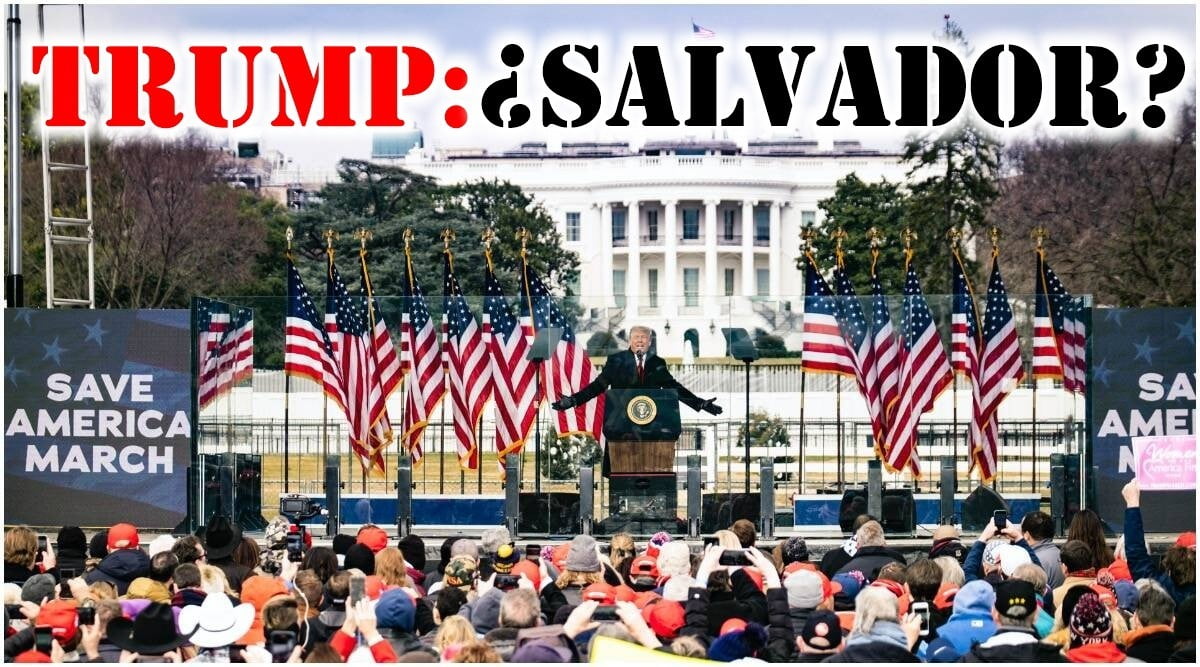
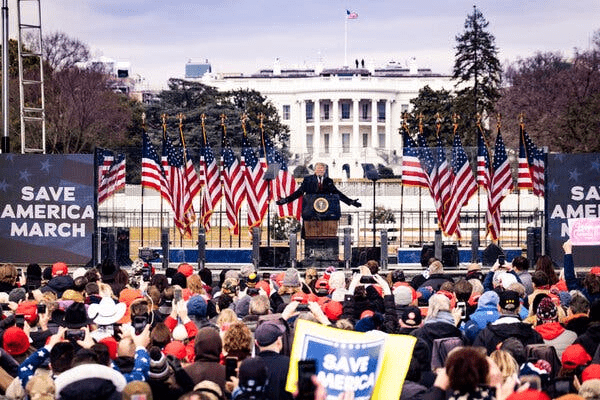
On January 6, 2021, the world witnessed the assault on the United States Capitol and the killing of a police officer who was protecting the building, at the hands of protesters who for the most part belonged to far-right and white supremacist groups, while President Donald Trump encouraged them, first from a podium and then through his Twitter account, to “Save America, by showing strength.”
That was the day the United States came closest to a coup d'état since the civil war of the 19th century. But did you know that behind those events there were not only ideological or political differences, but the outcome of a long strategy of digital manipulation, conspiracy theories, and fake news? Today I'm going to tell you how the movement that elected — and sustained for four years — the most unpopular president in the history of the United States came about, and how a conspiracy theory nearly put the oldest democracy in the world in check.
On the first Wednesday of that year, the world was attentively watching the events unfolding in Washington. That day, an usually ceremonial event takes place in which the members of the electoral college, chosen through the popular vote of the November elections, gather at the seat of Congress to cast their votes, the ones that legally define who will assume the offices of president and vice president for the following four years.
The electoral system of the United States is not easy to understand. It is based on primary elections in which each party's candidates are chosen; then come the campaign and the presidential election, in which citizens go to the polls (or to the voting machines) and cast their vote for the candidates of their choice. Up to that point, everything normal. But it turns out that in the United States, citizens' votes do not directly elect the president, but rather the members of the electoral college, made up of 538 members, which is called a college partly because it is formed by ‘colleagues.’
These electors are appointed by the leaders of the party that wins the popular vote, and their responsibility is to cast one of those 538 votes to elect the president and vice president. Now, the United States is made up of 50 states, but since not all states have the same number of inhabitants, each state has a different number of electors. Thus, California has 55 and Texas 38, but Wyoming and Delaware only 3.
What was about to happen on January 6 was that a representative of each of the 50 states that make up the Union was going to report the number of votes of their state for one candidate or the other — in this case, the incumbent president Donald Trump and the projected winner Joseph Biden. As I said before, this event is usually ceremonial, since the number of votes each candidate will receive is known in advance.
However, in this case, something quite unusual had happened: President Donald Trump had spent months, even before the November vote, saying he had information about electoral fraud. He said the Democrats were going to steal the elections, and that if Biden won, it would be proof of that fraud. The November elections arrived, and just as the polls predicted, Biden prevailed by seven million popular votes, although his victory in terms of electoral votes was much narrower.
From there, Trump stepped up his rhetoric of electoral fraud and set about filing lawsuits in the five states where Biden won by the narrowest margin. In total, he filed 60 lawsuits, with allegations ranging from poor conditions for election observers to massive fraud manipulating the voting machines and votes cast by deceased people and illegal immigrants[1]. In all these cases, except for a minor case filed in Pennsylvania, in which the court acknowledged that a small number of voters did not present valid identification. In all the other cases, the lawsuits were dismissed for failing to provide evidence, beyond questionable and inconsistent testimony[2].
59 judicial defeats in five states, handed down by judges who in many cases were sympathetic to President Trump's party, did not stop the president from escalating the accusations of fraud and the theories of liberal conspiracies allied with communism and even satanists to steal the elections.
On the contrary, with no legal recourse left for his battle, Trump devoted himself to inflaming with his speech the enormous number of far-right groups that resonated with his racist, misogynistic, and conspiracy-minded rhetoric. His goal: that the Republican congressmen who would gather on January 6 to certify Biden's victory would be so intimidated by the anger of Trump's followers that they would feel compelled to bend the electoral rules, justice, and democracy, and reject the Democratic votes of the five contested states.
At that point the situation was so unusual and strange that a group of congressmen from Trump's party embarked on the adventure of playing along with their political boss and challenging, using a legal recourse enabled for cases in which elections suffer severe trauma, the votes for Biden in those states. The endeavor had its defeat almost guaranteed, since the majority of Republican senators had already announced that they would not support those objections to the elections. However, this group of unscrupulous senators, perhaps motivated by a desire to look good before the boss and, more importantly, before the 63 million Americans who voted for Trump — most of whom believed in the supposed electoral fraud — proceeded to trip up the count of electoral votes.
I was in Medellín, following online the process taking place at the United States Capitol. Around 1:00 PM, Republican senator Ted Cruz, son of a Cuban[3], had the floor and was encouraging the thousands of protesters who, a few hours earlier, had gathered in front of the White House in response to the call that President Trump himself had made to “Save America,” telling them that “you will never take back our country with weakness. You have to show strength, and you have to be strong[4].”
And it was precisely during Cruz's controversial speech, full of fallacies and opportunism, that the security agents of the building announced that the protesters had broken through the doors of the Capitol and that at that hour they were heading to the place where the senators and the vice president were debating.
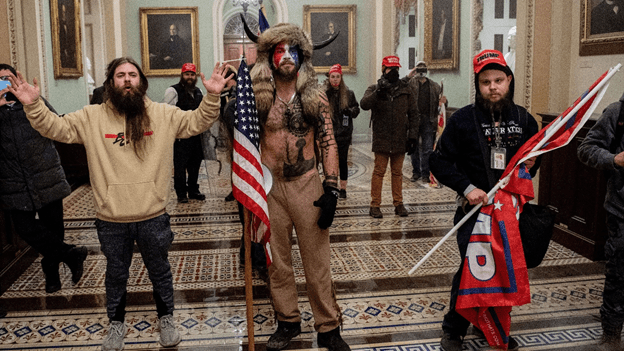
The rest of the events of that day will probably go down in history as a moment that split the political history of the United States in two. Characters who seemed to come out of a costume party sitting at the senators' desks, the guy dressed like Jamiroquai with his face painted making speeches, but the most lamentable part: the images of a protester shot and a police officer killed by the mob. The final toll was five dead, counting two protesters who died of cardiac arrest and another police officer who committed suicide a few days after the event.
The surreal images of hundreds of people forcing their way into what was believed to be one of the most secure buildings in the world aroused the surprise and mockery of the entire world. But the question most often repeated was: how had it come to that point? Why so much anger and so much hatred on the part of people who apparently benefit from living in a country with a high quality of life and abundance?
Well, there are structural reasons that explain the discontent of the middle class against the establishment, the United States being a country with incredible economic and social inequality. However, that by itself does not explain the loyalty, even fanaticism, that Donald Trump awakens — a ruthless and controversial billionaire who has never been (nor was he during his presidency) inclined toward social causes or fighting for equality.
It is also said that Trump, not belonging to the traditional establishment — that is, the traditional families and clans in power — was seen and admired as a disruptor, someone who challenges the establishment and could return power to the increasingly less influential majority of mature, middle-class whites who feel that for a long time (probably since George W. Bush) no one has represented them in Washington.
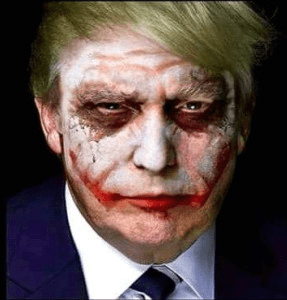
This last point I believe is one of the most important factors, since what Donald Trump clearly defended during his four-year term was the predominance of the white race in power, in executive positions, and in the social structure. Besides that, saying that Trump was a disruptor who put the American elite in check is at least an exaggeration. The tycoon certainly made many in power uncomfortable, but not because of his defense of the people or social causes, but because of his disregard for norms and protocols, his lack of consistency in his policies, and, in general, his unpredictability. In a way, Trump in power was like Christopher Nolan's Joker: someone without a plan, who only wants to watch the world burn.
But then, after four years of economic swings, one of the worst pandemic responses in the world, scandals, and very few positive results to show, how is it that 63 million people were willing to keep Trump in power for four more years? The answer, as has happened in more and more electoral processes in the world, is a single word: Fear.
In the American elections of 2016, the Brexit vote in the United Kingdom, the plebiscite to ratify the Colombian government's peace agreements with the FARC in that same year, and the presidential elections in Brazil in 2018, there were three common denominators: fear, conspiracy theories, and digital manipulation. In all the cases except Brexit, fear of 21st-century socialism, materialized by the failure of Chavismo in Venezuela. In the United Kingdom, the fear was of the avalanche of immigrants supposedly coming from the Middle East if they did not close their borders, but what all these far-right victories coincided on was the use of social media to spread fake news and conspiracy theories to scare the population.
But the 2020 U.S. elections had an additional ingredient that was not seen in the fake news campaigns of 2016: this time, the lies circulating were not only about communists infiltrating to turn the United States into Venezuela, or thousands of Latin American rapists and murderers entering the United States through an open border with Mexico. This time, the stories spreading through Facebook, WhatsApp, and other social networks were much more sinister.
It all began before the 2016 campaign, in which, taking advantage of Trump's appeal as an outsider — that is, someone outside the establishment — the digital marketing experts of the Republican campaign thought they had to sell their candidate as the guy who could “drain the swamp,” an expression with which they sought to portray Democratic politicians as elitist monsters disconnected from reality.
And so, during those elections, Trump's campaign took advantage of Hillary Clinton's recklessness in using a private email server for her communications as Secretary of State, to portray her as a corrupt, lying, “crooked” person, as Trump said at his rallies. However, that was not all the campaign did. Trump's strategists knew that despite being seen as traditional politicians, there was nothing in the résumé of Hillary Clinton, her husband, former president Bill Clinton (except the already worn-out topic of his affair with Monica Lewinsky), or the vice-presidential candidate Tim Kaine that could be exploited to tip undecided voters in Trump's favor.
Trump, on the other hand, had numerous scandals still fresh in the public's memory: accusations of sexual harassment and even rape between 1970 and 2005, bankruptcies of his companies including his airline and a university bearing his name, and the audio that had been leaked during the campaign in which Trump candidly told his interlocutor that “he didn't even wait, that he kissed any woman he wanted to kiss and that if he wanted, he grabbed them by the pussy.” There was no way the American public, especially women and the millions of faithful of the conservative churches, would see a narcissistic, misogynistic, corrupt person like Donald Trump as a better president than Hillary Clinton, unless...
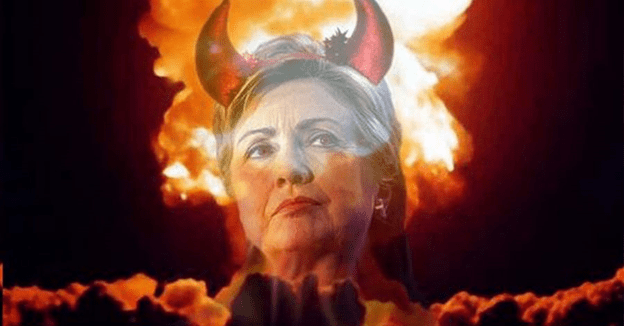
Unless they saw Hillary as someone much worse, more vile and dangerous, and, in passing, Donald Trump as the only one capable of protecting the country from a sinister threat, despite his unpleasant personality. It was then that the strategists set about amplifying, spreading, and repeating old conspiracy theories that surface from time to time, which speak of a shadow power structure that pulls the strings of politicians, celebrities, and other influential people, with a secret agenda that usually consists of taking away people's free will, enslaving humanity, handing the power of the world over to Satan, destroying the Churches, or a combination of the above.
I learned about many of these theories as soon as I began my spiritual path. Many of the people I met in the midst of that awakening of consciousness talked about secret sects, alien races, and lodges formed by establishment elites fighting to dominate the world. The Illuminati, the Bilderberg Group, and Skull and Bones were some of the names of those groups, and I learned a lot about those theories mainly through a book written by the English sports reporter and writer David Icke.
It was his most famous book, titled “The Biggest Secret.” In it, Icke describes how the world is dominated by a race of humanoid reptiles that can take human form, feed on human flesh, including that of small children, and maintain a complex hierarchy of reptiles, reptile-human half-breeds, and humans loyal to their cause, who are precisely the members of those secret cults I mentioned earlier.
In turn, the humans who supposedly receive power from the reptilians have to take part in all sorts of dark rituals, in which they sacrifice babies, drink their blood, and hold orgies among themselves and with sexually enslaved children.
I still remember the impression each chapter of that book made on me, each one always more macabre than the last. I never fully believed those theories, but I thought they must contain some truth, and it seemed probable to me that most of the world's millionaires and powerful people were satanists willing to do anything to maintain their control over the world.
Well, it was precisely parts of these theories — which of course were not invented but compiled and expanded by David Icke — that the members of Trump's 2016 campaign began to circulate to sow fear against a possible Hillary Clinton presidency.
It is not known whether this strategy of accusing the elite of the Democratic Party of being corrupt pedophile satanists was always coordinated by Trump's team, or whether the conspiracy theories took flight on their own, but the fact is that in October 2017, an anonymous user made a series of posts on the Internet forum 4chan, identifying themselves as a member of the government with the highest level of access to privileged information, supposedly known as “Q Clearance.” Those posts roughly announced that Hillary Clinton, along with a number of other politicians and government officials linked to pedophilia and satanism networks, would be arrested and executed. The posts were signed simply by Q[5]. That is where the name QAnon came from, from Q-Anonymous, to refer to that conspiracy movement led by the mysterious Q, of whom it has never been known whether it was a single person or a group. It is believed that, over time, many individuals interested in supporting Trump, or simply in creating viral content, have used the QAnon pseudonym to increase the mystery and spread of conspiracies with agendas generally of far-right ideology.
The first time I heard about this theory was in 2018. A healer friend of mine, knowledgeable in ancestral medicine and a yagé taita, told me he was receiving information from a good source indicating that Donald Trump is a “white hat”; a term I did not know until that moment but later learned referred to something like a secret agent in the service of good, of the light. According to my friend, the media attacked Trump because he was trying to free the United States and the rest of the world from the claws of darkness. Then he told me he was going to share with me the WhatsApp contact of a friend of his who belonged to one of the groups where that secret information was spread.
Out of pure curiosity I added the character to my contacts and greeted him, introducing myself as a yagé drinker and friend of the taita. Within minutes my phone was full of PowerPoint presentations, PDF documents, and images with a wealth of information about Trump's supposed plan against the “Deep State,” the name that followers of that conspiracy theory gave to the supposed group of pedophile satanists behind power in the United States.
Some of the prophecies I remember that contact telling me were that in September of that year Trump was going to return the dollar to its gold backing, and that in the following weeks we would see in the news a series of high-level arrests, which would probably include Hillary Clinton herself and Democratic senator Bernie Sanders. Keep in mind that Hillary's imminent capture was something that had been circulating in the conspiracy networks since before Trump's inauguration in January 2017.
A couple of days later I blocked my new conspiracy-minded friend, but it was not the last time I was in contact with the QAnon networks. Last year, just as the global pandemic was beginning, a Colombian friend of mine who had moved to the United States a couple of years earlier contacted me. She told me that because of the pandemic and because her status in that country was not yet legalized, she and her family had had to move to another city with very little money in their pockets and barely a few belongings.
In Detroit, their new city, they were fortunate to be taken in by a Christian Church that offered them financial assistance, and the members of the community quickly helped them put a roof over their heads; together they even furnished the new home with what was needed to get by. Up to that point, everything was wonderful. The problem was that, shortly after, my friend's husband had been indoctrinated by his new Christian friends to support President Trump at all costs. The reason was that a war between light and darkness was being waged, and they were the spiritual and social support of their womanizing, narcissistic savior.
When my friend told me this story, she said that all the prophecies arriving at her home had immersed her in a state of anxiety that no longer allowed her to enjoy her new home or even her new baby. The possibility that a sect of pedophiles and satanists would take over the country did not leave her at peace, and she did not know what to do to help, since they, because of their status, could not vote.
I tried to calm my friend down and, with arguments, debunk the most outrageous theories she was telling me, but I don't know if a single voice could have counteracted the whole web of disinformation in which she and her family were entangled.
One might think that such stories could only be believed by people without much education and/or with a high level of religious fanaticism, and in a way that is so. However, the conspiracy theories — not all attributable to Q — catered to all audiences and profiles of credulity. In the midst of the 2020 election campaign, an American friend of mine, a finance graduate from Georgetown University and manager of a consulting firm, shared with me several fake news items from portals known for spreading conspiracy theories and fake news. Some of these news items contained crude photographic montages and spoke of plans to dismantle the Rule of Law or hand over the monetary management of the United States to “International Zionism,” a derogatory way of referring to the supposed plan of world domination by the Jewish religion. This plan is part of the antisemitic conspiracy theories that already existed before Hitler came to power and that caused the monstrous consequences we all know.
These examples are only a few among the millions of people in the United States and around the world who believed, and still believe, that Donald Trump — despite not being a good person, nor a good businessman, and, as became clear, nor a good leader — could be a kind of world savior, for some comparable to a holy person. The degree of cognitive dissonance required to reconcile the evidence with that theory can only be explained through mental processes related to religiosity and superstition.
There is no evidence that Donald Trump in person was the creator of, or authorized the spread of, the conspiracy theories that portray him as a redeemer. But what is evident is that from the beginning of his electoral campaign, Trump began to use phrases like “Deep State” and “Washington Swamp” that his followers could quickly associate with QAnon theories.
On more than one occasion, Trump himself shared on Twitter messages from Twitter and Facebook accounts associated with QAnon, and whenever he was asked what he thought of QAnon and the groups that followed its theories, he said he loved them and that they were true patriots.
With that explicit or implicit backing, the millions of Donald Trump followers — particularly those affiliated with evangelical churches, men and women of all races, middle-class people without much education, and men with white supremacist ideology and far-right ideas — felt their beliefs validated. Even though the prophecies of mass arrests of Democratic politicians and the publication of evidence of pedophilia in the elite were, one by one, unfulfilled or at least postponed, Trump's followers kept accumulating fears of a possible Democratic government that, as Latinos in Florida said, would turn the United States into another Venezuela (Does that sound familiar to us Colombians?).
The campaign of fear and disinformation on social media reached its peak in the final days before the November vote, and the stories about the Democrats' satanic rituals, Biden's gay-indoctrination agenda, or worse things, sounded increasingly far-fetched. However, the polls showed that Trump had apparently hit his popularity ceiling, after being about to finish his term without fulfilling most of his campaign promises and none of the QAnon prophecies.
Most of the American population knew that their country would not withstand another four years of misrule with Trump in the Oval Office, so even though they were not particularly enthusiastic about the candidate Joe Biden, they closed ranks around him and set out to evict the tenant of the White House in the November 3 vote.
It was then that Trump's campaign, anticipating his imminent defeat at the polls, threw itself fully into cultivating a new conspiracy theory: that the country's electoral system was compromised and that the Democrats had the biggest electoral fraud in history ready. It did not bother them that people would ask why Trump, with four years in power, or the Republican party, with a majority in the Senate, had not taken care of fixing the flawed electoral system, or why there was not a single lawsuit, not one FBI investigation to clarify the supposed threat. None of that mattered, because those who followed Donald Trump had long ago given up skepticism or even common sense: the only important thing was that the Democrats were pedophile communist satanists and that even the irresponsible Donald Trump was a lesser evil in comparison.
This was, in fact, the only Trump prophecy that came true: he was indeed defeated at the polls by a margin much larger than he expected. This made it enormously difficult to hold on to power by challenging invalid votes here and there. His hope then lay in appealing to the conspiracy theory, carefully cultivated for months, of a massive and systematic fraud across the country. He would file a cascade of lawsuits in the states where the vote difference was narrowest, so that his followers would think the evidence had to exist — otherwise, it would not be possible for someone as important as the former mayor of New York and lawyer for Trump's campaign, Rudy Giuliani, to have dared to file the lawsuits.
What Trump did not count on was that all the courts before which the lawsuits had been filed would dismiss or reject, one by one, all 60 complaints — except the one in Pennsylvania I mentioned earlier — in record time. In some cases, even on the same day. But Trump and his allies had a plan B, a desperate measure that required completely setting ablaze Trump's most loyal base of followers: the far-right groups that, during his government, had been multiplying and strengthening exponentially.
The strategy consisted of increasing the circulation of QAnon messages and the new media outlets at Trump's service, like OAN or Newsmax, calling on “the people” to prevent the stealing of the elections, take to the streets to protest, and, if necessary, defend the homeland at all costs against the Deep State and its baby-eating members. The objective — I don't think it was ever to seize power by force, since the American army always stayed on the sidelines and, in fact, was never very close to Trump. The real objective was to make so much noise that the Republican senators would feel the pressure of the 63 million voters who supported Trump and decide, against their oath and against the constitution, to reverse the popular will in the states where Trump lost the victory.
The chances were always very remote, but Trump, incapable of accepting his defeat, despite having been a loser many times in his life, was not going to let go of power so easily to become a mere mortal again, perhaps now hounded by debts, discredit, and the tax authorities. What he did not count on was that his January 6 speech in front of the White House would be read by the enraged horde of far-right protesters as a call to invade and take over the national Capitol.
It is now known that many of those protesters had planned to kidnap and even execute Democratic senators and even Vice President Mike Pence himself, who at the last moment became a traitor to the Trumpist cause by refusing to reject the Electoral College vote, as Trump intended. This is something, by the way, that Pence did not have the power to do, but Trump, who understands very little of laws and norms, probably still thinks he could.
In any case, the protesters got out of control and came close to causing a bloodbath that would have split the country's history in two. The only reason this did not happen is that most of the hundreds of people who invaded the seat of Congress had no plan. Perhaps they never even imagined they would manage to get inside the Capitol. Once inside, they could be seen taking selfies and even livestreaming their audacity.
Trump, realizing the consequences of his incendiary speeches, ran to hide in the White House and did not publish any more tweets or say anything either for or against the protesters. They were perhaps waiting for their president's orders to execute the pedophile senators or at least arrest them, just as QAnon had been prophesying for years.
But the orders never came, and instead, a visibly uncomfortable Trump, reading from a script, published a laconic video in which he asked the protesters to go home, condemning every act of violence. The confused militants of his cause had no choice but to withdraw with the odd souvenir, unaware of the serious legal problems they had just gotten themselves into.
On January 20, 2021, Donald Trump boarded the Marine One helicopter bound for Florida, where he secluded himself in his new condition of former president. To this day no one knows what his political or even legal future will be, considering the number of lawsuits expected to fall upon the controversial tycoon after having lost his presidential immunity.
Journalistic investigations after Joe Biden's presidential inauguration show that among the communities of Trump and QAnon followers there is bewilderment and sadness. Some of its members wonder whether they were perhaps deceived and all the prophecies of arrests, executions, and liberation were never true. A few others now consider Trump a traitor to the cause and think he did not have the courage to carry out the plan and give the order to put an end to the deep state when he had the chance[6].
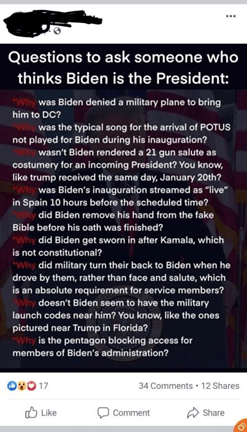
But many, perhaps the majority, are adopting the new conspiracy theories that are beginning to emerge, according to which what happened is part of the plan, and perhaps now Trump is going to work in the shadows to dismantle the deep state. Some theories even suggest that Joe Biden is not even the president legally, and that Trump can retake power at any moment.
The thing with conspiracy theories is that they almost never die when reality pulls the rug out from under them. Most of the pseudoscientific theories about the changes that were supposedly going to occur on December 12, 2012, for example, still exist today, only with alternative dates (including December 12, 2021, by the way), or without a specific date, but always with the quality of being “imminent.”
It is very possible that Donald Trump himself continues to take advantage of his far-right redeemer image and instigate new conspiracy theories, as a way of staying relevant over the next four years, with an eye toward a possible reelection campaign in 2024, for which he technically has legal possibilities to run, unless some new or ongoing legal process — such as the impeachment proceeding that the House of Representatives has already opened against him — disqualifies him from participating in the elections again.
The risk that QAnon represents, like many other conspiracy theories, is not that they are adopted by the majority of the population. A Pew Research survey in March 2020 showed that barely 3% of the American population said they knew a lot about QAnon, and the largest Facebook group this sect had barely managed to reach approximately 200,000 members before being shut down in August.
QAnon's real risk is its capacity to radicalize unstable and potentially violent people who, if they organize effectively through the Internet, could end up becoming terrorist groups coordinating attacks on the civilian population or on the people they consider part of the evil elite that controls power.
One of the most striking results of the Pew Research investigation is that most QAnon followers are older Republicans and evangelical Christians. But a very representative subgroup are believers in spiritual and New Age movements, particularly in populations of Latin American roots[7].
The magical and superstitious thinking I have spoken about on several occasions on this channel, especially in T2E13: The Dark Side of Spirituality, makes many people of good heart, good intentions, and with the desire to awaken their consciousness end up supporting authoritarian and despotic figures who use their image of supernatural beings or saviors to oppress the weak, marginalize minorities, and perpetuate themselves in power, even if to achieve it they have to destroy the institutions, the opposition, and the Rule of Law of a country.
In a next episode we will talk about how to recognize these dangers and prevent our democracies from ending up as the playing field of manipulation and fear.
[1] Here’s Every Trump Campaign Lawsuit Filed Since Election Day | Time
[2] Trump campaign has minor victory in Pennsylvania lawsuit over voter ID (nypost.com)
[4] Donald Trump Speech «Save America» Rally Transcript January 6 – Rev
[5] QAnon: What is it and where did it come from? – BBC News
[6] Opinion | Three Weeks Inside a Pro-Trump QAnon Chat Room – The New York Times (nytimes.com)
[7] QAnon explained: the antisemitic conspiracy theory gaining traction around the world | QAnon | The Guardian