Colombia is a very religious country. Even entering the third decade of the 21st century, Catholicism remains the predominant religion in the country, although with far less preponderance and influence than it had during my parents' youth. Some of those who have abandoned the Catholic faith have done so because of the overwhelming scientific evidence against many religious precepts, in favor of atheism, but in Colombia the reality is that the great majority of Catholic defectors have migrated to other religions, even more dogmatic ones, to New Age belief systems, and to other alternative belief systems.
My spiritual experience arose in this context of cultural transformation and was marked by a special interest I always had in exploring the unknown, especially in matters concerning human consciousness.
From the start, my parents made a special effort to instill the Christian faith in me. Religious symbols abounded at home, and on Sundays attending Mass was mandatory. Most Catholic holidays were observed, and like most Colombian children, I learned to pray the Our Father, the Hail Mary, and the Guardian Angel prayer before sleeping. However, the Catholic celebration I enjoyed most was Christmas, in which, besides the popular Western Christmas traditions like the Christmas tree and gifts, Colombians gather during the nine days before Christmas Eve to read biblical passages related to the Nativity, sing carols, and share cookies and desserts.
Around the age of six or seven, I remember first contemplating the existence of an omnipotent Being. Otilia, a sister of my mother's who lived with us, had taken me with her to the Easter Sunday celebration at a church in Bogotá. That day I understood that the hundreds of parishioners crammed around us, raising palm branches and wax palm figures, were eagerly awaiting the resurrection of the Son of God. What I did not understand was that, of course, it was a symbolic resurrection and that no one would see the risen Christ in person, so when the ecstatic congregation began to sing “Hallelujah, hallelujah, the Lord has risen,” I asked my aunt Otilia where the revived Christ was. – “Behind the altar, right under that purple curtain, the risen Christ is there,” she answered me. I don't know if with her answer she meant the tabernacle or the monstrance where the hosts are kept and displayed, or if she was playing a joke on me, but the thing is, I imagined a radiant bearded giant waiting behind the curtain for the right moment to make his appearance before the attendees.
I then began to formulate questions about that mysterious god who could be compressed into small wafers, get angry if I told lies, and punish me through household accidents when I misbehaved. I found it fascinating to get to meet in person a being who, according to my parents, was infinitely good and powerful but at the same time seemed very contradictory. My parents, always attentive to feeding my intellectual appetite, especially when it was oriented toward religion, chose to enroll me, along with my sisters, in the weekly workshops of the so-called “missionary childhood,” which took place after the Sunday Mass of our neighborhood.
That experience turned out to be very pleasant; besides learning much more about the history of God, trying to untangle the conceptual tangle of the Holy Trinity, and doing sporadic charity work such as visiting convalescents or delivering food to families in need, the missionary childhood was also an opportunity to make friends our own age.
In any case, my relationship with God was on the right track. I learned that if I prayed with faith, God always listened to me, that the Virgin Mary interceded for me when I fell into sin, that the Archangel Michael took care of protecting me from any harm, and that the Holy Spirit put the right words in my mouth when I spoke of God. A whole work team at my service! However, my favorite was Jesus Christ: a pleasant, smiling, understanding young man who was there to guide me with love.
In truth, I never had much trouble accepting the faith. I felt the presence of those divine beings in my life, and although I could not see or hear them, I perceived signs of their company. For a child with anxious traits and some terrifying fears, the existence of powerful beings looking after me when my parents were not there to keep me from danger was very comforting. It was only natural that I enjoyed professing my affection for those invisible friends through prayers, drawings, and good deeds.
It is likely that my parents at some point came to think that I would eventually become a priest, since on more than one occasion they saw me reciting long passages of the Mass while raising a cookie as a host in front of my sisters. On my own initiative I became an altar boy in the same church where I had previously belonged to the Missionary Childhood, and later I served as a catechist for children preparing for their first communion at the public school where I attended a couple of years of elementary school.
All these episodes were part of a search that, however, still was not bearing the fruits I desired. I had managed to obtain many answers that appeased the mind, but I was seeking a personal experience, an empirical confirmation of at least the most important precepts of the religion. The answer came in the form of a young Catholic missionary named Diego García.
Diego was a handsome young man born into an affluent family from Valle del Cauca. He was the nephew of Mrs. Martha Díez, a teacher friend of my parents, and he had lived a classic story of Christian transformation. Like many other young men of his social standing, Diego had used the money his family gave him to procure material pleasures of all kinds, and in the midst of it all he had descended into a spiral of degradation involving alcoholism and promiscuity. His quest to fill emotional voids with worldly pleasures had made him hit rock bottom, to the point that his family feared for his life.
When I met him in 1993, all those excesses were behind him thanks, according to his account, to the tireless prayers of his mother, who asked God to rescue her boy. A priest who ministered at the “Minuto de Dios” — the popular Catholic organization founded by Father Rafael García Herreros — approached Diego to propose a challenge: that instead of conquering confused young women and getting drunk on poison, he should try to conquer the heart of the Divine Mother and get drunk on the love of Christ. At a moment when he no longer derived any satisfaction from his familiar habits, the wayward Diego decided to give religion a chance, and he would never be the same again.
Because everything that is inside of me
needs to be changed, Lord.
because everything that is inside my heart
My mom had told us we would go visit her friend Martha to pray the Rosary together with one of her nephews, who was a charismatic leader of the Minuto de Dios. Although I was used to religious activities, the prospect of praying a full rosary with its 53 Hail Marys seemed soporific to me. Upon arriving at our destination, we met a young man whose appearance immediately recalled the modern image of Jesus of Nazareth: olive-skinned, tall, slender, handsome, with a thick beard and medium wavy hair. Although the most striking thing about him was the unusual and sincere affection with which he addressed people who, until minutes before, were complete strangers.
The Holy Rosary, which I had known as a tedious string of prayers packed into five decades in which the so-called joyful, sorrowful, or glorious “mysteries” of Christ's life were mentioned, was typically dispatched in half an hour. With Diego, the Rosary became a deep and meaningful meditation, where every word of every Hail Mary and every Our Father had to be pronounced and understood slowly. This, far from seeming simple, turned out to be enormously complicated, and the first time I tried it, I could not even get halfway through the prayer. I was used to reciting those prayers hastily and in the blink of an eye, so doing it slowly, reflecting on their meaning, as if I were truly speaking to God or the Virgin Mary, was a totally new experience.
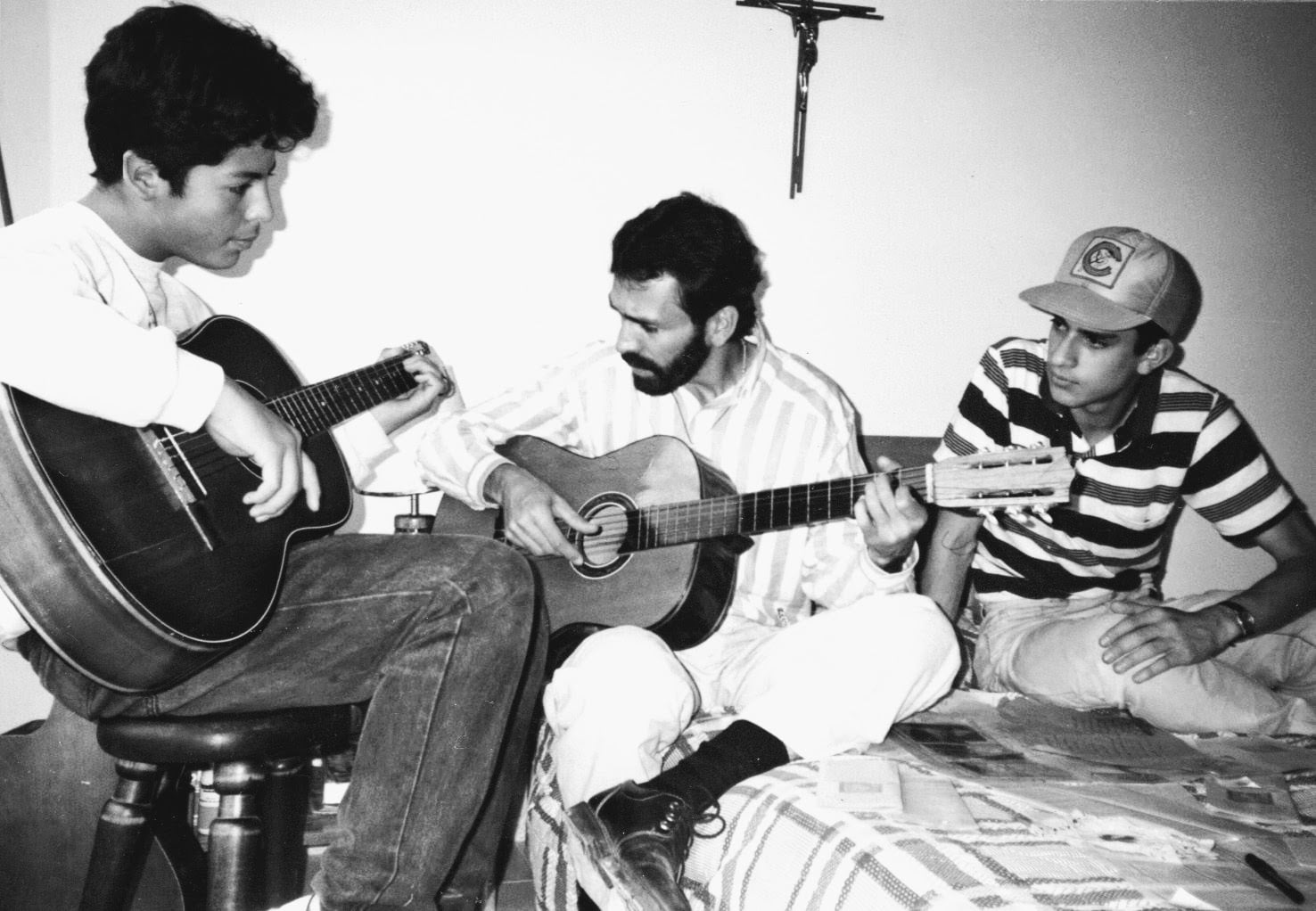
Of course, a full rosary with Diego could not be dispatched in 30 minutes as I had done until then with my family. Moreover, Diego, who in addition had a prodigious voice and played the guitar well, complemented the reflections that took place between the series of Hail Marys with beautiful Christian songs he usually sang with his eyes closed, conveying a powerful sense of transcendence and mysticism. It was common for the weekly prayer meeting, which we would come to call the Prayer Group “Friends of Mary,” to last two or three hours. Despite the considerable length of the ceremony, neither my sisters, nor the other preteens in the group, nor I ever found attending it boring.
Besides being pious and humble, Diego — who by then would have been in the second half of his thirties — was a very charismatic young man with a special ability to relate to young people and win their trust. That ability had probably been refined during his years of work with the Minuto de Dios Foundation and his apostolate with Christian youth, but on top of that, Diego had a playful, joking personality that allowed him to fit in very well with groups of adolescents. It was no surprise, then, that some of us kids who attended the prayer group became his close friends. I admired him; I saw in him many of the things I wanted to be when I grew up: eloquent, charismatic, assertive, and wise but still fun. He also — it must be said — had an appearance and demeanor that closely resembled the Western image of Jesus of Nazareth: slender, handsome, with sharp features, a thick beard, long wavy hair, and deep, joyful eyes. It is no surprise that the ladies too saw him as an apparition and attributed to him a “magic” that brought tranquility just by being in his presence.
It must not be forgotten, however, that despite Diego's modern and progressive appearance, his thought and speech were entirely aligned with the orthodoxy of the Catholic Church of the late nineties. Diego belonged to the so-called “charismatic” Catholic movement, well known for the importance of pop music, the affable and approachable attitude of priests, and the greater participation of young people in parish activities. Despite all this, the “progressivism” did not include any separation from the Roman canon, and therefore all the dogmas of the Church would be served up by Diego at our weekly gatherings with a shiny youthful wrapping.
One of those dogmas of the time was, of course, that all sexual activity outside of marriage was considered a sin and severely punished. I, who was then 13 years old, was particularly troubled by the overwhelming eruption of adolescent hormones and my total inability to restrain the practice of “self-love.” The subject also distressed another friend of mine of the same age who belonged to the group, so we decided to consult Diego privately to seek spiritual guidance.
I remember that sunny afternoon when my friend and I met with Diego at his house in northern Bogotá. We spent a few hours talking about everything human and divine, and when we got to the point that had been tormenting us, he smiled and comforted us with his words. – “Don't worry, those are small tests that God allows so that we strengthen our will.” Then he explained to us that masturbation was one of the Devil's temptations to pull us away from God's love, and that the solution was to imagine the Divine Mother carrying away those impure thoughts, to pray a lot, and to keep our minds occupied.
More than 20 years later, in retrospect, one can see how negative that message was, but for boys raised in Catholic families, without access to scientific information on the subject and with very deficient sex education, everything seemed to make sense.
That visit was the beginning of many other individual meetings with Diego, in which, besides receiving his religious guidance, I learned to play several Christian songs and deepened my relationship with God and the Virgin. I must say that from then on I had many conceptual conflicts with the idea of the Holy Trinity and the role of the Virgin Mary. That business of three distinct persons and one true God seemed simple when heard from Diego's lips, who attributed the confusion to linguistic problems of interpretation. – “They are ways in which God Himself manifests so that we worship Him, see Him as one of us, and receive Him in the Spirit” (...) As for Mary, the matter was a different story, because from his words one gathered that, in his cosmogony, Mary was the highest expression of love and the best way to relate to God. Diego said of the Virgin that she is our intercessor, head of the heavenly hosts that subdue demons, and protector of humanity. I, who had never felt a particularly close relationship with the figure of the Virgin, he called “the Virgin's favorite,” and in that way he got me more interested in connecting with her.
The truth is that the experiences I lived during the time the prayer group lasted, which must have been a couple of years, cemented the beginning of my spiritual search. As a music lover devoted to harmony, it was very easy for me to reach states of mystical ecstasy through musical notes. My fascination and curiosity about the mysteries of reality were nourished by the long existential conversations we held during and outside the prayer groups, and my vocation for the word and for leadership was well driven by the prominence that, over time, Diego allowed me to take during moments of prayer, with spontaneous invocations and playing the guitar.
During that time I remember feeling, on more than one occasion, inexplicable moments of sudden euphoria: suddenly I would open my eyes fully, look around, and feel completely flooded by an indescribable pleasure. The first thought that came to my head in those moments was gratitude; I felt it was the presence of God in my heart, filling me with joy and love. Little by little I began to feel the presence of God as much more than something figurative; I truly felt accompanied and protected. I was certain that God had chosen me for something important. The Prayer Group was only the beginning, so I had to find a way to discover what my mission would be, the task for which God had sent me.
My masturbating friend and I also agreed on this thought. Both of us, having become the members of the group closest to Diego, would talk to try to discern what our calling would be. Sometimes we found clues in the priests' sermons after the reading of the gospel during Mass, or in some individual biblical reading. Once, my friend arrived excited at my house with his bible under his arm and told me, “I found it: you and I are the two prophets of the Apocalypse.” I remember being surprised, but I did not think he was crazy or anything like that; rather, I hurried to grab my own bible and look up the passage my friend was referring to.
It was Revelation 11, from verse 3 onward: “3 And I will give power unto my two witnesses, and they shall prophesy a thousand two hundred and threescore days, clothed in sackcloth. 4 These are the two olive trees, and the two candlesticks standing before the God of the earth. 5 And if any man will hurt them, fire proceedeth out of their mouth, and devoureth their enemies: and if any man will hurt them, he must in this manner be killed. 6 These have power to shut heaven, that it rain not in the days of their prophecy: and have power over waters to turn them to blood, and to smite the earth with all plagues, as often as they will.”
I no longer remember how many times I reread those passages, and many times my dear prayer companion and I discussed what would be the best way to begin this work. We came to talk — although at least on my part without ever seriously considering it — about leaving our homes and dedicating ourselves to preaching the word of God on the streets of Bogotá. It must be said that while my family life was very healthy and loving, my friend's was not so much, so for me the idea of abandoning my warm home in order to fulfill a dark biblical prophecy was much more shocking.
The prospect, however, ended up causing me a mild trauma, since at some point I came to feel that it was inevitable that I would end up fulfilling the prophecy, despite all my reluctance. There were several nights of anguish and prayer asking God to “excuse me” from prophesying on the streets in exchange for more benign and effective forms of apostleship. Who was I to negotiate with God over the adjustment of prophecies written hundreds of years ago? Still, it had to be tried, since the second part of the prophecy made the mystical bargaining even more worthwhile:
“7 And when they shall have finished their testimony, the beast that ascendeth out of the bottomless pit shall make war against them, and shall overcome them, and kill them. 8 And their dead bodies shall lie in the street of the great city, which spiritually is called Sodom and Egypt, where also our Lord was crucified. 9 And they of the people and kindreds and tongues and nations shall see their dead bodies three days and an half, and shall not suffer their dead bodies to be put in graves. 10 And they that dwell upon the earth shall rejoice over them, and make merry, and shall send gifts one to another; because these two prophets tormented them that dwelt on the earth.”
Needless to say, neither my friend nor I ever set foot on the street with the intention of prophesying, but of course, that would not be the end of my search for the mission, which would continue for a while, at least, within the bounds of the Catholic religion.
What did repeat were the mystical events around my apostolate in Catholicism. I strove to carry out God's plan through every opportunity for service that came my way, and I felt great satisfaction both from feeling like an instrument of divine action and from making a positive difference in the lives of the people with whom I carried out those actions. Such was the case with the work I did preparing children between 7 and 10 years old for their first communion — an important event in the lives of Catholics, which typically requires understanding what it means to be Catholic, the ceremonies, commandments, sacraments, etc., as well as memorizing the most important prayers.
I also had the opportunity to use my knowledge of the bible and the skills of speech and counsel I learned from Diego to guide other members of the prayer group and friends from my school. These acts of service served me, on one hand, to compensate for my irrepressible fondness for self-eroticism, hoping that God would look upon me favorably and that I could keep being “the Virgin's favorite.” The bargain seemed to work well, since both Diego and the priests and nuns I knew immediately saw in me “something special,” a potential to achieve great things on a spiritual level.
All of this reinforced my own conviction that I was destined for some important mission, and my world began to fill with keys and signs that I understood I had to decipher in order to comprehend the path and be ready for my great moment. One of these signs appeared shortly before the death of my maternal grandmother, Ana María Rosa. I had stayed by her side during the first days of her hospitalization in the town where she lived, after she suffered a stroke that had left her bedridden, unable to move or speak. Although I never considered myself especially close to my grandmother, I was probably the grandchild who accompanied her the longest. I read to her, told her stories about her house, prayed, and occasionally helped the nurses with the care she needed.
I remember my grandmother's eyes bidding me farewell with gratitude when it was time for me to leave, and I would go away with the satisfaction of making her suffering a little more bearable, even if only for a few hours. On the other hand, I felt that surely God had put me there to accompany her in her last days, and that surely that was part of my divine mission. This was confirmed shortly after my grandmother was transferred to a higher-level hospital in Bogotá. I returned to the farm where my grandparents lived, to spend a few nights there while my mom and dad handled the transfer and care of my grandmother. One night, I woke up startled with a strange sensation, like a mixture of fear and expectation. I perceived a bluish light in the room and turned my gaze toward where I thought it came from. There I found an orb emitting a faint indigo glow, and when I looked at it, I perceived in my mind a communication coming from that strange object. I did not hear a voice, but I was certain I received a message that came from the floating sphere. The message told me to prepare for many changes that were coming, and that I had been chosen by God for an important mission.
The sense of apprehension I felt then turned into enormous joy, not only because of the message itself, but because I had experienced a supernatural event for the first time in my life. I tried to engrave the moment in my mind, and for me it was proof that God not only existed, but communicated with His chosen ones. However, when I recalled it the next day, it seemed too extraordinary to share with anyone else, yet still too utterly real to consider any other explanation, such as a hallucination or, more likely, a lucid dreaming experience.
A year after my grandmother's death, I was in my last year of high school, and the prayer group had received an interesting visit. A young friend of Diego's, from a neighborhood in the south of Bogotá, came to our house claiming to receive messages from the Virgin of Medjugorje, also known as the “Queen of Peace.” The young woman shared in Catholic churches, on the Minuto de Dios radio station, and in prayer groups the messages she claimed to receive from the famous Balkan apparition. Most of the public messages of Medjugorje, in which the Virgin refers to her devotees as “dear children,” deal with fairly generic matters such as strengthening faith, opening oneself to Christ, praying, and many other benign recommendations of good Catholic behavior. The young channel from Bogotá, however, shared more specific channelings directed at the prayer groups or parishes she visited.
Such was the case of her visit to our Prayer Group on a Saturday in 1994, while I was out of the city, taking part in a Catholic spiritual retreat organized by the school where I studied for the soon-to-graduate seniors. On the very day the channel visited our house, I attended, along with my schoolmates, a beautiful Eucharist during which I had a new experience of mystical rapture. The following night, when I returned home after the retreat, my mom told me that the young medium had asked about me — supposedly without knowing that a member of the family was missing — and had said that the Virgin thanked me very much for the work I was doing preparing children for their first communion. She also told me that at the end of the group prayer, she had walked toward an empty chair in the living room and had made the sign of the cross, dedicating it to the son who was not present.
My reaction to such a revelation was to lock myself in the bathroom and cry out of humility. The Mother of God was thanking me for something so simple! I felt overwhelmed and fortunate, and I promised that I would do Her will, whatever it might be.
Lord, I do not desire riches, nor children, nor knowledge.
If You so wish, I desire to have nothing.
Grant me only this: that I may give myself to You.
Without expecting rewards, and with a love without end.
A short time later, I learned that Diego had been diagnosed with an aggressive form of stomach cancer, and very soon he could no longer attend our Prayer Group. Some said it was the consequence of several years of alcohol abuse and perhaps drugs; others, that it could be because of the frequent fasts he practiced. The truth is that cancer is unpredictable and attacks the pure and the impious alike without hesitation. What did seem like a cruel irony was that a young man so similar to Jesus of Nazareth — physically, in his word, and in his works — should be condemned to an early death after suffering physical torments like those Christ Himself had to endure.
Diego died at his parents' house, far from chemotherapies and doctors, totally convinced that his task in the world was finished and that he was heading toward the longed-for encounter with his divine Mother and his good friend Jesus. I could not see him during his last months, but I am sure he spent the time comforting his parents, giving them strength, and occasionally cracking jokes. When his strength finally abandoned him, he left behind an indescribable pain in the heart of a mother who until then considered herself a critic of the Church, and a father who called himself a total atheist. But most importantly, he left a legacy that will live forever in those of us who had the fortune to know him and share his love for the Virgin, the Church, and humanity.
I don't know for sure whether his parents converted to Catholicism, but I do know that they continued the charitable works that Diego led. In particular, the delivery of food and clothing to the indigent who inhabited the famous-at-the-time “Calle del Cartucho” in Bogotá. My friend of the apocalyptic prophecies remained a fervent Catholic, attending Mass every Sunday and prayer groups, but life would take me down other paths of apostasy and searching, trying to reconcile the powerful burden of religious conditioning I had adopted during my childhood with the scientific thought and spiritual curiosity that drove me.
I never got to say goodbye to Diego the way I would have wanted; however, he managed to say goodbye to me after his death in a very special way: a few months after his passing, while I was already doing my compulsory military service in the National Police of Colombia, Diego's family made a pleasant discovery. Among his personal belongings, they found a cassette with an hour of songs played on the guitar and sung by him. Each song was like a life lesson for his friends, but it was the last song on side B that broke the emotional dam I had held since Diego's death:
To my friends I will bequeath when I die
My devotion in a guitar chord
And among the forgotten verses of a poem
My poor incorrigible cicada soul.
It was as if at that moment I had suddenly woken up to the reality that my friend and teacher was gone forever. I said goodbye to his presence, but not to his soul, since Diego would become, for better or worse, an important part of my own personality.