This week I tell you a little about my project, the Encyclopedia of the World of Children, something I've been working on for the past 6 years and which I just completed yesterday.
To celebrate this achievement, I share with you a new chapter of my spiritual path. This time, it's about the first memories of my life, a little about my childhood and the way I learned to understand love, pain, and reality through that very particular prism of childhood.
Without further ado, I invite you to visit The World of Children and listen to today's episode: Awakening to Life.
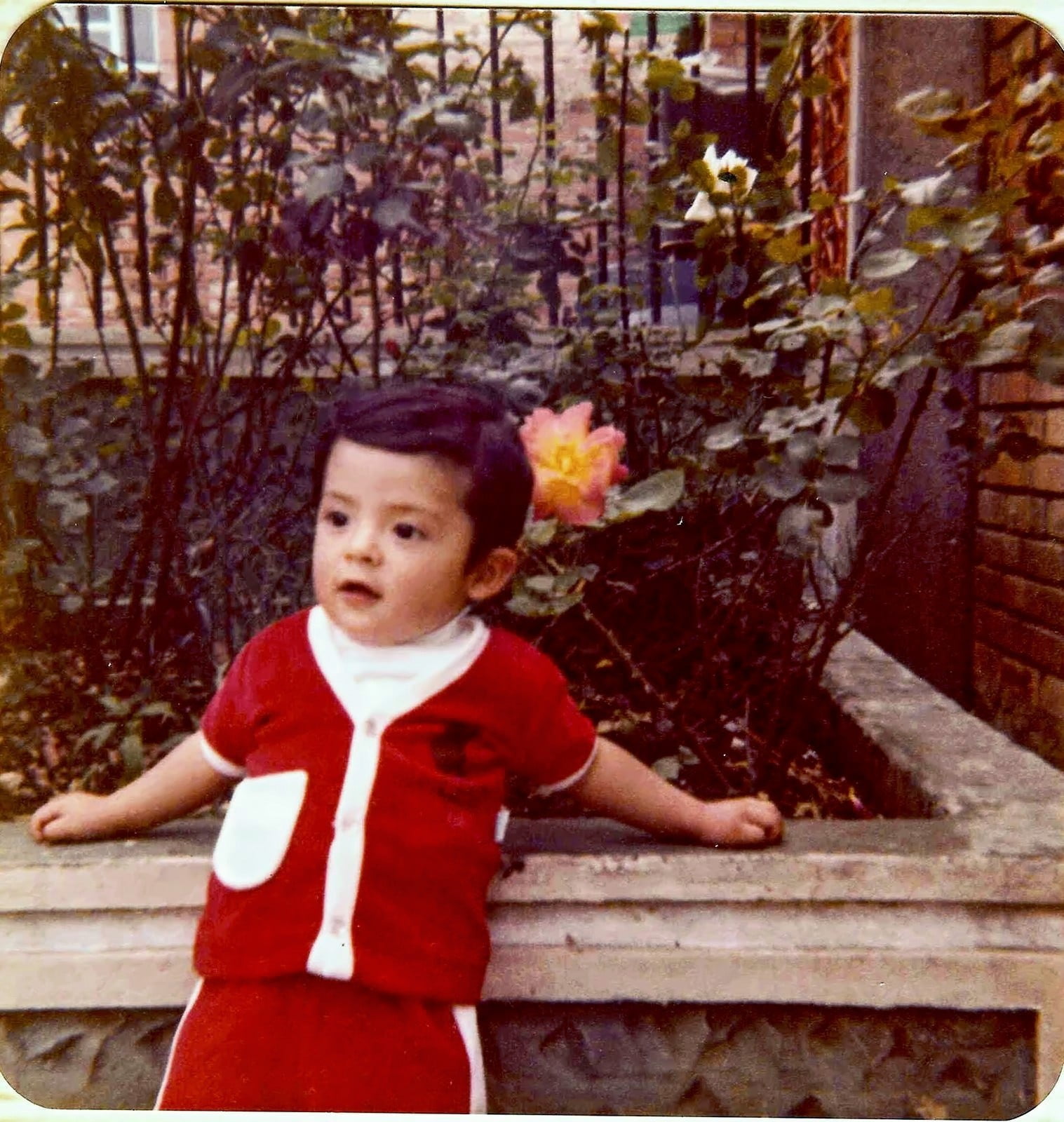
The first memory I have occurred at the La Presentación 'Luna Park' school where I did kindergarten, the only year of preschool education I took in 1983. I was three years old and I remember watching the counterweight of one of the school's basketball courts. The metal cylinder, probably filled with concrete to prevent the structure from collapsing under the weight of the backboard, seemed to me to have a diameter similar to that of the basketballs I knew. Therefore, I deduced that that must be the place where the balls were kept when they weren't in use. The memory has no importance other than the fact that it remains with total clarity in my mind and that the curiosity to understand how things work and what's inside them corresponds to the mental process that I still perceive today as 'my way of thinking'.
A year later, I was already in first grade with four years old and much more clarity of thought. I remember very well several episodes of my first year of public school at the 'San Benito' school, playing with friends, trying to internalize the spelling rules the teacher taught us and especially, facing the first fears I remember feeling. It was a little classmate who sat next to me in class and who was unfriendly to me. Her attitude was probably hostile toward other children too, because one time, after fighting with another boy, she received a cruel punishment: that boy took a pencil with an extremely sharp tip and gave her what appeared to be a deep cut on her neck from one ear to the other.

I remember the sensation of paralyzing fear when I heard the girl's screams and then seeing her with her bloody clothes and blood running down her neck while some teachers helped her. Later I would have to see my own blood for the first time when I suffered a deep wound to a foot while I was playing in the schoolyard, sitting on the ground. A piece of glass, perhaps from a broken bottle, had embedded itself near my ankle so that I had to be taken to the health center closest to the school to remove the fragment and suture the wound.
These events, in addition to the constant and demotivating red-ink 'C's with which the teacher disqualified my endless sheets of homework, caused my parents to move me to a school where one of them was working at the time.
The change was received as a balm, since attending classes was becoming an unpleasant penance. The problem was that my discovery of evil and danger in the world was not limited to the passive observation of the experienced events; on the contrary, my restless mind, accustomed to testing hypotheses and trying explanations for everything, was bent on the need to understand how it was possible for one person to harm another in such a cruel way. I also remember that experiencing physical pain so intensely made me think of other people's pain and gave me the capacity to empathize with them to the point that I could very vividly imagine how they would experience their own pain.
This way of thinking was just part of a general fascination with understanding the world, experiencing it firsthand by breaking it into parts and analyzing it down to the smallest detail. In the same way I questioned myself at such an early age about the nature of human emotions, I also did so about the workings of appliances and natural phenomena. If I were to summarize my attitude toward life for most of it in a single phrase, it would be 'I experiment'. Knowledge attracted me, but even more, the experience of building it based on my own perspective: I put my fingers into the flame of candles to learn the nature of fire, I disassembled my toys and little tadpoles to understand how they worked, but I also played with my own fears and instincts to learn their limits within my own mind.
The curiosity that characterized me from so small was at the same time encouraged and restricted by my parents, who undoubtedly struggled between the desire to instill in me an inquiring spirit, but also the obedience necessary to fit in society. On one hand, they provided me with books about dinosaurs, Leonardo Da Vinci, or Astrophysics and suggested me interesting challenges for the mind, but in the same way they had to limit my sometimes dangerous home experiments, some of which involved fire, electricity, heights, sharp objects, or a combination of all the above.
I lived a plainly happy childhood, protected, peaceful, and intellectually stimulated. Thanks to growing up with two sisters, I also always had companions for my adventures and allies to carry out my projects, many of them in secret from my parents. They were present, loving parents without the sentimentality characteristic of 21st-century parenthood, always available and always ready to support their children in everything we needed to grow up healthy and joyful. However, due to the way they were raised, their vision of emotions was always very pragmatic. Topics such as love, fear, evil, sex, the human experience, the purpose of life, or death were treated from the perspective of religion or of their practical function. Conversations about those topics generally ended by appealing to faith in the help of divine providence or arguing that they were topics one should not dwell on but rather occupy the mind with productive things.
The truth is that in my case, at least during childhood, those answers were sufficient, unlike for my sister Julia Gineth, who already in her pre-adolescence had to deal with a depression caused by the anguish the idea of death generated in her, her own and of her loved ones. I, on the other hand, was very busy devouring knowledge about all the topics that interested me and experiencing each new emotion that awakened in my being.
Within the spectrum of human emotions there were three in particular that have fascinated me since then: Romance, fear, and spirituality. The three, probably among the deepest emotions a human being can come to know, and in my particular case, the ones that would define my life from then on.
I had the fortune to grow up with parents who, without being cheesy or even using the phrase 'I love you' between them or with their children, always knew how to demonstrate love in a tender and profound way. Between them they always called each other 'Amor' (Love), and it's the form I learned to use to refer to my partner. In the same way, it was always everyday to see spontaneous expressions of affection from my father toward my mother, with a kiss, a surprise hug, a piece of poetry, and the occasional flirtatious remark.
With such an example at home, it was only natural that I wanted to explore the experience of love from very early on, and the first woman I remember having that feeling for was a cousin I saw on average once a year. This unlikely love accompanied me from when I was, I calculate, about six or seven years old until well into my adolescence. In a way, it also laid the foundations of my way of understanding love. Being an unrequited feeling that fed on just a glance, a hug, a smile, I learned to recognize love as an individual emotion and not necessarily a couple's one. There was no expectation in my childish love, except to eagerly await a new encounter to water that love with a few drops of water and keep it alive. My cousin was in fact hateful or indifferent toward me on some occasions, for which I don't blame her since my impertinence was legendary. But even so, I knew that between the two of us there was a special connection, a different affection, and generally that feeling shone at the moment of farewell when she had to return to her home city after the vacation. Those brief moments of a hug with a few words of affection were enough to keep the flame of that childish love alive and strong for the following months.
Tania was for me what Becky Thatcher was to the incorrigible Tom Sawyer: a silent and hopeless love that nonetheless gave me many of the happiest moments of my childhood. It was also a love that stayed in the background when life presented me with a new opportunity to experience romance. That's how at eight years old, in fifth grade, I had my first 'girlfriend'. Without even a kiss in between, that sweet girl with curly black hair of whom I never heard anything again after finishing primary school, also captivated my thoughts and my heart for a good while, during which my cousin provided me with many a sigh of her own.
The same thing happened on other occasions, sometimes fleetingly during a visit to a seaside resort or on a school outing; it was clear I was a person prone to falling in love and I enjoyed it enormously. Almost every night I devoted my last thoughts before sleeping to the girl or girls who at the moment were the object of my affection. I spent hours talking about them with my sisters, especially with Julia Gineth, and I lived with total intensity every encounter that existence allowed me with those who awakened that magical feeling in me.
With time I learned to recognize, however, that my experience of love was not limited to my relationship with women. In a way very similar to the ease with which I fell in love with girls, I also fell in love with music, books, television programs, or games. For example, I can clearly remember the exact moment I first listened to a song that resonated with my most intimate fibers. 'El baile de los que sobran' by Los Prisioneros back in 1985, 'Yo Que Te Amé' by Ricardo Montaner in 1988, 'Please Forgive Me' by Bryan Adams in 1993, or 'Yesterday' by The Beatles in 1994.
Some of the books that marked my childhood were some animated books about the life of Leonardo Da Vinci, space, and Dinosaurs. I ended up memorizing a couple of them in their entirety. The Encyclopedia of the World of Children was another work that became a love for life, since it reached my hands when my parents made the enormous effort to buy it on installments back in 1985, and even today, more than 30 years later, it's still present in my home library for my own enjoyment and that of my children. In all the above cases, the emotional sensation that linked me to the music or the books was very similar to the one I experienced with the girls I liked: I thought, talked, and intensely enjoyed the moments I shared with them.
In all the above cases, my active imagination was the tool that transformed simple notes, letters, or memories into true worlds in which I immersed myself and explored with the same emotion as in real experiences. What I remember about my capacity to imagine is similar to what Bill Watterson drew in his famous comic 'Calvin and Hobbes'. Any element that stimulated my creativity allowed me to create a temporary reality in which situations flowed with the same naturalness as in the real world. The way I remember it now, I wasn't aware that I myself was creating those realities, but rather I felt that I was 'connecting' with a parallel reality that I could invoke at any time.
I remember, for example, that I liked to get into the fold my mother made at the top of her bed's comforter. There I imagined I had shrunk to the size of a marble and that I was in a pocket of my father's shirt. I remember well that I could physically feel the movement of my dad getting up and feel the vertigo of being suspended at a height many times greater than my stature. Other favorite places to let my imagination fly in the house were the inside of bedroom furniture or under huge piles of clothes. Today when I see my daughter Luciana sitting on top of a wardrobe, I suppose that's where Queen Elsa is in her castle in the mountain.
During those years of childhood, my role in the games with my sisters was almost always that of 'director' and sometimes also 'screenwriter'. I explained the concept of the fantasy, which could be that of explorers in a lost city, or researchers facing a natural disaster, and I assigned my sisters the role they had to play and ideas of the lines they had to say. Many times the games had storylines that continued through several days or perhaps months and that moved through multiple places.
In any case, my imagination was always creating realities more exciting and fun than that of the physical world. Returning to my experience of love, one of my greatest pleasures was to fantasize new encounters with the girl I had in my heart. I could feel the emotion, the butterflies in the stomach, the pleasure of those moments. Sometimes I added to those memories as background music my favorite song of the moment or elements of romantic stories I borrowed from the Mexican telenovela of the moment, and that way, I could spend hours immersed in my fantasies.
This characteristic of my mind, which could undoubtedly be considered common in childhood, is the lens through which I have experienced life. The capacity to create vivid realities in my mind developed as I grew and stopped being limited to childhood games and adolescent loves to become a source of creativity to develop personal projects, write stories, create products, take initiatives, and change the way of doing things around me.
However, despite the usual belief that there is always a clear differentiation between reality and imagination, at least in people without mental disorders, in practice there is a wide spectrum of dimensions of the human experience in which the division between reality and imagination is not clear. The mind is not just a filter of the perceptions our senses deliver to us, but it builds the scaffolding of reality itself, which is formed not only with the information reported by the senses, but also with our entire system of beliefs, knowledge, and experiences.
In the coming chapters I intend to show my exploration of that objective and subjective reality within what I call my 'spiritual search', seen from the perspective of my arrival at the fourth decade of age and my new life in Canada. The paths I have traveled in this search have been equally strange, dangerous, and fascinating, but above all, full of lessons that, like flowers, bloomed even in the most difficult episodes. This is the testimony of my journey through the paths of mud and flowers of my spiritual search.