Science is not an invention by extraterrestrials nor did it appear to us in a divine revelation. It is a process independently developed by many civilizations that have existed throughout history. When we talk about science, we tend to automatically think of the Eurocentric scientific systems of which what we call “western” science is the heir. However, science was neither born in Europe nor was it developed by a single group of people a single time in the history of humanity.
While the word science barely began to be used in the 19th century and the scientific method is attributed to the period known as the scientific revolution of the 16th and 17th centuries; we talked about this in a previous episode, in which I said that I agree with Yuval Noah Harari that it should really be called the revolution of skepticism rather. For before the 16th century, those who studied the different sciences called themselves “naturalist philosophers” and their methods and theories were very close to what we today know as pseudoscience. Let us remember that the scientific method consists of observing, formulating hypotheses, carrying out experiments or studies with mechanisms to discard mental biases and submitting the results to the judgment of other experts, as well as to the confirmation of the experiments by other teams.
Well, all of that, which in itself is complex, tedious and expensive, was much harder to do 4 or 5 centuries ago. Nor did there exist the observation and experimentation methods that we have today, nor did everyone have access to scientific publications as in the present day. However, people had immediate needs: the sick had to be attended to, bridges and roads had to be built, tools and fertilizer had to be manufactured, etc. Therefore, there was no possibility of waiting for feasibility studies to be completed, or for the hypotheses to be formulated and the king to approve the funds to develop a new medicine or a new building material. Then one had to make use of what was already known with sufficient clarity and to try out the novel ideas one had with as much care as possible.
One can easily imagine a 16th-century farmer seeing that his crop was being ruined by some pest, trying out different mixtures of substances at his reach to try to control the pest: What might he have at his reach? Maybe urea derived from animal urine, lime from limestone, salt, tobacco smoke, etc. Well, it is possible that some of those substances made the problem even worse and the farmer ended up ruining the harvest. Or maybe he had luck and let us say that chili pepper, for example, turned out to be a good way to control that particular pest. Then we cannot say that the farmer did science, but he did do part of the scientific process. Because the knowledge he obtained did not stop there. The farmer learned that if little white spots appear on the potato stem, then he can scatter ground chili and within a few days the spots have faded and the plant has healed. It is also very likely that in his conversations with other farmers he shared his finding and gave them the recipe. Those farmers would probably try the formula when the same problem came up for them, and so little by little a chain of experimentation would take shape, in which there could have been hundreds of farmers trying the recipe at different altitudes, with different types of potato, different varieties of chili, against different species of fungus or parasites.
Many will have managed to reproduce the results of the first farmer but others not, either because they used a different variety of chili or because the pest they faced was not bothered by the spice, etc. In any case, within a matter of months the farmer's knowledge had already become vox populi and thousands of growers throughout the region were applying the technique. Some with more success than others; however, unlike urea, which contains an acid and, when handled correctly, can serve as fertilizer and in some cases as fungicide, but which if used incorrectly kills the plant without any consideration, chili is much more forgiving and in most cases the worst that can happen is that it attracts more little creatures instead of scaring them away.
For the foregoing, it is very likely that the tradition of using chili as a pesticide had much more success than that of using urea with lime. Sure, urea may be much more effective in certain cases, but surely many growers would have badmouthed that technique upon seeing how it ruined their planting, and this would have stifled the possibility of that practice spreading. The chili technique, on the other hand, was much more prone to the placebo effect: In many cases it will have happened that after applying the ground chili, the plant's pest was extinguished on its own, or had moved to a more inner layer of the plant, giving the appearance that it was improving, or simply nothing had changed, but the farmer, eager for the recipe to work, gave a favorable testimonial, contributing to making the chili technique go viral.
Note that I am not saying that the chili didn't work, because in fact the story is probably true, since in Mexico and many parts of Latin America even today natural pesticides based on chili are still marketed. It is possible that for SOME pests, of CERTAIN varieties of CERTAIN plants, chili is the perfect solution, but it is also true that even if it doesn't help, it doesn't do harm either, since in many cases it may be nothing more than a placebo. However, this is what existed in antiquity and it is the so to speak “social” way of doing science: Someone makes an observation and builds a hypothesis, experiments and shares the results with the community. The other experts test the experiment and confirm or reject the results.
From that we can infer that science is the natural product of the evolution of human knowledge. The techniques for building knowledge that all ancestral cultures used planted the seed for what we today call science. What the scientific method really does is speed up the process vertiginously and avoid the errors introduced by mental biases.
Despite that, formal science has had many missteps and ancestral science many hits. It is a fact that many ancient cultures that were methodical and disciplined like the Mayas, the Toltecas, the Incas, the Muiscas and many peoples of Asia and the Middle East developed important advances in astronomy, mathematics, biology, chemistry and many other fields.
I am going to tell you of some examples of scientific theories that were considered certain, in some cases even in the last century, that are today totally discredited: Well, but let us do it as a Top 5 to give it a YouTubey air.
In position number 5 we have a story that comes from Carl Sagan's Cosmos series and that I personally like a lot: The canals of Mars.
In 1877, the Italian astronomer Giovanni Schiaparelli reported the finding of what seemed to be “canalis” on Mars, or canals, which in Spanish would rather be translated as “ducts”. At that time photography did not exist, so astronomical observation was done by looking for hours through a telescope, waiting a moment when the air was still, when there were no clouds, and drawing an image of what was observed. On top of that, the telescope Schiaparelli used had an aperture of 15 centimeters, so what he saw was a little reddish ball a couple of centimeters in diameter, with shadows and shapes that looked like oceans and continents. The canalis he reported did not actually refer to ducts, but to lines that seemed straight and that Schiaparelli associated with coastal lines.
The thing is that other researchers of the time, intrigued by the canalis, made their own observations, with the same limitations, and also saw the lines. One of them was the American astronomer Percival Lowell, who became fascinated with the idea of Martian ducts and from his precarious observations concluded that they must have been irrigation channels built by a Martian race to transport water extracted from the polar caps of Mars.
As Carl Sagan put it: “Observation: you see almost nothing; conclusion: there is an advanced extraterrestrial race on Mars”.
Of course, the evolution of optical technology allowed the formations of Schiaparelli to be seen with greater clarity and the theory of the canalis was left behind, although not so the fascination with Martians, which even today still accompanies us
In position No. 4 we have the Ether, which is a compound that has had several incarnations. In medieval science it was also called the quintessence and it was said to be the material that filled space, above the celestial vault. At that time it was considered that any kind of transmission of something, like light or heat, or gravity, required a medium to propagate through. Even Newton used the concept of Ether to fill the gaps between his observations and the strict mathematical rules he worked with.
By this quality, let us say “elevated” or subtle, of the ether, it was also surrounded by mystic connotations, such as that it could be produced by elixirs, by medicinal alchemy or by the philosopher's stone.
Between 1881 and 1887 experiments were created to detect the ether that were not successful, and these results were confirmed by the special theory of relativity, which confirmed that light does not require any medium to propagate through.
In number 3 is the Phlogiston, which was postulated in 1667 by the German physicist Johann Becher. The phlogiston was believed to be an element contained in combustible bodies and that was released during combustion. With this element an attempt was made to explain the phenomena of combustion and corrosion, which we now know collectively as “oxidation”.
On to number 2: Phrenology. Probably some of you have heard of this discipline, which around the 19th century became fashionable and which held that the shape and characteristics of the human skull served to predict mental characteristics. If we look at the theories we have seen so far, you will notice that they all stem from a genuine interest in finding the truth and that in some cases they came close to achieving it. Phrenology is yet another example, since it laid the foundations for the study of the brain, because it popularized the principle that different areas in the brain were dedicated to different functions or areas of the mental process. The difference with current neuroscience is that instead of encephalograms and resonances, the phrenologists made do with poking around the patient's head to find bumps or marks, taking measurements and drawing diagrams of the shape of the patient's skull.
The studies of the phrenologists led to identifying guides with which mental pathologies could be identified, such as schizophrenia, hysteria in women, and even a propensity to commit crimes or intellectual capacity.
Today we understand that the genetic characteristics of the individuals of certain populations can make certain shapes of the skull prevail in them. For this reason, it was common that the characteristics associated with madness, lack of intelligence and tendency toward crime were often characteristics more frequent in people of black, indigenous or mestizo race. However, it was a discipline accepted by the medical science in almost the entire world and even as evidence in court.
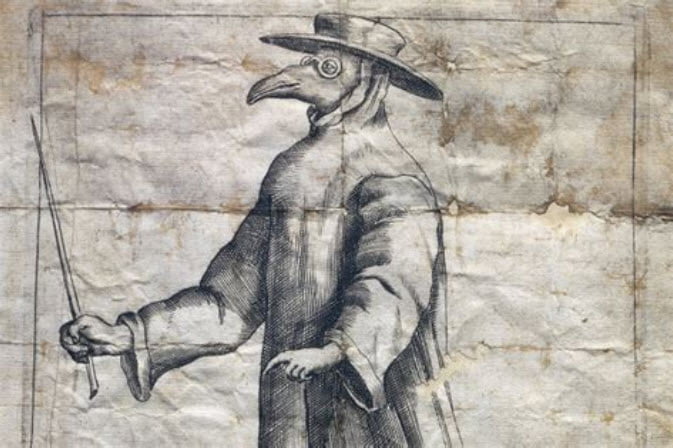
And at the top of the list: The Miasma theory. This theory held that many diseases such as cholera, chlamydia or the plague were caused by a miasma, a word that comes from Greek and means “pollution”. It was also known as “bad air”. In any case, it was believed that epidemics originated in the miasma that emanated from organic matter in decomposition.
Even today, many shamans and curanderos consider that the miasma exists and associate it with things like the evil eye, the “hielo de difunto” and other ills of popular culture. Later at some point I will do an episode on curanderismo and shamanic medicine, which is a topic that I am passionate about and of which I was very close during my path in the ancestrality.
Today we know that those diseases I mentioned come from different origins: viruses, bacteria, fungi, etc. But again, that was the knowledge of the time and besides a good beginning to understand that matter in decomposition could be unwholesome.
In the Middle Ages, many doctors and midwives would go from handling corpses or cleaning privies to attending births. It was not a surprise that in many communities there was a maternal mortality rate in childbirth of up to 1 in 10. The miasma theory could have helped the culture of handwashing, which began to become popular in the mid-19th century.
In fact, in those years, asking a doctor to wash his hands was seen as an offense, because we already know the religious connotation of washing feet or hands: it was seen as an act of humility, that one has to give of one's own will, and doctors were often seen as some of the most distinguished people in their community. The discovery of germs after 1880 eradicated the miasma theory from science, although not from popular culture.
As we see, some of the theories abandoned by science still accompany us in the form of superstitions or “alternative” beliefs. I have not wanted to mention in this episode astrology or homeopathy because I feel that they deserve a longer conversation, but it is evident that both disciplines have also been put in the catalog of pseudosciences, which really are nothing else than bodies of knowledge that have not passed the scientific method.
Technically, there may be certain conditions or diseases about which homeopathy is effective, and there may be some interaction between the celestial bodies and people, but it has not yet been possible to verify it. At least not in the form in which popular astronomy is presented.
Now, the phenomenon of leaving behind certain beliefs is in itself counterintuitive and difficult for the human mind. We do not wake up one day with the decision to believe in something different from what we believed the day before. Not even a scientist can do that! What science allows us is a method to escape the prison of our own mind. It gives us the possibility of advancing, since our mind tends to keep us tied to what we already know, to what we are accustomed to.
For the ancients it was surely tempting to think that the theories of the canalis, the phlogiston, the miasma, the ether or phrenology were abandoned by science to make way for theories that would support the interests of some minority. Maybe the one who wanted doctors to wash their hands had a soap factory; maybe the government didn't want the existence of Martians to be known and discredited Schiaparelli and Lowell, etc.
But will it not rather be our fear of the unknown and our clinging to the everyday that makes it difficult for us to abandon old beliefs and accept the evidence? Let me give you a current example: A year ago it was debated whether we should stop producing so much carbon dioxide, perhaps by working from home, limiting air traffic, stopping certain industries.
What did our politicians tell us then? That it was not possible, that the economy would go to the floor and there would be people in the streets making revolution, that global warming was a conspiracy theory. And well, here we are, doing the impossible and it has been possible: Yes, it is true that many people lost their job, that the economy is heading to the floor, but at the same time, the Earth is flourishing like it had not done in a long time, the ozone layer has been restored and the ecosystems are being restored.
On top of that, we are learning to do business from home, to innovate with door-to-door services, to create tools for social distancing. Because that is what we humans do: we adapt, we create solutions and we use science to overcome the obstacles we find.
My friends, the tool to get out of the matrix is the scientific method. The same one that the Mayas used in their architecture, and the Incas in their cultivation techniques, or the Muiscas in their goldwork. The same one that we can use internally to become better Beings and find our happiness.
That is the path of Spirituality and Science.
For now I take my leave and remain attentive to your comments or questions.
https://en.wikipedia.org/wiki/History_of_science
http://www.aniorte-nic.net/archivos/trabaj_histor_lavado_manos.pdf
https://www.space.com/19774-percival-lowell-biography.html
6 years ago Chain of Experimentation. In fact, this is the Mother of science………..in principle, the first scientists were people with scanty training, but with some kind of need to navigate problems and also possessing a little of constant spirit in the Test, trial, functionality…..
Comentarios (archivo, solo lectura)
Mostramos 1 comentario guardados de la versión anterior del sitio. Ya no se aceptan nuevos comentarios.
Cadena de Experimentacion.
De hecho es la Madre de la ciencia...........en principio los primeros cientificos, fueron personas con escasa formacion, pero con algun tipo de necesidad para sortear problemas y poseer tambien un poco de espiritu costante en la Prueba, ensayo, funcionalidad.....