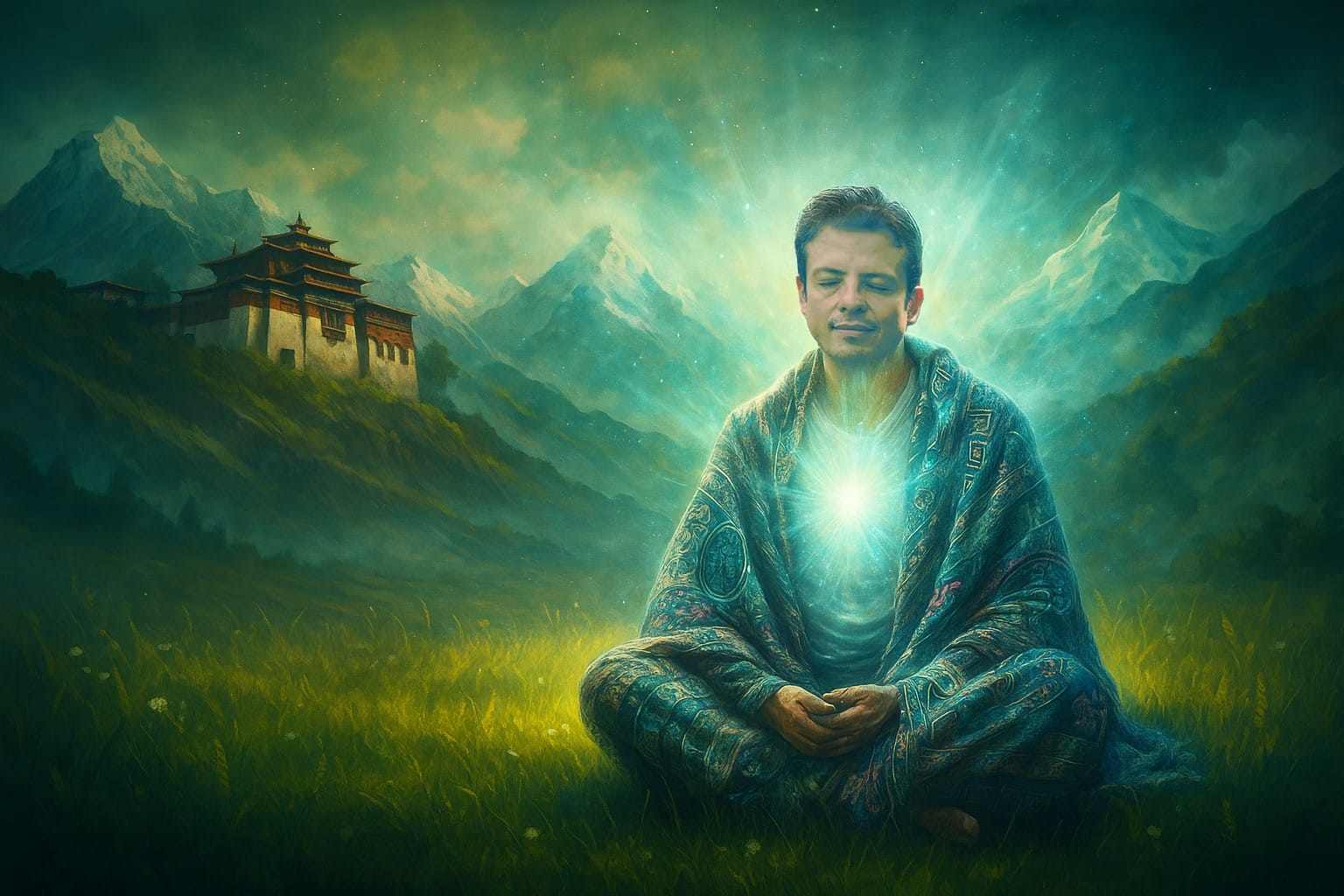
As some of you will remember from an earlier episode where I recounted my personal experience, I recently had the opportunity to immerse myself for the first time in a 10-day Vipassana meditation course. It was an intense and profoundly revelatory experience. Today I want to go beyond the day-to-day of the retreat and share with you the reflections that emerged as I explored the heart of the Dhamma teachings, as presented by S.N. Goenka, the key figure who brought Vipassana to the West.
Goenka, a Burmese businessman of Indian origin, found in Vipassana meditation, learned from his teacher Sayagyi U Ba Khin in Burma (today Myanmar), not only relief from severe migraines but a vital transformation. His gratitude drove him to share this technique which, according to tradition, was rediscovered by the Buddha more than 2,500 years ago and preserved in its purity in Burma. From India, the Buddha's homeland, Goenka spread it to the world.
But what exactly is the Dhamma? A religion, a philosophy, a worldview? This is the complex question that will guide us. We will explore its essential components - Sīla, Samādhi and Paññā - concepts such as the Saāṃhāras, the nature of suffering and the technique to transcend it toward peace.
True to the essence of this space, my intention is to offer a critical and at the same time appreciative look. There are elements of the Dhamma that are profoundly experiential, universal and, I would say, scientifically observable in their effects on the mind. However, there are also aspects that, despite Goenka's and many practitioners' conviction, may brush against pseudoscience or, at the very least, require a more careful analysis before being taken literally. I am thinking of concepts such as the kalapas (indivisible particles that the Buddha supposedly discovered through meditation, analogous to atoms), the doctrine of reincarnation, or a certain moralism that can be gleaned from interpretations of Sīla. My aim is to salvage what is valuable and objectively useful, especially the Vipassana technique as a powerful mental training, without falling into the need to accept supernatural beliefs. To illustrate, I will draw on some of the beautiful parables that Goenka used to share, stories which, like the biblical parables, convey deep truths beyond their literalness.
Approaching the Dhamma, especially through Goenka's courses, one naturally wonders whether one is entering a religion or a sect. Goenka insisted that he was not: the Dhamma is the universal law of nature, applicable to all, regardless of their creed. The Buddha (Gautama) is not a god, but a human being who attained enlightenment by understanding and living this law. 'Buddha' is a title: 'the awakened one'.
From my perspective, the Dhamma taught in Vipassana contains elements of a life philosophy, a practical psychology and a worldview. It includes an ethics (Sīla), a method of mental training (Samādhi) and a path toward experiential wisdom (Paññā). It differs from an organized religion in that it does not propose doctrines of blind faith (although some elements come close), there are no rituals of worship and no creator god. The responsibility is individual: 'Attāhi attano nātho' - 'You are your own master,' the Buddha said. Goenka recounted that Gautama himself emphasized that neither he depended on the Sangha (the community of monks) nor they on him; each individual depends on themselves and on the Dhamma.
Nevertheless, it is undeniable that Goenka's Dhamma comes from Theravada Buddhism. Although it is presented as non-sectarian and 'scientific', fundamental Buddhist beliefs such as reincarnation and the laws of karma/dharma are present in his talks. Goenka told the story of a man who, after years of listening to the Buddha and seeing others be freed while he remained the same, asked him: 'If you are so compassionate, why don't you free us all?' The Buddha replied by asking whether he knew the road from Sāvatthī to Rājagaha. The man knew it and explained it to anyone who asked. 'And have all the people you have explained the road to arrived?' the Buddha inquired. 'How could that be possible, Lord! If someone does not walk the path, how will they arrive?' the man retorted. 'Young man, that is what I tell you every day. I show the path; each one has to take their own steps.' This beautiful story underscores individual responsibility, but it can also imply a path of many lives, a point where I would suggest caution. One can appreciate the technique and the philosophy without adopting the complete Buddhist cosmogony. We do not need to believe in an afterlife to improve our life here and now.
For me, the Dhamma is, above all, an invitation to understand the nature of the mind and of suffering, offering practical tools such as Vipassana and Anapana meditation. That is what is universally valuable.
The path of the Dhamma rests on three pillars, like a tripod where each leg is essential:
To understand how Vipassana leads to wisdom, key is the Dhamma's view of the mind and of suffering. The mind has four interactive parts:
The problem is that we react blindly to sensations, generating Saāṃhāras continuously. These are the seeds of future suffering (dukkha). A Saāṃhāra of anger repeated over and over creates a habit, a deep groove. Goenka used to say that there are Saāṃhāras like lines in the water (they disappear instantly), in the sand (they last longer) or engraved in rock (they may take years to be erased, or never).
Dukkha (suffering, misery) permeates life: birth, illness, old age, death, association with the undesired, separation from the loved. Although I do not fully share the view that 'everything is suffering' unless you follow the Dhamma, it is true that much of our suffering comes from fears and projections, not from immediate reality. The phrase 'pain is inevitable, but suffering is a choice' resonates, although I would nuance 'choice' to 'conditioned reaction'.
The Buddha identified the root of this added unhappiness: our reaction of attachment (rāga) or aversion (dosa) toward our experiences, fundamentally toward our vedanā (sensations). We attach to the sensation that a person or thing produces in us. This attachment and aversion arise from the ignorance (avijjā) of the true nature of reality, especially of the fundamental truth of Anicca: impermanence. All flows, all changes, even we ourselves at the cellular level.
The five aggregates to which we cling (the material body and the four mental ones: Viññāṃa, Saññā, Vedanā, Saāṃkhāra) are suffering because of our attachment to them and to the idea of 'I' and 'mine'.
The Buddha's crucial discovery, according to Goenka, was identifying Vedanā as the missing link. Many teachers spoke of overcoming attachment and aversion, but the Buddha pointed out that the reaction does not arise from the external object, but from the sensation it generates. If we are not aware of this sensation and our automatic reaction to it, we operate superficially. By bringing attention to Vedanā and observing it with equanimity, we break the chain of reaction. Goenka used to say that the sensation is a crossroads: one path leads to misery (if we react), the other stops it (if we observe with wisdom, recognizing Anicca).
The Path of Exit: Observing Vedanā with Anicca and Upekkhā
Here Vipassana becomes practical. By scanning the body, we feel sensations, develop awareness of them and experientially understand Anicca: every sensation arises and disappears. This is not intellectual acceptance, but direct realization. Goenka compared the flame of a candle or the water of a river: they seem continuous, but they change at every instant. If you cross a river, the water you touch going is different from the water you touch coming back. Even the riverbed changes with time.
With the awareness of sensations (Vedanā) and the understanding of their impermanence (Anicca), we develop Upekkhā (equanimity): we learn not to react with attachment to the pleasant nor with aversion to the unpleasant. We simply observe. Feeling subtly, recognizing impermanence, remaining equanimous. By doing so, we cease generating new Saāṃhāras. According to the theory, old accumulated Saāṃhāras (the root of our patterns of suffering) begin to surface as sensations. If we continue observing them with equanimity, they weaken and are eradicated in a process of deep purification. 'Aniccā vata saāṃkhārā, uppādavaya-dhammino. Uppajjitvā nirujjhanti, tesaṃ vúpasamo sukho' (Impermanent, indeed, are the conditioned things; their nature is to arise and cease. Having arisen, they cease; their stilling is happiness).
This is where my scientific perspective finds a point of friction: the idea that observing physical sensations eradicates deep Saāṃhāras, even childhood traumas or past lives, seems to me to enter the metaphysical. However, I do firmly believe that meditation and attentive observation train us to be more resilient before life's vicissitudes, diminishing the suffering that comes from habitual reactions. It is not 'magic', but it is an effective mental training. I see a parallel with my experience with Yagé, which amplifies sensations and emotions. Vipassana offers more control and tools to navigate those experiences, a slower process but one that builds a solid capacity to use the mind healthily.
The Parable of the Two Jars
Goenka illustrated karma with the story of a young man who asks the Buddha to help the spirit of his dead father go to heaven. The Buddha has him fill one clay jar with ghee (clarified butter) and another with stones, seal them and break them in a pond. The ghee floats, the stones sink. 'Now,' the Buddha says, 'ask your priests to pray for the stones to rise and the ghee to sink.' 'Lord, that is impossible, it goes against the law of nature!' the young man exclaims. 'You know the law of nature so well, yet you do not want to understand it,' the Buddha retorts. 'If your father did heavy actions, like stones, he will go down. If he did light actions, like the ghee, he will float. Who can change that? Action, volition, is what matters.'
The Vipassana technique is presented as a science of the mind and of matter. In many respects, it is:
Goenka himself, aware of these possible objections, used the metaphor of a mother who tells her son to take the cardamom (a black speck) out of the food if he does not like it and to enjoy the rest. 'If some theoretical aspect of the Dhamma does not resonate with you,' he would say, 'take it out and focus on the practice, on the food that is meditation.'
At the end of the course, the Ten Pāramīs are mentioned, qualities to be cultivated for the complete liberation from the cycle of death and rebirth (the goal of Buddhism):
Despite the criticisms of certain metaphysical aspects, I consider the benefits of Vipassana meditation as a technique, and of the Dhamma as a life philosophy (selecting its components), to be immense. It is the closest thing to a 'pure' spirituality I have known, less mixed with dogmas. In a world so full of division, hatred, manipulation and attachments, an objective, equanimous view grounded in reality is invaluable.
Personally, this experience has been very positive. I hope to repeat the retreat one day, but, above all, I want to keep this tool as part of my life, applying it to improve, to let go of unnecessary suffering and, God willing, to help spread the knowledge of these teachings as a valid path.
I would love to read your questions, comments or your own experience with meditation or the Dhamma in the comments.
Good journey and good breeze.