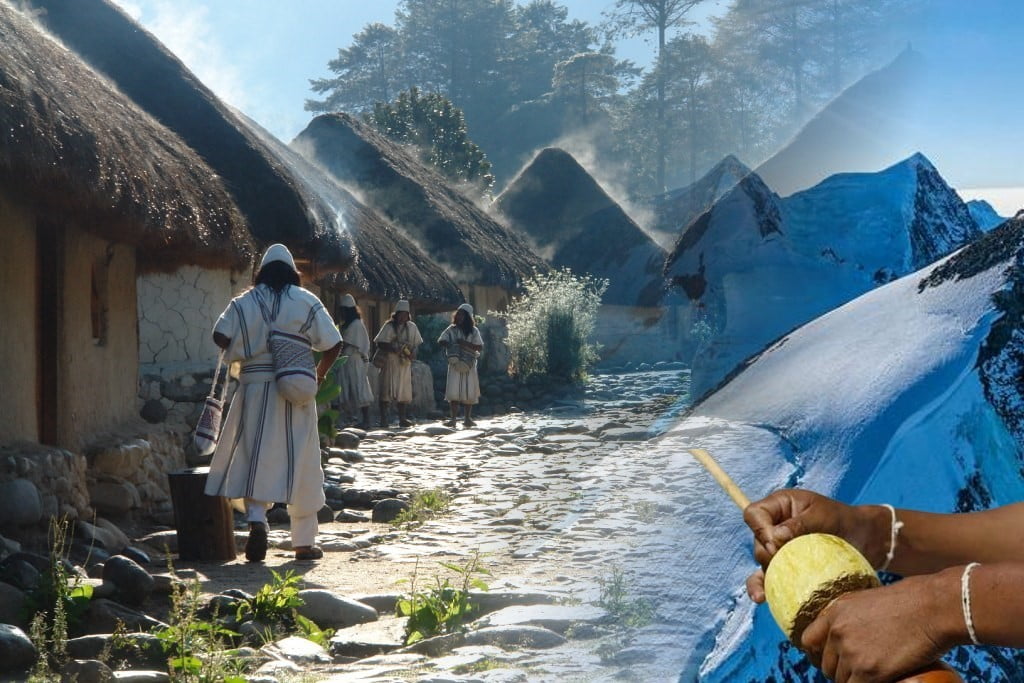
The following days were frenetic; the commitment with the elders of the Sierra Nevada was that the members of the community would receive spindles and poporos the following Friday, again at Perseo's house, so we had to have ready all the necessary elements for the ritual. This was one of the times when I felt that the community of the Pueblo Nación Muisca-Chibcha was moving as a unit, a common-unit: The necessary tasks were distributed and there were always volunteers for every assignment.
Some tybas, or men of the community, were commissioned to travel to the nearby towns of La Vega and Sasaima and to obtain at least fifty gourds with the proper shape to become poporos. Another group had to coordinate the purchase and transport of chonta rods and stone wheels to make the women's spindles.
Grandmother Yanguma would be in charge of obtaining the virgin cotton and of spiritually preparing the less experienced future spinners, among whom Paula was. On the other hand, grandfather Suagagua asked me to accompany him to obtain the sea shells, quartzes, seeds and other elements we would need later for the aseguranza.
A final group would be in charge of obtaining the hayu (coca leaf) and the sea lime for the poporeros.
The logistics worked perfectly and the following Friday evening we met again at Perseo's house with all the necessary elements for the ceremony. Paula had even traveled along with grandmother Yanguma and other women of the community to the town of Facatativá to perform an empowerment ceremony in mambe, which the grandmother considered necessary before they could receive their spindles.
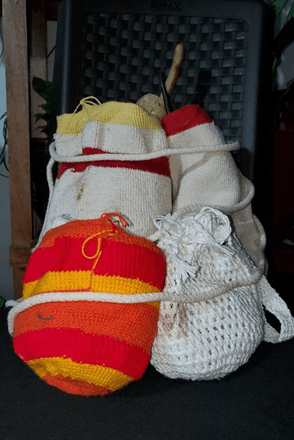
The ceremony of the marriage of poporos and spindles lasted from Friday night until Sunday, well into the afternoon. During all those hours, we were concentrated on different activities related to the spiritual process we were carrying out, but we also took turns doing the sustaining chores of such a large group of people: cooking, cleaning, organizing the place, and so on.
The first night was devoted mainly to listening to the word of mamo Andrés, who shared with us the impressive story of the ten-year payment of the clay moyo, the mysticism of the work with the poporo and the spindle and some of the traditions and customs of the Arhuacos during processes like the one we were advancing. The constant was that whatever we did, in the Sierra it was ten times more difficult to achieve, so we should feel ourselves fortunate.
The anticipation of receiving my poporo the next day and the amount of stories and teachings we were receiving from the elders made the effort of staying awake through the night more bearable. The next day the community work, the camaraderie and the good humor of my tybas friends kept the group's spirits up, so much so that when the time came to sit down to receive our new spiritual instruments, we were still cheerful and energetic.
Finally, we sat again in circle, first the already-formed couples and then the single members of the community. After some last-minute recommendations about the importance of the rite we were performing and the responsibility that lay upon our shoulders, the grandfathers went around with the gourds, chucunos and spindles so that each one could choose the one with which he felt an immediate connection.
I took a good-sized gourd and the straightest chucuno I saw. Paula took a spindle with the stone wheel with the engravings she liked most and we remained seated awaiting further instructions. Once the whole group had received their elements, grandfather Suagagua took the word and, as if he were an officiating minister, presented before the cosmos the new poporos and spindles that had just been delivered and decreed that from that moment on, the spirits of those elements ascended to the subtle worlds as an indissoluble and eternal spiritual couple:
– “Your spindles and your poporos remain in sacred marriage in the Cosmos; you will see if you maintain that union here on earth or if you prefer to end up in a ball of string.”
Paula and I took each other's hand with force while the grandfather said those words and we looked at each other, confirming that both of us longed for the union of our spindle and poporo to be not only eternal, but also that of our lives and our souls. Then we gave each other a kiss and said goodbye for a few hours when the grandfathers separated us by sex in order to instruct us in the use of our new tools.
When the moment came to use my poporo for the first time, I took from my pack a bag in which I had the portion of hayu the grandfathers had given me. It was a large bundle of previously toasted coca leaves, although still green in color and broken into small pieces. I carried to my mouth a small portion that I took with the tip of my fingers and placed it on the left side of my mouth, between my cheek and my molars.
Then, following the instructions of grandfather Nemequene, I poured a part of the sea-shell lime they had delivered me into the bottom of the gourd. The next step, which was the one I liked least, consisted of sucking a swab of ambira, which I extracted from the black flask with the tip of my right little finger. I could not avoid the gesture of distaste that usually overcame me when I felt the strong taste of the nicotine, and I proceeded to suck the tip of the chucuno, trying so that it would be coated not only with saliva but also with the juice of coca and ambira.
Finished forming the fertilizing part, I inserted the chucuno into the gourd, let it be impregnated with the lime that was at the bottom, and then I used the chucuno as a spatula to smear the yellowish wet lime onto the neck of the gourd. My heart was beating strongly; it was the first stroke of cosmic gold I was imprinting on my own poporo.
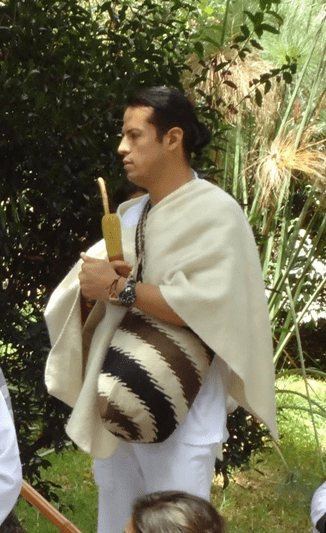
The grandfathers and mamo Andrés watched the scene smiling, the new poporeros getting to know their new “spiritual wife”, the title by which the knowers recognize the poporo, which, according to them, has a feminine spirit, just as the spindle has a masculine spirit.
The task seemed pleasant to me and being there poporeando with my community companions while we listened to the wise teachings of the elders was a dream come true. I imagined the magical experiences the poporo would provide me and how great it would be when my gourd exhibited a thick collar of golden lime.
While we were chewing mambe and poporeando, continuing to ingest ambira, sucking the chucuno, inserting it among the lime and painting the gourd, after a couple of hours I began to feel a small burning on the inner part of my cheek, near the corner of the mouth. At first I didn't pay it much attention, but little by little the burning intensified until I could not continue poporeando any more. Then I realized there were a few small drops of blood on the lime that was on the chucuno.
I was not the only one having trouble poporeando. Several of my friends also complained of having burned their mouths and when the grandfathers heard them, they did not hide their mockery. Apparently, burning oneself with the lime is part of the initiation rite with the poporo, and it happens to almost all beginners, while they learn to somehow isolate the live lime from the skin of the mouth.
Apart from the burning, that day I felt no other sensation at all while poporeando. I thought the mixture of ambira with hayu and lime would produce some altered state of consciousness, but that was not the case, or at least I couldn't notice it, but I committed to myself to keep working with my new tool until I achieved some of those experiences so many poporeros had shared.
And so passed the second night and the final day of the ceremony of the delivery of poporos and spindles, enduring the pain of the mouth, trying to learn to mix the ingredients, calculate the precise proportion of lime and the best way to paint the poporo while we listened to the word of the elders. Paula, for her part, was trying without much success to spin the cotton so that the resulting thread would be continuous and of consistent gauge.
One anecdote of the event happened on the last day of the gathering when the grandfathers were in the kitchen making a preparation in the famous clay moyo that mamo Andrés had fabricated during his ten-year payment. In an unfortunate movement, some helper in the kitchen pushed the moyo off the stove and it came down along with the preparation of aromatic herbs it contained. Grandfather Suagagua, who was nearby, threw himself to prevent the moyo from crashing against the floor, saving it from ending in smithereens by a Muisca elbow and, he said, perhaps also saving Bogotá from being smashed to pieces by the earthquake the moyo supposedly prevented.
After the exhausting weekend, the work of the community, especially of the couples, had only just begun. The delivery of poporos and spindles had been but the first step in the construction of the ancestral aseguranza. Until that moment I had thought the main ceremony was the one we had held at Perseo's house, but the grandfathers explained to us that the aseguranza is much more than the spindle and the poporo. That is what we would verify during the following two weeks.
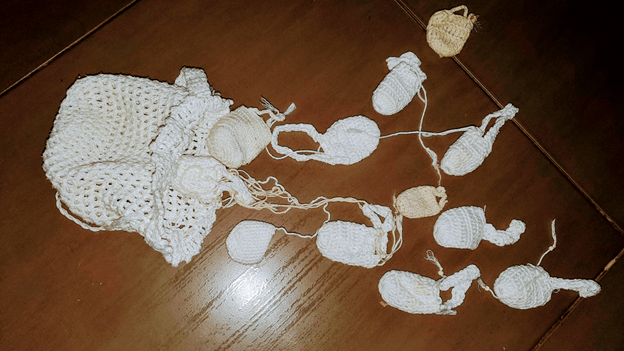
The first part of the process consisted of weaving: men and women had to sit down and learn, those who didn't know how to do it, or to practice, those who had an idea. I think my mother was the most surprised when I asked her where I could get white wool and a crochet needle. Paula didn't know how to weave either, so the two of us became weaving apprentices under my mother's mentorship. The task was to weave two medium packs, with enough capacity to hold in them half a kilo of rice. The weaving, besides, had to be so tight that it could hold flour and its handle had to be long and resistant enough to carry it on the shoulder.
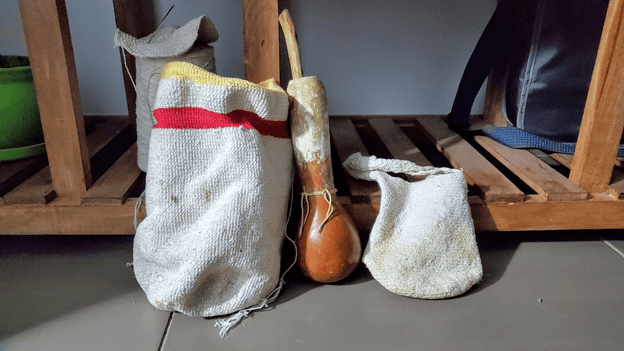
In addition to these two packs, each one of the candidates to receive the aseguranza had to weave twelve small packs. Each of these was to be like a miniature version of the previous two, about six or seven centimeters high by five wide, and with a small handle so they would be little packs and not little pouches.
Weaving turned out to be a very entertaining activity. I remember the long sessions of chewing mambe with the community, with no tobacco smoke or hoska snorted through the nose. Everyone weaving their white packs and chatting animatedly. We also had to dedicate time at home to do the homework because a few days later we realized that, due to our lack of skill in the weaving, the labor was going to take much more time than we had thought.
The following weekend, the grandfathers called us to a place very special for the Muisca: a clearing in the forest in the Mirador de los Nevados park, next to an old tree we called “the grandfather”. At the place the grandfathers were waiting for us, including Xieguazinsa. I thought we were going to listen to the word about the weaving or about the aseguranza, but instead, there was more handicraft work for us:
– “Today we have to start creating the elements of the aseguranza, so you have to bring out that Muisca artisan talent you carry in your blood”, pronounced the grandfather Suagagua.
Each one of us had to carve a series of wood miniatures, which should represent as faithfully as possible a bow with its arrows, a cane, a lance, a mask, a chair, a bundle of firewood, a small poporo and a small spindle. In addition, each candidate to receive the aseguranza received a seed of chocho (Ormosia coccinea), a quartz, a shell, a seed of oxeye and a small sea snail. All these elements would be important later to build the aseguranza.
That weekend, after spending many hours weaving and carving, the hour came to complete our ritual of the aseguranza of the Sierra Nevada. The appointment was at the farm “Sol Naciente”, mentioned earlier, which was in the municipality of La Vega and was the property of the controversial taita Orlando Gaitán, who several years later would be sentenced to 19 years in prison for the rape of three minors in a state of incapacity to resist.
At that time, taita Orlando had taken in at his farm the mamos of the Sierra Nevada so that they would carry out their mission of delivering the aseguranza to the Muisca, and for other exchanges of knowledges between the indigenous people of the Sierra and his indigenist community of yagé takers known as the Carare Foundation.
Those days, the non-sanct activities of taita Orlando were not publicly known and Gaitán's image was that of a benevolent healer and knower of yagé, who had achieved national fame after receiving an award supposedly considered an alternative Nobel of peace, for his community leadership at the head of peasant communities in the midst of the violence. Later it was learned that the award was not received by Gaitán, but by an association of peasant workers, Carare, of which the taita was a part.
In any case, we never did get to see taita Orlando at the farm, although his presence and influence were indeed breathed in the place. On our arrival, we were led to one of the great malocas arranged for the yagé ceremonies that were held at the farm. There we found a good number of benches and chairs and the Muisca and Arhuaco elders in the center of the maloca. We settled into a couple of chairs in the periphery of the place and, like good Colombians, proceeded to finish at a run and with little care our failed artisanal undertaking.
While we completed our little packs and little figures, grandfather Xieguazinsa spoke to us about the work of the mamos in the nine snow peaks, the four guardian communities of each snow peak and the ancestral prophecies we were fulfilling with our work of those nights. Then came the practical instructions of how to organize all the elements we had built in those days: each element received and each object carved had to be inserted into one of the small packs we had woven. As the grandfather was indicating to us which object to pack, he told us its spiritual meaning and what the inner work to be done with each of them should be.
And so, the seed of chocho represents the heart, by reason of which, it had to be kept in a little pack tied to another in which we would put a wisp of virgin cotton that represents the spirit. In that way, we would create a connection between our own heart and our spiritual path. The other elements would care for a part of the life of the insured: the bundle of firewood and the cane assured that we would always have work and support in the moment we needed it. A small lance and a bow with its arrows in their respective packs would represent the aseguranza of our capacity to obtain food and protection. The mask and the chair, each one in its pack, would care that we always find a seat in the place of the cosmos that corresponds to us and protected from the world of appearances. The shell and the small snail represent the balance of the feminine and the masculine in its childish version and the poporo and the spindle in miniature as its adult counterpart.
Once we had finished putting all the elements in their packs, mamo Andrés initiated the ceremony properly so to speak. He told us that we had to gather our placenta. The indigenous people have the custom of burying the placenta a few months after the birth, but in the cities the most common thing is that they are incinerated or thrown in the trash. In my case, I didn't even know what would have become of my placenta and probably my mother had no idea either. However, the mamo explained that we would do it in a spiritual way, with the creative imagination, connecting ourselves with the spirit of the placenta wherever it happened to be.
I supposed it had been thrown in some dumpster behind the clinic, where in turn it would have been collected and transported to some municipal sanitary landfill. There it had surely rotted and ended in the digestive system of birds of prey, worms and bacteria. Transformed later into organic matter that would have given rise to new plant life from which many beings would have later fed. Following the instructions of the mamo, I then imagined reversing all that process, returning the matter and energy of all the corners of the Earth to my placenta forgotten in the dumpster. In my mind a violet-tinged placenta materialized that I transported with the power of the imagination to a place of power chosen by me. The place chosen was my grandparents' farm in the vereda of Guane, in the municipality of Fómeque in Cundinamarca. There arrived my imaginary placenta and I planted it carefully in a small clearing of trees on one of the small mountains that delimit the property.
I thanked grandmother placenta for bringing me to this plane of existence and asked her that, from there, in her new astral location, she connect with my new aseguranza and my poporo to assist me on the path I set out on December 10, 1979.
After gathering our placenta, came the work of spindles and poporos, which occupied the rest of the night. The experience was so novel and pleasant that we saw the dawn come almost without realizing we had not closed our eyes. By day we took part in the offices of the community, chatted with the grandfathers and ate food without salt or meat. In the afternoon, we returned to the maloca to continue with the work of the aseguranza.
The second night of the work of the aseguranza passed again with coca leaf and ambira in my mouth, adhering salivated lime onto my gourd. Paula, meanwhile, kept trying to acquire the skill necessary to create a continuous thread from her skein of virgin wool. The small packs with the elements of the aseguranza rested between a medium pack we wore slung across the chest and while we worked on the spindle and the poporo, mamo Andrés explained to us the final part of the aseguranza:
That night we would do a long pagamento, traveling through the geography of Colombia, again with the power of the imagination. The pagamento, as I explained in an earlier chapter, is an ancestral ceremony in which through a performance, the practitioner recognizes the need to offer a counter-payment to nature, for all that we take from it for our benefit.
In this case, we would make an imaginary journey to each of the nine major snow peaks of the national territory and in each one, we would offer our work with spindles and poporos as pagamento not only for what we take personally from nature, but for what the material and spiritual grandfathers that keep watch over each snow peak take for themselves. The logistics of the pagamento caught my attention since it was more complex than that of other pagamentos I had performed before in which we simply said out loud that for which we were paying, as if it were a prayer of thanks.
According to the explanation of grandfather Xieguazinsa, in each snow peak, we had to manifest out loud our pagamento for each element of the aseguranza, each type of food and each natural resource we could recall, alluding to each one of the four elements: water, fire, earth and air, of which according to the indigenous people all matter is composed. Besides that, according to the knowers of the Sierra, each one of these elements exists in potential form within the other three elements, as well as in its own reflection. So that, in each snow peak, we would manifest our willingness to pay for a list of probably 40 or 50 elements, each one of them in the form of water of water, water of fire, water of earth and water of air. Then, in the form of fire of water, fire of fire, fire of earth and fire of air and so on.
According to my counts, the complete pagamento would have implied mentioning out loud the payment of 4 elements by 4 elements by 40 items by 9 snow peaks, for a total of more than 5,000 phrases. After about an hour of this complex mistic retahíla and conscious that the night would not be enough for us - and probably neither the next day - to finish with the pagamento, the mamo agreed to grandfather Xieguazinsa's proposal to simplify the matter of the 4 elements, saying simply “I pay the water of Huicán in four by four”.
Thanks to the timely spiritual algebra, the pagamento lasted only a couple of hours and with it, we considered the construction of our aseguranza finished and the spiritual consummation of the marriage between my poporo and Paula's spindle. We saw the dawn come again, having hardly slept for stretches of a few minutes and although by that time Paula and I were worn out by the fatigue, we also felt proud of having completed that spiritual marathon, which, as you will recall, did not begin at taita Orlando's farm, but weeks earlier at Perseo's house and that involved for us many hours of weaving and carving work.
The light of the dawn also brought us, as if it were an epiphany, the understanding of what we had really done during all those days: With the poporo and the spindle, we received some tools that represent the labor that joins our humanity with the divine: procreation and weaving, which are archetypes of conscious creation and couple work as the nucleus of the construction of community. Then we had to carve with our own hands small symbols of many aspects of life like childhood, the couple, work, appearances, purpose, food, vision, and so on. Each one of those symbols had to be kept in packs woven by ourselves, that is, protected by the threads of our spiritual work, stitches that represent each decision we make during our life.
All those symbols of the spiritual work had to be connected with our placenta, which is in itself a pack in which was planted the seed from which we come and where spiritually we carry the elements of which the spiritual work is formed. With that pack full of meanings we traveled to the snow peaks, which represent the connection with the Earth, to recognize and give thanks for what we take from it every day to carry out our work.
The aseguranza is life itself, represented in sensible symbols that had to be forged with our own hands to understand the value and importance of each aspect of life, but above all to understand that spirituality is based on work, the effort it implies to remain awake despite the fatigue and the humility of recognizing that all that we take from the Earth has a price that we must be willing to pay.
Often I think of the pack that contains my aseguranza and I see it as a connection with my origin, my territory and my companion. I believe also that it protects me, since the teachings I received in raising it have been integrated into each one of the aspects of my life represented by those small objects. When we built our aseguranza, we built the life we wished to live from then on and a decade later, I can say I have seen blossom all around us what we planted in those nights of medicine, word and tradition.