At Perseo's house began one of the most beautiful processes of my walking with the Muisca, and the only one in which Paula participated with the same intensity as I did. Until that moment, initiation as a Muisca knower had been a mostly individual matter, one in which Paula participated more as a companion than as a participant. As I told earlier, she had never been very enthusiastic about all the work the ancestral spiritual path implied, but by force of taking part in ceremonies, word circles and other activities with the community, she had begun to find some things valuable for her own personal growth and already had her own pack of ancestral work, which held tobacco, mambe, a weaving, and her first little flask of ambira after taking part in her first preparation of the ancestral medicine at the Lombana house.
For her part, the problem was that despite feeling accepted and appreciated by the grandfathers and the community in general, she also felt that she was belittled or at least not fully valued as my spiritual partner. It was evident that the grandfathers, above all Xieguazinsa and Yanguma, had some preference for me among the men of the community, but for her, that meant a higher level of demand. The wife of a Muisca who might one day become a grandfather was supposed to be a woman disciplined in the medicine, the weaving and the household work, and Paula, barely 21 years old and not very motivated to become part of an ethnicity she did not consider her own, hardly fit the mold the grandfathers had in mind.
All of this changed suddenly, a few months after my rite of passage. The grandfathers nominated Paula to perform her own initiation rite and, in fact, included her in the next cohort that would receive it. The sudden zeal came from an event that had just occurred and aligned completely with the “prophecy” of the return of the Muisca people: A group of mamos, or spiritual authorities of the Arhuaco ethnicity of the Sierra Nevada de Santa Marta, announced to the grandfathers Xieguazinsa and Suagagua that it was time for the members of the community to receive the aseguranza of the Sierra Nevada.
The history goes back to 1992. That year, mamo Andrés Izquierdo and his brother the future mamo Lorenzo Izquierdo received the order of their elders to seek out and gather together the elders of the nine snow peaks of the Colombian Andes, for the healing of the communities and their ancestral territory.
Back then, mamo Andrés was in the midst of the most important payment of his life: In 1985, the same year that in Colombia the Nevado del Ruiz volcano buried the municipality of Armero under a river of lava and mud, leaving more than 23,000 dead, an 8.1 magnitude earthquake on the Richter scale devastated the City of Mexico, burying under the rubble more than 20,000 people, according to the calculations of some organizations.
The coincidence of the events did not go unnoticed by religious and spiritual organizations around the world, many of which saw in the tragedies a message from the beyond. Even Pope John Paul II, then the hierarch of the Catholic Church, dedicated two of his numerous trips to attend to the battered congregations of Mexico and Colombia that same year.
The mamos of the Sierra Nevada de Santa Marta, accustomed to reading in natural phenomena messages for humanity and validation of their spiritual work, entered into a permanent council, closed themselves off to consult on the cause of Serankua's fury and above all to understand what they should do to avoid further punishments of Seünniünhachün (Seynekun), which is what the Arhuacos call Mother Earth.
The answers they received were not good news. The spiritual grandfathers revealed to them that a terrible earthquake would destroy Bogotá, a city of more than four million inhabitants at the time. The only way to avoid the new tragedy was if the spiritual authorities of the most important snow peaks of the Andes cordillera united in payment.
As it was unlikely that such a goal could be achieved in the short term that the Deities seemed to demand, the mamos managed to negotiate a deal according to which Serankua would stop her punishment upon humanity if one of the mamos seated in the council of elders performed the ancestral payment of the clay moyo during the following ten years.
The steep price of divine mercy consisted of the fact that a mamo would have to go on diet, not have sex or hulu-hulu as they call it in the Sierra, and keep silence, while for ten years he fabricated with his own hands a clay moyo over a fire that must never be allowed to go out again from the start of the payment[1].
Having participated in spiritual works that required similar diets of two or three days, I can barely imagine the magnitude of committing to a similar effort for ten years. The thing is that mamo Andrés Izquierdo took on the heavy burden, for the salvation of perhaps hundreds of thousands of lives that could have been lost had they suffered an earthquake like the one the City of Mexico lived through, in a city so poorly prepared to withstand earthquakes as Bogotá was in the late 1980s.
While mamo Andrés devoted himself to the payment of the clay moyo in the Sierra Nevada, his younger brother Lorenzo, who was barely a boy, was charged with preparing for the search of the major guardians of the nine snow peaks of the territory, to complete the pact with Serankua. Like the Ingatyba Neusa brothers, the Izquierdo brothers had been chosen by destiny for an important work of spiritual awakening in the heart of America.
It was not until 2008, many years after the pact with Serankua and several years after mamo Andrés finished his exhausting payment of the clay moyo, that Lorenzo set out on his journey through the Andes, looking for the representatives of the indigenous communities that kept watch over each of the nine major snow peaks of the cordillera, to convey to them the petition of the deities.
Lorenzo set out from the Sierra Nevada itself, where are found the two highest snow-covered summits of the country: Pico Simón Bolívar and Pico Cristóbal Colón, both part of the Gonawindúa system and kept by the Kogi, Wiwa, Kankuamo and Arhuaco peoples. He headed toward the south-east to the serranía del Cocuy where he met the U'wa peoples, descendants of the original Muisca, who call their sacred mountain 'Güicán'.
After reaching agreements with the elders of the first three snow peaks, Lorenzo traveled to the coffee axis where he met up with the Nasa, Paez, Emberá, Guambiano and a few other ethnicities, keepers of the snow peaks of Ruiz, Tolima, Santa Isabel, Quindío and Cisne.
Now mamo Lorenzo, ended his tour at the snow peak of Cumbal, located in the south-west of Colombia on the border with Ecuador and kept by the Awá, Pastos, Cofán and Cumbales ethnicities. The endpoint of the journey was no coincidence. Cumbal was not only the snow peak situated furthest south in the Colombian territory, but in an ominous coincidence due to global warming, its summit completely lost its glacial cap in 1985[2], a year that, as we have already seen, is as synonymous with fatality for Colombia as 2020 would later be for the whole world due to a global pandemic. According to mamo Andrés, that would be the first but not the last snow peak to lose its tutusuma of snow[3].
– “If we do not set ourselves in order” the elder pronounced, “we will be left without a single snow peak and then no man will ever be able to again carry the sacred tutusuma on his head. We will be lost.”
Lorenzo realized that around each of the nine snow peaks he had found four major indigenous peoples, although there were some smaller ones, which formed the four posts that held up the spiritual house of the invisible grandfathers of the snow peaks. Each elder of each indigenous people was a post or main pillar, around the sacred mountain, which was the central post. But around the snow peak of Cocuy or Güicán, he had only found three guardian communities: The U'wa, the Betoye and the Sikuani. One tribe was missing.
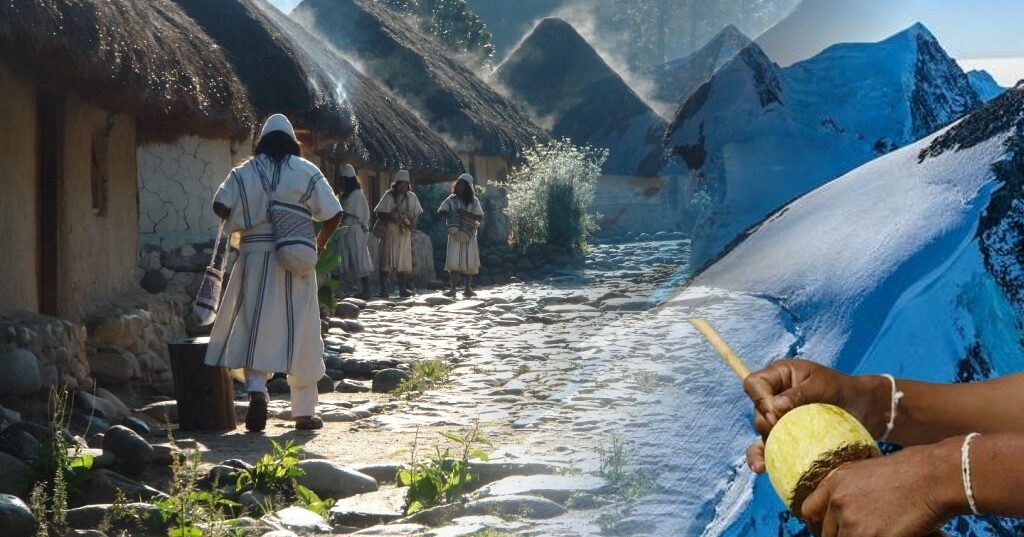
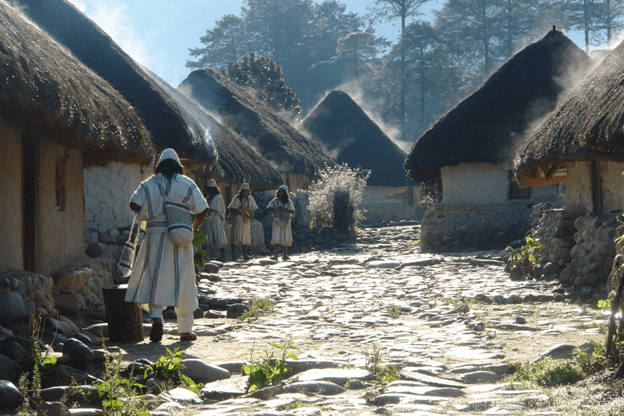
When Lorenzo returned home, he consulted with mamo Andrés, his brother, who had already made contact with the elders of all the native guardian communities of the nine sacred snow peaks. However, he told him, he believed that the guardians of Güicán were not complete, so his task was still not finished. Mamo Andrés stopped his work with his poporo, closed his eyes and leaned toward the central fire of the sacred house in which the elders gathered. The building was the only one with a cylindrical base and conical roof, since all the other dwellings had a square shape and pyramidal roof[4].
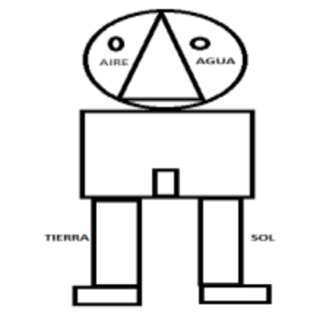
Mamo Lorenzo knew as well as his older brother did that the number four or Ma'keywa, was of vital importance in the cosmogony of his people. The four for them meant perfection: four elements of nature: earth, fire, air and water; four sacred geometric figures: square, circle, rectangle and triangle: the four cardinal points, four stages of life: birth, baptism, reproduction and death, four phases of cultivation: clear, burn, plant and harvest. For that reason, the number four was also the number of the human being.
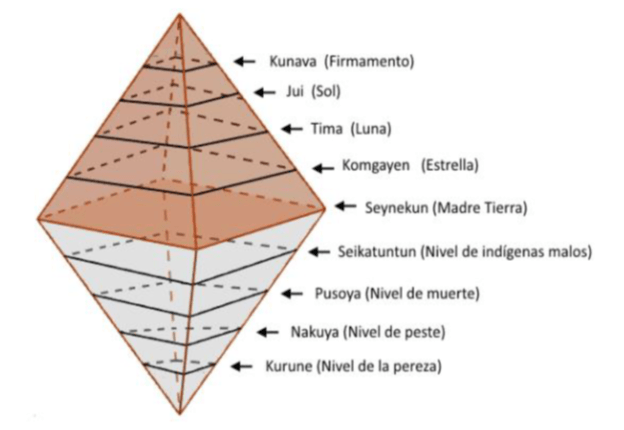
But the four was especially important because according to the Arhuacos, it is at the center of the very structure of the Universe: Four lower worlds: the first level, Estrella (Komgayen), the second level the moon (Tima), the third level, the sun (Jui) and the fourth level, the firmament (Kunava). Four lower worlds: that of bad people (Seikatuntun), the second level, that of death (Pusoya), the third level that represents the pestilence (Nakuya) and the fourth level that represents laziness (Kurune).
The human being would find itself in the middle between the four upper worlds and the four lower worlds, in Seynekun - Mother Earth, so that the creation consisted of nine worlds in total for nine snow peaks, which were to be kept by four major posts each. Lorenzo had not been mistaken. Around Güicán there had to be another major post[5].
The elderly mamo Andrés opened his eyes, looked at his brother and told him:
– “From here I have heard the song of the fourth post that is between the mountains in the center of the cordillera. There is a people clothed in white who has been singing to the Sierra; they want to awaken, but it is time to help them. Their men have not received the poporo and their women have not received the spindle. We will have to deliver to them what was given to us to keep many years ago when the younger white brothers came from the ocean.”
It was not long before the mamos came to be with the elders of the Pueblo Nación Muisca-Chibcha. Mamos Andrés and Lorenzo met with the grandfathers Xieguazinsa, Fagua, Suagagua, Yanguma, Nemequene and Comba. In a ceremony that took place over several days on the farm El Sol Naciente, property of Taita Orlando Gaitán, located in the municipality of La Vega, in Cundinamarca, the Arhuaco elders delivered to their Muisca counterparts the ancestral poporo that once belonged to their native ancestors. The invited grandmothers, in turn, received the sacred spindle with which the elder women spin the cotton to weave the packs of their husbands and children.
Having delivered the necessary tools for the spiritual work, the Muisca were ready to take part in the important work that since 1993 the mamos had committed themselves to carry out to prevent the Colombian territory from suffering a new tragedy, this time of even more devastating proportions.
That is how in 2009, as a result of his tour of the nine snow peaks, and at last with the representatives of each of the four guardian ethnicities of each of the nine snow peaks, the first national meeting of spiritual authorities of Colombia took place. The event was held in Pasto, in the department of Nariño, near Cumbal, the snow peak that had already lost its white tutusuma.
At that gathering, the spiritual elders assembled came to understand that difference makes for the complement among peoples and that the union of knowledge contributes to the healing of the Earth[6].
The Muisca of the Pueblo Nación had officially become one of the four major posts, keepers of the snow peak of Güicán-Cocuy, and each of the four grandfathers gathered in the meeting - Xieguazinsa, Suagagua, Nemequene and Comba - had been designated as major posts of the sacred Muisca house, in what would be configured as a spiritual fractal: A double pyramid of nine sacred houses in nine snow peaks that unfolded into 36 sacred houses of 36 ethnicities, each of them formed by four major posts and at the center the sacred fire that was never to go out.
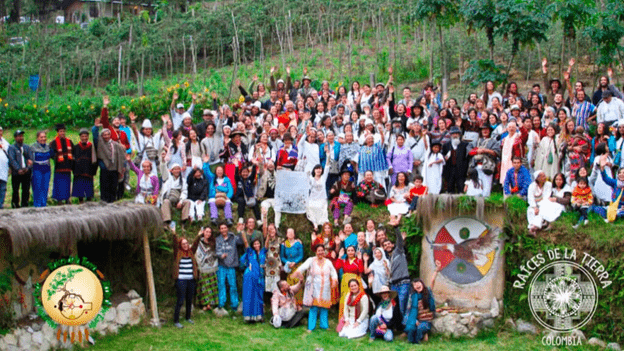
Now everything was set for the new Muisca people to continue awakening and to receive their poporos, their spindles and their aseguranza. Many believe that the aseguranza is only a bracelet of cotton thread that the Arhuacos give to those who visit them to protect them from all danger, but as Paula and I were to experience in body, mind and spirit, it was much more than that: it would be our connection with the sacred matrix and our spiritual marriage.
I first learned of the delivery of poporos one night at the house of the grandfathers Yanguma and Suagagua, during a special meeting of the community. We had been announced that an important announcement would be made and the unusual presence of Xieguazinsa on the scene confirmed such an announcement. As was usual with the most important matters of the Pueblo Nación, Xieguazinsa took the word, told a condensed version of the history of the mamos Izquierdo and informed us that from that moment on, the couples already formed in the community had to prepare ourselves to receive poporos and spindles.
I had seen the grandfathers use their poporos in almost all the ceremonies of the community, but I had no idea what a spindle was. The grandfathers Suagagua and Nemequene spoke frequently of their poporos and recounted how by working the poporo with discipline they could achieve incredible things like receiving messages from their spiritual grandfathers, entering states of Samadhi, seeing the future and bringing material prosperity. All this by stamping with the chucuno a golden crust of sea lime mixed with saliva, ambira and coca leaf over the long neck of a gourd.
The relationship between poporo and prosperity was historically well established thanks to the famous pure gold craftsmanship found in the municipality of Anorí in the department of Antioquia and attributed to the now-disappeared Quimbaya culture, which also belonged to the Chibcha language family.
According to grandfather Xieguazinsa, by smearing the chucuno with one's own saliva, previously mixed in the mouth with ambira of tobacco and hayu or coca leaf, a spiritual seed is formed similar in essence to semen, but of spiritual and not physical quality. The long chucuno, impregnated with the fertile saliva carrying the spirit of the word of coca and tobacco, was then inserted, in the manner of a phallus, into the uterus represented by the base of the gourd, where the fecundation of the word takes place when it joins the lime extracted from the sea shells that rest inside the poporo.
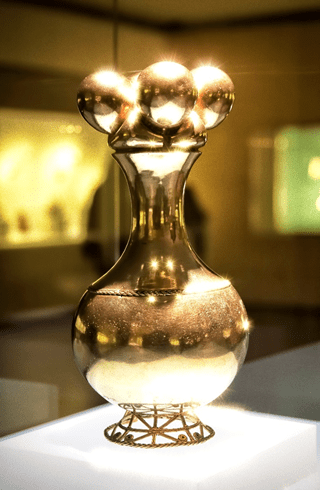
The mixture of murky saliva, earth-colored ambira, green hayu (coca) and white lime results in a yellowish paste of consistency that varies according to the proportion of each ingredient. The poporero then proceeds to smear the fertile mixture over the neck of the poporo, like an artisan covering a vase with paint.
– “When we spread the lime on the poporo, we are writing in the Cosmos with the spiritual gold we have created with our inner work.” Clarified the güexica Xieguazinsa.
What I had heard from the grandfathers was that the poporo was only delivered after many years of preparation and an empowerment process that could take weeks, but these were atypical times. There was an important spiritual task to perform and the gods had agreed to deliver poporos and spindles to the Muisca despite our scant preparation. Receiving my own poporo would have seemed unthinkable a few days earlier, so much so that I had to ask grandfather Suagagua if I was included on the list of those nominated to receive a poporo, to be sure.
The grandfather smiled and told me:
– “Tell Paula that the grandmothers are going to prepare her to receive her spindle too. If she doesn't get it together, she'll be left behind and there she'll lose the year.”
There once again was the contrast between the trust the grandfathers placed in me and their skepticism toward Paula as my spiritual companion. However, after not having discovered any extraordinary advance in my life after receiving the rite of passage, I thought that perhaps something so sacred and ancient as the poporo would be the key I had been looking for to finally discover the subtle world of spirit and magic. I would make sure Paula was ready too.
A few days later, the first meeting of candidates to receive poporos and spindles took place at Perseo's house. The sculpture workshop, which was the largest room in the house and where we usually gathered, was bursting at the seams. There were at least twice as many people as usually gathered and among the attendees were some I had never seen. Apparently, the limited offering of aseguranza from the Sierra Nevada was an opportunity no one was willing to let go.
The meeting was presided once again by grandfather Xieguazinsa, but this time at his side was none other than mamo Andrés Izquierdo himself. He carried with him the black clay moyo he had made with his hands during the ten years of payment he had to endure to prevent the destruction of Bogotá.
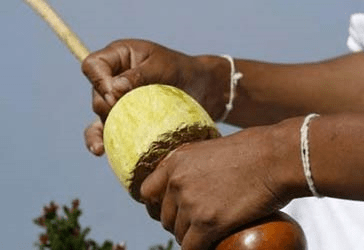
The mamo's poporo had a crust of lime so thick that it served as an umbrella for his hand. The old man presented himself and, in his calm tone, began to describe to us the important work of the ancestral poporo and how, at the moment of receiving it, we would become cosmically linked with the spindle delivered to our spiritual partners.
– “What about those of us who don't have a partner?” asked nervously some member of the community.
– “You have to look for her with the poporo itself, because to her is delivered her spindle in the spiritual”, responded the mamo.
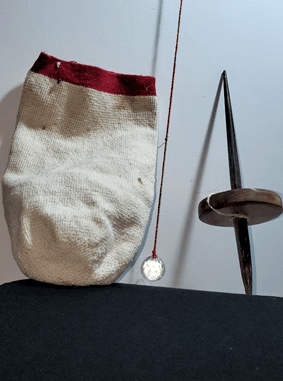
The spindle was a medium-length rod of black chonta with a disc or wheel of stone or wood, threaded at a third of the length of the rod from its lower end. Its function is to convert a cotton bobbin or some other textile fiber into a skein of thread for weaving, principally packs, making use of a bone needle that would also be delivered to the women of the community.
Just as the man with his poporo carries out the spiritual fertilization and planting of the word and the inner work of the couple, fecundating the poporo with his chucuno, the woman spins life itself, converting the bobbin of destiny into the thread with which the spiritual work of the couple is done. The spindle converts the immaterial into its manifested physical form, the archetypes into substance. In this way, the woman, by turning the wheel of the spindle like a cosmic spinning top, fashions the thread of life with which she holds her family.
That is at least the meaning I managed to discern from the words of the grandfathers, the mamos and the weaver women with whom I walked during those years.
While the hours passed and we listened attentively to the explanation of the mystery we were on the verge of embarking on, I noticed on Paula's face that she was not convinced of being willing to all the effort that seemed to be implied in becoming a Muisca spinner; something that did not surprise me. But I knew it was vital that she be with me one hundred percent in this new adventure, so when the session ended, I invited Paula to a pretty and discreet corner of the house, on some stairs next to the front garden.
Paula confirmed her doubts to me and let me know that she did not feel she belonged to that world, that she appreciated the word circles and the work with the grandfathers, but that among her plans was not spending days and nights working to obtain a tool she had no plans to keep using in the future.
I listened to her attentively, fully understanding her position. However, I told her, receiving the aseguranza was for me much more than receiving a gourd and a spindle. What I had understood at a deeper level was that, with the work we were about to begin, we would join our spiritual work as a couple. I reminded her of the words of the mamo when he said that the Poporo and the Spindle are spiritual spouses who complete each other mutually, so for me, the aseguranza we would receive would be our spiritual marriage.
Then I took from my pocket an engagement ring I had bought for the occasion, opened the little case in which it was, showed it to her and asked her if she wanted to be my spiritual wife. Paula embraced me, moved, and told me:
[1] Having found no detailed record of this payment and having no contact with the Arhuaco indigenous people who participated in the event, the description of this payment corresponds exclusively to the collection of facts that were recounted by mamo Andrés Izquierdo during the ceremonies of aseguranza, carried out ten years before this account was written.
[2] GLACIARES EN COLOMBIA - IDEAM
[3] The tutusuma is the name the Arhuacos give to the headdress or hat of wool woven with a bone needle, which identifies the Arhuaco men who have received their poporo. The tutusuma is, in fact, an allegory of the glacial summit of the snow peaks of the Sierra Nevada.
[4] ARQUITECTURA KOGI | Revista Credencial
[6] Biography (Mamü) Mamo Lorenzo | Terunna Foundation (fundacionterunna.org)