
In a recent episode, I told how, in a difficult stage of my life, I felt overwhelmed by the fear of death and by the calamities that inexorably stalk us and that can end up twisting life in the blink of an eye. My weariness of feeling that fear was the main purpose I had for taking part in that beautiful ceremony under the Juan Curí waterfall.
I was saying that the answer I got during the ritual was that no matter what happens, as long as I am alive, I will always be able to find a way to be happy again. I had already tried to anesthetize myself from the terror that being alive produces, with religion, esotericism, and superstition, but deep down I always considered that faith, prayers, conjurations, and assurances were nothing more than lukewarm cloths for the burning of the soul in which the anguish of existing was manifest to me.
But that day at the waterfall, I felt that my affirmation of being able to be happy no matter how hard or difficult the situation that the future presents me is, was different, was true, not because someone told me so, or because I had found it in a magical text, but because it fit well with my logic and with the experiences I had lived until then.
Today I will speak about that affirmation, why it is so powerful, but above all, why it is true.
In another recent episode I spoke of the fear of death, and it is said to be the primordial fear of human beings, but I have realized that in reality what we fear is life. Death is not something in itself, it can only be defined as the absence of something that does exist, and that is life; therefore, it would be more accurate to say that the fear of death is really a fear of not living.
This affirmation seems Perogrullo-esque, but translating death as non-life communicates to us an additional meaning: not only does not existing produce fear, but not living as well; that is to say, that the life we have becomes unbearable, that something happens that makes us express "this is not life".
The fear of death consists of the fear of not managing to live enough, of not managing to enjoy youth, good health, or the time that we believe we have a right to.
Then that fear becomes a cyst in life, and as usually happens with all fears, it ends up becoming that very thing we fear. The fear of death or of something ruining our life locks us into a mental cage that promises to protect us from those misfortunes, but in exchange demands life itself, not the simple fact of existing, but the capacity to live fully, to enjoy being alive.
We are not always conscious of the fear of death, or perhaps you may think you are not afraid of death because imagining your funeral does not cause you anguish, but if we understand the fear of death as the fear of non-life that I describe here, then you will realize that the fear of facing your parents, of declaring love to someone, or of accepting that love is over, or also the fear of losing that job you hate, all of those are different versions of the fear that life stops being pleasant, or at least tolerable; because no matter how bad your life is, you know it could be much worse.
You also know it could be much better, but that does not matter to you, because rather than avoid the prospect of things going worse, you accept with resignation letting go of that possibility of a change that could bring something extraordinary to your life.
To this fear – often irrational – one sometimes refers laconically as "fear of change" or "comfort zone", as if there were something comfortable in the agony of living while carrying that backpack full of stones of dissatisfaction, resentment, frustration, and so many other ills that we accept as an inevitable part of life.
I simply call it fear of life, because most of us were not taught to live but to survive: following the predefined script according to the society in which we are born, so that we make the transition from cradle to tomb with the least number of startles possible. And so we endure the agony of being dead while alive, until death comes to collect us and we leave without having really arrived at living.
With this I do not intend to fall into the modern coaching cliché and the poetic humanism of leaving fears behind and fighting for your dreams, because you can achieve anything you set your mind to, and be happy if you so desire. No, the truth is that you cannot achieve everything you set your mind to, and happiness is not reached either by desiring it with soul, life, and hat, nor by declaring it three times before the universe.
What I want to propose in this disquisition is simply a path to put a rein on the fear of living, to give you the impulse so that, even if it is by a few grams, the possibility of remote happiness weighs more than the certainty of living without being alive. Or at least, to be able to live in a world governed by chance, without the permanent anguish of losing everything in an unexpected turn of destiny.
It is not hard to believe that, as human beings, we have the capacity to overcome almost any calamity, because the examples of people who have overcome indescribable tragedies abound in our society. In the previous episode, I spoke of a case that moved me a lot, of a peasant I met at the peace camp of Colombia in 2016, to whom members of an armed group had killed all the members of his family.
After having been on the verge of madness, that man gathered all his strength of will and transformed his life, giving it a new purpose in the search for peace for his community and then for the rest of the country. Like him, there are many inspiring examples of people who have gone through terrible illnesses, unbearable captivities, torture, drug addiction, or other nightmares, and who have then become people with complete lives, loving families, and a mission that gives them motivation and purpose.
Each of these people speaks from their experience of the tools and strategies that helped them come out of the abyss of pain and retake the course of their lives. Love is usually the central component, whether coming from their loved ones, self-love, or love for their trades. But they usually also refer to a specific moment in which they discovered they could not remain anchored in the past, they had to accept their new reality and walk toward a future different from the one they had imagined, building a new life around them.
This is – very generally – the process of mourning, of which typically 5 to 7 stages are recognized depending on the author: crisis or shock, anger or rage, fear, depression, acceptance, rebirth, and emotional equilibrium.
These stages are usually described with a valley, to which one descends from the emotional shock, in states of increasing density and pain until reaching depression, to then ascend through acceptance and rebirth to reach equilibrium again.
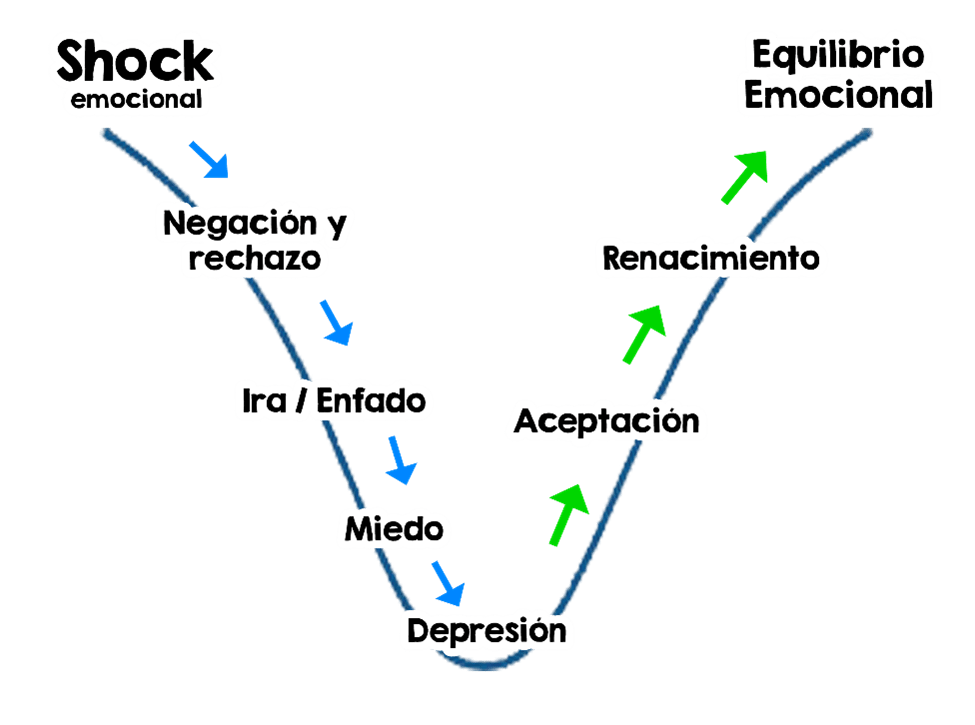
This process of descending and climbing back up to where we were is also a good representation of the concept of resilience, which by the way is a term much used and abused by recent "transpersonal" esotericism and coaching movements. The concept is that human beings are like a spring, which can deform or compress but has the capacity to return to its original state.
The word resilience comes from Latin and means "to jump back" or "to rebound", and it is an interesting concept, but we all know that something that bounces does not return exactly to the point from which it started. Even springs, if subjected to too high a pressure, can remain deformed, even if slightly, and do not return to be exactly the same.
Likewise, some people who have gone through very deep crises, such as the loss of a daughter or a son, understandably declare that their lives will never be the same again and that the pain never goes away, that they manage to function in life, but not as before. The same is true of lovers who have given everything, only to be cheated on or abandoned, and who – also understandably – decide that they will never be able to love in the same way again.
Well, that was exactly what I was always so afraid of: not the passing difficulty that becomes an anecdote in the future, but the tragedy that divides life in two and makes the second half of it unbearable. Resilience did not seem to me enough to silence the fear of living, there had to be something better.
It is here where religious, esoteric, or superstitious people turn to magic or to faith. We all know we have some capacity to rebound from wherever we fall, but we anticipate that we will not be left the same, so we go to negotiate with a superior power so that it avoids the fall for us, just as is implored in every Lord's Prayer: "Give us this day our daily bread", "Deliver us from evil".
When I was on my gnostic and esoteric path, I learned protection conjurations like that of Jupiter:
FASTER OF ALL THE GODS,
'YO', I CONJURE YOU, I WATCH OVER YOU COSLIM”
I also learned to draw with my hand a five-pointed star between a circle in the air; while doing so I would pronounce some words in Sanskrit that I never learned what they meant but which supposedly sealed in the macrocosmic star any spirit of material or immaterial damage that could attack me: "Klim Krishnaya Govindaya Gopijana Vallabhaya Swaha".
In my country, where fortunately the gnosis and esotericism are not so widespread, popular culture has an extensive vademecum of conjurations and protection rituals, ranging from baths with herbs like altamisa, ruda, or mint, aloe pads that hang behind the door – indigenous inheritance – to medals of San Benito, Crosses of Caravaca, crucifixes, images of the virgin, scapulars, prayers to the divine child and invocations to the archangel San Miguel – European inheritance.
But let us not be hasty to disqualify religious people and esotericists for this search for magical protection; science has its own sin and has also put in its fair share of dubious balms for the fear of living.
If we look around us, in this age of technological advances and almost unlimited availability of knowledge, we are more and more surrounded by "solutions" to the problem of being alive, which promise us more and more "security" and less probability of becoming victims of misfortune.
Some of these advances certainly protect us from many calamities. Perhaps the most important inventions in this sense have been toilets, drinking water and fertilizers, closely followed by soap, vaccines and penicillin. However, as we have gone about neutralizing the most serious dangers that stalked us, we have become even more fearful.
So modernity offers us more and more solutions to silence those fears: life insurance, containment fences on highways, GPS, alarms monitored by the Internet, tear gas or AR-15 rifles like those sold at Walmart in the United States. Just the other day Paula asked me what I thought of the new fashion in the United States of equipping school-age children with backpacks made of bulletproof material.
Because when it comes to our children, of whom we have fewer and fewer, that is where paranoia strikes us with cruelty: they must be protected from absolutely everything: from germs on the floor to serial killers in schools, passing through the supposed child snatchers that lurk on every corner, and also from having to pay for their own master's degrees and save up to buy their own house.
It is no coincidence that some people speak of the new generations growing up in these times as "kids of glass", not because they are fragile but because we are raising them to believe that they are.
And here we touch the central theme of this episode: fragility. Fragility is the degree of ease with which something breaks or shatters: a characteristic of many of the materials we use daily and that come to mind when we mention that word, for example: glass, paper, balsa wood or crystal, but also a characteristic trait of abstract or subjective ideas of our lives, such as couple relationships, job or economic stability, health, peace or often life itself. "Life is fragile", we hear with some frequency and with a tone of revelation, perhaps so that we realize we must live intensely because, given its fragility, we can lose our lives at any moment.
But the effect of our generalized perception of life as fragile, has the opposite effect, and it is to treat our life and those dimensions of life that we judge fragile by nature, as if they were glass vases that are better locked in a metal box with padded felt inside, for fear that with the slightest squall they go to the floor and shatter into a thousand pieces.
Again the example of children is pertinent, because if you have them and they are still small, you know that sensation of seeing them surrounded on all sides by dangers that you must neutralize, assuring, disinfecting, supervising, restricting, controlling, containing, and punishing when the case arrives. After all they are fragile and at the slightest carelessness they can suffer some calamity.
I have also observed in recent times a growing perception of fragility of our social and political systems. The political campaigns I have seen in recent years in several countries, including Colombia, the United States, the United Kingdom and France – to speak of those I have followed most closely – have revolved around the imperative need to "save" democracy, or freedom, or peace, or even the very existence of the nation for the most paranoid.
Human beings by nature, inherited over hundreds of thousands of years of living as prey, have the tendency to this paranoia about our fragility, but in recent years, that instinct has been aggravated by the boom of fake news, the excess of negative news reporting, the unprecedented access to information from all over the world, but above all, the capacity and influence of social networks to propagate stories that amplify that perception of fragility and hook users through their fears.
With this cocktail in the background, it is not surprising that we are witnessing one of the most turbulent periods in history: a world pandemic that caught us unprepared, forced us to lock ourselves in for months and taught us to fear physical contact, not only did it take the lives of almost six and a half million human beings, but it put us face to face with our worst fears and led us to make many hasty decisions whose ramifications and effects are only beginning to be glimpsed and will surely reverberate with force for the rest of this decade.
The first immediate effect of those decisions is the alarming rate of mental illnesses recorded in almost all countries where the longest quarantines were carried out. There is also talk of learning problems and delays in almost all students, especially in elementary school, and an increase in domestic violence in places where the problem was already worrying in itself.
Another tragic effect of the mixture of fragile paranoia, pandemic and biased algorithms of social networks, has been the rise of conspiracy theories, which without a doubt are responsible for a large part of the rise of authoritarian governments throughout the world and the unfortunate distrust in science, especially in vaccines, which has already dramatically increased the number of contagions of polio, measles and other diseases that we were about to defeat thanks to early vaccination.
Also in the moribund world economy we see the effects of our fear of fragility: the governments of the richest countries in the world considered that the pandemic would end many industries, thousands of companies and would leave millions of people without sustenance, who would have no alternative but to become criminals and perhaps cause civil wars or coups. Without much remorse they printed enormous amounts of money and distributed it lavishly to companies and employees who even continued receiving their salaries while working comfortably in pajamas from bed.
With all this money, the rich societies of the planet lived an orgy of waste and profligacy, which engendered the largest economic bubbles in history: that of real estate, that of luxury consumption and that of the stock market. Three mega-bubbles that have not yet finished bursting but that continue advancing irreversibly toward the abyss.
And to complete this tragic panorama, a paranoid autocratic head of state, obsessed with the fragility of his health, convinced of multiple conspiracy theories, disconnected from his loved ones by the pandemic and emboldened by the sudden flow of money coming from one of the economic sub-bubbles that emerged, decided to invade a neighboring country and put us on the verge of a third world war.
Nassim Nicholas Taleb, a Lebanese-American essayist, published in 2012 a book in which he proposed an alternative to our understanding of nature, the economy and life, based on scientific observations, clinical studies and statistics, of many physical, biological and socioeconomic phenomena.
His observations and analyses led him to understand that the fragility we perceive in nature and in our own lives, is nothing more than a result of the instinctive biases with which evolution endowed us to ensure our survival. It is also a problem of perspective, since many phenomena that we consider fragile, are nothing more than stages or subprocesses of other larger phenomena that do not suffer from that fragility we perceive.
An example can be cellular life: Living beings are constructions formed by trillions of cells of many types, which on average have very short lives and which are vulnerable to an infinity of external factors, almost always, but also internal. From that point of view, cells are fragile, since a simple imbalance of alkalinity or temperature, or the presence of some unknown substance, can result in the death of the cell.
However, cells are not very relevant in themselves, but as part of enormously complex systems, for which the death of a cell or in reality, of millions of cells every day, is nothing more than a normal part of their processes. As they say in English: "business as usual".
Dr. Taleb observed during his careers in medicine and finance, how materials can be fragile, but the autonomous systems they form (understanding also the economy or society as autonomous systems, because they are not consciously commanded by a single entity or committee) tend to be much more robust. The external stress factors that disturb or harass the system, cause changes and adjustments that allow that system, not only to recover from the disturbance, but that, in almost all cases, help it to strengthen or improve in some way.
This is different from the concept of resilience, because as I said before, resilience means "rebound", returning to the original state. Nature does much more than return to the original state, self-controlled complex systems tend to adapt, strengthen and become more efficient in the face of external disruptions, to this phenomenon, for lack of a more appropriate term, Nassim Taleb called it "Antifragility".
Taleb was looking for a perfect antonym for fragility, but the possible words that the dictionary offers us: robustness, elasticity, strength, adaptability, or the famous "resilience", barely describe part of what "inverse of fragile" means. These words refer to resistance to external aggression or to the capacity to restore, but antifragility is something that goes much further. An antifragile system not only resists but improves under stress, in fact, an antifragile system requires stress to prosper.
The examples we can see everywhere: when a bodybuilder trains with weights, he subjects his body to an elevated stress, which, in fact, leads the muscle fibers to fail and rupture. This rupture of fibers is not a side effect but the very objective of the exercise, because the body replaces those torn fibers with new ones that are thicker and stronger than the previous ones. That is the mechanism behind hypertrophy or muscle growth. Hence the motto of those who train is "no pain, no gain": "no pain no gain".
Another example is bone fractures. When the body welds two fragments of a broken bone, the place where the joint forms becomes the most resistant part of the bone. This also happens in the skin when a wound heals. To us a scar may seem an undesirable effect of the wound from the aesthetic point of view, but for the body the scar is now a perfectly functional region of the skin and in fact more resistant. Some cultures also appreciate the symbolic value of scars as war trophies or even as badges of courage and experience.
There is much evidence that the human mind is also an antifragile system, that not only benefits from being under stress, but that also longs for and seeks that training at all costs. That is the reason why since childhood we rebel against the rules of adults and seek adventures in unknown places, because the mind needs the unknown and the difficult to develop itself.
But as we grow and become more conscious of our mortality, fears increase and with them our sense of fragility. Then we begin to look for ways to feel increasingly safer in all aspects of our lives. To a certain point, that search for security is positive and improves our quality of life, but eventually it becomes pernicious and in fact increases our fragility, instead of diminishing it.
Examples of the effects of overprotection to the detriment of our antifragility is the economy: many measures that are taken to make us less vulnerable to recessions, unemployment and other financial crises, have ended up generating more crises than the ones they were trying to avoid. Here we can mention again the recent financial crises: in the 2008 crisis the governments of almost the whole world threw themselves to save the bankrupt banks to supposedly avoid the collapse of the economy and in the pandemic crisis of 2020, the lifebuoy was for thousands of companies not to have to fire employees or declare bankruptcy.
These seem like good intentions, but what was lost sight of was that crises also bring out the best of us. Many companies that face a crisis learn to adapt, improve their processes, become more efficient, fire redundant employees, reduce expenses and strive to adapt, find new markets and generate better products.
Some of those companies will fail in the attempt and enter bankruptcy, but that failure, while it is an unfortunate situation from the point of view of the company, its shareholders and employees, from the perspective of the industry and the market can be something positive: the patents and products of the disappearing company usually pass to the hands of other more efficient and creative companies, some employees also leave with their experience to other companies and others become entrepreneurs, creating companies that in the future will generate more employment. In fact, it has been demonstrated that economic crises are the periods in which the most new ventures are incubated and the most companies are born.
Taking that example back to the human body again, we never mourn the death of our cells, in fact, we need millions of cells to die daily for our tissues to renew and for us to live healthily. This is, to generate antifragility. When cells refuse to die and reproduce without control, a phenomenon occurs that exponentially multiplies our fragility: to that phenomenon, we call cancer.
With human life exactly the same thing happens as with companies and cells: from the individual point of view it can be seen as a tragedy, but from the point of view of the community, the society or humanity as a whole, death is necessary and not only natural death in old age, death is the mechanism by which natural selection chooses the most efficient characteristics according to the environment of each species.
When you go out for a walk on the street look around you and you will see everywhere the results of the antifragility of our society, derived from our fragility as individuals: Almost all the safety features of your car, the traffic signs, the material of the constructions, the design of modern airplanes, the anti-fire protocols and the judicial system, all that has been strengthening year after year thanks to the experience obtained with the accidents in which hundreds of thousands of human beings have suffered injuries and died. Through those tragedies we understood something about the reality of the world that surrounds us and the principles that govern it.
Let us now speak then, about how the principle of antifragility applies to our life. As I said before, human beings need adversity not as a test, to prove to someone that we are worthy or capable, but to train ourselves in the same way that our bones and muscles need to reach their limit to strengthen and grow.
Our brain is an incredibly elastic organ and also responds in an antifragile way to external pressure. Many people grow and prosper in environments of uncertainty or after tragic episodes such as an illness, a near-death experience or an important loss. For those people, overcoming the event and becoming a better someone, becomes a way of giving new meaning to their life and of changing the way they perceive the unfortunate situation so that it is no longer just an unpleasant memory, but also the motivation or impulse to make a positive change in their lives.
Well, that vision is precisely the one I decided to adopt with respect to the possibility of a tragic event in the future: the certainty that no matter what happens, no matter how dark the night is, there will always be a new dawn and with it, a new opportunity to build something new, to know myself in a different way and to know love in a new way. That is not a mystical promise of any sacred book, nor the result of a clinical analysis. It is the result of a personal decision, on which there is no condition or exception.
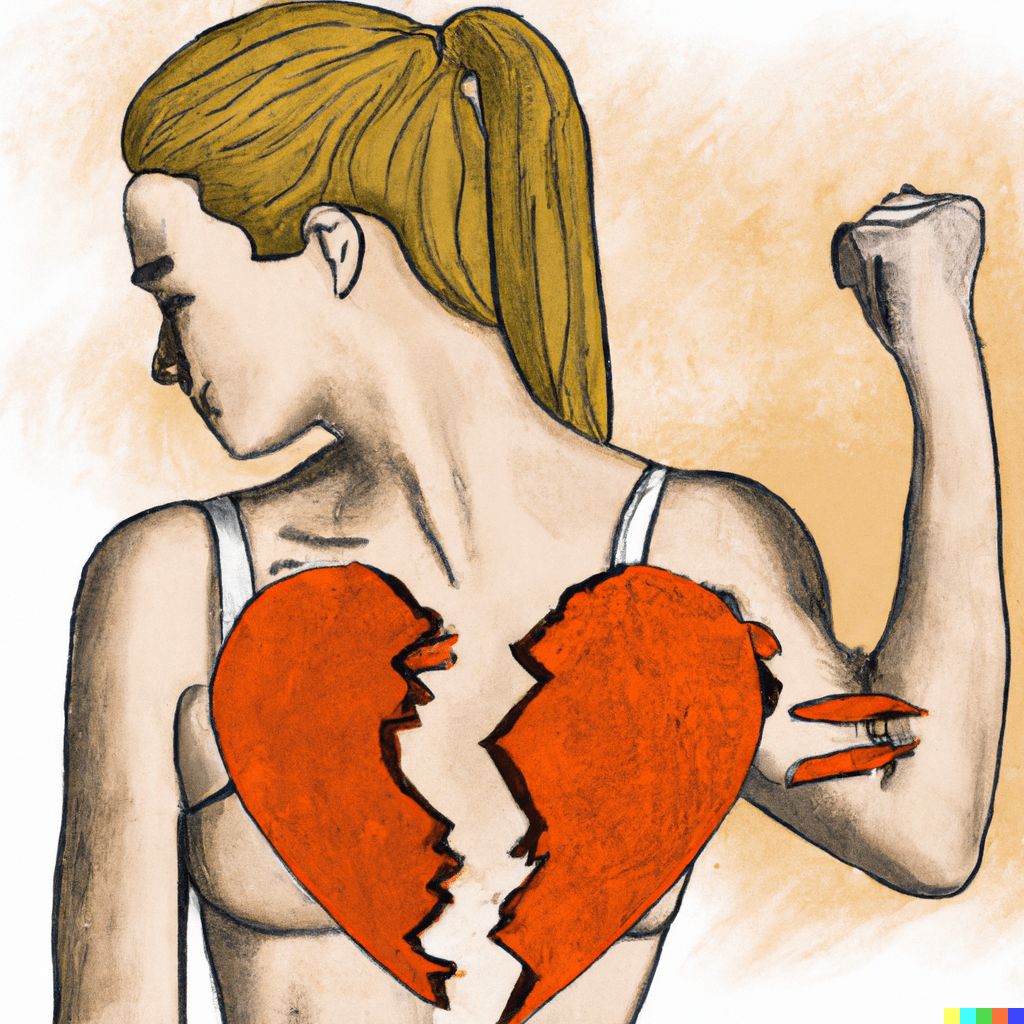
It does not mean that achieving it is easy, nor that everyone who tries will achieve it; but it is important to know that it is possible and that you have the natural capacity to achieve it. It is also important to recognize that antifragility is a characteristic of complex systems and not of individuals, therefore, achieving an antifragile state and being able to transcend a state of misfortune toward one even higher than the one that existed before the traumatic event requires the participation of a support community formed by the people with whom one shares bonds of love and, with frequency, with professionals in mental health, guides and mentors.
I introduced the word "trauma" because it is also important to know that our brain also has survival mechanisms that can make recovery after a disruptive event very difficult. This is the case of post-traumatic stress, which occurs when part of a person's consciousness disconnects to avoid facing a reality that is too devastating.
In this particular case, it is fundamental to seek the support of professionals in psychology or psychiatry, who know how to treat and guide people with different types of trauma, to unblock the process of recovery and natural growth of the human being.'"
From the point of view of Spirituality, a way to see antifragility is to understand human consciousness as the divine essence that shines within each Being and that empowers itself in its own destiny. In that way, that divine spark within you refuses to see calamity as a punishment or a test and chooses to see it as a training, a process of transformation at the end of which it will blossom in your life as a new level of consciousness, an octave of higher vibration and greater happiness.
I saw a very beautiful analogy to this perspective in a very lovely but heartbreaking movie that perhaps you have seen: it is The Shack with Octavia Spencer and Sam Worthington. That movie is about the grief of a father for the death of his little daughter and shows how that father travels to the Kingdom of the Spirit where he meets God, Jesus Christ and other divine beings and through several parables, they show the man how the death of his daughter becomes the place where a beautiful tree will be born and blossom that will be the center of the garden of his heart. Well, it is one of those movies that make you cry, but also feel very nice things inside, so if you have not seen it, I invite you to do so.
And well-managed grief is also a magnificent example of antifragility: those who have gone through a loss and have managed to find themselves after the grief happier and more at peace than before, say that the pain and the absence never go away and that is why almost always the tears arise when they return to that episode: that is fragility. But they also say that the moment comes in which they accept their new reality and are capable of reconciling themselves with their new life and remembering with joy the life of that person who left: that is resilience. But they also tell that they decide to look to the future, find new purposes and with time they realize that yes, the pain and the absence are still there in the center of their hearts, but around that loss their life, their relationships and their love continue to grow, in such a way that that loss is an increasingly smaller part of life, and life then becomes a celebration in honor of that person who left and who now makes part of their own existence: that is antifragility.
To finish, I think the most important lesson about antifragile thinking is that it invites us to stop fearing the small discomforts of life and take a more open attitude about uncertainty: Meeting new people, traveling, learning new things, reading about topics that do not interest us, going to places about which we have reservations or negative ideas, trying again something that we have always rejected, attempting something for which we have always believed we are not good. In general, taking more steps toward the unknown, not necessarily jumping into the void. All these actions serve us to train ourselves for an antifragile life, they can give us the capacity to respond with more wisdom and adaptability to any situation that life puts before us.
It is also important to program our mind for antifragility with positive affirmations about our capacity for transformation. Saying things like "I will never be good for such a thing" or "that, if it is not something I would be capable of tolerating or enduring", or "if such a thing happens it will be the end for me" even if you say them in jest can create conditionings that later will become a conscious or unconscious burden when you need the impulse to move forward.
By contrast, I suggest you always speak in a positive and optimistic way about yourself, making affirmations that give you security. Remember that your own voice is the way in which that inner divinity expresses and manifests its will. "I always find a way", "I am not going to let that beat me", "No matter what happens, I will always find a way to be happy."