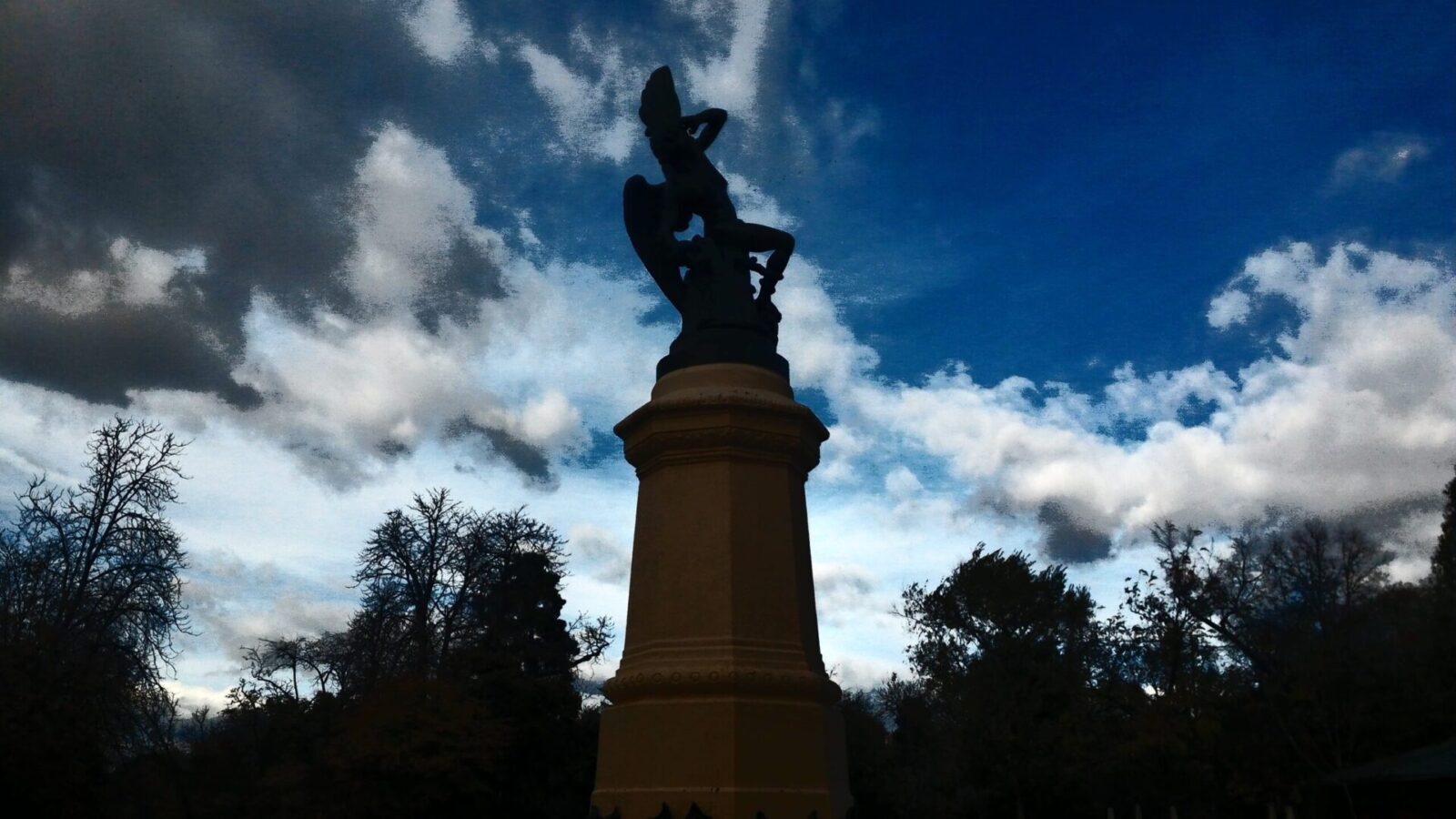
In episode 13 I told you how it is possible to reconcile an objective understanding of the Cosmos based on science with a mystic vision of natural phenomena based on narratives that we build to connect our internal world with external reality. This is Poetic Naturalism and through it, or at least a simplified version of poetic naturalism, we can resignify terms and practices that traditionally have belonged to the terrain of the supernatural.
This is the exercise that I have been doing to reinterpret the concepts that I have collected during these years of spiritual path, which have been useful in my life and have allowed me to help other people.
Not long ago we also talked about good and evil, and we saw how this duality expresses itself in many forms in different belief systems. In religion, for example, one speaks of virtue and sin, but in esoteric knowledge one frequently resorts to the pair of light and darkness.
These terms are interchanged frequently and it is usually thought that light is equivalent to good and darkness to evil, but in the ancestral vision that I knew, light and darkness have more to do with their physical meaning than with the esoteric one. Light represents pure consciousness and darkness represents the absence of light, that is, unconsciousness. From that point of view, there is no moral judgment about what that light reflects or what that darkness hides. It simply recognizes the fact that there are situations, behaviors, thoughts, sensations, emotions and reactions that we can identify at the moment when they happen and which therefore correspond with our conscious will. We could say that those thoughts, emotions and reactions are in the light.
But there are other processes that occur without us noticing, one could say that against our conscious will or even to the detriment of our own interests. Self-destructive thoughts, sensations that do not come from any real stimulus such as phobias, emotions that cause us suffering such as hatred and envy, or disproportionate reactions such as anger or panic. All these things are what we could call darkness, not because they are bad, but because they do not occur consciously, we cannot see them, they are hidden. In fact, we could find some examples of positive things that are in the darkness. For example, positivism: There are people who are positive in a natural way, even beyond logic they are able to remain optimistic despite adverse circumstances.
Another example could be heroism: there are people who have the capacity to go over their own interests or even their own life for the well-being of others. I am again talking about cases in which those behaviors arise without there being a conscious mental process. If it is unconscious, it is part of the darkness. Why? Because even love, when it is experienced without consciousness, can end up causing unnecessary harm. Positivism disconnected from consciousness can become stubbornness, and heroism can become a form of unnecessary martyrdom.
Light is associated with the values related to equilibrium: love, consciousness, equanimity, justice, understanding, truth. In English there is the expression “to shed light” which translates literally as “to cast light” and means “to clarify”. Science and spirituality seek to “shed light” where there is darkness: science in all the physical phenomena that we do not understand, and spirituality in all the phenomena of the human mind about which we have no consciousness.
Darkness is not evil, but it is the terrain where evil prospers: unconsciousness, fear, tyranny, conflict, deception. The period of time between the fifth and the fifteenth century in Europe is remembered as the “Dark Age” or the obscurantism because it was a time of little intellectual progress, compared with the times of classical Greece and the Roman Empire that preceded it, and the Renaissance that came after, in which there was an explosion of scientific and artistic creativity. However, many historians avoid the use of the term “Dark Age” precisely because it carries a quantity of negative connotations, partly because of the popular culture in which this period is frequently identified with violence and backwardness.
It goes without saying that the stigmatization of darkness has a lot to do with the racism that has prevailed in Western culture since its beginnings. Black, the shadow, darkness are related to evil, sin and vices, and therefore, throughout history, men and women of black skin have been defamed, being considered prone to evil, sin and vices.
Of course, human beings have an instinctive fear of darkness because we are predominantly diurnal animals without sensory adaptations for darkness such as those that snakes, felines or rodents have. Historically we were hunters by day and prey by night, and that is why we have a natural distrust toward visual darkness, but it has been the darkness of the mind that has prevented us from overcoming those ancestral conditionings and recognizing our mental biases.
Darkness and its demons
We were talking before about how our brain has been evolving by layers through millions of years. The Homo Sapiens became the dominant species on planet Earth thanks to a quantity of physical and mental adaptations. Among the latter are the consciousness of oneself, of the past and the future, of the long-term consequences of our acts, and of our own emotions and those of our fellow beings. To this quantity of phenomena that are generalized with the term “consciousness”, it would be better to call it “human consciousness” because some of those more or less sophisticated processes have been verified in many other animal species.
That human consciousness, as we saw in the episode about the Self, emerges from the cerebral neocortex with particular importance of the frontal lobe, but it has to coexist and cooperate with the other two layers of the brain: On the one hand the limbic system, also known as the paleomammalian cortex, where the emotions that we share with the rest of mammal animals are originated: maternal instinct, social behavior, motivation to make decisions and long-term memory.
Well, this is the battlefield between light and darkness: the instinctive forces of human survival and cooperation arise, doing whatever is necessary to keep us alive and safe, and the neocortex has to quiet the emotions down and control them so that they don't run wild. For example, neuroscience has identified the brain activity related to sexual orientation, fear and emotions in a small part of the limbic system called the Amygdala, and instinctive forces such as hunger, thirst and sexual desire in the hypothalamus. Both zones belonging to the limbic system.
Science has called all these brain processes as I have referred to them: instincts, natural forces. Religion has another name for them: Demons.
All those beings that are said to be tempting and seducing us so that we yield to our appetites and primitive instincts are in the limbic system. With or without the participation of consciousness, they are going to do what they have to do: force us to eat, drink, sleep, rest, seek love and reproduce. Have you ever done an involuntary fast or have you ever distanced yourself from someone you love from one moment to another? Then you have noticed how these processes of the limbic system fight to restore what we are depriving ourselves of.
Indigenous thought has another way of seeing these mental systems: they don't call them demons, but internal animals.
The initiated say that inside each of us there is a snake coiled in the spine. This represents sexuality. Also that there is a bull in the chest, which would be anger, a bear could be associated with laziness, the crow with envy and the parrot with gossip.
While in the traditional religions the objective of spirituality is to withstand the temptation of the demons, and in some esoteric cults like the Gnosis the task consists in destroying them outright, for the Amerindians the work of the Being is also known as the “internal hunt”. But this is not a hunt to destroy, but to capture and tame the animal that is being pursued.
The grandpas say that those animals must be hunted one by one, because otherwise, they will take turns to counterattack when they feel pursued. Then one has to silently follow the animal and observe it with a lot of attention, learning at what time it wakes up, how it moves, how it feeds, what calms it. Then one has to approach little by little, never appearing threatening, but on the contrary, always showing empty hands without losing sight of the animal's gaze. Finally, after many attempts, when the animal discovers that the warrior respects it and is there to learn from it and to join it, then the animal bows its head and lets the lasso be placed on its neck.
Does this story sound familiar to you from somewhere? Where have you seen this relationship between a warrior or hunter and a wild animal? Yes! This is the plot of “How to Train Your Dragon”, a movie full of wisdom in which we see an insecure and fearful boy approach and end up taming precisely a black dragon of a breed that is called “Night Fury”. We also saw it in Avatar, when Jake Sully, who is an impulsive and undisciplined boy, becomes the first Na'vi to domesticate Toruk, which is -again- an imposing flying animal, like a kind of dragon. The Life of Pi also comes to my memory, in which Pi ends up taming the tiger that travels with him in his boat.
Notice that in this last case, the metaphor is even more precise because it is not only a matter of a wild animal, but also because it is in the same vehicle, so there is no way to flee. Either it is tamed or one ends up becoming the prey.
The moral in all these stories, which for some reason makes us feel identified and moves us, is that once the animal has been domesticated, the warrior and the animal become one. Turuk Makto they called in Avatar the one who managed to conquer the beast and join it -moreover, in a very literal way, because in Avatar the Na'vi connected their hair to that of the animal.
Now we know where the stories of the Greek mythology about beings half man and half beast probably came from: Centaur if it is a horse, Minotaur if it is a bull, or Manticore if it is a lion.
The Mayas speak of the Nahual or guide animal, which comes from the same worldview of mastery over the internal animals, and although it is spoken of the capacity of the initiated to physically become their guide animal, the truth is that the most probable is that it is more of an adoption of characteristics that are attributed to each animal. Like the vision of the eagle, the hearing of the ocelot or the smell of the wolf.
Even in Colombia, the knowers of the Cofán ethnic group also narrate stories of grandpas like the Taita Querubín Queta, who is said to have the capacity to transform himself into a jaguar at will. The jaguar for most Amazonian ethnic groups symbolizes the wisdom and the strength of the yagé, so it is not surprising that during the ayahuasca trance on a moonless night, many coincide in seeing their venerated grandpa take the form of a black panther.
In any case, we have made a somewhat strange journey from the processes of the limbic system in the brain to the Greek and Amerindian mythologies, but I have done nothing more than support my initial hypothesis of how the initiatic knowledge of many cultures can be validated from the point of view of science, making use of the concept of poetic naturalism to use narratives or fantastic stories that represent things that are very real and experimentally verifiable.
But then we are missing a part of the sacred trinity of the mind: We already talked about the Neocortex, which is where human consciousness arises, the limbic system where the emotions and the mammalian instincts are found. We are missing talking about the R complex or reptilian brain, although its most accepted name is the brain stem.
We saw in a previous episode that in the brain stem reside the most primitive instincts, which arose in evolution when we still formed a single family with the reptiles. We were saying that in this region of the encephalon the instinct of aggressiveness, the respect for hierarchies and territoriality are produced. Here the key part that I want to highlight are the last two functions: hierarchy and territoriality.
But in addition to this, the brain stem is also in charge of the autonomic functions of the nervous system, including breathing, the heartbeats, sleep and wakefulness.
This is the most important part of the journey that we have been making up to this moment, because we are arriving at the most important place for an initiated: The Sanctum Sanctorum, and we are going to see why.
The autonomic processes of the human body are those that function in a totally unconscious way. They do not require our attention nor our intention, however they perfectly fulfill their function. They are not hidden, but if we pay attention to them we can see them, feel them, even control them to a certain point. Yes, even the heart rate can be modified with the adequate techniques.
The heartbeats and the breathing are the fundamental tools for different types of meditation, and sleep and wakefulness are tools that many esoteric cults use to make internal journeys and contact what they call “other dimensions”. Look how curious, these tools are located in a part of the brain that has the same shape of a crook. If you search in Google for an image of the brain stem, you will find a kind of scepter formed by the spinal cord, the medulla oblongata, the pons and the head of the crook that is called the Thalamus.
That is the staff of the indigenous grandpas, the scepter of the esoteric magician, the crook of the bishops. It is there where the inner work is done and mastery is achieved, in order to then go on to practice in the battlefield of the limbic system the hunt of the internal animals.
The shaman trains with the crook and then uses his wisdom and his power, conquering with the light of consciousness all those unconscious mental aggregates that embitter our existence and are waiting for us to wake them up.
I was telling you that the limbic system is the battlefield between light and darkness, and we talked about the instincts and natural forces of the mind, which are what many identify as demons. Then are there also angels? Well, the brain has many mysteries and many aids, but one in particular that we know is in the limbic system just above the staff of the brain stem: it is a gland very special for the esotericists: The pineal gland.
Of this gland many mystics say that it is a dimensional portal, that it is the way of contact with the divinity, that it is the third eye and other things that for now remain in the terrain of mystic speculation. But what science has indeed discovered is that the pineal gland produces Dimethyltryptamine or DMT, which is the same psychoactive chemical compound that Ayahuasca and LSD have. Today the functions that this chemical has in the brain continue to be discovered, but some that have been verified are that of producing emergency oxygen to avoid the death of the cells when there is a sudden lack of oxygen, regulating the sleep cycles, but the most curious: producing mystic experiences and altered states of consciousness.
Could the pineal gland be the one responsible for generating experiences of encounters with spiritual or divine entities? And if so, the question would be: why do we humans need these experiences as part of evolution?
In any case, there is the game board in which we will continue to discover the spirituality linked to science and the path to wake up and leave the matrix. The task is to cast light on the darkness, to reveal what is hidden, to tame our internal animals and to find an individual equilibrium that brings us lasting peace and happiness. This process is known as Enlightenment.
I recommend you to have listened before to:
Episode 4: The experience of reality – A Self that in reality is many
Episode 13: Can one be a skeptic and spiritual at the same time?
https://kidshealth.org/es/teens/brain-nervous-system-esp.html
https://en.wikipedia.org/wiki/Limbic_system
https://en.wikipedia.org/wiki/Amygdala
https://theconversation.com/chemical-messengers-how-hormones-make-us-feel-hungry-and-full-35545#:~:text=The%20body%27s%20system%20for%20regulating,produce%20the%20sensation%20of%20hunger.
https://web.oas.org/childhood/ES/Lists/Temas%20%20Proyectos%20%20Actividad%20%20Documento/Attachments/511/9%20Beatriz%20Pizarro%20ponencia.pdf
https://beckleyfoundation.org/2017/07/05/do-our-brains-produce-dmt-and-if-so-why/
6 years ago Finding the light, Taming our internal animals, finding peace……..Can all this be obtained with the mental aggregates, which strive to stay in the darkness?
0 Reply manuelr Author Reply to Gabriel Pulido B. 6 years ago That is the task of life, my brother, we are in that and we get lost, we get tangled and we despair at times, but little by little we are understanding that the trick is in acceptance, observation, and even in not taking the game so seriously 🙂
Comentarios (archivo, solo lectura)
Mostramos 2 comentarios guardados de la versión anterior del sitio. Ya no se aceptan nuevos comentarios.
Encontrar la luz, Amaestrar nuestros animales internos, hallar la paz........Se podra obtener todo esto con los agregados mentales, que se esfuerzan por quedarse en la oscuridad?
Esa es la tarea de la vida mi hermano, en esas estamos y nos perdemos, nos embolatamos y desesperamos a veces pero poco a poco vamos entendiendo que el truco esta en la aceptación, la observación y hasta en no tomar tan en serio el juego :-)