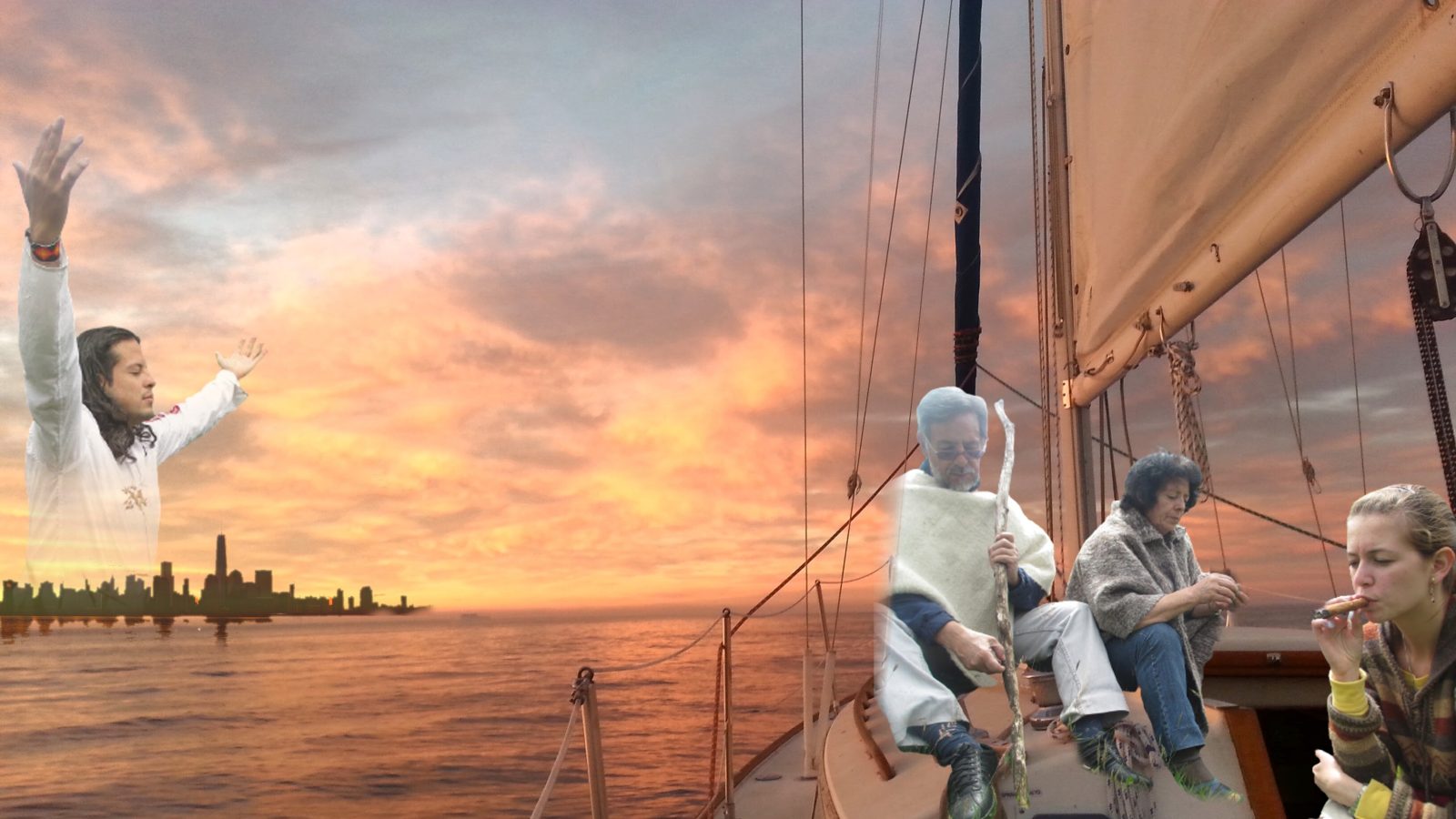
I grew up admiring the culture of the United States. Like so many other Colombian children, during my childhood I spent countless hours enjoying American series, which in Colombia were known as "enlatados" (canned goods). On weekends, Colombian television would dress itself in bars and stars, and then I would let myself be transported to the exciting world of private detectives.
My favorite series, apart from my admired Cosmos series by Carl Sagan, were those that combined action with science fiction, like Automan, The Fantastic Car (El Auto Fantástico), Lobo del Aire, Manimal, The Sorcerer (El Hechicero), and even McGyver could enter into that category. I was amazed by the way they mixed ingenuity and technology, which is a combination that I still aspire to achieve today in my work and personal projects; but beyond that, I admired something else in those television programs: American culture generated in me a sense of familiarity, and I often felt a nostalgia for the style of houses, the enormous yards with trees, and the rural landscapes of the American Midwest, as if I had known all that in another life.
It was only natural that as I grew older, I became increasingly interested in the history, the culture, and the language of the country to the north. At fourteen I heard a song by the Beatles for the first time, and immediately I became a fan of the Liverpudlian quartet, which made me start practicing English with even more diligence, while translating their songs and trying to sing them in the most correct way possible.
Around the same period of my life, I also had my first contact with a computer, and in a manner similar to my encounter with the Beatles, I knew from that moment that computing would be an inseparable part of my life. The Beatles gave me countless hours of inspiration from then on, and they fostered the beginning of the most enduring friendships of my life, but English, which at that time was mastered by very few young Colombians, and computing, which was likewise just making its transformative irruption in the third world, would become the keys that opened for me the doors of North America, but there were still many years to go before that.
During my adolescence and early youth I kept trying to perfect my English, mainly because I liked it and it came easily to me, and I kept cultivating my computing knowledge because it was my passion; but my admiration for the United States eroded as I began to understand something of international politics, and I realized that for the country of McGyver, Colombia was merely part of its backyard. The growing phenomenon of drug trafficking in my country made it so that, from the North, we were increasingly a country of drug traffickers with Pablo Escobar at the head, rather than the country of the world's best coffee and One Hundred Years of Solitude.
I have already mentioned that my parents had belonged to Communist parties in their youth, and although that had been left behind precisely when the Colombian guerrillas became drug-addicted, their ideals and political thought continued to be fundamentally left-wing, so that when in my family the United States was talked about, it was usually in unaffectionate terms, highlighting its imperialist role, its excessive consumerism, or the apparent absence of moral values in its inhabitants, with the pretended moral superiority that can only arise from an inferiority complex.
Perhaps because of this posture of useless dignity, I had decided that I was not interested in going through what I considered the humiliation of begging for a visa at the American embassy. I remember that at some point my mother asked me if I would not like to get the visa to visit the United States, and I answered her:
– "I am not going to beg them to let me in. If someday I go there, it will be because they invite me to go."
During the years I lived in Santa Marta, I did not think about the country to the north either for good or for ill, but on September 11, 2001, while I watched stunned on television how the towers of the World Trade Center in Manhattan crumbled, I knew that if up to then people were already talking about how difficult it was to achieve the "American dream," from that moment on it would be almost impossible.
By 2006, the lines of aspirants to visit the country to the north at the American embassy were as long as the list of visa denial stories, frequently preceded by a hostile attitude of the consular officer or even some disrespectful comment. I, who had always been terrified of rejection, had no intention of putting myself in that situation. Besides, I was enthusiastic about an Irish girl that I had met on the Internet, so I rather aimed at the British embassy, with which I ended up being rejected by the British instead of the Americans.
But my life took a new course, and the doors of American territory began to open to me one July afternoon in 2008, with a phone call coming from Cary, North Carolina. I was then working for Telefónica, and I had been commissioned to coordinate the acquisition of a technology service management software, but the manager did not want me to limit myself to the big companies that had the monopoly of that segment of the industry; he wanted me to look for other alternatives.
In that search I contacted a couple of Colombian companies, with which I soon began to work to evaluate their products, and three foreign companies that had products with the characteristics we were looking for. However, of the three foreign companies, only one of them — infraWise LLC — contacted me by phone. I remember the exact moment I took the call, because it was a moment that truly changed the course of my life. It was a pleasant executive with a British accent and a Greek name: Andronicos Zervides.
My English in those days was still very limited, but even so I managed to chat for about five minutes with Andronicos, and I immediately felt empathy with him. It was not the typical salesman with a memorized script, but he seemed enthusiastic about the idea of working with Colombians, and he told me about his experience living in Mexico for a few months, next to a beautiful Mexican woman.
The conversation, which might have seemed inappropriate for a business call, was handled with such decorum that Andronicos fulfilled the objective of establishing a relationship of trust with me and distinguishing himself immediately from any other salesman. Besides that, iWise, which was the name of the product he was selling, was truly the best among the alternatives I evaluated, so a little while later, I found myself working full time on the purchase and implementation of iWise in my company.
Practicing English in emails and increasingly frequent phone calls was the first benefit I received from that relationship, but little by little I began to know the other members of the company, and I realized that they were also very pleasant and simple people. During the execution of the contract, my main contact at infraWise was David Collins, a financial executive of the company who lived in Chicago and always began the phone calls with a short conversation about the weather, or commenting on some news of the day.
I usually understood less than half of those casual chats, because my English was mainly technical, and besides, David's accent was less accessible to my incipient bilingualism than Andronicos's well-articulated British English. However, I also began to develop a good empathy with David, although not as quickly as with Andronicos.
In December 2008, infraWise sent to Colombia its head of engineering, Dan Douglas, who turned out to be as kind as Andronicos and David. For a week I became his guide through Bogotá, and I enjoyed the privileges of being the object of the representation expenses of a contractor company, with lunches and dinners at high-end restaurants. But what I remember most of that visit is that Dan, a wealthy American engineer, was the person who introduced me to the ceremonial use of tobacco.
One afternoon when we were at his hotel in the north of the city, Dan gave me a medium-sized Cohiba cigar as a gift. I appreciated the gesture, but I told him that I did not smoke, and that besides that I had no idea how to do it. Then Dan offered to teach me. We went to the smokers' terrace, and he explained to me:
– "A cigar for me is not like a cigarette, nor like a drink; it is rather part of a ceremony. I only light one when I am celebrating something important, or when I meet with my son to talk, or in a moment like this one, where I am getting to know such a pleasant place."
Then he gave me a cigar cutter and taught me to cut off the cap of the cigar before lighting it. He also showed me how I had to puff it to avoid the smoke entering my lungs, and how often to do it so that it would not go out. Even so, I had to light it several times during the hour and a half that we spent on that terrace talking, mainly about life in the United States, a topic that, as I discovered, still caused me a great interest, and that did nothing but increase after getting to know Andronicos, David, and Dan.
Before leaving Colombia, Dan gave me a small box of Cohiba cigars and told me that he expected to see me in Cary. He suggested that I ask David for an invitation, so that the visa process would be easier for me, but I did not have to do that, because a few days later, David himself told me that Dan had mentioned to him that I wanted to get to know the United States, so I only had to tell him when I would go, so that he could send me a formal invitation from the company for business reasons.
Barely can I describe the emotion I felt with that offer. My rejection of the United States was somewhat like the attitude of someone who shows himself odious toward a woman because he is secretly in love with her. I proposed to my sister Laura that she accompany me on the adventure, and as David had promised it, a few days later I already had in my hands a brand-new invitation to visit infraWise's headquarters in North Carolina, with which my sister and I received the elusive American visa without any qualm from the embassy officer.
We made the trip in the summer of 2009, barely months before I went to my first yagé ceremony and met Paula. Dan and Andronicos kindly offered us lodging for a few days in their houses, but Laura and I planned to travel to Chicago to get to know David, and then to New York — Laura to visit her father-in-law who lived there, and I to fulfill my dream of getting to know the Big Apple.
The trip was a revelation for me. I recognized how much I admired that country, and thanks to David and Andronicos, I had the opportunity to know Washington DC, where what took my breath away was the immensity of knowledge, history, and culture that the Smithsonian museum housed. We penetrated the earth to know the Luray Caves in Virginia, and we admired the countless farms and rural landscape of the northeast of the country during an authentic road trip that the company gave us as a gift.
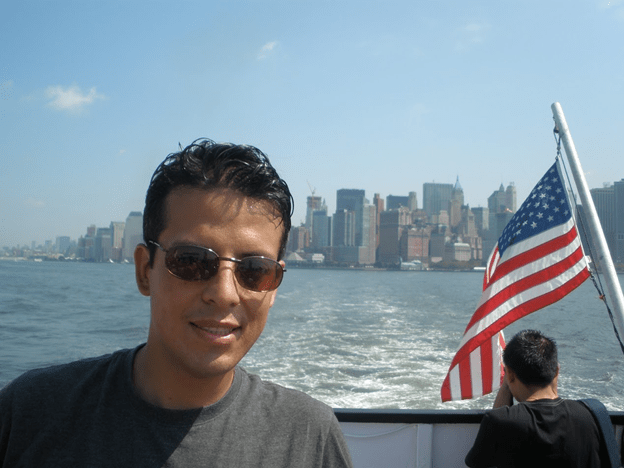
When I got to know David, who was the highest-level executive at infraWise, I confirmed his human quality, and I recognized in him someone for whom personal relationships came above business. I shared with him my ideas for improvement of his product, and I offered him my help if he ever became interested in the Latin American market. His response was that he trusted that soon we would work together again.
From then on I kept cultivating my friendship with Andronicos and David. We frequently exchanged emails, and sporadically we talked on the phone about all kinds of topics. David often consulted me on technology matters, but with Andronicos our friendship was more personal, so we started talking about spirituality, humor, science, and other topics that we had in common.
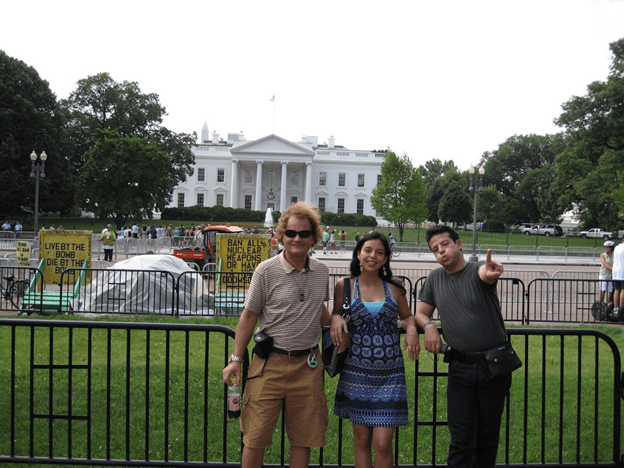
Finally, in 2013, while I was alternating my work for a pension company with word circles with Grandpa Luis and visits to Grandpa Juver, I received a call from David Collins. He told me that he had just signed a new contract with the city of New York, and that he needed a project manager, so he wanted to offer me the opportunity. I think my eyes watered as soon as I finished the call, and immediately I called Paula: "Darling, we're going to the United States!".
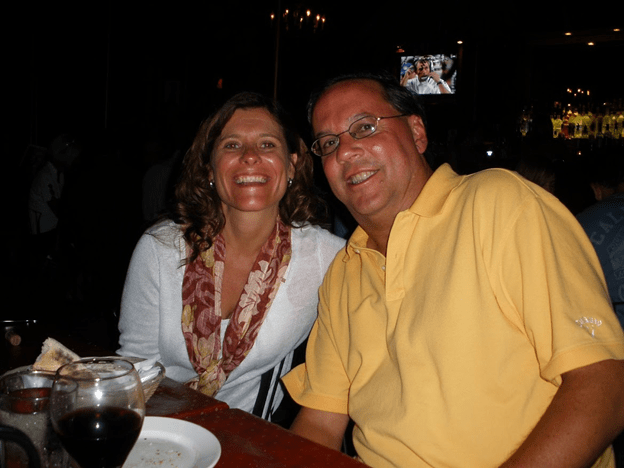
Of course, things would not be that easy. David did not imagine how difficult it was — and still is — to hire a foreign employee. The United States immigration system is not designed to facilitate the arrival of immigrants, but to prevent it as far as possible. In such a way that a company has to prove that it was impossible for it to hire someone of American nationality, and even so, manage to get the candidate to obtain one of the 65,000 professional immigration slots that the country grants each year. In 2013 more than half a million candidates were competing for one of those slots, and for better or for worse I did not come out favored in the drawing.
Fortunately, David did not give up on bringing me on; instead he agreed to keep me as a contractor while we retried the application in 2014, and he also accepted that in the meantime I would work from Colombia, making frequent trips to Chicago and New York, where our main client was located. My first trip would be in July of that year, as soon as I finished my contract with the company I was working for, but before that I had to ask for the protection of my territory, and permission to undertake this new stage of my path.
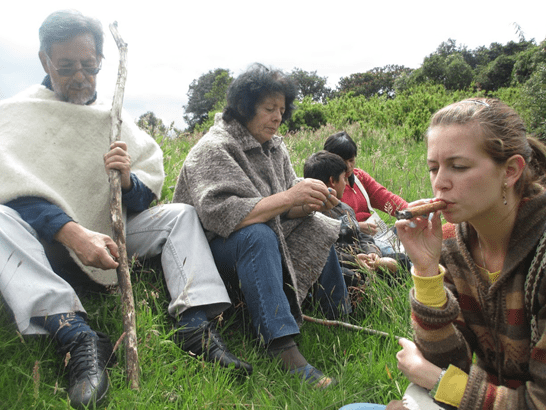
Grandpa Luis and I had talked several times about the idea of making a pagamento at one of the most sacred places for the Muisca: the Juaica hill. This mountain, near the municipality of Tabio, is a place that the chroniclers of the conquest pointed out as a sacred site where the natives of the region revered the goddess Huaica, to whom they asked for abundance for their crops, rain for their lands, and fertility for their women.
Some locals tell that until just a few decades ago, moanes, or mojanes, were still seen on its slopes. These half-historical, half-mythological characters are usually described as goblin guardians of the ravines, or as elderly indigenous people who smoked tobacco at the edge of these. Considering the sacred connotation of the place, the most probable is that for generations the muiscas knowers and grandpas were the ones who were sighted by the inhabitants, while they performed their ceremonials.
Juaica is also a place where many say that sightings of UFOs, lights without known explanation, and other phenomena are reported on a daily basis. In 2017, Grandpa Suagagua even starred in a television documentary about the supposed supernatural phenomena that happen on that mountain.
In any case, Juaica seemed to me the most indicated place to ask for a good path and a good breeze for my next trip to New York, with the perspective of achieving emigrating entirely together with Paula and my daughter Ana María. As always, Grandpa Luis was there accompanying me unconditionally, but at Juaica we also had the gift of sharing that pagamento with my parents, my sister Laura, and my nephew Santiago.
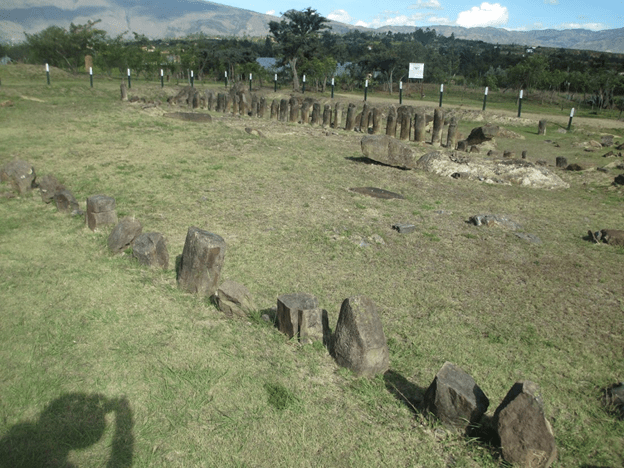
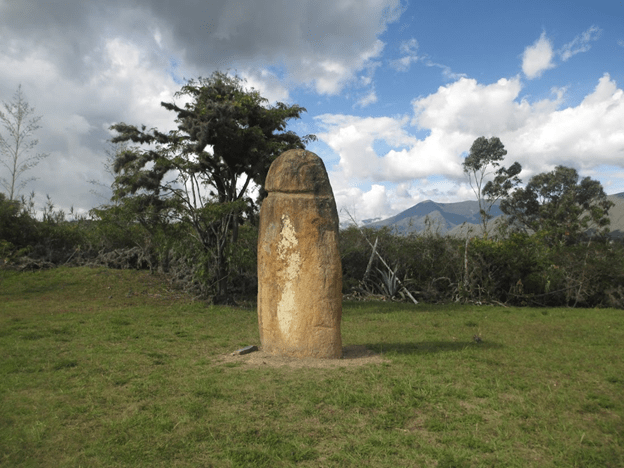
After the pagamento at Juaica, Paula and I made a tour through the ancestral territory of Villa de Leyva, where we visited the solar calendar and the monoliths of fecundity, where the Muisca entrusted the fertility of their crops and their homes. Our petition was the same that we had whispered before to the ear of the world in the Sierra Nevada: That the path would open for the arrival of our little angel.
Before leaving for New York on a trip that would last three months, I decided
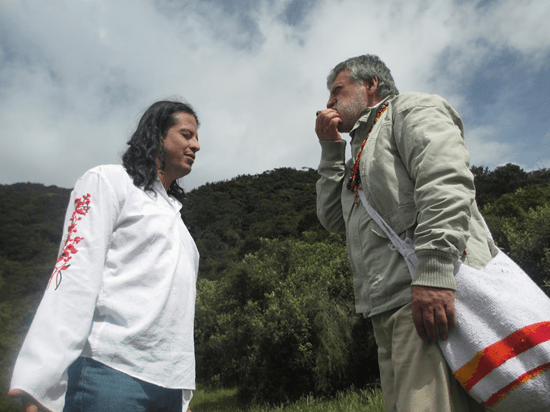
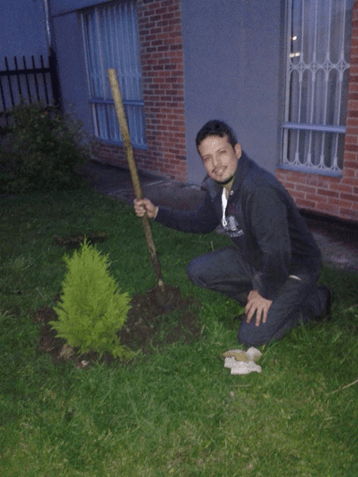
to give to the earth the long hair that I had let grow for three years, since I made my vows of loyalty toward the grandpas of the Muisca-Chibcha Nation People during my rite of passage. On the one hand, David and Andronicos had not seen me with the long hair, and I did not want them to worry about any prejudice that the executives of the city of New York might have toward my personal presentation; but besides that, I felt that my long hair was part of a pact that I had made with a spiritual process in which I no longer believed, so without hesitating I had my mane cut, and over it I planted a tree in a small intimate ceremony with Paula.
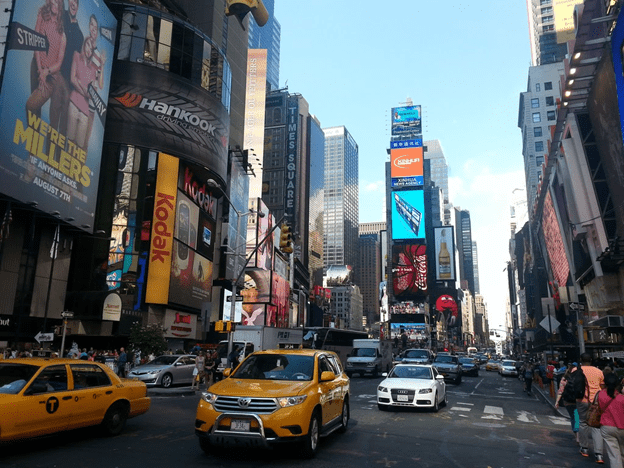
A few days after giving my hair, I landed at John F. Kennedy airport in New York, and I headed to 23rd St with 1st Avenue, in full Midtown Manhattan, where the company had rented a comfortable studio apartment for the executive who would be visiting our important client. When I arrived at the place, which was on the eleventh floor, I unpacked my luggage, took a beer out of the fridge, and I sat down to rest, looking out the window that opened onto the street.
I could hardly believe it! I was lodged in one of the most exclusive places in the center of Manhattan, working for an American company, and about to become manager of an important project for the government of the city of New York. I remember that I insufflated tobacco through my nose and I meditated for a while, greeting the spirit of the territory that the Lenape indigenous people had baptized Manaháhtaan, which meant "the place where the bows are obtained".
My life had changed again, and it did not resemble at all what it had been barely a couple of months before. My daily routine consisted of taking the subway from the station that was about a 15-minute walk, to the offices of the city's technology department in the north of Brooklyn. There I functioned as a project management consultant, and I had a desk like any employee of the agency.
In the afternoon I returned to the apartment, but I took advantage of the fact that the sun set after 9:00 PM, and I devoted myself to walking the streets of Manhattan. I liked walking through the bookstores, the street art exhibitions, admiring the architecture, and tasting the enormous diversity of street food that the city offers.
I also tried going out of the apartment to walk at two or three in the morning, on one of the many nights that it was hard for me to fall asleep, and I discovered that New York is truly a city that never sleeps, where it is possible to find restaurants, stores, and department stores operating even at those hours of the night.
I explored tirelessly the streets, avenues, bridges, plazas, skyscrapers, and ports of Manhattan, but at the same time I was exploring the emotions that all those places caused in me: some, unsettling flashes of remembrance, as if I had already been there, perhaps by the force of having seen so many movies and series filmed in New York. Others, they caused me apprehension, as if I perceived from them a dense and repelling energy.
I tried to decipher what the city was telling me, and the purpose of my presence in it. What was arriving to my mind was that perhaps I was part of the prophecy that I had heard from the grandpas, which said that America would awaken when the eagle of the north met the condor of the south. I asked the Manaháhtaan territory itself to guide me in that path, and to show me what I had to do during my stay in that beautiful and chaotic metropolis.
A possible answer to that prayer arrived when I received a message from Grandpa Juver. He told me that he had talked with his brother Raúl, who lived in New York, and that he had told him that a Muisca was in the city, so he gave me his phone number so that I would get in touch with him.
– "Raúl is also a knower, and he can connect you with people who are on the path of solar awakening in that territory", he told me in his message.
Without hesitating I got in touch with Raúl, and soon we set up a meeting at a Colombian bakery that was on Roosevelt Ave, near where he lived. The place was in the middle of what is known as "Little Colombia," a zone that between the 80's and 90's received so many Colombian immigrants that it seemed more like a bustling commercial zone of any Colombian city, than a New York district.
In 2013, however, a large number of Ecuadorians, Mexicans, and Vietnamese had arrived in the zone, with which the omnipresence of Colombians gave way to other cultural expressions, but even so it was common to hear paisa, santanderean, and caleño accents in the street; that is, when the terrifying noise of the elevated subway that passes over Roosevelt Ave. allowed hearing anything else.
Raúl and I became friends immediately, and from that day we shared many hours of talk about esoteric, spiritual, and mystical topics. He told me about his work as a disseminator of the gnostic knowledge that his brother Juver shared with him, and his own speculations on esoteric laws of nature, especially those related to vibrations and frequencies, something that is common in those who practice esoterism, but that in his condition as a musician, he investigated with greater diligence.
As Grandpa Juver had promised, Raúl took me to meet some of his esoteric friends. That is how I got to know a Peruvian gentleman who was a member of one of the city's Masonic lodges, a lady spiritualist, and a family of Samael Awni gnostics whom we visited in their home. All of them were Latin Americans, and all of them delighted to share knowledge with a mystic who had just arrived from their territory, which the majority of them — including Raúl himself — had not set foot in for many years, since they found themselves in the United States without legal status.
The lady spiritualist I got to know was also a co-owner of a non-formal education institute for Spanish-speaking adults of the city, and she proposed that I give a talk on ancestral spirituality at her school. Raúl also wanted me to share my knowledge with his circle of people, so he invited me to take part in one of the workshops for elderly adults that he offered at the Elmhurst Adult Learning Center in Queens.
Both experiences did nothing but reaffirm my certainty that my arrival in the United States corresponded to some providential design, and that perhaps I was beginning to fulfill that important mystical mission I felt that I had to fulfill at some point. As if those years of intense and sometimes painful work with yagé, the long days of tobacco offering and word with the grandpas until late into the night, and the esoteric and gnostic practices I used to perform, had been the preparation for an important service to humanity that was beginning to take shape.
However, the road to my great moment did not go through that door. The talk at the Elmhurst center was a lovely experience in which I led a shamanic meditation for a few old folks, who at the end offered me a tip for my services that I vehemently rejected while Raúl looked at me with pride. For the talk at the non-formal education institute, I was requested to focus it on ancestral health and element therapy, so I carefully prepared a presentation in which I touched on topics such as Ayurvedic medicine — with information Mara had given me —, principles of ancestral medicine that I had mainly learned from grandpas Suagagua and Juver, and a compendium on the supposed spiritual origin of illnesses that I had found in some blog on the Internet.
I don't know whether the attendees of the talk were there out of obligation, or perhaps more likely they were taking advantage of the space to fill with a couple of hours of anything their monthly state-paid training requirement. The fact is that of the seven or eight attendees, only an elderly lady in the first row seemed interested in what I was saying. A young Peruvian woman kept smiling at me, and I didn't know whether out of kindness or flirtation, but she didn't utter a word during the two hours, and the rest just watched the projection as if it were a particularly uninteresting history lecture.
I collected with a heavy heart the $60 dollars they paid me for my time, and I convinced myself that this had been but the beginning of a prolific series of spiritual talks with which I would manage to help awaken the consciousness of the American people. It goes without saying that I never spread ancestrality or anything similar on North American territory again, but I had one more surprise waiting for me in that powerful territory.
Of the many topics we tackled during our encounters in New York, the one that definitely interested Raúl most was that of yagé. I was surprised when he told me that he had never tried the sacred plant, but he explained that when he had emigrated from Colombia, his brother had not yet become a yagé knower, and that he was afraid to try something so sacred with any of the many taitas — mainly Ecuadorians — who offered private ceremonies in the yard of some house in Long Island or in some farm in the north of the state.
One afternoon, already close to my return to Colombia, as I was telling Raúl about the marvels yagé had worked in my life and the surprising mystical revelations I had received, Raúl made the decision to reveal a secret to me:
– “I have yagé at home, could you lead the ceremony?”
Yagé? In the United States? And just like that, in the house? I asked him how he had obtained it, and he told me that his brother Juver had sent it to him a few months ago with a friend who had traveled from Colombia, but that he had been afraid to try it alone. Despite the explanation, I thought that perhaps I had misunderstood and that what Juver had sent him was not yagé proper but rather the famous Yagé Espíritu that he prepared, which was a distilled, transparent and much less potent version than traditional yagé.
I asked Raúl if I could see the substance, and he agreed. We went together to his tiny apartment, which was in one of the many dwellings in Queens, in which its owners had created extravagant divisions to turn a four-bedroom house into six independent apartments. Raúl opened a safe he had in his closet and passed me a small bottle with a dark brown content. I unscrewed the container, brought it to my nose and immediately felt a shiver. It was the unmistakable smell of traditional yagé, and moreover it was in its most concentrated presentation, in the form of honey.
It was clear that in Raúl's home it would be impossible to carry out even remotely acceptable an ayahuasca ritual, so the only possibility left would be to do it in my Midtown Manhattan apartment, where there was a strict visitor-approval policy with the building's administration. To complicate matters, Raúl asked me to let a friend of his attend the ceremony, who was going through a very difficult personal situation and needed the remedy.
That without counting the fact that I had never received the training necessary to lead a yagé taking, nor did I know the handling of the plant beyond my personal experience as a taker and what I had learned watching the taitas I had taken with. Despite all of this, I decided to go ahead with the ceremony. I didn't plan on announcing Raúl and his friend's visit, because surely I would have had to ask permission from David Collins, who was now my boss, and explaining that I was going to administer my guests a dose of a powerful hallucinogen while I was working for the city government was not among my plans.
Instead of that, I insufflated tobacco in the apartment and I asked the spirit of the territory to open the paths so that everything would flow if that was its will, or that by contrary, something would stop the plan, if that was what was fitting. Most likely the building's doorman would not let the two visitors in, and I would play dumb about never having heard of the rule.
I explained the situation to Raúl and his friend Efraín, and they were agreeable to taking the risk, so on the afternoon of that Saturday, the three of us met at the subway station that was near my apartment and we entered the building together. I greeted the doorman on duty with a gesture and he answered me the same way. Then he turned around and kept absorbed in a book he had been attentively reviewing when we arrived. My guests made it to the elevator without having been noticed at all by the doorman, perhaps because he was engrossed in the unfamiliar task that occupied him.
While we were going up to the eleventh floor my heart raced because I understood that there was no turning back, the signal had been received and the ceremony had to be done. Then the fatalist thoughts came: what if something serious happened to one of them during the taking? What if one of them turned violent or started screaming out of control? Even worse and more likely — what would happen if that unknown yagé caught me with force as so many other times and I lost control?
At that point I felt that it was not worth thinking that way, and I convinced myself that if I thought with positivism, things would turn out well.
With the arrival of dusk, after giving my guests the corresponding recommendations, I began the ritualization of the yagé in the way I had learned it. I dressed in the white garment and the indigenous necklaces I had brought, I diluted the honey yagé with water until the texture, color and smell became familiar to me, I put it on a small altar that I improvised with the shamanic objects I had brought, and I began to sing and whistle to the yagé using the sounds that came out of me spontaneously, clearly inspired by the ícaros and songs of taita Gregorio and taita Fernando, who were the ones I had listened to the greatest number of times.
When I felt it was appropriate, I served the yagé in three cocktail glasses I had, and I offered two of them to my guests with a parsimonious performance, not before hastening my own drink, as I had seen the taitas do. While they ingested the brew, I to myself only prayed to the divinity and I asked the yagé that they forgive my boldness for leading a yagé taking without having even taken part in a single brewing of the drink, but — I tried to justify myself — if the yagé had gotten me all the way there and everything had worked out for the occasion, it was because it was meant to be.
To my fortune, not only was the experience of Raúl and Efraín harmonious and totally silent, but somehow, the yagé allowed me to be in my five senses during the whole time my guests' experience lasted. For a little more than two hours I could keep an eye on them, assist them to the bathroom, offer them water and bring them their bags to vomit into.
Besides, I accompanied their entheogenic journeys with sounds of harmonica, rain sounds with my necklaces, and songs. Around 1:30 in the morning both had completely returned from their journeys and they found themselves joyful and very grateful. I placed them on the sofas I had arranged as improvised beds and I headed to my room, grateful that the yagé had not caught me.
I thanked too soon. It was a matter of lying down on the bed for me to start having my usual sensation of being prepared for an astral journey, then came the streaks of colors, the memories of childhood and other lives, and the disordered senseless thoughts, but fortunately I did not reach experiencing the dark part of the journey that so often tormented me. The yagé of unknown origin, taken in the center of one of the cities considered by many to be dense or even infernal, and acting as officiant without having training nor permission, turned out to be one of the most benevolent yagés I had ever taken. Such are the things with that mysterious plant.
I did not have to go down to hell in New York, but what was indeed granted to me was the opportunity to pull out of my chest a pain I did not know I had. During the small hours of the morning I thought a lot about my daughter Ana María, and I felt her sadness and her pain as a child for so many times I was not there for her, for the many moments in which I prioritized my fun, my comfort, or my obligations over playing with her, listening to her, or giving her quality time.
I had always felt proud to say that I was a father who had been more present in my daughter's life than even her mother, and I believed when friends and family members told me it was admirable to be such a good dad being so young. All of that was pure pride and a facade, because the truth was that I had failed as a father on many occasions, and Anita had frequently taken on the role of my protector and guardian better than I had done for her.
On that yagé morning in Manhattan I cried as I had not cried in many years, and as soon as I had the opportunity I called Anita to ask her forgiveness for all my faults and neglects, and she cried with me, as always, telling me that she loved me and understood me and that together we could heal whatever needed to be healed.
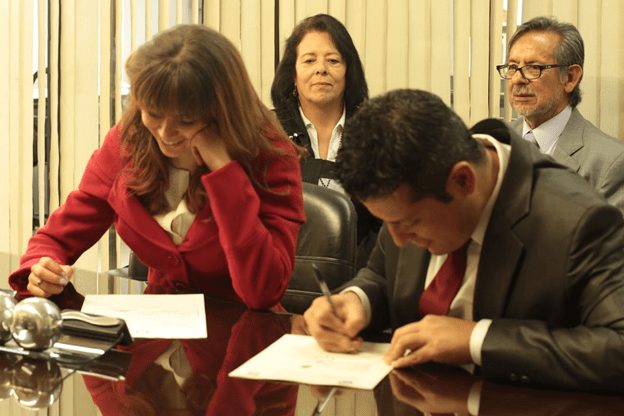
With that gift ended my first experience of living in North America for three months. Then came many more trips to the United States, including a couple longer than that one, although with increasing frequency in Chicago rather than in New York. In November 2013 Paula and I got married civilly in a notary office in the Chapinero locality of Bogotá, with my parents as the only witnesses to the ceremony, and barely a handful of close friends accompanying us with a special dinner at one of our favorite restaurants in the city.
The "official" wedding was something Paula and I wanted to plan and enjoy once we had already moved to the United States, so as to have the peace of mind of knowing how much time we would have to do it. But Luis Alfredo Pinilla, the immigration lawyer David had hired to manage our process, told us that we had to legally marry as soon as possible, because the marriage certificate was one of the main requirements to process Paula's visa as a spouse, so Paula's dream of a ceremony at the Church with many guests, or my idea of a ceremony in the Sierra Nevada, remained unfulfilled.
Despite the rush, Paula and I were happy to make our union official before the law, since in Spirit we had already committed ourselves before the yagé, before the Muisca grandpas, and before the mamos of the Sierra Nevada, when we built our aseguranza. We knew we had no time to organize something more elaborate, but even so we improvised a small ceremony presided by Grandpa Luis, during which we communed with tobacco, ambil, and yagé. Moreover, the notary who officiated our wedding turned out to be a pleasant gentleman who even pronounced some beautiful words on the occasion of our union.
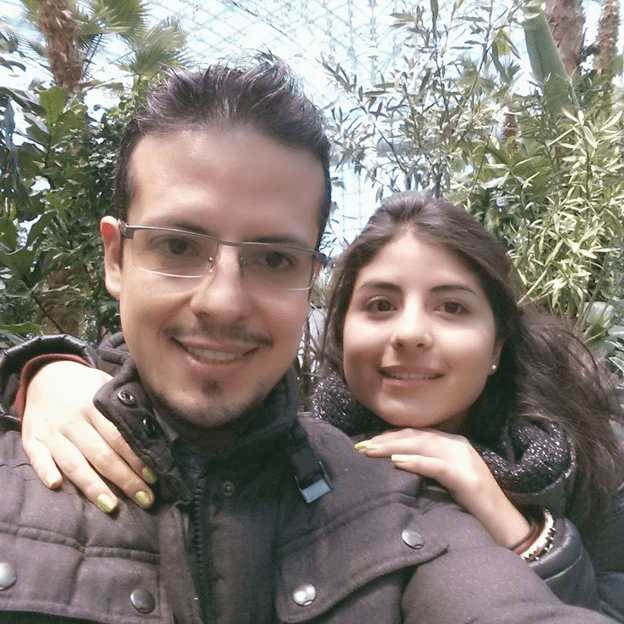
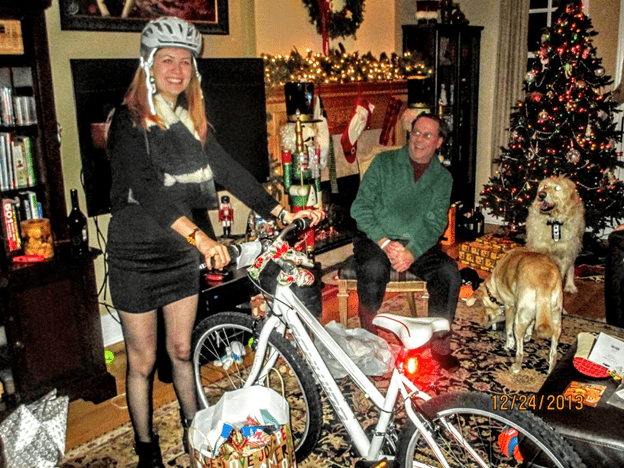
A few days after our marriage, Paula and I enjoyed a short honeymoon in Washington DC, to then fly to Chicago where we met up with Anita, and so my beautiful girls got to know their new American family: David, his companion Debra, our friend Bob, and his pets Callaway and Chunk. Together with them we spent the first of several Christmas holidays in the windy city, with snow, fireplace, Jingle Bells, eggnog, gingerbread cookies, and all the television clichés of those festivities that I had yearned for so much as a child.
David had rented a space with two offices in the vibrant Diversey zone in the south-center of the city, and one of those offices had been set up for me when I would finally manage to move entirely to that city, but for the time being, I would use it while I was visiting.
One day, as I was leaving the post office that was next to our office, I noticed an old house that was a few meters further to the north. It had an old style and a plaque at the entrance that said "URANTIA Foundation." I recognized the name and I approached, because Urantia was the name of a book I had read a couple of years earlier, which is considered by many esotericists as a book of revelations about the nature of the spiritual world, God, the Universe, and many other things.
Once again I thought that there might be the sign of the mission I had to fulfill, so a few days later I knocked on that mysterious door and introduced myself as a Colombian admirer of the Urantia Book. The amable receptionist informed me that that very day there was a meeting of executives, and after talking by phone with one of them, they let me into the meeting room.
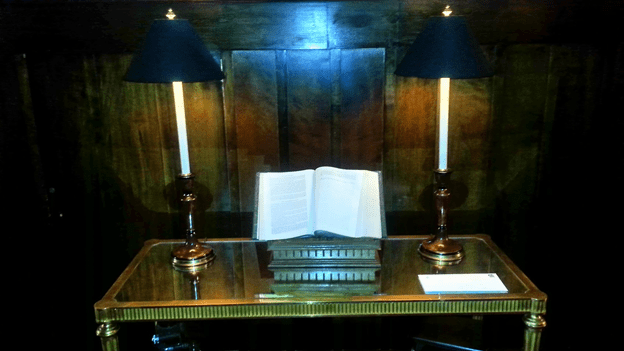
The place had the appearance of a Masonic lodge headquarters, and everywhere there was Christian symbology, artistic representations of passages of the book, and photographs of the foundation's former and current members. I was invited to the enormous mahogany table, and for a little more than an hour we chatted about spirituality, ayahuasca, and indigenous wisdom, but once again there was no second visit, nor any other encounter with the "Urantians." The impression they left me was that they were kind people, interested in esoterism, and with free time to dedicate to promulgating a book they genuinely believed contained the definitive knowledge about the spiritual world and valuable information for achieving personal self-realization. They did not seem to have any other ambitions beyond that.
Little by little I was accepting that my path in the northern territory would not be like the one I had walked in Colombia. The few people I got to know in the United States who showed interest in ancestrality or shamanism were Latin Americans. I had many conversations about those topics with people from other cultures, including our friends in Chicago, but I always felt more like a museum guide explaining my culture than like a spiritual guide showing a path of healing.
In the United States there are subcultures and communities of spirituality that explore shamanism and other ancestral knowledges, but they are much more marginal than in Colombia, where in almost every city there are yagé taking places, groups of ancestral knowledge exchange, and perhaps too many esotericist groups. Much to my regret, I did not manage to contact any group of those characteristics either in Chicago or in New York, although on a short trip to Las Vegas that I made together with David and Debra, I got to know a Native American from a tribe of northern Wisconsin and we chatted for a while about tobacco word. That was all of it; I kept practicing my spirituality in private, and my shamanism when I returned to Colombia.
One day, during a flight from New York, David asked me if I believed there was something after death. I told him what I thought, in the same way I had done so many times during the word circles of the Solar Clan. My boss and friend listened to me attentively and asked me several questions. Then he told me that he believed his mom was close to the final hour: her dementia was becoming more and more evident, and her health breakdowns more frequent.
Then I realized that I had forgotten one of the most important lessons yagé had ever taught me: what makes us important is not the number of people who hear our word, nor how organized is the structure through which we touch the lives of those people. What was truly important was being there for a single soul, with whom a genuine bond has formed or arises, in the moment and in the form in which they need you.
This is what happened with David. During the following months I accompanied him in his process of healing the relationship with his mother, unveiling the keys that relationship had left in his life and the way in which it affected his other relationships. I listened to his stories of childhood, the pain that produced the early departure of his admired father, I shared with him my own fears about death, about pain, about seeing my parents decline during old age, and above all of departing without having reached whatever it was that I was supposed to reach during this human experience.
There was no tobacco, no ambil, no incenses, no invocations of divinities. Simply two friends talking about life, about death, and about building a legacy, making a difference in the lives of those we love.
Once Paula and I accompanied David to visit Kitty, his mother, while she was still living in a retirement home in an affluent zone of Chicago, and we enjoyed the tenderness and irreverence of the elderly lady. I believe that in those moments David missed one of his brothers, of whom he had been very close in his childhood, but who sadly had succumbed to the vice of alcohol and had definitively distanced himself from the family. It is possible that I was filling a little of that void, and I liked being able to return to David in that way everything he had done for me and my family.
An autumn morning of 2014, when the maples and the elms had already shed almost the totality of their colorful leaves, David and I visited Kitty one last time. By then, she had been hospitalized for a couple of weeks at the San José hospital of Lake View. The formerly combative elderly lady now remained calm and absent most of the time. Perhaps intuiting that the moment was close, David asked me to stay alone with her and help her in some way. I believe David believed that I had some kind of power or magic, or that is how it seemed to me then.
I did not know what to say, nor did I think I was going to start invoking spirits of the territory or doing guttural chants. There was no place for performance. I told her:
– “Kitty, I just want to tell you that you have a wonderful son. I can only imagine what a good mother you must have been to raise a person like David. My wife, my daughter, and I are very grateful for all that he has done to help us, and you can have the peace of mind that no matter what happens, I will be there for David… It is a beautiful afternoon, almost all the trees are without leaves and the sunset looks like a painting… May Mother-Father God bless you.”
I did not know whether the elderly lady had heard or understood something of what I told her, but I felt light. Then I stood up, I headed toward the door, and when I was a few steps from the entrance I heard Kitty's weak voice:
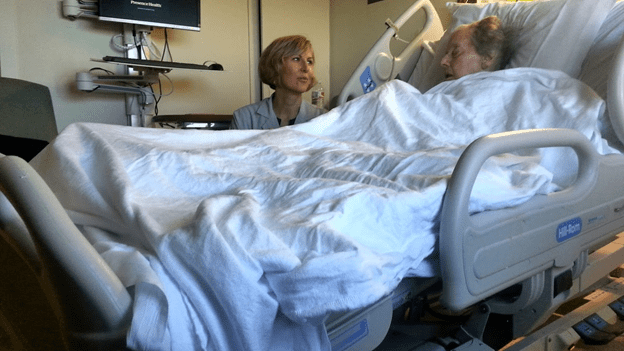
– “Thank you Manuel,” she told me as she closed her eyes again.
Two or three days later, in the small hours of the morning, the nurse who cared for Kitty called David and announced to him that his mother had died. David called me a few minutes later, while he was walking his faithful labradoodle Chunk, as he always did before dawn:
– “She is gone” — She has gone… “Thank you for accompanying me these months. My mother took a liking to you.”
I ended the call and I leaned back on the pillow while I thought: Yes, this is my mission: to truly be there when someone I love needs me. On the nightstand rested a blue card that in almost all of the hospices in the United States they give to the families of terminal patients. On the back cover was printed a poem from the nineteenth century that, for me, after accompanying someone in their process of disincarnation for the first time, took on a meaning that still reverberates in my mind and gives perspective to every day of my life:
I stand on the shore of the sea. A ship at my side unfurls its white sails with the morning breeze and departs toward the blue ocean. She is an object of beauty and strength, and I remain standing and I watch her until she hangs like a speck of white cloud just where the sea and the sky descend to meet and mix with each other. Then someone next to me says: “There! She has gone!” Gone to where? Disappeared from my sight, that is all. She is as big in mast, hull and perch as she was when she left my side, and as capable of carrying her load of living cargo to the place of her destination. Her diminished size is in me and not in her. And just at that moment when someone next to me says: “There! She has gone!” there are other eyes watching for her arrival; and other voices ready to take up the cry of joy: “Here she comes!” And that is: “dying.”
4 years ago Manu, as always it is a pleasure to hear everything there is in your knowledge, excellent beginning and end of a passionate narrative, well done and above all genuine, so real, you made me remember many things, like the interview we did with you for the university about the Cerro de Juaica. Knowing how all that trip to North America was, I always followed you on social networks, each one of those processes. Since I got to know you I always knew that you are a beautiful soul loaded with a lot of information that comes to teach us, how much learning today. Thank you, thank you, thank you! A huge hug, good path and good breeze.
Comentarios (archivo, solo lectura)
Mostramos 1 comentario guardados de la versión anterior del sitio. Ya no se aceptan nuevos comentarios.
Manu, cómo siempre es un agrado escuchar todo lo que hay en tú saber, excelente incio y fin de un relato apasionante, bien logrado y sobre todo genuino, tan real, me hiciste acordar de muchas cosas como la entrevista que te hicimos para la universidad sobre el Cerro de Juaica.
Saber cómo fue todo lo de viaje a Note América, siempre te seguí por Redes sociales cada uno de esos procesos.
Desde de que te conocí siempre supe que eres un alma bonita cargada de mucha información que viene a enseñarnos, cuanto aprendizaje hoy.
Gracias, gracias, gracias!
Abrazo inmenso buen camino y buena brisa.