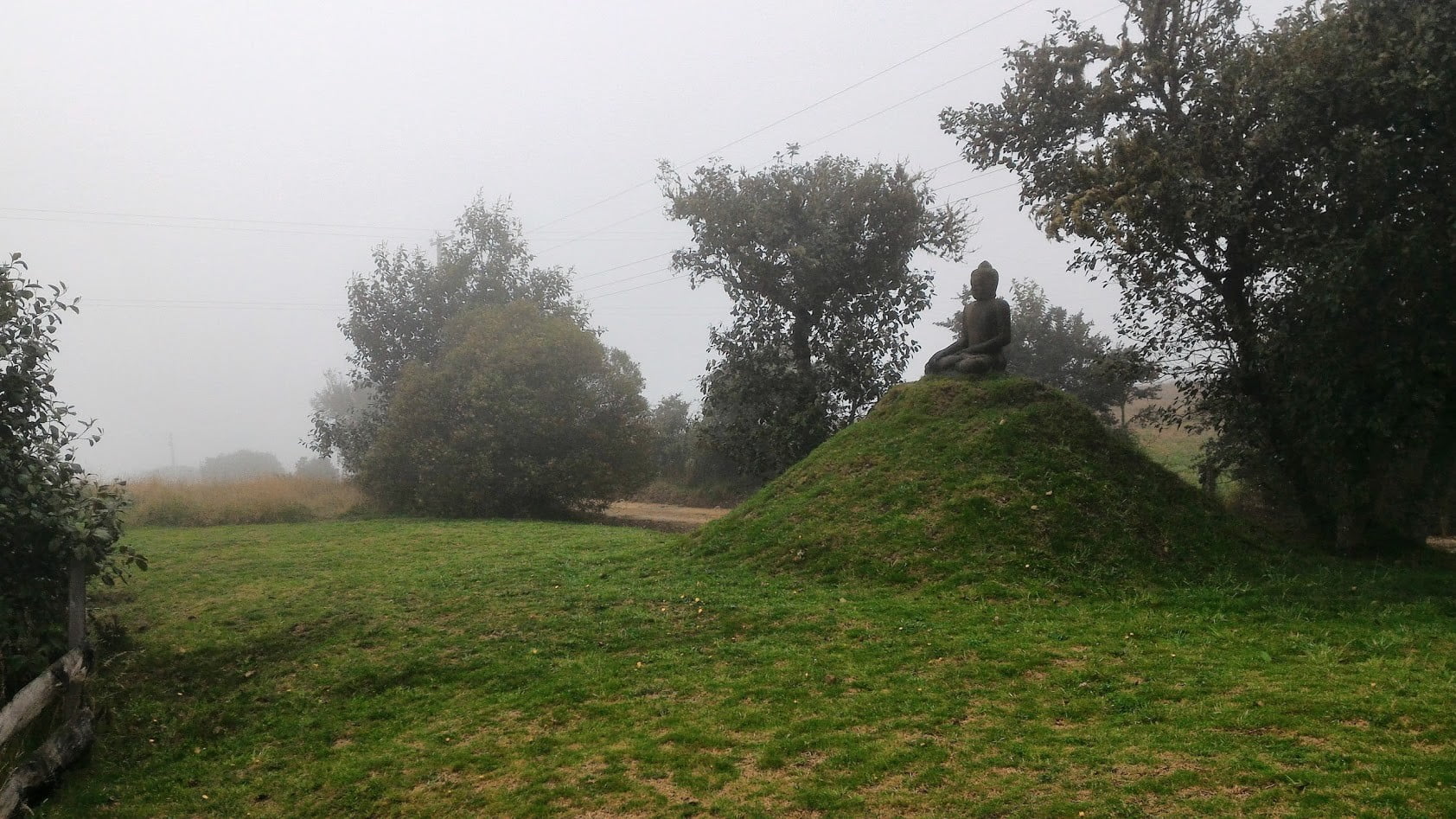
A couple of episodes ago I shared with you what I believe is the best, if not the only, system for leaving suffering behind: The power of remaining in the present and breaking the cycle of attachments and rejections of our mind, or "sankaras," which is the name that Gautama the Buddha gave to these instinctive behaviors of the mind when he understood them.
I hope I have managed to explain to you why it is so important to make all the effort we can train ourselves to unlearn that compulsion to hold onto the things that give us pleasure and to reject those that do not please us. However, I want to delve a little into this logic, because in doing Spirituality and Science, it is not enough that an enlightened person has said something for us to believe it and apply it to our lives.
I remember that when I came to know the path of the Dhamma, thanks to the lectures of the Vipassana meditation course, I thought that sankaras were attachments to evil things or rejections of natural things, better said, that suffering is generated when we attach ourselves to things that harm us, such as a toxic relationship, or a substance that gives us pleasure but turns us into dependents.
In the same way, I thought that pathological rejection was what we felt in letting go of our children as they grow, or of a love that is not reciprocated, or a job that enslaves us. The truth is that in both cases I was wrong, or rather, my vision was incomplete: Certainly these attachments and rejections that I just mentioned are part of the behaviors that generate suffering, but what made me open my eyes and think with a new perspective was understanding that the key to leaving suffering is to detach ourselves even from what we consider good in our lives, and to stop rejecting what we consider bad.
What does that mean? Well, if we look carefully, the greatest sufferings arise when we lose something we love, that we consider a positive part of our lives, things and people to which we attribute, at least in part, the reason for our happiness. I believe we can all understand or even justify a long suffering at losing a loved one, a good job, our health, a part of our body, or losing our life.
Rejection then comes by opposition, when something that causes us pain has already arisen and we refuse to accept the new reality. In all the examples I just mentioned, that to which we attach ourselves: a loved one, our health, a good job, are things that we all want to have, and it would be illogical to think that in order to achieve inner peace, we have to stop longing for them, fighting for them, or valuing them.
But that is not what the Buddha tells us. Gautama did not say that suffering came from longing, nor from effort or from gratitude; he said that suffering arises from attachment. Reaching this point then, it seems important to define exactly what attachment is.
Our scientific bible "Wikipedia" tells us that attachment is an intense and lasting affective bond whose objective is the search and maintenance of proximity, since it provides security and comfort. It says further that one of the main characteristics of attachment is "Resisting separation by feeling anxiety, desolation, and abandonment at the loss."
Notice that in this definition, which uses books of psychology as its source and not books of Buddhism, it is clear that attachment implicitly entails a rejection: the rejection of losing the object of our attachment. Now well, rejection, which we have not defined, is a somewhat more generic term and denotes the action of rejecting, that is, not accepting something. So attachment is a feeling, but rejection is an action. You reject something that can cause you harm, such as an attack, a proposal that goes against your principles, an unjust accusation. There is nothing negative about that, because rejection does not imply vengeance or counterattack, but as I said before, "non-acceptance," "denial," it is as if we dodged something that harms us. Rejection seen in this way protects us and can save our lives.
So, what is the problem with rejection? Rejection becomes pathological when we do not accept reality. Whatever reality is, if we do not accept it, if we reject it, then it becomes a sankara.
Now that we have understood a little more what rejection is, let us return for a minute to attachment: We saw in the definition from Wikipedia that one of the characteristics of attachment is "Resisting separation by feeling anxiety, desolation, and abandonment at the loss." That is to say, that attachment implicitly entails a rejection, and this rejection is of one of two things: the possibility of losing the object of our attachment, or a rejection of the temporary or permanent absence of that to which we are attached.
If we reject a real absence, we are denying reality; if we reject the possibility of something leaving our side, then we are rejecting something that does not exist, and do you know what the word that defines rejection of something that does not exist is? Fear.
We arrive then at the essence of sankaras after this "dissection" of attachment and rejection: At bottom, attachment and rejection are two sides of the same coin, and each side of that coin has one of two origins: fear, or the denial of reality.
With fear, something similar happens to what I said about rejection: Sometimes it is demonized, because according to some "spirituals," fear is the opposite of love. Which, by the way, I find nonsensical, the opposite of love is the absence of love, just as the opposite of light is darkness.
Fear is not bad in itself, just like rejection; when it is an immediate reaction to a real threat, such as an aggression or a dangerous situation, fear is a survival tool that all animals have, and even some think that all living beings have. The problem is when fear arises in the face of something that is not real, or at least when the threat we perceive is too great compared to the real threat.
Just as rejection becomes a sankara when we reject reality, fear becomes harmful when our fear is not based on reality.
Reality: Accepting reality as it is, not as we would like it to be (attachment) and not as we would like it not to be (rejection). The healing for attachment and rejection is found in the acceptance of reality.
Accepting reality sounds like something simple, you just have to look, listen, smell, taste, feel, and not reject what our senses tell us, is it not? Well, if it were simple, humanity would not be lost in endless cycles of attachment and rejection.
In episode No. 2 on the awakening of consciousness, when we talked about Plato and the myth of the cave, we said that human beings are programmed to tell ourselves stories or fictions to complete the information that is lacking to us about the world that surrounds us. Having such limited senses, our brain needs to fill the many voids that it finds in order to understand the overall picture.
The problem is that these stories have never served to really understand the Universe, nor to know reality. On the contrary, historically, our fictions have been the biggest obstacle we have had in being able to advance toward knowledge. The reason science has flourished as it has in the last 500 years is precisely because we stopped believing in our stories, we accepted that there were many things we did not know, and we began to value rigorous observation and evidence more than the ideas we might have had, no matter how attractive and pleasant they might be to us.
However, no matter how much our tendency to create and believe in stories without foundation discomforts us, this capacity of our brain, developed by natural evolution over millions of years, is not going to disappear in the near future.
Denying reality and instead blindly trusting in lies we create is a temptation too big for our primate brains. Believing with certainty in a lie that answers all our questions gives us much more peace of mind than accepting with resignation that there is very little we know and very little we can control.
We have already seen that because of this tranquilizing, analgesic capacity of lies, that we are so prone to believing in conspiracy theories (See Episode 3: The Nature of the Matrix: The world of illusions). Well no, accepting reality is not easy at all, it implies a judicious training and the conquest of many fears that take hold of us every time we face the abyss of the unknown.
The philosopher, humanist, and sociologist Gerardo Schmedling coined the term "Aceptología" (Acceptology) in something he called the "School of the Magic of Love," and it was about this same concept related to the importance of learning to accept reality as it is, without adornments or prejudices. This is also what Vipassana meditation, mindfulness, and other healing techniques and therapies teach.
However, it is important to clarify something about the concept of accepting reality that often causes confusion: Accepting does not mean justifying nor making oneself content. Accepting means observing what happens without rejection or opposition. If the reality is that the person who is next to you does you more harm than good, you can accept that and still decide not to be content with that situation, but to fight to change it or to move away from that relationship. I can accept that there are causes and reasons for why some people become murderers or rapists, without the need to justify the murders and the rapes. Acceptance is the door to make change possible; denial, on the other hand, prevents you from moving forward, because you cling to the idea that there is no better alternative, that there is nothing that can be done, or that things are better than they really are.
The same thing happens with respect to the world that surrounds us. We humans are living the dramas we are currently living because we refuse to accept that our lifestyle is destroying nature, that for the majority of us our comfort is more important than the lives of people we do not know, or that the people who think differently than we do have the right in some things.
But sometimes we also deny the reality of how much we have evolved and achieved as a species, that the world is not as bad as the news and the newspapers show us. I will speak in detail about this in particular in a future episode. In any case, accepting reality is learning to see, hear, and feel with understanding, but without judgments or reactions. This is what science seeks, and that is why true spirituality is science applied to oneself.
When Goenkaji tells us that we must sit down to meditate simply by observing our breathing in a small part of our nostrils, what he is actually doing is training us for two purposes: to liberate the mind from the constant inner dialogue, and to train ourselves to limit ourselves to observing what our senses tell us, without making a judgment about each sensation we receive.
The Vipassana training teaches that if during your meditation a pleasant sensation arises, we must simply observe it, analyze it, scrutinize it, but not attach ourselves to it, not pursue it, not desire it, not think about it once it is gone. In the same way, if what arises is an unpleasant sensation, we must observe it, analyze it: How does it feel in my mind? How does it feel in my chest? How does it feel in my belly? How does my breathing change? In this case, what the technique suggests to us is that we must not reject that sensation, nor think "when is it going to go away," nor try to mentally escape and think about something pleasant.
The word that Goenka uses to refer to the way we must behave in the face of each sensation we perceive is equanimity. The exercise consists in learning to observe our sensations without making a judgment about them, and even if the judgment is instantaneous and automatic: pleasant or unpleasant, not to react to the sensation, nor attach ourselves to the pleasant ones, nor reject the unpleasant ones.
But how can I tell that I am reacting with attachment or rejection to a sensation? Well, this is something that also does not come easily the first times we decide to practice Vipassana meditation. The reason? That usually we deceive ourselves: – No, I am not attaching myself to this sensation –, or – No, I am not rejecting that thought.
The solution is delivered to us by the technique itself: In order to be able to observe the moment in which an attachment or a rejection arises, we have to train, develop, and enhance our capacity for observation. Some call this "moment-to-moment observation." It means our capacity to be aware of each subtle change that arises in our surroundings, our body, or our mind during a certain period of time.
This is the objective of the exercise of observing (or perceiving) the air that passes through a small section of our nostrils as we breathe normally. At first it happens that after a few seconds of meditation, your mind wanders and focuses on the tasks to do for the next day, the bills that are unpaid, or the anniversary that is approaching. While that happens, your unconscious is already dealing with a new rejection, perhaps a rejection of the boredom you are feeling, or a small back pain that is starting to develop.
At first you are not going to see the point of the exercise, just as Daniel San could not understand the reason for which Mr. Miyagi had put him to painting fences and cleaning cars in The Karate Kid. You do not notice it, but your mind is getting a little more disciplined each day, your capacity for observation is getting sharper and sharper, your ease of being distracted by any thought is getting smaller.
After a few days, if you do it consistently, you are going to notice how you return more quickly to the present after a distraction, how you identify an attachment in the very moment it arises, or a rejection as soon as the unpleasant sensation presents itself. And just as Daniel San was able to stop the rain of attacks that Mr. Miyagi directed at him in an unexpected way in The Karate Kid, you will be able to stop the sankara when it presents itself to you in an unexpected way.
In all this, it would seem that breathing is just a prop, or a tool to do the important thing, which is to center the mind and train the moment-to-moment observation. I am going to tell you an impressive story so that you realize the incredible power of breathing, apart from keeping us alive, of course!
The United States Navy officer Jake D was on duty in Afghanistan when his vehicle went over an explosive mine. After the confusion of the moment, he looked down and noticed that his legs had been almost completely severed below the knees. Instead of giving in to panic, Jake remembered a breathing exercise that he had learned in a book for cadets. Thanks to the exercise, the officer was able to remain calm enough to check on his men, give orders to request support, and put a tourniquet on his own legs before falling unconscious.
The doctor who attended him when the help arrived stated that if Jake had not put on the tourniquets and kept his heart rate under control, he would have bled to death. The United States military has been using breathing techniques known as SKY Meditation and Mindfulness to treat veterans of Iraq and Afghanistan who suffer post-traumatic stress and anxiety, achieving benefits in their mental health up to a year after the application of the techniques[1].
From the scientific point of view, what happens with breathing is that it has been proven that each emotion is associated with a different type of breathing. For example, when we feel cheerful, our breathing is regular, deep, and slow. During an episode of anxiety or anger, breathing becomes irregular, short, fast, and superficial. When we feel fear, we also usually incur in accelerated and superficial breathing, but when we are in love, well, imagine when you have been next to the person you love, or if you have children, nieces and nephews, or pets, when you are pampering them very closely: I bet you notice that your breathing becomes slow and very deep, the inhalation becomes much longer than the exhalation, and that is where the sighs of love come from.
Well, each type of breathing is a consequence of these emotional states, but since time immemorial, it has also been used in reverse: as a tool to cause emotions. In other words, when you become aware of your breathing, you can change its cadence at will. When you breathe slowly and deeply, your blood receives more oxygen, which reduces your heart rate and stimulates your vagus nerve, which runs from the brainstem to the abdomen, that is, the one that connects your two brains, as we saw in Episode 19: The Power of Intuition and Energies.
This stimulation of the vagus nerve triggers your parasympathetic nervous system, which helps you calm down, making you feel better and allowing your ability to think rationally to return.
With this we can then understand the enormous power that meditation gives us: We stop that machine of thought that constantly bombards us with remorse about the past, fears about the future, and distances us from the present moment. It trains us to detect the exact moment in which an attachment or a rejection arises, and gives us the capacity to see reality as it is. As if that were not enough, it gives us an emergency exit for moments of crisis through conscious breathing.
Now, here is my personal experience with meditation: I have never meditated for more than an hour continuously, I do not do it every day, and I have almost never had a mystical experience or a samadhi during my meditation. It is probable that if I practiced with more discipline, I would already have achieved experiences similar to the ones I have had with Ayahuasca, but the truth is that I have not considered it necessary to do so.
First of all, because for almost 10 years I had yagé at my disposal to experience those moments of mystical rapture that I have been describing in this podcast. I have also used other entheogens for that purpose, such as marijuana and tobacco, therefore, my search in meditation has not been for altered states of consciousness, but for balance and inner peace.
Once you have learned to meditate and your body has internalized the mechanism, then it becomes a kind of superpower that you can use when you need it. In moments of stress, anger, fear, or sadness, you can resort to meditation to return to your center, recover your rational thought, and be able to move forward with your life without carrying a new burden on your shoulders.
Once you have experienced this power in your daily life and you realize that you do not need to remain for an indefinite time in states of anger, sadness, anxiety, or fear, then the true empowerment that is required to walk the path of Spiritual Initiation begins: You understand that your tranquility and your happiness do not depend on anyone but you.
Moment-to-moment observation is another power that you acquire by practicing meditation, and this power becomes your best ally for personal growth. You see, when you meditate and observe your mind with attention, little by little you realize that you are not your thoughts, you are also not your joy nor your sadness. But furthermore, if you can observe someone who thinks, who feels joy or feels sadness, then you are also not the one who thinks, feels, or breathes. You are a consciousness that is beyond thought or sensations. You begin to deidentify with yourself.
Once you no longer identify with your ego, then you discover your inner voice, the inner wisdom that guides you through life. For some, your inner divinity, or your connection with the Divinity. Whatever your form of seeing it, the truth is that this deidentification is the base for your personal growth: If I am not the one who feels this sadness, I can observe the sadness, understand it, and live it without judging it. Then it will not become a sankara, the sadness will fulfill its purpose and help us heal a wound, but then it will go away without becoming suffering. You will be able to observe your own fear, study it, scrutinize it, and let it be without rejecting it or fighting against it. Then your fear will alert you about the things you have not seen, it will uncover the aspects you need to strengthen, and it will go away without paralyzing you or preventing you from peering into the infinite.
The greatest secret of spirituality keeps you in your eternal present, you just have to inhale and let go...
[1] https://hbr.org/2020/09/research-why-breathing-is-so-effective-at-reducing-stress